
The Search Brief · News analysis
Googlebot’s 2 MB Fetch Limit: The Technical SEO Check That Belongs in Your Next Release
Googlebot’s fetch limit makes response size worth checking. See how to audit large templates, locate essential content and remove unnecessary document payloads.
Development covered: March 31, 2026
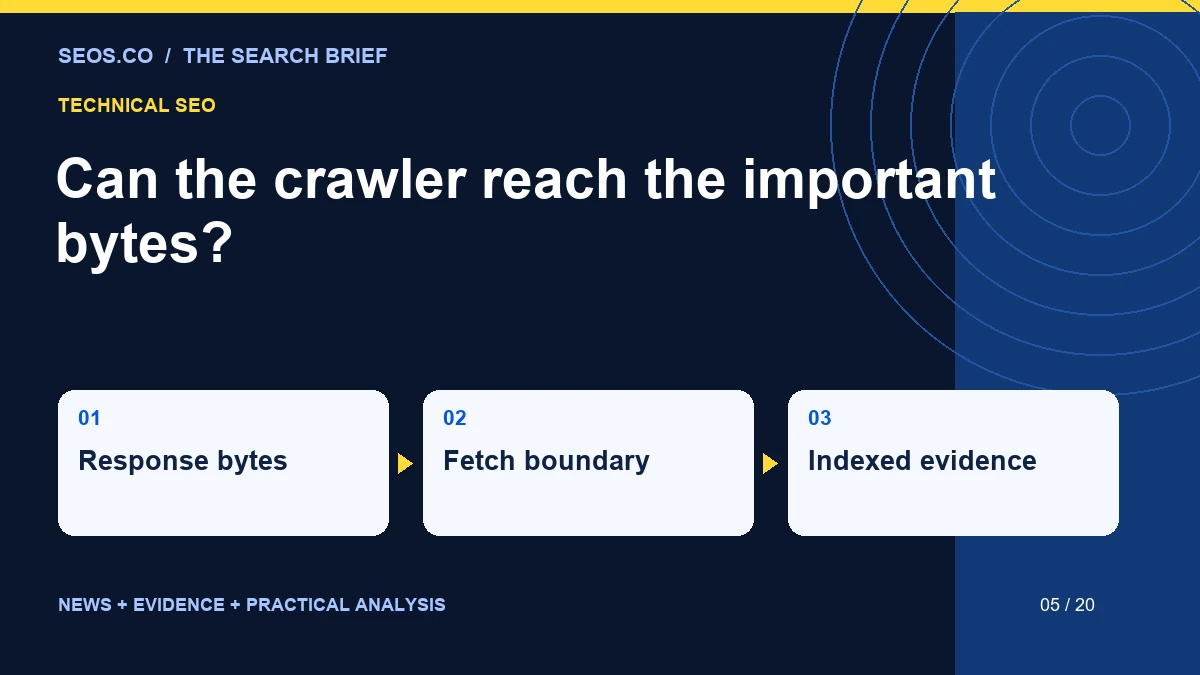
Large pages have a less obvious SEO risk than a slow loading indicator: the important information can sit beyond the portion a crawler retrieves. Google’s March explanation of its crawler infrastructure puts that risk back on the technical SEO agenda, particularly for websites that send large amounts of application data inside their HTML.
In its March 31 crawler infrastructure explanation, Google specifies a 2 MB fetch limit for Googlebot’s non-PDF responses and a 64 MB limit for PDFs. The response budget includes headers, while separately requested resources have their own limits. Google’s shared crawler infrastructure can use other limits, including a 15 MB default when a crawler has not configured a different one. These distinctions matter: a Googlebot limit is not a universal statement about every Google crawler or the total download weight of a page.
The practical issue is not whether every large website is suddenly in danger. It is whether a team knows what it delivers, how much of that response matters, and where critical information appears. This article sets out an audit method for answering those questions without confusing a fetch boundary with a general performance score.
A page can look complete while its response is poorly organized
Modern publishing systems often include several versions of the same information in one response. A product may appear in visible HTML, a hydration object, an analytics payload, a personalization configuration and structured data. A directory can repeat an entire agency collection in hidden interface states even when the visitor sees only twenty results. A page builder may include substantial style and layout information before the article begins.
None of these patterns automatically creates a search problem. Their combined size does create a reason to measure. A page that works in a developer’s browser does not prove that every relevant crawler received every byte. Likewise, an attractive performance dashboard does not necessarily reveal the position of the main content within the original document.
The right first question is simple: where does the information we want discovered actually appear in the delivered response? That question connects technical inspection with editorial priorities. It also prevents an engineering team from spending time reducing a harmless icon library while a much larger duplicated dataset remains embedded in the document.
Separate three measurements that often get mixed together
Total page weight describes the collection of resources loaded during a visit. It can include images, fonts, scripts, stylesheets and additional requests. The size of the main HTML response is a different measurement. The position of a particular heading, paragraph or link within that response is different again.
A page with several large photographs might have a heavy total download while retaining a compact HTML document. Another page might look visually simple but contain a huge serialized application state. Optimizing the photographs helps the visitor’s experience, but it does not necessarily address an oversized document. Removing redundant embedded state may help the document even if the largest image remains unchanged.
Compression introduces another opportunity for confusion. A network panel can show transferred bytes and resource size differently. Record which measurement is being used rather than comparing an unlabeled number with a crawler limit. When a decision depends on the boundary, inspect the actual response and the crawler’s documented accounting instead of assuming a small compressed transfer settles the issue.
| Measurement | What it helps explain | What it does not establish |
|---|---|---|
| Main response size | The amount of document data being delivered | Whether the useful content is early or late |
| Total resource weight | The broader loading burden | The size of each individual fetched response |
| Content position | Whether important evidence is buried | Whether the page deserves to rank |
| Rendered text | What a browser can present | What every crawler retrieved successfully |
Start with the templates most likely to grow
A useful audit is based on risk, not a random selection of ten convenient URLs. Start with pages whose response can expand as the business adds records: category listings, directory results, product collections, location indexes, filtered search pages and long comparison resources. Include the largest example from each relevant template.
Then inspect pages with unusually rich application state. Interactive calculators, comparison tools and personalized experiences may carry data that is not obvious from a screenshot. These deserve measurement even when their visible text is short. Finally, include ordinary editorial pages as a baseline so the team can distinguish a platform-wide issue from a particular feature.
Keep the sampling record. Note the template, number of visible records, approximate document size and whether the response changes for signed-in users or selected filters. A repeatable sample is more useful than a one-time warning because it can show whether a later release increased the problem.
Do not assume a sitemap contains every risky URL. Filtered and parameterized pages may be discoverable through internal navigation without appearing in the sitemap. The audit should follow actual crawlable links and the site’s intended indexing policy, while avoiding the accidental creation of an unlimited crawl of every possible filter combination.
An illustrative budget shows why placement matters
Consider a hypothetical directory document with 300 KB of layout and navigation, 900 KB of embedded records, 500 KB of duplicate state, and 450 KB of visible content plus supporting markup. The combined document would be approximately 2.15 MB using the same decimal units throughout. This is an invented example for planning, not a measurement of SEOS.co or a prediction of exactly how a particular response will be processed.
The most useful repair may be the duplicate state. Removing it could create considerably more room than shortening the introductory paragraph. Moving essential content earlier can also reduce dependence on late document sections, but rearrangement should not substitute for removing waste. A bloated response remains harder to maintain even when the main heading has been moved upward.
A sensible internal budget leaves margin. A template that is just below a boundary today can cross it when an editor adds a table or a developer introduces a new configuration object. Set a warning below the external limit, document the units and define who responds when the warning fires. The exact internal threshold should reflect the site’s architecture and growth pattern.
Fix duplication before cutting useful evidence
The wrong response to a document-size problem is often editorial: remove the detailed comparison, shorten the methodology or delete the references. Those may be the parts that make a page worth visiting. Before cutting them, examine repeated datasets, unused interface states, redundant markup and inline resources that do not need to be repeated on every request.
For a directory, server-side pagination may provide a clearer experience than delivering thousands of hidden records at once. For an application, the initial state may only need the data required for the first useful screen. For an article, a reusable stylesheet may be more efficient than extensive repeated inline declarations. Each change still requires a functional check; smaller output is not success if filtering, navigation or accessibility breaks.
Avoid replacing useful links with interactions that only become available after a complex sequence of actions. A size reduction should preserve discoverable pathways to important pages. When pagination is introduced, test the actual links and the relationship between the collection and its component pages. The objective is a smaller, coherent publishing system, not a smaller response with missing navigation.
JavaScript is a delivery choice, not an escape hatch
Moving everything into a later client-side request may reduce the original HTML size, but it changes the content delivery model. It can introduce dependencies on scripts, network requests, error handling and rendering. That tradeoff should be assessed deliberately rather than presented as a universal fix for a fetch limit.
For essential editorial content, delivering a useful document before optional enhancements run is a strong operational choice. Visitors on unreliable connections benefit, and the team can inspect the primary information without reconstructing a complicated application state. Interactive features can still improve the experience around that foundation.
If a page genuinely requires client-side rendering, test it as such. Confirm what appears when a supporting request fails, whether important links are available, and whether loading states remain visible indefinitely. A crawler limit is only one possible failure point. Repairing it should not introduce a different dependency that makes the page less reliable.
A release check should capture evidence, not just a green badge
The most useful automated check records the document size and flags changes against a known baseline. It should identify the affected template and the relevant release. A warning that says a response grew by a substantial amount is easier to investigate than a generic statement that the site is now less optimized.
Pair that measurement with a small set of content assertions. Verify that the main heading, the principal comparison or product information, the relevant internal links and the canonical element are present where expected. These checks should be tailored to the page’s purpose. A service page and a searchable directory do not need identical assertions.
Retain a representative response from before and after the change where appropriate. That makes the review concrete: the team can see what was removed and whether useful content survived. It also makes a rollback decision easier if a release unexpectedly changes rendering or navigation.
| Release question | Evidence to retain |
|---|---|
| Did the document grow? | Comparable size measurements with units |
| What caused the growth? | Template or payload difference |
| Is the key information present? | Saved response and rendered inspection |
| Did functionality survive? | Completed navigation and interaction checks |
| Can the change be maintained? | Owner, budget and warning threshold |
What this means for large directory websites
Directory pages have a particular incentive to become oversized. More records, more comparison fields and more filters can all sound like improvements. They are improvements only when the information helps a visitor make a decision and the interface remains usable. A giant undifferentiated list may be less helpful than a well-structured collection with clear links into more specific pages.
The editorial and technical teams should agree on what belongs in the initial document. A category introduction, an explanation of the selection process, the visible results and meaningful pathways to related categories are defensible priorities. Thousands of hidden entries included merely to power a convenience feature deserve closer scrutiny.
The same reasoning applies to structured data. Markup should accurately describe the page and its visible content. Repeating large records in several overlapping graphs can increase complexity without improving the underlying resource. Consolidation should preserve valid relationships and required information; it should not be an excuse to invent a minimal graph that no longer matches the page.
Do not turn a boundary into a ranking promise
Being comfortably within a fetch limit does not establish relevance, originality or authority. It removes a possible delivery problem. A small page can still be unhelpful, and a technically valid document can still compete poorly against stronger information. The benefit of this work should be described honestly as making important content reliably available.
After a repair, monitor the affected templates and their indexing signals over time. Do not attribute every later traffic change to the size reduction. Seasonality, demand, competing pages and other releases may be changing simultaneously. A release log and a stable comparison group make the analysis more credible, even when they cannot provide a perfect causal answer.
For agency buyers, ask for the actual measurements and the affected URLs. “We optimized crawlability” is too vague to assess. A report showing an oversized response, the duplicated payload removed, the preserved content and the verified result is a much stronger demonstration of useful technical work.
The next audit can be small and decisive
This is a tractable investigation. Select the largest examples of growing templates, inspect the delivered response, locate the essential content and remove unnecessary duplication. Add a release check so the same issue does not silently return. The work does not require treating every page as an emergency or rewriting an entire site around one numeric limit.
The broader lesson is that publishing quality includes delivery. The strongest research or comparison table cannot help a visitor or a retrieval system if it is missing from the usable response. Keeping a document understandable, appropriately sized and easy to inspect is therefore part of content quality, even though the repair may happen in a template rather than a paragraph.
Source and analysis note: The crawler limits and infrastructure distinctions above come from Google’s linked March announcement. The budget example, audit sequence and release recommendations are SEOS.co editorial analysis. They are not measurements of a particular website or a claim of guaranteed ranking improvement.