
The Search Brief · News analysis
Cloudflare’s BotBase Update Makes Crawler Identity More Practical—and More Important for SEO
Cloudflare updates BotBase for operators. Separate crawler identity, purpose and permission, then use verified observations to guide access and technical reviews.
Development covered: August 28, 2026
Knowing who is requesting a website is becoming a more practical concern for SEO teams. Search crawlers, assistants, monitoring services and other automated clients can all appear in traffic records, while a familiar user-agent string does not by itself prove identity. Cloudflare’s BotBase operator update addresses part of that identification problem.
The August 28 announcement describes an operator workflow for submitting and maintaining bot information, with verification approaches including IP information, reverse DNS and Web Bot Auth. It also separates dimensions such as behavior, content use and operator role. Registration and verification help describe a client; they do not require every website owner to permit its requests. That distinction is central to using the information responsibly.
For publishers, the opportunity is better-informed access decisions. For agencies operating crawlers, it is a reason to make their own identity and behavior transparent. Neither side benefits when an automated service is difficult to identify, poorly documented or treated as trustworthy solely because it presents a recognizable name.
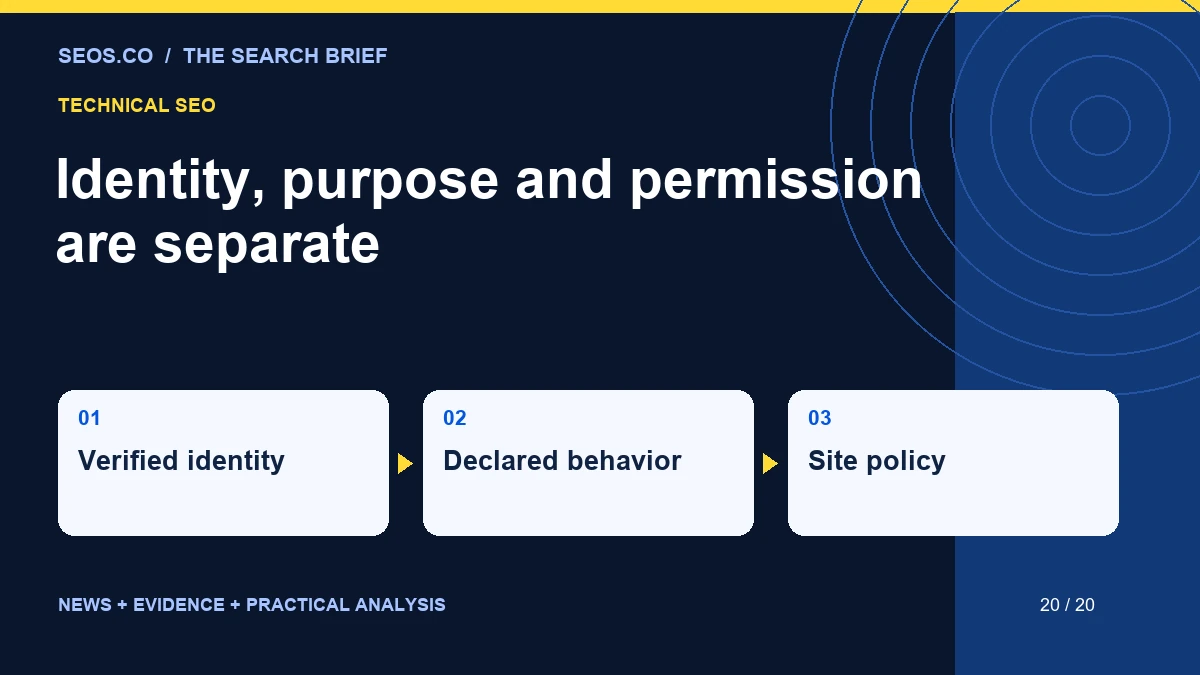
Identity, purpose and permission are separate questions
Identity concerns who operates the client. Purpose concerns what it is doing. Permission concerns whether the site owner allows that activity under the relevant policy. A useful system keeps those questions separate rather than compressing them into a single approved-or-unapproved label.
A verified operator may run a service that a publisher does not wish to allow. An unknown request may be harmless but insufficiently understood. A known search crawler may deserve access to public pages while still having no reason to enter private account areas.
The distinction helps avoid two common errors: blocking every unfamiliar request without investigation and allowing every familiar name without considering behavior. Both can be costly in different ways.
For an SEO team, the practical goal is to preserve intended discovery while giving security and infrastructure teams enough information to manage requests sensibly. That requires a shared vocabulary and a record of the evidence behind decisions.
A user-agent string is a claim
Clients can send descriptive headers, but a label alone is not complete proof of who sent the request. If an operational decision depends on identity, use the verification methods documented for the operator and supported by the environment.
Do not invent a verification process from a partial clue. An IP address, a hostname and a signed request each have their own interpretation and validation requirements. The details matter, especially when access rules will rely on the result.
For a marketing report, uncertainty should remain visible. “Requests presenting this user-agent were observed” is different from “this platform definitely crawled the site.” The latter requires stronger evidence.
This precision can prevent misleading visibility claims. A bot-like request does not establish that the page was indexed, cited or used in an answer. It is one event in a possible discovery process, and the report should describe it at that level.
Operators should publish a coherent identity
An agency or software provider running a crawler should make it reasonably understandable to site owners. A clear name, purpose, documentation and contact route can reduce confusion. The behavior should match the description.
For a client-authorized audit, the operator should also have a defined scope and sensible request behavior. Authorization to review one site is not a reason to crawl unrelated destinations or ignore operational limits. The audit should be proportionate to the task.
Maintain the identity information when infrastructure changes. Stale network details or an abandoned contact address can undermine a legitimate service’s ability to explain its requests. Registration is a maintenance obligation, not merely a one-time badge.
The same transparency helps clients. They should understand which service is accessing their website, what data is collected and what the audit can demonstrate. A mysterious crawler is not more advanced because it is difficult to identify.
Publishers need a request inventory they can interpret
Begin with the automated traffic that materially affects the site or its discovery goals. Record the observed identity signals, requested paths, volume, errors and available verification status. Keep unknowns explicit.
Group requests by useful operational questions. Which clients reach important public pages? Which repeatedly request expensive routes? Which encounter denials or challenges? Which produce errors that suggest a broken discovery path?
The inventory should support investigation rather than become a permanent wall of raw logs. A compact summary with links to the underlying evidence can help editorial, SEO and infrastructure staff discuss the same issue.
| Observation | Next question |
|---|---|
| Known crawler receives repeated errors | Is an intended public route broken? |
| Unverified client uses a familiar name | What verification evidence is available? |
| High volume on an expensive endpoint | Is the behavior useful and proportionate? |
| Verified operator is blocked | Does the rule match the site’s policy? |
| New client appears | What purpose and scope can be established? |
Verification does not replace behavior review
A known operator can still send too many requests for a particular site or request paths outside the useful scope. Identity information should inform the review, not end it. The publisher retains a reason to consider load, purpose and policy.
Conversely, a burst of requests does not automatically indicate malicious intent. It may be a scheduled audit or a discovery process. Investigate the timing and context before assigning a motive.
The response can be proportionate. A costly endpoint may need rate management or a more efficient implementation. A broken link may need repair. A clearly unwanted use may be restricted. Different diagnoses lead to different actions.
This is where collaboration matters. The infrastructure team can see load and errors, while the SEO team may know that an audit was scheduled or that a sitemap changed. Combining those observations can resolve an issue without unnecessary blocking or speculation.
Protect the distinction between public and private routes
No crawler identity should turn private resources into public ones. Authentication and authorization remain the mechanisms for controlling account data and administrative functions. A recognized automated client does not need broad access simply because it supports discovery elsewhere.
Review the route classes and their intended audience. Public articles, category pages and profiles can have one policy; dashboards and private records need another. The boundaries should be enforced by the application, not inferred from polite crawler behavior.
When testing access, use representative public routes and avoid exposing private data in logs or screenshots. If a security issue is discovered, address it through the appropriate controlled process rather than making a broad exception to complete an SEO test.
A clear access map helps both sides. Legitimate operators know what they can use, and the publisher can verify that protections remain intact while public discovery works as intended.
Bot data can reveal technical SEO defects
Observed requests can help identify problems that a page-level inspection misses. Repeated redirects, broken destinations or errors on important routes may indicate a discovery issue. A crawler spending time on unhelpful parameter combinations may point to weak navigation or an unbounded URL space.
The evidence still needs interpretation. A requested URL is not necessarily important, and a request count does not establish indexing priority. Connect the log observation to the site’s intended architecture and the pages that matter to users.
For a directory, examine whether category links lead to stable destinations and whether filters generate unnecessary duplicate paths. A coherent structure can make both human navigation and automated retrieval more efficient.
Repair the actual defect and verify the result. If a redirect chain is shortened, show the new destination. If an error is fixed, confirm the page returns useful content. Avoid reporting a vague improvement in crawl quality without the affected URLs and evidence.
Do not equate crawling with recommendation
An automated request can be an encouraging sign that a resource is reachable, but it does not prove that an AI system will cite or recommend it. Retrieval, selection, answer construction and user action are separate stages.
Keep those stages distinct in reporting. Access logs can show requests. Platform reports may show supported visibility observations. Analytics can show identifiable visits. Business systems may show inquiries or sales. Combining them requires careful attribution.
An agency should not sell a crawler appearance as a completed GEO outcome. It can report the event accurately and use it to guide further checks. The content still needs to be useful, current and defensible.
This distinction protects the client’s expectations. Technical access is a necessary topic to investigate, but it is not a guarantee of external selection or commercial success.
A crawler policy should be maintainable
Bot identities and infrastructure can change. A rule based on stale information may deny intended access or allow an outdated pattern. The policy needs a review process and a clear owner.
Record why an exception exists, what evidence supports it and when it should be reconsidered. Avoid a growing list of unexplained allowances that no one is willing to remove. Equally, do not let old blocks persist solely because their original purpose has been forgotten.
Where possible, use supported verification and management mechanisms rather than manually maintaining fragile assumptions. The implementation should remain understandable to the people responsible for the site.
The review cadence can be proportionate. A small publisher may need periodic checks and investigation of meaningful changes. A large platform with significant automated load may need continuous monitoring and a more formal response process.
Procurement questions for crawler-based services
When hiring an audit or monitoring provider, ask how its crawler identifies itself, what scope it uses and how it handles limits and errors. Ask what data it stores and how the client can contact the operator if requests cause a problem.
The provider should explain the difference between its own crawl findings and the behavior of search or AI platforms. A third-party crawler can detect many useful issues, but it does not perfectly reproduce every external system’s processing.
Ask for evidence tied to concrete findings. A report should identify the page, the observed problem and the recommended repair. A large issue count without prioritization can create work without improving the site.
Finally, clarify what happens after a fix. The provider should verify the relevant result and distinguish resolved defects from warnings that remain uncertain. That completes the loop between observation and useful action.
A practical incident review follows the evidence
Suppose a hypothetical publisher notices that a known discovery client is receiving denials on category pages. The first step is to verify the identity and the affected requests. The second is to identify the rule responsible. The third is to compare that behavior with the documented access policy.
If the denial is unintended, make a narrow correction and retest representative pages. Then monitor for recurrence. If the denial is intentional, document that choice so the marketing team does not misdiagnose the resulting lack of access as a content problem.
This sequence is deliberately ordinary. It avoids the temptation to disable protections broadly or attribute every visibility issue to a mysterious algorithm. Many operational problems become manageable when the request, rule and intended outcome are all visible.
The incident record also improves future work. A later audit can reuse the reasoning and test cases instead of rediscovering the same relationship between crawler identity and site policy.
Better identity supports better decisions
Cloudflare’s BotBase update makes operator information and verification more practical to manage. The value for publishers is not automatic permission; it is a stronger basis for deciding how requests should be treated.
For SEO teams, that creates a useful bridge between discovery analysis and infrastructure operations. Identify the client, understand the purpose, inspect the behavior and apply the site’s policy. Then verify the actual result. This approach preserves useful access without confusing a recognized bot with a guaranteed recommendation or a universal entitlement to the website’s resources.
Report the confidence of the classification
A traffic inventory becomes more useful when it distinguishes verified identity, a plausible match and an unknown client. Those categories prevent a tentative inference from becoming an operational fact as it moves between teams.
For each material classification, retain the evidence and review date. If the operator’s infrastructure changes or a verification check fails, revisit the conclusion. The record should make that update straightforward rather than requiring someone to reverse-engineer an old rule.
This confidence label also improves client communication. A report can explain that a request pattern deserves investigation without accusing an operator or claiming a platform interaction that has not been established. Accurate uncertainty is part of competent technical analysis, especially when the result will influence access to important public pages.
Source and analysis note: The operator workflow and verification approaches are attributed to Cloudflare’s announcement. The request inventory, procurement questions and incident example are original analysis. No specific bot incident or recommendation gain is claimed for SEOS.co.