
The Search Brief · News analysis
Cloudflare Says Automated Traffic Overtook Humans: Why SEO Teams Need a Cost-and-Value View
Cloudflare reports automated traffic overtook human traffic in May. Examine request costs, useful discovery and why machine volume is not customer demand.
Development covered: September 27, 2026
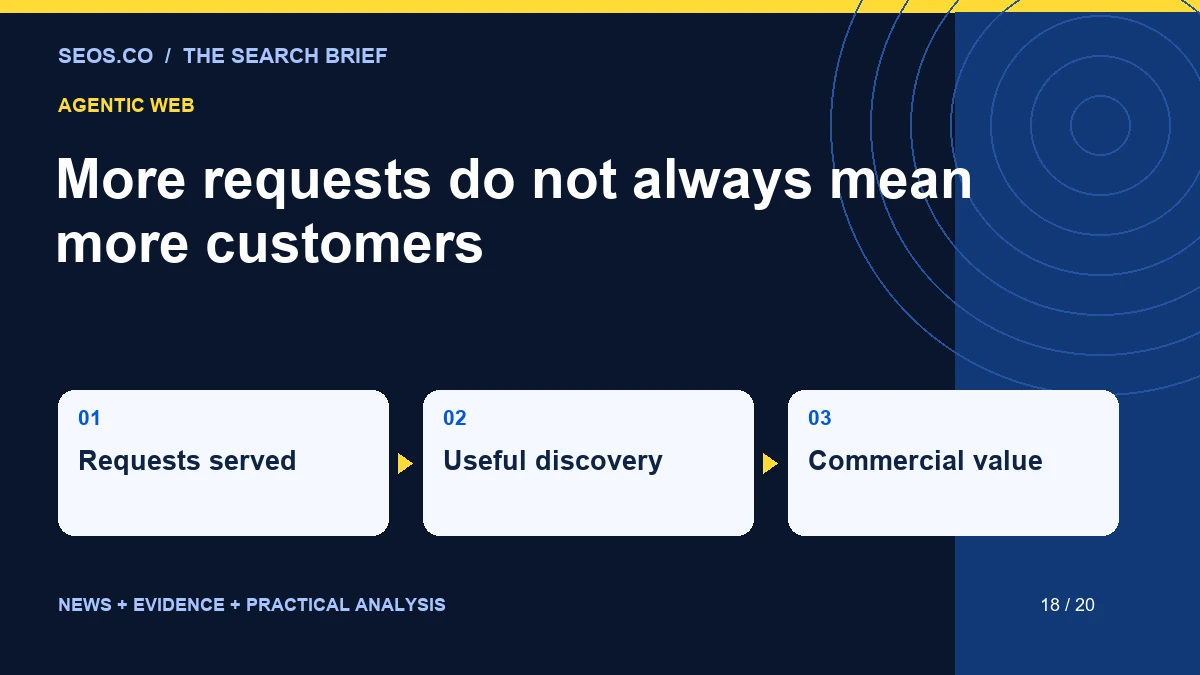
Cloudflare’s annual founders’ letter adds a striking claim to the debate about the changing audience of the web: the company says automated traffic overtook human traffic in May 2026. For publishers and SEO teams, the useful response is to examine what those requests cost and what value they create, rather than treating every automated visit as either a threat or a commercial opportunity.
The claim appears in Cloudflare’s September 27 founders’ letter. It is the company’s account of the traffic transition it observes, not a census independently measuring every request on the internet. “Automated” also covers more than generative AI. A crawler, monitoring service, integration and malicious script can all be automated while serving very different purposes. The headline is a reason to investigate the composition of traffic, not to assume that most visitors to a particular site are AI agents.
The business question is becoming more explicit: which machine requests help the website serve its audience, which support a useful external service, and which consume resources without an acceptable return? Answering that requires a more careful model than counting pageviews alone.
Request volume is not audience size
A single automated process can make many requests. A human visit can also trigger numerous resource requests. Raw traffic volume therefore does not map neatly to the number of people interested in a business or the number of meaningful tasks completed.
Start by defining the measurement. Is the report counting HTTP requests, sessions, pageviews or a classified subset? Does it include static assets and background checks? Without those definitions, comparisons can become misleading even when the numbers are accurate.
The distinction matters when infrastructure and marketing teams use the word traffic differently. One may be discussing server load while the other means potential customers. A shared report should preserve both views rather than forcing them into a single total.
For a directory, repeated retrieval of profile pages might support discovery, but it could also reflect a scraper collecting the entire database. The request pattern and operator context matter to the interpretation. A large count alone does not establish value.
Classify by purpose before deciding on treatment
A useful taxonomy separates known search discovery, user-initiated assistance, monitoring, integrations, bulk collection and suspicious activity where the evidence allows. Some requests will remain unknown, and the report should retain that category rather than forcing a confident label.
Identity and purpose are related but different. Knowing the operator helps, but a provider may run several services with different roles. A familiar user-agent name is not always enough to identify either the operator or the specific use.
The classification should support a decision. A monitoring request may be valuable because it detects outages. A search crawler may support discovery. A costly, repetitive request pattern may need rate management even if the operator is legitimate. The treatment depends on purpose, behavior and the site’s policy.
Avoid a simplistic good-bot/bad-bot story when the tradeoff is more nuanced. A request can be legitimate yet expensive, or low-cost yet outside the owner’s intended use. The business needs a policy capable of expressing those distinctions.
Measure marginal cost, not only total hosting expense
The relevant economic question is often what additional cost a class of requests creates. A cached static page may be inexpensive to serve compared with a dynamic search that triggers several database operations. Equal request counts can have very different operational effects.
Where available, examine response time, cache status, backend work and transfer volume by route or request class. Use the site’s actual billing and infrastructure data rather than applying an invented universal cost per bot visit.
A useful analysis can begin with relative burden even when exact allocation is difficult. Identify the paths responsible for disproportionate work and investigate why. An expensive endpoint may need technical improvement regardless of who is requesting it.
This connects bot analysis with performance engineering. Better caching, efficient queries and sensible pagination can reduce costs while preserving useful access. Blocking is one possible policy tool, but it is not the only response to inefficient delivery.
A hypothetical model clarifies the decision
Imagine two invented request classes. Class A produces 100,000 mostly cached requests at an estimated incremental cost of $2 per 100,000. Class B produces 10,000 expensive dynamic requests at an estimated cost of $20 per 10,000. These values are illustrative and are not Cloudflare prices or measurements from SEOS.co.
Class B has one tenth the volume but ten times the modeled cost. A dashboard focused only on request counts would direct attention to the wrong group. The example shows why a cost model should include the work performed, not just the number of arrivals.
Now add value. If Class A supports a useful discovery service and Class B is an unnecessary repeated query, the prioritization becomes clearer. If Class B is a critical customer integration, the response may be to optimize it rather than restrict it.
| Illustrative class | Requests | Modeled incremental cost | Initial question |
|---|---|---|---|
| A | 100,000 | $2 | Is the access useful and policy-compliant? |
| B | 10,000 | $20 | Why is each request expensive? |
The model is deliberately simple. Its purpose is to make the variables visible, not to imply that every business can assign an exact monetary return to every request.
Value may appear outside the immediate visit
A search crawler does not behave like a customer, yet its work can support later discovery. A monitoring service may never create a lead but can protect availability. An agent acting for a user may retrieve information that helps a later decision without sending a conventional referral.
Those possibilities make direct revenue attribution incomplete. They do not justify assuming unlimited value. The analysis should distinguish observed outcomes, plausible benefits and unverified claims.
For a directory, useful observations might include identifiable referrals, completed comparisons or inquiries associated with a channel. Broader citation or visibility reports can provide additional context. None should automatically be converted into a dollar amount without an explained model.
The business can make a policy under uncertainty. It should simply state the basis: low cost and plausible discovery value, for example, or high cost with no demonstrated useful purpose. That is more honest than pretending the economics are fully known.
Protect important public pathways
When reducing unwanted load, preserve the pathways that support the site’s intended audience. Broad restrictions can affect search access or legitimate tools if the rules are too coarse. A narrow diagnosis supports a narrower repair.
Identify critical routes such as the homepage, category pages, profiles and editorial resources. Understand which requests are expected and which controls apply. Test the public experience after changes and inspect relevant logs for unexpected denials or challenges.
Do not weaken account security or expose private resources in pursuit of machine accessibility. Public discovery and private access are separate concerns. An agentic web still needs ordinary authentication and authorization boundaries.
A clear policy can allow useful public retrieval while constraining expensive or inappropriate behavior. The aim is to align access with the site’s purpose, not maximize or minimize all automated traffic indiscriminately.
Expensive pages deserve a content and architecture review
An unusually costly route may reveal a deeper design issue. A directory search that loads the entire dataset for every request, a page with unbounded filters or a template that repeatedly queries the same records can create avoidable work.
Review the user need behind the route. Could a stable category page answer a common task more efficiently? Could pagination or a better index reduce the burden? Could repeated calculations be cached without showing stale or private information?
These decisions should preserve the usefulness of the page. Removing a comparison feature solely to reduce load may harm the reader’s task. The better solution may be a more efficient implementation of the same useful capability.
Content structure can help. Clear categories and maintained summaries can reduce the need for repeated exploratory requests, while stable links make important resources easier to reach. The technical and editorial teams should investigate together when architecture drives unnecessary work.
Keep security analysis separate from marketing claims
An increase in automated requests is not proof of increased market demand. It may reflect a new crawler, a changed schedule or unwanted activity. Marketing reports should not count those requests as audience growth without an appropriate basis.
Similarly, a reduction after a security rule changes is not necessarily a loss of valuable visibility. The meaning depends on which requests were affected and why. A single combined traffic chart can hide that distinction.
Maintain separate views for operational load and audience outcomes, then connect them where the evidence allows. This gives each team the information it needs without encouraging inflated reach claims or unnecessary alarm.
For clients, a useful report explains the classification, the action and the observed effect. “Bot traffic fell” is incomplete. “Repeated requests to an expensive endpoint were reduced while tested public discovery routes remained accessible” describes a concrete operational result, if those checks were actually performed.
Establish thresholds that trigger investigation
A monitoring plan should identify meaningful changes: a sharp increase in backend work, an unfamiliar operator, repeated errors or unexpected access denials on critical pages. The threshold should prompt investigation, not automatically determine the final policy.
Use the site’s normal behavior as context. A scheduled crawl can produce a predictable burst. A new publication or campaign can change legitimate demand. The analyst needs enough history to distinguish routine variation from a new problem.
Record decisions and their outcomes. If a rate limit reduced load without affecting useful tasks, retain that evidence. If it caused failures, adjust the implementation and document the lesson. The policy should improve through observation rather than remain a collection of unexplained rules.
Assign ownership across teams. Infrastructure may detect the change, but editorial or marketing staff may understand why a particular resource is being requested. A shared response avoids both overblocking and passive acceptance of costly behavior.
Forecasts should remain forecasts
The founders’ letter is a strategic statement about a changing web. Strategic statements often combine observations with expectations about the future. Readers should preserve that distinction when using them in a budget or a presentation.
A company-wide trend can justify preparation without dictating the exact future of an individual site. Build a plan that remains useful across several scenarios: more automated retrieval, changing referral behavior or new interaction patterns. Efficient delivery and clear policy are valuable under all of them.
Avoid rebuilding the business around a single extrapolated ratio. Instead, identify which decisions are reversible and which require stronger evidence. A small measurement improvement is easy to justify; a major access restriction or product pivot deserves a fuller assessment.
The most durable response to uncertainty is better observation coupled with deliberate choices. That gives the business room to adapt as the evidence develops.
The web’s changing audience needs a better ledger
Cloudflare’s claim is a prompt to look beyond human session totals and ask what the website is serving. Automated requests have purposes, costs and consequences. Understanding them requires classification, technical measurement and a clear view of the site’s business model.
For SEO teams, this creates a useful connection with infrastructure work. Discovery depends on access, while sustainable access depends partly on efficient delivery and sensible controls. A cost-and-value view can help preserve what is useful, repair what is wasteful and avoid mistaking raw machine activity for commercial success.
Separate capacity planning from channel valuation
Infrastructure teams may need to prepare for increased automated load before the business can measure its full value. That is a reasonable capacity decision. It should not be presented as proof that the new requests will produce proportional revenue or audience growth.
Use different assumptions for the two exercises. Capacity planning can model request peaks, response cost and acceptable service levels. Channel valuation can examine identifiable referrals, useful tasks and broader discovery evidence. Connecting the analyses is useful, but merging them into one optimistic forecast can hide uncertainty in both.
For a growing directory, this might mean improving a costly query path while continuing to investigate which automated clients use it. The efficiency repair can be justified by observed resource consumption. The business value of each client can remain a separate, ongoing question.
This approach helps teams act without pretending every uncertainty has been resolved. It also prevents a false choice between allowing unlimited load and blocking all automated access. The business can improve delivery, preserve useful pathways and refine its policy as better evidence becomes available.
Source and analysis note: The reported timing of the traffic crossover is attributed to Cloudflare’s founders’ letter. All cost figures are invented examples. The classification and evaluation framework are original analysis, not a measurement of SEOS.co traffic or a universal forecast for the web.