
The Search Brief · News analysis
Cloudflare Expands Vary Support: A September Cache Update With Real SEO Consequences
Cloudflare expands Vary support. Build a response test matrix that protects correct variants, private content and coherent URLs while improving cache efficiency.
Development covered: September 22, 2026
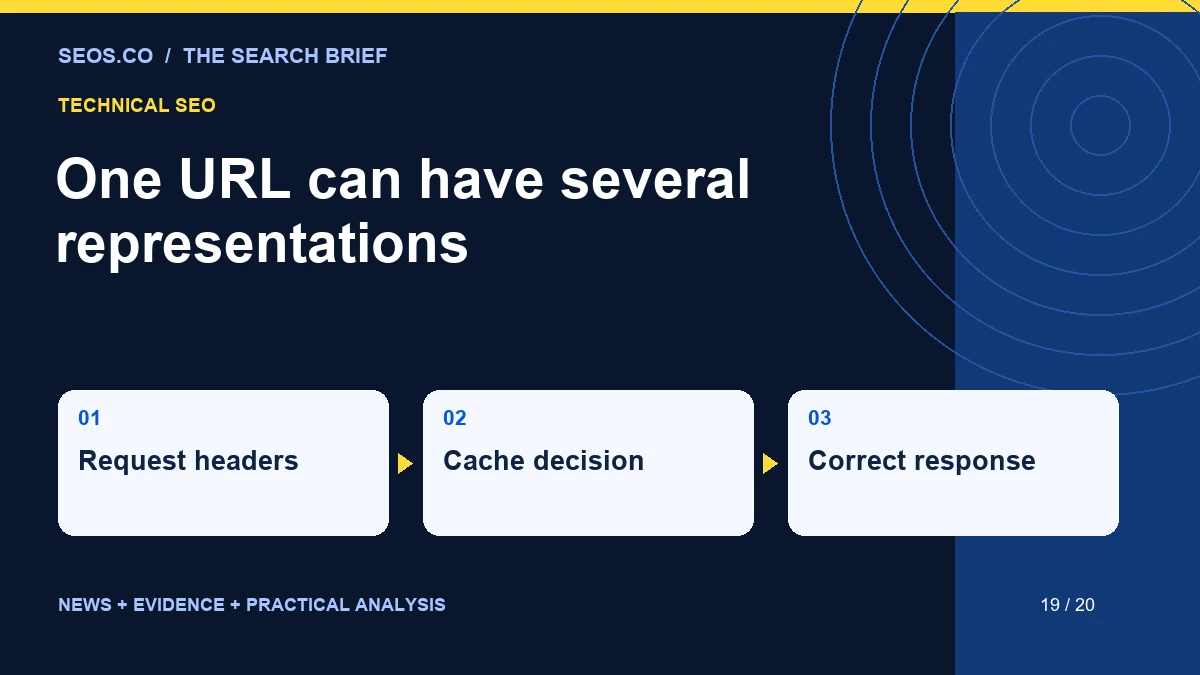
A cache improvement can be an SEO improvement when it helps the right page reach the right visitor reliably. It can also become a serious content-delivery problem if different responses are mixed together. Cloudflare’s September expansion of Vary support makes this a timely issue for sites that serve negotiated versions of a resource.
In its September 22 announcement, Cloudflare describes expanded Vary support through Cache Rules across plans. The design allows policies for known negotiation headers, exact values or bypassing variation that cannot be handled predictably. Vary identifies request fields that influence a response; it does not automatically create an SEO URL strategy, canonical policy or language annotation. Those remain separate publishing decisions. The new capability is therefore best evaluated through a response matrix rather than a general claim that caching has been optimized.
The practical question is whether two requests that should receive different content remain correctly separated, while equivalent requests can share a response safely. That balance affects performance, correctness and the consistency of what users and crawlers can retrieve.
Caching is a correctness problem before a speed problem
A fast response is not a success if it contains the wrong version of the page. Language, media format or another negotiated property can affect what the origin sends. A cache needs enough information to avoid reusing an inappropriate response for a later request.
At the same time, separating every tiny variation can reduce cache efficiency. If irrelevant differences create many distinct entries, the origin may do more work than necessary. The policy should therefore distinguish meaningful variation from noise.
This is a design decision that requires knowledge of the application. A generic rule copied from another site may not match the fields that actually affect the response. The safest starting point is an inventory of real variation, followed by a limited test.
For SEO teams, the concern is consistency. Important public pages should deliver the intended information under the relevant conditions. Performance work should preserve that meaning rather than treating every cache hit as inherently good.
Identify what actually changes the response
Start with the origin behavior. Does the same URL return different content based on a request header? Is the difference limited to a representation format, or does it change language, pricing, availability or personalization? The consequences vary substantially.
Document the fields and the reason they matter. If a field does not affect the response, including it in variation may create unnecessary fragmentation. If it does affect the response and is ignored, the cache may serve an incorrect version.
Do not infer the behavior from a configuration label alone. Inspect representative responses and the application logic responsible for them. A legacy rule may no longer reflect the current template, or a new feature may have introduced a variation that was never documented.
The inventory should separate public reusable responses from private or user-specific information. Content tied to an authenticated account requires particular care and should not accidentally enter a shared public cache.
Build a small request-and-response matrix
A matrix makes the intended behavior reviewable. List the relevant request conditions, the expected representation and whether responses should share a cache entry. Include both matching and contrasting cases.
For an illustrative multilingual resource, the test might compare two language preferences and an unspecified preference. For an image representation, it might compare supported formats. The exact cases must come from the site’s actual behavior rather than a generic checklist.
| Test case | Expected question |
|---|---|
| Same relevant request values | Can the response be reused safely? |
| Different meaningful values | Is the correct variant returned? |
| Missing negotiation field | Is the fallback predictable? |
| Unsupported value | Is the response valid and consistent? |
| Private session | Is user-specific content protected from shared reuse? |
The matrix should include the expected content, not just headers. A response can have plausible cache metadata while still displaying the wrong language or record. Inspect the body and the user-visible result.
Canonical URLs solve a different problem
A cache policy determines when a stored response can be reused. A canonical policy communicates the preferred URL for a resource. One does not automatically establish the other. Confusing them can lead a team to believe that a delivery configuration has solved duplicate or alternate-page issues.
If a site intentionally publishes separate language URLs, those resources need a coherent URL and linking strategy. If it negotiates a representation at one URL, the team needs to understand how discovery and user access work under that design. The cache rule should support the chosen architecture.
Do not add canonical tags mechanically to hide a delivery problem. First determine which resource the page is intended to represent. Then ensure the response, internal links and metadata are consistent with that intention.
The same applies to redirects. A redirect should serve a defined navigation or consolidation purpose, not compensate for an unexplained cache mismatch. Solving the underlying variation issue is usually easier to maintain than layering corrective behaviors around it.
Avoid uncontrolled fragmentation
A request field can contain many values. If every value produces a distinct cache key, the number of variants may grow rapidly. Some of those distinctions may be useful; others may be irrelevant to the actual response.
Review the cardinality of the chosen fields and the application’s normalization behavior. Equivalent preferences should not create unnecessary variants if they lead to the same representation. However, normalization must preserve distinctions that genuinely affect content.
This tradeoff should be tested with real examples. A policy that looks efficient in theory may produce poor reuse because clients send many syntactically different values. Conversely, an aggressive normalization can collapse cases that should remain separate.
Monitor both correctness and efficiency after rollout. A higher cache-hit rate is welcome only if the right content is being served. Keep the two measurements side by side so one does not hide a regression in the other.
Public and private content must remain distinct
The most consequential caching mistake is not a slow page; it is exposing information to the wrong user. Any response that depends on private account state needs an explicit policy that prevents inappropriate shared reuse.
Review authentication, cookies and application behavior with the engineering team. Do not assume that adding one variation field makes a private response safe for a public cache. The correct design depends on the full response and the access model.
Tests should include signed-out and authorized states where relevant, with care not to expose private data in test artifacts. The expected result should state whether the response is cacheable at all, not only which variant it uses.
SEO work does not justify weakening those boundaries. Public discoverability concerns public resources. A cache optimization that creates a privacy problem is a failed implementation regardless of any apparent performance benefit.
Inspect the entire delivery path
A website may have several layers of caching: application, hosting, edge and browser. A change at one layer can interact with another. When the visible result is wrong, identify which layer supplied it rather than repeatedly purging everything without a diagnosis.
Record relevant response headers and the test conditions. Compare a fresh response with a repeated request where appropriate. Check whether the origin itself produces the intended variant before attributing the problem to the edge.
Keep the test narrow enough to interpret. Change one policy at a time when possible, and retain the previous configuration for rollback. A broad performance release involving templates, compression and cache rules can be harder to diagnose if a variant begins behaving incorrectly.
The completion evidence should show both the expected content and the delivery behavior. A technical report that lists only configuration settings does not demonstrate that the public experience is correct.
Use meaningful representative pages
A homepage test is not enough if variation occurs on product, directory or account routes. Select examples from each affected template, including the cases most likely to differ. The sample should reflect the scope of the rule.
For a directory, consider whether filters are represented in the URL, whether results depend on location preferences and whether logged-in features share a template with public content. Each design choice can affect what is safe to reuse.
For editorial pages, inspect language behavior and media representations where relevant. Confirm that the main article, title and canonical destination remain coherent. A correct image format does not establish that the document itself follows the intended policy.
Record the sample so future releases can repeat it. The objective is not to test every possible request manually, but to cover the meaningful classes and preserve the reasoning behind the selection.
Do not confuse legitimate variation with hidden persuasion
Serving an appropriate language or supported representation is a user-experience decision. Deliberately showing materially different claims to a crawler and a human visitor is a different practice. A cache feature should not be used to disguise content or manufacture a misleading external impression.
The public resource should remain coherent across its intended variants. If a comparison has limitations or commercial disclosures, those should not disappear in a machine-oriented response. Important context belongs with the claim.
This principle also helps debugging. A site with a clear representation policy is easier to test than one containing many unexplained conditional differences. Editors and developers can agree on what must remain consistent and what is legitimately variable.
For buyers of technical SEO services, ask what changes between variants and why. The answer should describe a user or delivery need, not a secret technique designed to present a different reality to external systems.
A release plan should include rollback and observation
Before deployment, define the expected behavior and the failure conditions. An incorrect language, a mismatched record or any exposure of private content should have a clear response path. The team should know how to restore the prior policy promptly.
After deployment, inspect representative requests and monitor errors, origin load and cache behavior. Compare against a suitable baseline. A change in hit rate alone does not establish whether the release improved the system overall.
Keep an eye on less common variants. A popular default can appear healthy while an infrequent but important case fails. The test matrix should make those cases visible rather than allowing aggregate metrics to hide them.
Document the final policy in terms of the application’s behavior. Future maintainers should understand why a field matters and what would require revisiting the rule. This is more durable than a note saying only that a setting improved performance.
The SEO value is reliable delivery of the intended resource
Cloudflare’s expanded support gives teams more control over a subtle part of content delivery. Used carefully, that control can improve efficiency while keeping variants correct. Used without understanding the application, it can create confusing or consequential errors.
The appropriate response is a focused technical review: identify real variation, define expected responses, test the matrix and monitor the rollout. That produces evidence of a useful improvement. It also keeps caching in its proper relationship with SEO: a delivery foundation that supports the resource, not a substitute for relevance, evidence or a coherent publishing architecture.
Include the editorial team in variant review
Developers can verify that two responses are technically distinct, but editors may be better placed to judge whether the differences preserve meaning. A translated or localized version can omit a qualification even when the cache behaves exactly as configured. Correct delivery and correct content are separate checks.
Have the relevant content owner inspect representative variants after a material change. Confirm that important disclosures, dates and comparison limitations remain visible. If a variant intentionally differs, document the reason so later reviews do not mistake it for an error.
Keep a known-good example for each class
A small set of known-good responses can make future diagnosis faster. Retain the expected status, key content and relevant conditions for each meaningful variant. The artifact should avoid private information and remain tied to the release that produced it.
When a problem is reported, compare the current result with that baseline before changing several rules at once. The difference may reveal whether the origin, cache policy or template changed. This makes the investigation more focused and reduces the chance that a broad purge temporarily hides an unresolved defect.
The baseline is not permanent truth. Update it when the intended behavior changes, with an explanation of why. Its value is that the team can distinguish a deliberate publishing decision from an accidental delivery regression.
Source and analysis note: The September product change is attributed to Cloudflare. The test matrix, implementation considerations and hypothetical directory cases are original analysis. No cache configuration change or performance gain for SEOS.co is claimed in this article.