
The Search Brief · News analysis
Cloudflare Separates Training Preferences From Search Access: Read the New Controls Carefully
Cloudflare distinguishes training preferences from blocking. Review mixed-use crawlers, provider-specific limitations and a practical access verification plan.
Development covered: September 15, 2026
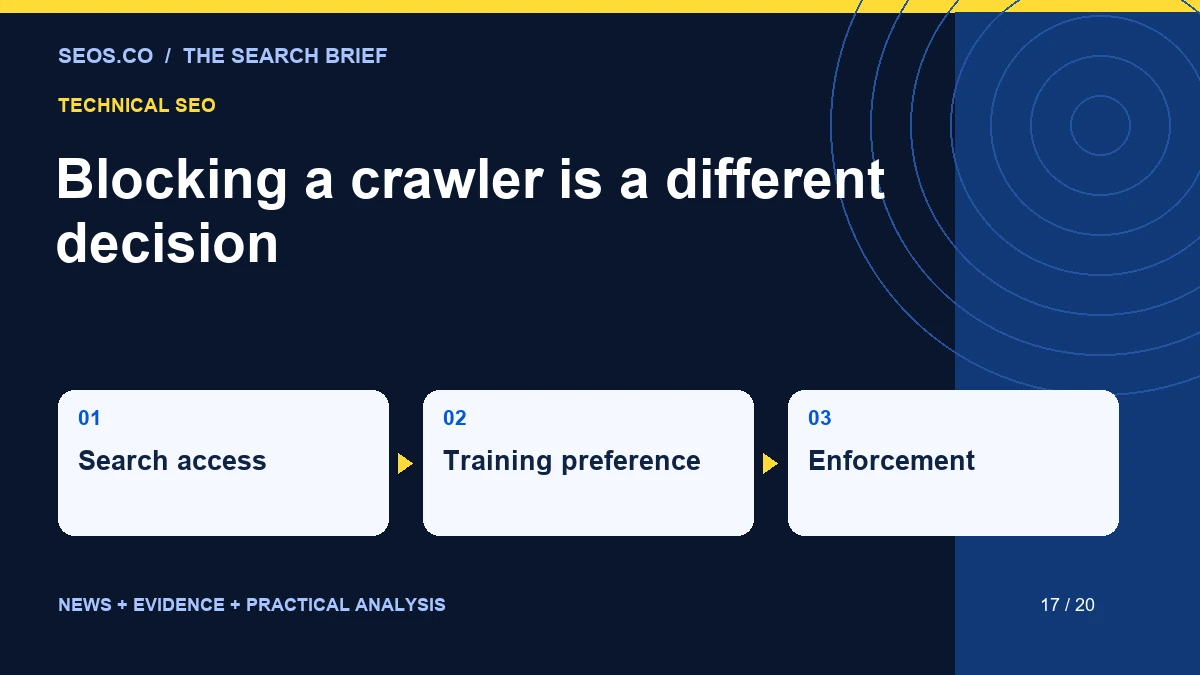
Cloudflare’s September crawler-control update addresses a practical dilemma for publishers: how to express a preference against AI training without unintentionally cutting off search discovery. The new controls are more specific than a broad “block AI” decision, but their effect depends on the crawler and the support currently available from its operator.
In its September 15 announcement, Cloudflare distinguishes Disallow AI Training from blocking requests and introduces an Accountable designation based on capabilities and commitments. It says mixed-use search crawlers can remain available for search under the training preference, whereas Block can stop those crawlers entirely. A material exception is Bing: at publication, selecting Disallow AI Training did not automatically convey a no-training preference through robots.txt because the relevant support had not launched. The announcement therefore describes both current controls and an evolving implementation landscape.
For website owners, the important lesson is to read the control as an operational policy with provider-specific behavior. A setting name alone does not explain every downstream effect. Before changing it, define the intended outcome, inspect the applicable mechanisms and plan how to verify that important public pages remain reachable.
A preference and a blocked request are different outcomes
A preference communicates an intended use of content. Blocking prevents a request from obtaining the resource through the controlled path. The two can support related goals, but they operate differently and can have different effects on discovery.
If a crawler serves more than one purpose, a broad block may affect more than the use the publisher intended to restrict. That is why the distinction matters to SEO teams. A business may want public pages discoverable while objecting to a separate use of their content.
The implementation should follow a written intention. “Preserve ordinary search discovery while expressing the available training restriction” is more precise than “stop AI.” The latter phrase can conceal several different preferences and lead to a configuration whose consequences surprise the owner.
This article concerns operational interpretation, not a legal conclusion about content rights or the enforceability of a preference. Businesses with contractual or legal requirements should evaluate those separately from whether a request receives a page.
Start with the business model
Different sites can reasonably make different choices. An advertising-supported publisher may care deeply about visits to its own pages. A service business may value discovery that leads to a smaller number of qualified inquiries. A documentation site may prioritize helping users find accurate instructions.
Those differences do not produce an automatic answer, but they shape the tradeoff. The same request pattern can have different value depending on what the website is trying to accomplish. A policy should reflect that purpose rather than copying a setting from an unrelated business.
For a directory, useful questions include whether discovery helps buyers reach comparison resources, whether referrals can be observed and whether automated requests impose a meaningful operational burden. The answers may vary across public editorial pages, search results and account features.
Document the rationale. When a later team reviews the policy, it should be able to understand why the choice was made and what evidence would justify changing it. Otherwise, crawler settings can become inherited assumptions that no one wants to touch.
Build a provider-specific matrix
A single row labeled “AI bots” is usually too broad for a serious access review. Identify the relevant operator, the documented role, the desired treatment and the mechanism that implements it. Record known limitations and the date of review.
Do not assume that providers use identical crawler architecture. Some separate roles more explicitly than others, and support can change over time. The matrix should therefore be based on current documentation rather than a permanent list copied from an old article.
| Policy question | Evidence to record |
|---|---|
| What use is being addressed? | Search, training, agent interaction or another defined role |
| What outcome is intended? | Access allowed, preference expressed or request blocked |
| Which control implements it? | Relevant setting, directive or application rule |
| What limitation remains? | Unsupported behavior or unresolved provider-specific issue |
| How was it checked? | Date, public response and relevant logs or reports |
This is an internal decision record, not a claim that every listed mechanism provides identical enforcement. Its purpose is to make differences visible before they affect the site.
Migration deserves an explicit review
When a platform changes its controls, existing settings may be migrated. Even if the provider aims to preserve practical behavior, the site owner should understand the new labels and their effects. A familiar toggle position can conceal a revised meaning.
Capture the current configuration and the intended policy before making changes. Note which rules are inherited, which were manually configured and which defaults apply to newly added domains. Then compare the resulting behavior with the intention.
Avoid changing several unrelated security and caching settings at the same time. A focused release makes it easier to identify the cause if public access changes unexpectedly. It also reduces the complexity of a rollback.
The review should include the people responsible for both discovery and security. One team should not discover after the fact that another team interpreted a broad label differently. A short shared policy can prevent a long incident investigation.
Test real access without overstating the result
A basic public-page check can confirm that an ordinary request receives the intended content. It does not prove that every verified crawler receives the same response. Security services can make decisions based on identity, network, behavior and other context.
Use the provider’s relevant logs and verification tools where available. Inspect actual observed requests rather than assuming that changing a user-agent string reproduces a crawler’s identity. A spoofed header is not a complete verification method.
Select representative pages: the homepage, important category pages, editorial resources and any paths governed by special rules. Confirm status, content and intended indexing instructions. Keep the sample and date so the test can be repeated.
If a request is challenged or blocked unexpectedly, identify the rule responsible before weakening protections broadly. The repair should be as narrow as the diagnosis allows. Restoring intended access does not require removing unrelated safeguards.
Keep access and content policy aligned
A page can be technically accessible while its visible statements are misleading or outdated. Conversely, a strong article can be difficult to discover because an access layer prevents retrieval. These are different problems and need separate workstreams.
The access review should not become a substitute for editorial maintenance. Important pages still need accurate descriptions, clear dates and a defensible basis for comparisons. A crawler control cannot create authority that the resource lacks.
For directories, ensure the public methodology explains how listings and placements work. If an external system retrieves the page, the distinctions between editorial judgments, business-supplied facts and genuine reviews should be visible in the content itself.
Likewise, editorial staff should know when a policy intentionally limits discovery. They should not diagnose the resulting lack of visibility as a writing problem without checking the technical context. Shared documentation helps prevent the teams from solving the wrong issue.
Watch the effects over a suitable period
Some consequences can be checked immediately, such as a blocked request or an unexpected challenge. Search visibility effects may take longer and can be influenced by other factors. The monitoring plan should distinguish immediate technical verification from later performance observation.
Record the change date, affected scope and expected behavior. Track relevant request patterns and any available indexing or visibility signals. If a change appears, compare it with other releases and demand conditions before attributing it solely to the crawler policy.
Use a rollback condition that relates to a concrete failure. For example, verified search access to critical public pages being unintentionally denied is a clearer trigger than a small daily traffic fluctuation. The latter may be noise or an unrelated event.
The monitoring should have an owner. Without one, a configuration can remain in place even when warning signs appear in a report that no one reviews. Operational accountability matters as much as the initial choice.
Do not turn a provider designation into a universal guarantee
A designation based on capabilities and commitments is useful context, but it should not be described as proof that every future request or use will match a publisher’s expectations. Read the scope and current limitations of the program.
Where behavior depends on a planned capability, distinguish that future support from what works now. The Bing limitation in the announcement is an example of why this matters. A site owner should not assume that selecting one setting communicates every preference through every provider’s current mechanism.
Maintain a review date for these dependencies. A future launch may resolve a limitation, while another product change may introduce a new distinction. The policy record should be easy to update without reconstructing the entire history.
This is not a reason to avoid all controls until certainty is perfect. It is a reason to make a deliberate choice using the best current information and to state what remains unresolved.
Agency reporting should explain the actual change
A useful completion report identifies the previous state, the new state, the intended effect and the checks performed. It should name any provider-specific limitation that affects the client’s goal. A screenshot of a green toggle is insufficient on its own.
The report should also explain what was not measured. If no actual crawler requests were available during the verification period, say that the relevant behavior remains unobserved. Do not convert a configuration review into a claim of comprehensive traffic validation.
For clients, this level of detail makes the work reviewable without requiring deep technical expertise. They can see whether the change matches the business intention and what will be monitored afterward.
Avoid framing the work as a guaranteed GEO improvement. Its direct outcome is a more deliberate access policy. Any effect on referrals, citations or recommendations must be evaluated separately and may involve tradeoffs rather than a universal increase.
A practical review can remain proportionate
Most businesses do not need an enormous governance program to make a sensible crawler decision. They need a clear intention, a current view of the relevant controls, a narrow implementation and a repeatable check. The complexity should match the site and the consequences.
A small editorial website may use a short matrix and a few representative URLs. A large platform with accounts, paid content and multiple domains needs a more extensive inventory. Both benefit from keeping the terminology precise.
The review should also consider who can change the settings later. A well-intended support action can reverse a policy if the rationale is not visible. Record the decision where the operational team will actually find it.
When new information appears, update the policy deliberately. The goal is not to defend the original choice forever. It is to preserve the business’s intended balance between discovery, control and operational reliability as the ecosystem changes.
More specific controls require more specific thinking
Cloudflare’s update makes an important distinction easier to express, but it does not eliminate the need to understand the crawler and the site’s goals. Training preferences, search access and blocked requests should be discussed as separate outcomes.
For SEO teams, the priority is to prevent accidental loss of intended discovery while respecting the publisher’s chosen policy. That means reading provider-specific limitations, checking actual behavior and keeping the configuration connected to a documented business decision. The result is more useful than either an indiscriminate block or an unexamined default.
Keep the exception list short and explained
An access policy can become difficult to understand when every incident creates another permanent exception. Review exceptions for their scope, owner and continuing purpose. A temporary allowance for a test should not silently become an indefinite rule for unrelated requests.
Where a provider-specific limitation requires a different mechanism, document that mechanism explicitly. The record should explain what it accomplishes and what it does not. This prevents a later maintainer from assuming that the general setting covers a case that still needs separate treatment.
The same principle applies to blocks. A rule created during an incident may remain long after the original behavior changes. Periodic review can identify obsolete restrictions without weakening the controls that still serve a clear purpose.
A concise policy is easier to verify and less likely to produce accidental contradictions. The objective is not the smallest possible number of rules, but a set whose effects can be explained and tested. That clarity is particularly valuable while provider capabilities continue to evolve and product labels become more specific.
Source and analysis note: The control descriptions and Bing limitation are attributed to Cloudflare’s September announcement. The access matrix, verification plan and reporting recommendations are original operational analysis, not legal advice or a claim of universal enforcement.