
The Search Brief · News analysis
OpenAI’s Publisher FAQ Clarifies Search Access, Training and Atlas: Three Different Decisions
OpenAI’s publisher FAQ separates search access, training and Atlas interaction. Build an access map and test public pages, controls and referral measurement.
Development covered: Current documentation reviewed September 27, 2026
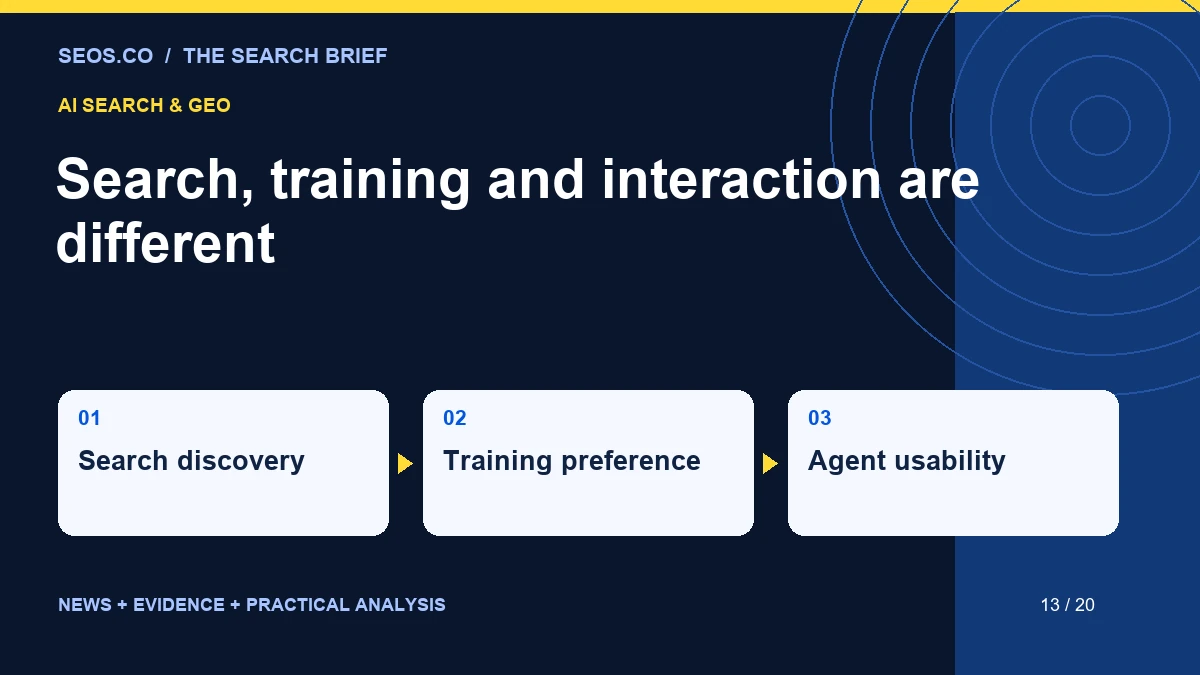
Publishers deciding how AI systems can access their websites face several different questions at once. They may want to appear in search, limit training use and make interactive pages understandable to a browsing assistant. Treating all three as one “allow AI” switch is an easy way to make the wrong operational decision.
OpenAI’s current publisher and developer FAQ, reviewed September 27, distinguishes OAI-SearchBot access from GPTBot training controls. It explains that allowing the search crawler supports summaries and snippets, while a blocked page can still have its title or URL discovered through other sources in Atlas. A noindex instruction must be accessible to be read. The FAQ also identifies utm_source=chatgpt.com on referral links and discusses accessible roles and labels for agent navigation. These are separate mechanisms, not a single promise of inclusion or exclusion everywhere.
The useful next step for a website owner is an access map: which public resources should be discoverable, which uses are permitted and which tasks an agent should be able to complete. That map should be implemented and tested through the relevant controls rather than inferred from a generic AI optimization checklist.
Search discovery and model training are different decisions
A publisher can have different preferences for different uses of its content. Helping a user find a public page is not the same activity as using material in a training process. The technical controls and the business reasoning should reflect that distinction.
Start by writing the intended policy in plain language. Which public pages should be available for discovery? Are there types of content that should not be indexed? What is the organization’s position on training use? The answers may differ across a publication, a customer portal and a public documentation section.
Then map each preference to the supported mechanism. Do not assume that one crawler rule governs every product or that a familiar bot name represents every request associated with a company. Product documentation and observed behavior should guide the implementation.
Keep private information behind proper access controls. A crawler preference is not a substitute for authentication. If a resource must not be publicly accessible, its protection should not depend on a cooperative crawler choosing to honor a published instruction.
An access matrix makes conflicts visible
A small matrix can expose contradictions before a configuration is changed. List the resource types, desired discovery behavior, permitted use and relevant technical control. Add an owner who can resolve ambiguous cases.
For a directory, public category pages and methodology explanations may be intended for broad discovery. Draft editorial notes and administrative interfaces should not be public resources. A member-only document may require authentication regardless of whether a crawler is permitted elsewhere on the domain.
| Resource type | Intended audience | Main question to resolve |
|---|---|---|
| Public article | Readers and discovery systems | Can the current, canonical page be reached? |
| Public comparison | Buyers evaluating options | Are claims and qualifications clear? |
| Private account page | Authorized users | Is access enforced by authentication? |
| Draft research notes | Editorial team | Are they excluded from public publication? |
The matrix is a planning aid, not a replacement for the actual controls. Its value is that a developer, editor and business owner can inspect the same intention before making changes that affect discovery.
Blocking retrieval can create an information gap
When a system cannot retrieve a page, it may have less current information about that destination. Depending on the product and discovery path, it may still know that the URL exists. Website owners should therefore avoid assuming that blocked retrieval produces a perfectly clean disappearance from every interface.
This matters when the goal is to correct an outdated title or description. Preventing access to the updated page can work against the desire to have current information understood. The appropriate response depends on the intended outcome and the product’s documented behavior.
Distinguish removal, non-indexing and restricted use. They are not interchangeable requests. A team should be able to explain which one it is trying to accomplish before changing a rule or tag.
After implementation, inspect the public page and the relevant reporting or testing tools. A configuration file that looks correct locally is only part of the evidence. Caching, security layers and template behavior can affect what an external request actually receives.
Agent usability begins with ordinary interface clarity
A browsing assistant needs to understand controls and the state of a page. Human users benefit from the same clarity. A button with a meaningful label is easier to interpret than an unlabeled icon. A form with clear fields and validation is easier to complete than one that relies on visual proximity alone.
For a directory, examine search, filters, comparison controls and contact paths. Can a user tell which filters are active? Does a button describe the action it performs? Is a successful submission clearly distinguished from an error? These are practical usability questions before they are AI questions.
Do not add hidden instructions that contradict the visible interface. The page should present a coherent task to all users. If a control means “request information,” its accessible name should not imply that it purchases a service or submits a review.
The best improvements reduce ambiguity at the source. They help assistive technology, human readers and automated interaction without requiring the site to guess which kind of visitor is present.
Separate reading from consequential actions
An agent that can read a public comparison page does not automatically need permission to submit a form, change an account or initiate a transaction. The website should make those boundaries clear in its interface and server-side behavior.
For low-risk browsing tasks, clear navigation and stable content may be sufficient. For actions that change data or create commitments, the flow should show what will happen, validate inputs and provide an unambiguous result. The website should not rely on a vague button label or a hidden side effect.
Consider a hypothetical agency inquiry form. A visitor should know which business receives the inquiry, what information is sent and whether submission creates any obligation. That clarity benefits both direct users and users assisted by software.
Do not treat agent compatibility as a reason to weaken authentication, remove necessary confirmations or expose administrative functions. Reliable automation depends on well-defined boundaries, not on making every action easier to trigger accidentally.
Referral tags are useful but incomplete evidence
An identifiable referral parameter can help a publisher recognize some visits from a platform. It does not describe every prior exposure or guarantee that all subsequent conversions will retain the same attribution. Analytics settings, user behavior and later visits can complicate the path.
Check that the landing page remains usable when the parameter is present. The canonical URL should represent the intended page, and the parameter should not create a separate duplicate resource. Avoid redirect chains that discard useful context unnecessarily or send the visitor to an unrelated destination.
Measure meaningful actions on the site, not just arrival. A reader who consults the methodology and compares relevant categories may be more valuable than a brief visit to a generic article. Define those actions according to the site’s purpose.
Keep attribution claims proportionate. A report can say that a set of visits carried a particular source parameter. It should not automatically claim that every later business result was caused by a specific AI answer unless the evidence supports that connection.
Test the public experience in a repeatable way
A practical test begins with the destination page: response status, visible content, canonical URL and key navigation. Then inspect the access controls relevant to the intended policy. Finally, complete a representative user task through the interface.
Record the date and the conditions of the test. An observed answer or interaction is a sample, not a permanent guarantee. The goal is to create a baseline that can be repeated after changes.
For a directory, a representative task might be finding a category, comparing two entries and locating the explanation of how placements are determined. The test should verify that the information is available and understandable, rather than merely checking whether a page loads.
If a task fails, identify the exact point. Was the label ambiguous, the result delayed, the destination missing or the access denied? Specific failures lead to specific repairs. A generic statement that the site is “not AI ready” does not.
Keep editorial evidence separate from technical eligibility
Making a page accessible gives a system the opportunity to retrieve it. It does not establish that the page is the best source for a question. A technically reachable directory can still have weak methodology, outdated records or unclear commercial relationships.
The content program should therefore run alongside the access work. Claims need sources or an explained editorial basis. Dates should help readers understand currency. Ratings, reviews and paid placements should be labeled according to what they actually are.
For articles, distinguish a platform announcement from an independent test. For comparisons, explain the selection criteria and limitations. These practices improve the resource a system might retrieve without claiming to control whether it will recommend the site.
An agency proposal that focuses only on bot access is incomplete if the underlying pages lack value. The technical and editorial components solve different problems, and a useful project should identify both.
Assign ownership before a policy becomes fragmented
Access decisions can be spread across a content management system, a security service, a robots file and application code. Without a clear owner, one team may allow a resource while another layer blocks it. The result can be confusing to diagnose.
Document where each rule lives and who can change it. Keep a short record of the reason for material changes and the verification performed afterward. This reduces the risk that a later maintenance task silently reverses an intended policy.
Review the policy when a product or provider changes its documented behavior. A setting that was appropriate for one crawler role may need reconsideration if the role changes. The review should be based on current evidence rather than an old screenshot of a dashboard.
For a small business, the process can be simple. A one-page access map and a release checklist may be enough. The important point is that someone can explain the intended behavior and demonstrate that the public implementation matches it.
The useful outcome is a coherent public resource
The publisher FAQ helps separate decisions that are often collapsed into a single AI visibility discussion. Search access, training preferences, referral measurement and agent interaction each require their own interpretation and checks.
A website benefits when those decisions are coherent. Public pages can be discovered as intended, private material remains protected, interface actions are clear and editorial claims are defensible. That foundation supports both human visitors and machine-assisted discovery without promising a recommendation that no publisher can guarantee.
Keep a record of unresolved access questions
Some policies cannot be fully verified immediately. A relevant crawler may not appear during the test window, or a provider may describe behavior that is still changing. Record the uncertainty and the evidence needed to resolve it rather than treating the absence of an error as proof of every intended outcome.
The record should identify the resource, the intended behavior and the next check. If the issue concerns private access, resolve the protection before exposing the resource. If it concerns public discovery, a later observation may be appropriate while the documented configuration remains in place.
This distinction keeps the project moving without overstating completion. A configuration can be deployed and its ordinary response checked while a specific external observation remains pending. The report should say exactly that.
Recheck after changes to navigation and templates
Agent usability can regress even when access controls remain unchanged. A redesigned button, a new overlay or a changed form can alter how a task is understood. Include the important journeys in release checks whenever the surrounding interface changes.
For a directory, confirm that the same category and comparison tasks still work and that the final state remains clear. Do not assume that a visual refresh preserves every accessible name or status message. The public experience is the result to protect, and it should be checked directly after material changes.
Source and analysis note: Product behavior is attributed to OpenAI’s linked FAQ as reviewed on September 27, 2026. The access matrix, testing sequence and hypothetical directory examples are editorial analysis. This article does not claim that any access setting guarantees inclusion, recommendation or traffic.