
The Search Brief · News analysis
WebMCP Moves Into an Origin Trial: What SEO Teams Should Ask Before Adding Agent Tools
WebMCP enters an origin trial. Examine structured website actions, safe task boundaries and a reversible pilot without confusing the experiment with rankings.
Development covered: June 9, 2026; documentation updated August 7, 2026
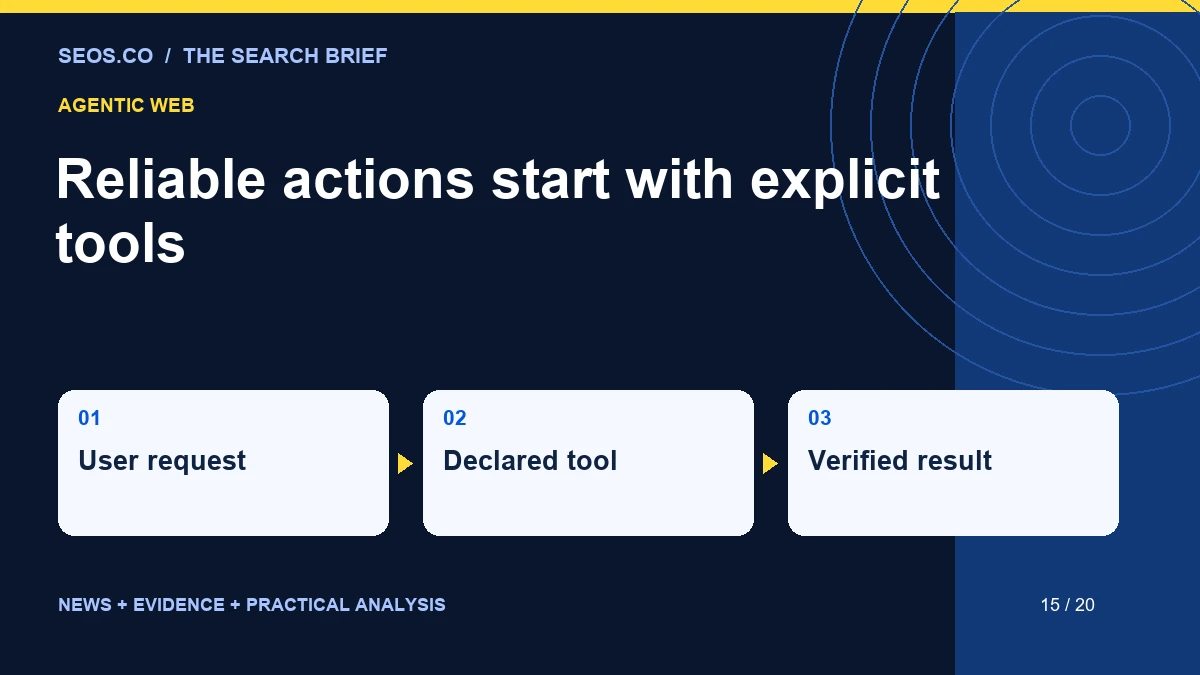
Websites are beginning to face a new interface question: how should an AI agent understand the actions a page offers? WebMCP’s move into a Chrome origin trial gives developers a way to explore structured tools for website interaction. For SEO teams, the development is relevant to task completion and usability, but it should not be confused with a newly announced ranking requirement.
Chrome’s June 9 announcement introduced the WebMCP origin trial in Chrome 149. The documentation updated in August describes a proposed API for exposing structured website tools, including declarative form-based and imperative JavaScript approaches. An origin trial is an experimental deployment mechanism, not evidence of universal browser support or permanent standardization. The proposal concerns interaction between agents and sites; it does not promise search placement or AI citations.
The immediate planning question is narrower and more useful: which tasks on the website would benefit from an explicit, well-defined action interface, and can those tasks be exposed safely and reliably? Answering that question requires more than adding a schema to a button.
Retrieval and action are different layers
A system reading a public page needs to understand information. A system acting on a page needs to understand inputs, permissions, side effects and results. The second problem has additional consequences. Selecting a filter is different from submitting an inquiry or changing an account.
An SEO team may naturally focus on discoverability, but an agent-facing feature belongs in a broader product discussion. Developers, security owners and the people responsible for the user journey should agree on what an action means before it is exposed.
For a directory, useful read-oriented tasks might include searching categories or applying filters. A contact submission changes state and transmits information. Those tasks should not receive identical treatment merely because both can be represented as a tool.
The interface should preserve the user’s intention. A tool that appears to retrieve information should not silently create a lead or subscribe someone to communications. Explicit behavior is the foundation of reliable agent interaction.
Start with the tasks users already perform
A good pilot begins with an existing, useful workflow. If visitors struggle to find a category or compare records, clarify that workflow first. Exposing a confusing process through a structured interface can make the confusion easier to trigger rather than solving it.
Write the task in ordinary language and identify the expected result. For a hypothetical directory search, the task might be finding agencies associated with a stated service and region. The result should make clear which criteria were applied and what the records actually represent.
Avoid inventing actions solely because the new technology supports them. Every tool creates documentation, testing and maintenance obligations. A small set of meaningful, stable actions is easier to evaluate than a large catalog of loosely defined capabilities.
The pilot should also have a fallback. Users and browsers outside the experiment still need a working website. A new interaction layer should complement a coherent public experience rather than making basic functionality depend on experimental support.
Tool names and inputs are part of the user experience
A structured tool needs a precise name and description. Those elements should explain what it does, not advertise the business. “Find agencies matching filters” is more informative than a vague promise to discover the perfect partner.
Inputs should use clear types and constraints. If a field accepts a category identifier, do not describe it as arbitrary free text. If a region is optional, say so. If a combination can produce no results, define that outcome rather than treating it as an unexplained error.
The same care applies to outputs. A result should distinguish successful completion, no matching records and a failed request. Ambiguity at this point can lead an agent to retry unnecessarily or tell a user that an action succeeded when it did not.
These are familiar interface design principles. The new context makes them more explicit because another program must interpret the contract without relying on the same visual assumptions as a person browsing the page.
Classify side effects before implementation
Create an action inventory and classify each operation by its consequences. Reading a public record is low risk. Submitting personal information, changing a preference or creating a commercial commitment requires stronger handling. The classification should guide confirmation, validation and access requirements.
| Hypothetical action | Side effect | Design priority |
|---|---|---|
| Search public categories | None beyond retrieval | Accurate filters and clear results |
| Compare selected profiles | Usually local presentation | Consistent fields and source context |
| Save a private shortlist | Account data changes | Authentication and ownership checks |
| Send an inquiry | Information transmitted | Clear recipient and explicit intent |
| Purchase a service | Financial commitment | Appropriate authorization and confirmation |
This table is a planning example, not a specification of features currently available on SEOS.co. Its purpose is to show why “agent ready” cannot be a single undifferentiated state.
Server-side validation remains essential
A well-described input does not guarantee a valid request. The server must still enforce permissions, validate values and reject operations that violate the application’s rules. A client-side tool declaration is not an authorization boundary.
For a contact action, validate required fields and the intended recipient. For an account operation, confirm that the authenticated user owns the affected resource. For a search, constrain expensive queries and handle malformed input predictably.
Do not trust a request simply because it appears to come through an agent-facing interface. The application should apply the same substantive controls it would require for any other client. Otherwise, the new convenience layer can create an unintended path around existing protections.
Keep error messages useful without exposing private system details. A user or agent needs to know whether to correct an input, sign in or try again later. It does not need internal credentials, stack traces or information about another user’s records.
Repeated actions need predictable handling
Agents, browsers and networks can retry requests. A repeated read is usually harmless, but a repeated submission can create duplicate inquiries or other unwanted state. Design consequential actions with that possibility in mind.
Where appropriate, use a mechanism that identifies a repeated operation and returns the existing result rather than performing it again. The exact implementation depends on the application, but the user-facing behavior should be clear: a retry should not silently multiply the commitment.
Test the boundaries deliberately. What happens if the request succeeds but the response is lost? What if the user changes their mind before confirmation? What if a tool is invoked twice in quick succession? These cases reveal whether the action contract is robust enough for real use.
The test is not complete when a happy-path demonstration works once. Reliability includes failures, interruptions and ambiguous timing, especially when the action affects other people or business records.
Keep untrusted content out of the control path
A page may display user submissions, third-party descriptions or imported records. Those materials can contain text that looks like instructions. An agent-facing design should not treat that content as authority to change the task or perform unrelated actions.
Separate the data being retrieved from the tool’s defined behavior. A profile description should remain profile data. It should not be able to redefine where an inquiry is sent or instruct the system to disclose private information.
For a directory with contributed content, this distinction is particularly important. The platform controls the action contract; listed businesses contribute information within that contract. Mixing those roles can create both reliability and trust problems.
Testing should include misleading or instruction-like text in data fields. The goal is to confirm that the workflow still follows the user’s intended task and the application’s rules, rather than treating every sentence encountered as an instruction.
Evaluate completion, not just tool invocation
A successful call is not necessarily a successful user task. The result may be irrelevant, incomplete or misunderstood. Evaluation should therefore include the final state and the explanation presented to the user.
For a search task, check whether the returned records match the stated criteria and whether important limitations are visible. For a submission, verify that the intended record exists once and that the user receives an accurate confirmation. For a comparison, confirm that the fields mean the same thing across entries.
Create a small test set containing ordinary, ambiguous and unsupported requests. The system should handle unsupported tasks honestly. A clear statement that the available data cannot answer a question is better than an invented recommendation.
Retain the test cases as part of release checks. A later change to category names, field meanings or authentication can break a previously working action even if the tool declaration itself remains unchanged.
SEO teams have a useful supporting role
SEO practitioners can contribute knowledge about the tasks visitors are trying to complete and the information architecture that supports them. Search queries, landing-page behavior and content gaps can help identify a worthwhile pilot.
They should also protect the coherence of public destinations. An agent-assisted result should connect to stable, useful pages where a reader can inspect the evidence. The new interface should not become an excuse to remove explanatory content from the website.
However, a technical experiment should not be marketed as a guaranteed ranking improvement. The immediate outcomes concern clarity, reliability and task completion. Any later search or referral effects require their own observations.
This division of responsibility makes the project stronger. Product and engineering teams own the action behavior, while editorial and SEO teams help ensure that the information and user journey remain useful and discoverable.
An origin trial calls for a reversible pilot
Experimental support can change. Keep the implementation isolated enough to disable or revise without breaking the ordinary site. Document which browser versions and conditions were tested, and review the current trial status before expanding deployment.
A pilot should have a defined scope, owner and evaluation date. It should also have a reason to stop: insufficient usefulness, excessive maintenance, unclear user demand or unresolved reliability problems. Continuing an experiment indefinitely is not automatically progress.
The strongest case for expansion is a demonstrated improvement in a real task with acceptable operational cost. A successful demo or a fashionable acronym is weaker evidence. The decision should reflect what users can accomplish and what the organization can maintain.
WebMCP is worth watching because it makes the contract between websites and agents more explicit. That is a meaningful product development. The responsible response is to test a useful task carefully, preserve ordinary usability and keep claims about search visibility separate from the experiment’s actual results.
Document what the pilot deliberately leaves out
A narrow pilot should state its boundaries. If it supports public search but not inquiries, say so. If it works only under specified experimental browser conditions, preserve that qualification. Clear boundaries prevent a successful demonstration from becoming a claim that the entire website supports every agent workflow.
The documentation should also identify dependencies. A tool may rely on a particular data field, an authentication state or an external service. When that dependency changes, maintainers need to know which behavior to retest. Otherwise, a small interface change can silently invalidate the action contract.
Test the explanation returned to the user
The final message matters as much as the underlying operation. A tool can return accurate data while the surrounding interaction describes it incorrectly. For example, a list of agencies matching stated filters should not be presented as independently verified winners unless that is what the evidence establishes.
Review the language of completion and uncertainty. A successful search means matching records were found; it does not mean the user’s procurement decision is complete. A submitted inquiry means information was transmitted to the stated recipient; it does not mean a contract was accepted or a response is guaranteed.
These distinctions should be reflected in the tool descriptions, output structure and test cases. A reliable agent-facing experience preserves the meaning of the business process from the user’s request through to the final explanation. That is a stronger standard than checking only whether a function returned without an error, and it is essential before expanding a pilot into a consequential workflow.
Source and analysis note: Trial status and the proposed interface approaches are attributed to Chrome’s linked materials. The action matrix, security considerations and hypothetical directory pilot are editorial analysis, not a report of a deployed SEOS.co WebMCP implementation.