
The Search Brief · News analysis
A 331,000-Page AI Content Study Raises a Better Question Than ‘Will Google Penalize AI?’
An Ahrefs AI content study raises questions about quality and indexation. Explore detector limits, source verification and a maintainable publishing process.
Development covered: July 27, 2026
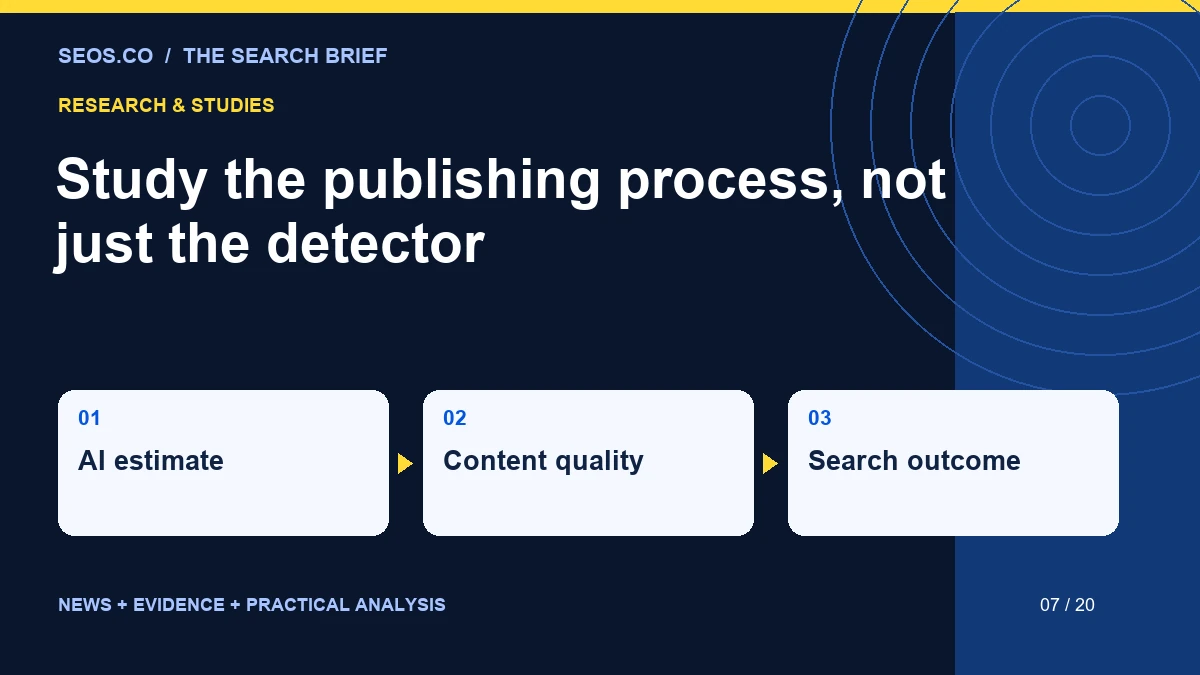
An argument about whether Google “punishes AI content” can hide the more useful question: what kind of publishing process produces pages that deserve attention? New research from Ahrefs brings data to the debate, but its strongest value is as a prompt to inspect quality, evidence and selection effects rather than to search for a universal permission slip.
The July 27 study by Ryan Law, with Xibeijia Guan, combines analyses presented as 331,000 pages studied. It uses estimated AI-content levels, not verified authorship records. Higher estimated AI use was associated with lower indexation and impressions in parts of the research, while the time-series panels did not show an obvious sudden collapse for highly AI-classified pages. Its indexation analysis used observable proxies, including rankings, Search Console impressions or an exact-URL search result. The authors explicitly acknowledge detector uncertainty and possible confounding factors such as site age and authority.
For publishers, the finding should narrow the conversation. A detector label does not explain why a page is useful, accurate or distinctive. A responsible content program needs those qualities regardless of which tools helped produce the first draft.
Estimated authorship is not a quality measurement
An AI detector attempts to classify text patterns. A quality review asks whether statements are true, sources support the claims, the page answers a real question and the reader receives something useful. Those are different tasks. A page can pass one kind of inspection and fail the other.
Consider two hypothetical articles about selecting an SEO agency. The first is written entirely by a person but repeats generic advice, cites no evidence and describes every agency as excellent. The second uses drafting assistance but contains a carefully checked comparison, transparent selection criteria and current source links. Authorship alone would not tell a buyer which page is more helpful.
The reverse is also possible. An assisted draft may sound polished while inventing a statistic or collapsing an important distinction. Fluency can make the error harder to notice. That is why the review process must inspect claims and reasoning instead of treating smooth prose as evidence of reliability.
A detector can be a research instrument with known limitations. It should not become the sole basis for accusing an individual writer, approving a publication or explaining a traffic decline. Those decisions require more direct evidence.
Correlation leaves several explanations open
Suppose a group of heavily automated publishers has weaker search performance. The use of automation may be related to the outcome, but it may also travel with other characteristics: younger domains, fewer resources, broad topic expansion, weak editing or large volumes of similar pages. An observational comparison cannot automatically separate those mechanisms.
The direction can also be complicated. A successful publisher may have the budget for deeper research and a slower editorial process. A struggling publisher may turn to high-volume automation in search of growth. The relationship between the tool and the outcome can therefore reflect business decisions as well as content characteristics.
This is not an argument that all explanations are equally likely. It is a reminder to match confidence to the research design. A study can identify a pattern worth investigating without proving the private reasoning of a search system.
For a site owner, the practical response is to inspect the publishing process directly. Look at the briefs, source records, editorial changes and maintenance history. Those observations are more actionable than debating whether a single percentage of estimated AI text is inherently safe.
The real risk is scaling an unresolved weakness
Automation changes the economics of producing a draft. It does not automatically change the economics of verifying a claim, obtaining original evidence or maintaining a large collection. A team that can generate hundreds of pages may still have the capacity to review only a small fraction properly.
That mismatch creates a predictable operational risk. Weak assumptions become templates. Missing sources become repeated omissions. A mistaken explanation can spread across many related pages before anyone notices. The volume makes the problem harder to repair because the team must first identify where the error was reproduced.
The right scaling question is therefore not how many words can be generated. It is how many publishable units the organization can research, check and maintain. A publishable unit includes its supporting evidence, metadata, links, illustrations and update responsibility. The draft is one component of that unit.
This distinction is especially important for directories. A new category page should have a defensible purpose and meaningful distinctions. Changing a location or industry name inside an otherwise identical article does not establish local knowledge or sector expertise.
A claim ledger makes review concrete
One practical improvement is to create a compact claim ledger for every substantial article. List each material factual assertion, its source, the date checked and any qualification that must remain attached. The ledger does not need to include ordinary editorial observations, but it should cover numbers, platform behavior, named examples and consequential comparisons.
An editor can then check whether the source actually supports the sentence. A study of a selected customer sample should not become a statement about all websites. A vendor’s product announcement should not become independent proof of business outcomes. A forecast should remain a forecast even when it makes a compelling headline.
The ledger also helps during updates. If a platform changes a feature, the team can identify the passages that rely on the old behavior. Without that record, maintenance often consists of changing the year in the title while leaving the underlying claims untouched.
| Claim type | Review question | Typical repair |
|---|---|---|
| Research percentage | What population and denominator does it describe? | Restore the sample and comparison period |
| Platform capability | Is the feature available or experimental? | State status and review date |
| Company example | Who reported the outcome? | Attribute the claim accurately |
| Editorial recommendation | Is it presented as an inference? | Separate advice from observed evidence |
Original value does not require a laboratory
Publishers sometimes interpret originality as a requirement to run a large proprietary study for every article. That is unrealistic and unnecessary. A page can add value through a clear calculation, a well-designed comparison, a worked example, a careful critique of methodology or a useful decision process.
The contribution should be visible. If an article explains a new reporting feature, it might show how two different denominators lead to different conclusions. If it discusses a crawler change, it might provide a reproducible audit sequence. If it reviews a study, it might identify which business decisions the evidence can support and which it cannot.
These additions should not be mislabeled as experiments. A hypothetical scenario is useful when clearly identified. Calling it a case study with implied real-world results would undermine the very credibility the page is trying to build.
The standard is whether the reader can do something better after reading. More paragraphs are not necessarily more value. Repetition can make the useful contribution harder to find, even when the total word count looks impressive.
Quality control should occur before publication
A workable process has several distinct passes. The factual pass checks claims and sources. The structural pass checks whether the article has a coherent argument and useful headings. The editorial pass removes repetition, inflated language and unsupported certainty. The technical pass verifies links, images, metadata and the public page.
Combining these into one quick skim is tempting, particularly when a draft reads smoothly. Separate passes make omissions more visible. A reviewer focused on grammar may not notice that a percentage has changed from relative decline to percentage points. A reviewer focused on sources may overlook a broken category link.
The process should also include a decision to withhold publication when the central claim cannot be supported. Not every draft deserves a URL. A content system that can reject weak work is more credible than one that treats every generated article as inventory that must be shipped.
For assisted publishing, transparency should be accurate. Do not invent a human expert review, field test or interview. A concise explanation of the research and checking process is more useful than a fabricated byline intended to imply experience that did not occur.
Maintenance is part of the original cost
A news analysis article about a changing platform can become stale even when it was accurate on publication day. Features leave preview, reports change definitions and documentation moves. The page needs a maintenance expectation proportionate to how much its usefulness depends on current behavior.
Assign a review trigger rather than relying only on a distant annual audit. A linked announcement, a product release or a visible change in the tool can prompt a targeted update. Preserve the original publication date and explain substantive revisions where they affect interpretation.
Do not silently convert an old prediction into a statement of fact. Readers should be able to tell what was known at the time and what changed later. That distinction is particularly important for articles discussing experiments, previews or emerging standards.
The same principle applies to directory recommendations. If an agency’s services, ownership or evidence changes, the associated profile and comparison pages may need revision. Publishing at scale creates an obligation to keep the relationships coherent, not merely to add more entries.
Evaluate the portfolio, not only the winning pages
A content program can look successful if reporting highlights only the articles that gained traffic. To assess the process, include the pages that received little attention, were not indexed or required substantial correction. Otherwise, the organization cannot estimate the real cost of producing useful outcomes.
Track the number of drafts rejected, the time spent verifying material claims, the frequency of post-publication corrections and the share of pages that still serve a clear purpose. These are operational measurements rather than ranking factors. They help determine whether the workflow is producing maintainable assets.
A small pilot can reveal problems before a large rollout. Publish a limited, carefully reviewed group with distinct purposes, then inspect the live results and maintenance burden. If the process cannot sustain that group, increasing volume is unlikely to repair it.
The pilot should not be judged solely by immediate traffic. New pages may need time to find an audience, and demand varies. The first checks are whether the work is accurate, discoverable, usable and differentiated. Search and business outcomes can then be assessed with appropriate context.
What an agency should be able to show
An agency selling AI-assisted content should demonstrate its research and review process, not merely its production speed. Ask for an example of a claim that was corrected during editing, a draft that was rejected and a published page that was updated because the evidence changed.
Those examples reveal whether quality control is an active practice. A checklist is useful, but a record of decisions shows how the checklist operates when a deadline or commercial incentive pushes in the other direction.
The contract or brief should identify the intended audience, the page’s purpose and the evidence required. It should also clarify who owns factual review and future maintenance. Ambiguity at the beginning often becomes a dispute when a polished article contains a serious mistake.
Do not accept a promise that a detector score guarantees search safety. A stronger promise concerns work the agency controls: accurate sourcing, clear attribution, original analysis, proper implementation and transparent reporting. Those commitments remain meaningful even as search systems and writing tools change.
The better question is about the finished resource
The Ahrefs research adds useful evidence to a debate that is often framed too simply. Publishers should resist turning it into either a blanket endorsement of automated volume or a reason to reject every assisted workflow. The relevant judgment concerns the finished resource and the process that supports it.
A good article earns its length through explanation, evidence and practical value. It distinguishes observation from inference, admits uncertainty and gives readers a clear route to the underlying source. Those qualities are inspectable. They provide a more durable standard than trying to infer a hidden ranking rule from a detector label.
Review the opening promise against the finished article
One final editorial check is whether the headline and introduction promise more than the body delivers. A title suggesting a definitive answer about Google’s internal treatment of AI content requires evidence that an observational study cannot provide. A title about what the study found and how publishers can respond is more defensible.
Apply the same check to commercial claims within the article. If a paragraph promises a complete solution, the following material should actually support that scope. Tightening the promise often improves the page more than adding another section, because readers can understand exactly what they will learn and where uncertainty remains.
Source and analysis note: The study summary is attributed to Ahrefs. The claim ledger, publishing workflow, hypothetical examples and procurement questions are SEOS.co analysis. No original detector experiment or causal ranking study was conducted for this article.