
The Search Brief · News analysis
Google’s AI Optimization Guide Changes the GEO Conversation: Evidence Before Extra Markup
Read Google’s AI optimization guidance through a practical lens: distinctive evidence, useful pages, technical access and measurable editorial improvements.
Development covered: May 2026; documentation reviewed September 27, 2026
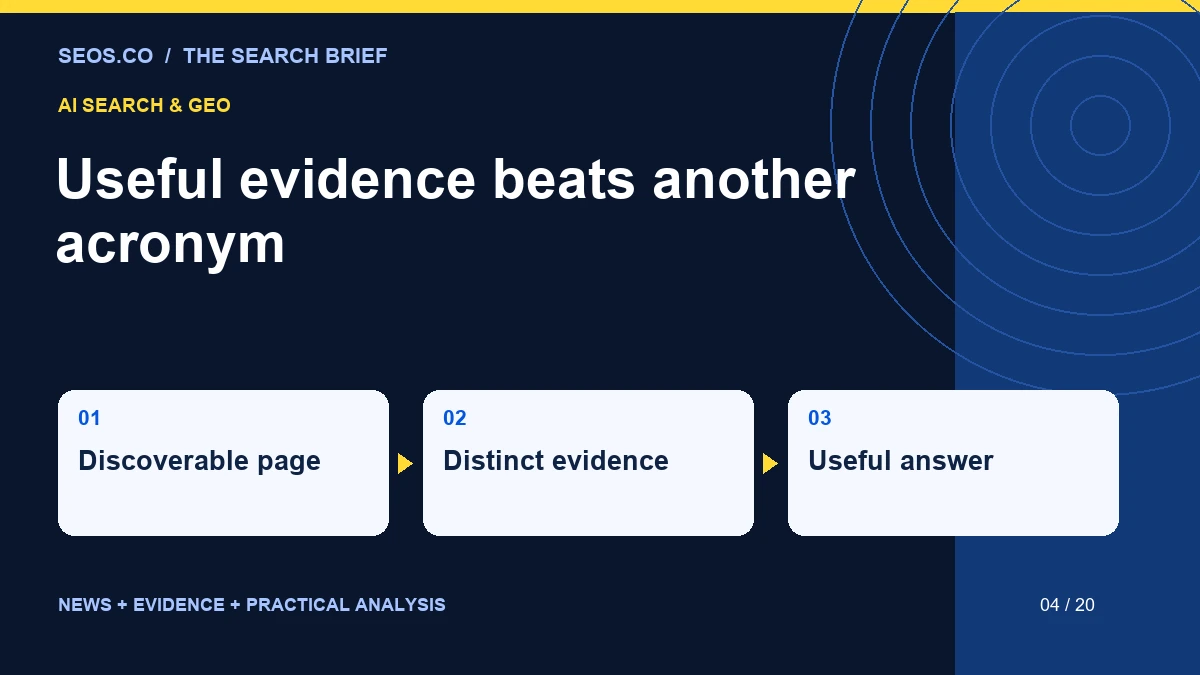
The most useful development in the GEO debate may be a clearer explanation of what website owners should already be trying to accomplish. Google’s generative AI optimization guidance gives businesses a reference point for evaluating advice that often arrives wrapped in new terminology, confident promises and very little evidence.
In its current AI optimization guide, Google connects generative search experiences to its existing search systems and emphasizes distinctive, useful content and sound technical foundations. The guide discusses retrieval and query fan-out, explains that eligibility is not a guarantee of inclusion, and rejects the idea that special AI files or a separate markup formula are necessary. This article examines the planning implications of that position rather than treating a documentation page as a newly disclosed ranking algorithm.
For buyers of SEO, AEO and GEO services, the key question is now more concrete: what will the work add that a visitor could actually use? A technically tidy page may still have little to say. A long article may still repeat the same public facts as every competing result. An elaborate schema graph may describe a weak resource with impressive precision.
The acronym is less important than the deliverable
A business can reasonably use GEO to describe work focused on generative search, just as it can use local SEO or technical SEO to describe a particular emphasis. The problem begins when the label becomes a substitute for specifying the work. “Optimized for AI” should lead to questions about evidence, content, accessibility, discovery and measurement.
An agency proposal should identify the pages it will improve, the audience decisions those pages support and the specific weaknesses it has observed. It should explain whether the project involves research, technical changes, clearer product information, comparison resources or better measurement. These are inspectable deliverables. A proprietary percentage score without an explanation of the underlying work is much harder to evaluate.
The same discipline applies internally. A team should be able to describe a proposed change without relying on the acronym. “We will add a documented compatibility table because customers cannot choose the correct model” is a stronger brief than “We will add an AI-ready information layer.” The first statement tells the writer, designer and analyst what success might look like.
Information gain needs a source
The phrase information gain is increasingly used as if it were an ingredient that can be sprinkled into a draft. In practice, additional value usually comes from having something useful to contribute: an original observation, a carefully constructed comparison, a transparent calculation, a worked example or a well-supported interpretation of evidence.
Those contributions require provenance. If an article contains a statistic, readers should be able to identify where it came from and what it measures. If a comparison ranks providers, the page should explain the selection and ordering rules. If a calculation uses assumptions, the assumptions should be visible. The appearance of analytical depth is not enough.
For many businesses, the best material already exists outside the marketing department. Support teams know which instructions confuse customers. Product teams understand compatibility limits. Sales teams hear recurring objections. Operations teams see the conditions under which a service succeeds or fails. Turning that knowledge into public content requires review and permission where appropriate, but it can produce information that a generic summary cannot.
A hypothetical procurement example
Consider a company buying software that must work with an existing system. Ten competing articles might repeat the same feature list. A more useful resource could explain the integration questions a buyer should ask, identify the data that must move between systems and provide a sample acceptance test. It could distinguish a native integration from a custom implementation without claiming to have tested every vendor.
That resource creates value through decision support. The author does not need to invent an industry study or pretend to have conducted interviews. A clearly labeled sample test can help the buyer discover whether a promised capability meets the actual requirement. The page becomes useful because it reduces a specific uncertainty.
The example also shows why length is an unreliable proxy for quality. A two-thousand-word article that restates the same feature list may be less useful than a shorter, carefully designed evaluation tool. Long-form work earns its length when it develops the reasoning, limitations and examples necessary for a reader to make a better decision.
Technical foundations still deserve precise work
The rejection of magic markup should not become an excuse to ignore technical implementation. A page that cannot be accessed, renders important information inconsistently or points to the wrong canonical destination creates practical discovery problems. Technical work matters because it makes the intended content available and coherent.
The priority is to connect each fix to an observed failure. A broken internal link needs a correct destination. Duplicate versions need a deliberate consolidation decision. A page whose main text appears only after a fragile interaction needs a more dependable presentation. A misleading title needs editorial correction. The more specific the diagnosis, the easier it is to verify that the change worked.
Structured data belongs in that same framework. Use it to describe supported entities and visible information consistently. Do not add invented reviews, credentials or relationships to make the graph appear richer. A schema implementation should be checked against the page and the underlying records, not merely against a validator that can confirm syntax without confirming truth.
The problem with producing a page for every imagined prompt
Generative interfaces encourage expansive thinking about the questions people might ask. That can be useful during research. It becomes less useful when every variation turns into a separate page with essentially the same answer. The resulting collection may be difficult for readers to navigate and expensive for the publisher to maintain.
A better editorial test is whether the proposed page serves a materially different need. Does it require different evidence, a different explanation or a different decision process? If the answer is no, the topic may belong as a section in an existing resource. If the answer is yes, the new page should make its distinct contribution clear from the introduction.
For a directory, this distinction is especially important. A location page should explain something relevant to choosing providers for that market. An industry page should address the industry’s actual purchasing requirements. Replacing a city or sector name in a generic paragraph is not a meaningful research contribution, even if the resulting URL targets a real query.
A more useful page brief
We recommend a page brief built around five questions. Who is making the decision? What do they already know? What remains uncertain? What evidence can the publisher contribute? What should the reader be able to do afterward? These questions keep the work focused without requiring a speculative model of a platform’s internal ranking process.
The brief should also list what the page will not claim. An editorial comparison may not establish independent customer satisfaction. A hypothetical budget model may not represent market pricing. A summary of a study may not establish causation. Identifying these boundaries early makes the final article clearer and reduces the temptation to overstate the evidence during editing.
| Brief component | A useful entry | A weak substitute |
|---|---|---|
| Audience | Operations manager replacing a system | Everyone interested in technology |
| Decision | Which implementation risks must be checked? | Rank for a broad keyword |
| Evidence | Documented requirements and a sample test | Unsupported superlatives |
| Limitation | Example has not been run against every vendor | A small disclaimer after strong claims |
| Next step | Compare proposals using the same criteria | Contact us with no useful context |
What this means for keyword work
Keywords remain useful for understanding language and organizing a page’s focus. They can reveal how people describe a problem, which distinctions matter and where the publisher’s terminology differs from the audience’s. The mistake is to let a repetition target dictate sentences that no editor would otherwise choose.
An exact phrase can appear naturally in the title, introduction and relevant sections when it accurately names the subject. Related terms can explain the surrounding concepts. The editorial question is whether those words help the reader understand the page. If a paragraph becomes repetitive simply to increase a density percentage, the metric has displaced the purpose of the writing.
For a commercial site, it is usually more useful to resolve a missing buying question than to insert another instance of the same phrase. Explain who the service fits, what the engagement includes, what evidence supports the claims and what constraints apply. Those details make the page more informative while giving it a coherent topical focus.
Evidence should survive extraction
A statement can be technically accurate in a long article and still become misleading when separated from its qualification. Writers should therefore keep important scope information close to the claim. If a result applies to a small sample, say so in the same paragraph. If a number is a company’s own report, identify it as such where it appears.
This is useful for human readers who skim as well as for systems that reuse short passages. It does not require turning every paragraph into a rigid answer block. Good prose can remain connected and readable while making the subject, source and limitation clear. The goal is precision, not a page that sounds like a database export.
Tables and charts need the same treatment. Include the denominator, the observation period and the meaning of each category. If a chart counts directory labels, do not title it as a measure of proven delivery capability. Visual clarity should make the underlying evidence easier to understand rather than make weak evidence look stronger.
How to judge an optimization claim
When a provider says a technique improves AI visibility, ask what was measured and how the comparison was made. Was the result based on a fixed prompt panel, a first-party report, referral traffic or a single observed answer? Were the same pages and time windows compared? Were other changes made at the same time?
The answers do not need to resemble an academic paper, but they should be specific enough to inspect. A small experiment can be useful when its limits are clear. A broad claim based on one favorable screenshot is much less useful. The important distinction is between a testable hypothesis and a sales assertion presented as settled fact.
Our methodology page explains the role of editorial comparison on this site. Readers evaluating agencies should bring the same attention to the provider’s own claims. Ask for documented examples, relevant references and a plan that connects proposed changes to identifiable problems.
A realistic implementation order
Start by correcting factual and technical failures on important pages. Then improve the resources that already serve relevant demand but leave important questions unanswered. Build new material where there is a distinct audience need and credible evidence to contribute. Finally, measure what happens using methods that preserve the difference between exposure and business value.
This order is deliberately practical. It avoids spending the first month on decorative signals while basic content remains unreliable. It also gives the organization useful intermediate results: fewer broken journeys, clearer explanations and better decision resources, even before a search platform reassesses the site.
The documentation has not ended debate about how generative search selects sources. It has provided a firmer basis for deciding which advice deserves attention. Businesses should use that basis to demand clearer deliverables, stronger evidence and more honest measurement. The most defensible optimization program is one that makes the website meaningfully better while remaining precise about what the available data can prove.
Ask what would make the recommendation wrong
A useful final question for any optimization proposal is what evidence would change the recommendation. If an agency cannot describe a failure condition, the proposal may be too vague to evaluate. A clear hypothesis identifies a page weakness, a specific repair and an observable consequence, even when the final ranking effect remains uncertain.
For example, adding a comparison table can be justified because buyers currently struggle to distinguish service scope. The immediate checks are whether the table is accurate, readable and actually contains the distinctions buyers need. Later search visibility is another outcome to observe, but it should not be the only way to determine whether the work was competently executed.
This approach also improves maintenance. When a table becomes outdated, the original purpose tells an editor what to refresh. When a feature is unused, the team can reconsider its role. A page built around explicit reader needs is easier to improve than one assembled from a checklist whose items have no stated purpose. That clarity is a practical advantage in a field where the vocabulary and reporting tools continue to change.
Reporting note: Google’s position is summarized from its linked guidance. The procurement example, page brief and implementation order are original SEOS.co analysis, not statements about undisclosed ranking factors or findings from a controlled experiment.