
The Search Brief · News analysis
Publishers Are Turning Archives Into AI Products: The SEO Lesson Goes Beyond More Articles
News publishers are building AI products around archives. Explore the role of provenance, current information and useful reader tasks in an archive strategy.
Development covered: July 22, 2026
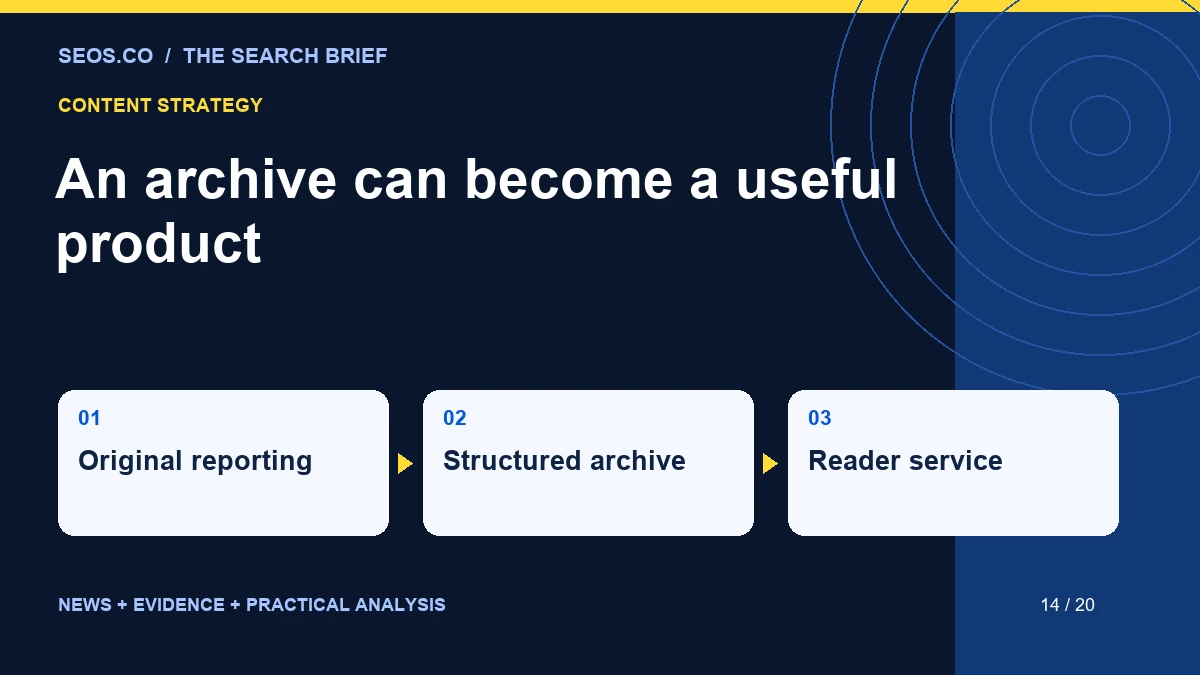
The next phase of AI publishing may be less about producing more articles and more about helping readers use information that already exists. News organizations experimenting with archive-based assistants, search tools and audio products point toward a different content strategy: turn a maintained body of knowledge into a useful service.
In a July 22 account of newsroom projects, OpenAI describes examples including Bon Appétit’s Test Kitchen Assistant, Eater’s use of its restaurant coverage and Chicago Public Media’s work with a long-running WBEZ archive. These are company-reported examples in a vendor publication, not an independent comparative study of product effectiveness. They illustrate possible uses of editorial collections; they do not establish that every archive can produce the same audience or commercial outcome.
For SEO and content teams, the strategic question is compelling. If a website has accumulated useful reporting, reviews or documentation, can it make that material easier to find, compare and apply? The answer depends less on the size of the archive than on its structure, provenance and continued accuracy.
An archive is not automatically a knowledge product
A large collection of pages can contain considerable value, but it can also contain contradictions, outdated descriptions and missing context. A retrieval interface does not eliminate those problems. It can make them more visible by bringing material from different periods into the same answer.
Before building a product, identify what the archive actually contains. Which resources remain current? Which are historical records? Which claims depend on a date, location or particular set of conditions? These distinctions affect how the material should be presented.
For a directory, a current agency profile and an old announcement serve different purposes. A service listed several years ago may no longer be available. A product that retrieves both without distinction can give a reader a misleading impression even if every sentence once appeared on a real page.
The first investment may therefore be editorial organization rather than a conversational interface. Clear dates, consistent fields, source links and relationships between records create the foundation for a useful service.
Begin with a reader task, not an interface trend
A product should help a reader accomplish something specific. Finding a recipe that fits available ingredients is different from browsing the latest food news. Comparing agencies by service scope is different from reading a general article about SEO. The task determines which information needs structure.
Write the intended task in a sentence that can be tested. For a hypothetical directory feature, it might be: help a buyer identify relevant categories and understand the evidence needed to compare providers. That is clearer than “add an AI assistant to the site.”
Then ask whether a conversational interface is the best way to serve the task. A filter, comparison table or guided form may be more predictable for structured choices. Conversation can be useful when the reader needs explanation or help expressing a complex requirement. The choice should follow the task.
A product that adds friction to a simple lookup is not improved merely because it uses AI. The benchmark is the reader’s ability to reach a useful, accurate result.
Provenance is a product feature
Readers should be able to see where an answer comes from. A source link is not just a credibility decoration; it allows inspection of context, date and limitations. For an archive-based service, provenance should be designed into the output from the beginning.
The system should distinguish direct source facts from synthesized advice. If a recommendation combines several records, the reader should understand the basis rather than assuming an editor personally endorsed the exact result. The distinction matters particularly for commercial comparisons.
Keep the source relationship durable. If a page moves, redirects and internal identifiers should preserve the connection where possible. If a source is withdrawn or corrected, downstream uses should be reviewed. A product built on editorial material inherits its correction responsibilities.
This is one reason structured content matters. A record with a clear source, date and status is easier to use responsibly than a paragraph whose provenance must be reconstructed each time it appears in an answer.
Historical content needs explicit treatment
An archive may be valuable precisely because it records the past. The goal is not to erase older material but to prevent it from being mistaken for current guidance. A historical article can remain accessible while being labeled and retrieved according to its role.
For a hypothetical agency archive, a 2022 service announcement could help explain the business’s history. It should not automatically establish its current capabilities. A maintained profile or a current source would be needed for that claim.
Products can offer date filters, freshness labels or a clear distinction between historical and current views. The exact design depends on the task, but the underlying requirement is the same: time is part of the meaning of the information.
Do not rely solely on the most recent page modification date. A formatting change can update that date without refreshing the facts. Editorial review status is a different piece of information and should be recorded separately when it matters.
A small pilot can expose the hard problems
Choose a limited, coherent collection for an initial product test. A narrow set of well-maintained resources is easier to evaluate than an entire archive containing many unrelated formats and periods. The pilot should reveal whether the information supports the intended task.
Create representative questions and expected evidence, including difficult cases. Ask about missing information, conflicting records and outdated facts. A product that performs well only when the answer is obvious has not yet demonstrated reliable usefulness.
Keep a record of failures and classify them. Some may reflect retrieval problems, some poor source structure and others a misleading answer. The repair depends on the cause. Adding more documents is not a universal solution.
| Failure observed | Likely investigation |
|---|---|
| Correct source not found | Retrieval and document organization |
| Old fact presented as current | Date and status handling |
| Unsupported recommendation | Output rules and evidence requirements |
| Conflicting sources combined silently | Conflict detection and editorial policy |
| User cannot verify the answer | Citation and interface design |
The strongest product may improve the archive itself
Building around a real task often reveals weaknesses in the underlying collection. Inconsistent service names, missing dates and ambiguous categories become obstacles. Repairing them can improve ordinary browsing and search even before a new product launches.
For a directory, standardizing the meaning of fields can make comparisons more useful. A “specialty” supplied by an agency should not silently become a verified performance claim. A rating should have an explained basis. A review should reflect a genuine review process.
These distinctions are editorial infrastructure. They help both a human reader and a retrieval system understand what the data can support. Without them, a sophisticated interface can make weak information appear more authoritative than it is.
The product project should therefore include time for source cleanup. Treating the archive as perfectly reliable input can shift the cost into later corrections and damaged trust.
Success needs more than usage volume
A new feature may attract curiosity without helping users. Counted interactions are useful, but they should be paired with task outcomes and quality checks. Did readers find the relevant resource? Did they understand the limitations? Could they verify the answer?
For a commercial directory, a useful outcome may be a better-informed shortlist rather than a larger number of generic inquiries. The product should not be judged only by how many people start a conversation if the answers fail to support a meaningful decision.
Measure failure as well as completion. Track cases where the system appropriately says the archive lacks enough information. That response can be a sign of responsible behavior, not necessarily a product defect. The defect would be inventing certainty to keep the interaction moving.
Keep the evaluation aligned with the stated task. A tool designed for discovery should not be criticized for failing to replace a detailed procurement process, but it should clearly explain where its assistance ends.
Commercial relationships need visible boundaries
Archive-based recommendations can affect business outcomes. If a publication includes paid placements, sponsorships or preferred relationships, the product should not obscure them inside a conversational answer. The reader needs to understand how commercial factors affect presentation.
For a directory, distinguish a sponsored position from an editorial assessment and from a factual match to a user’s criteria. Those can coexist, but they should not be collapsed into an unexplained claim that one provider is objectively best.
The same rule applies to source material. A sponsored article should not lose its disclosure when its contents are summarized elsewhere on the site. Metadata and output design should preserve the relevant context.
This is a product governance issue as much as a writing issue. The team must decide how the information is represented and test that the interface actually preserves the distinction in realistic cases.
Search and product strategy can reinforce each other
A useful archive product does not eliminate the need for strong public pages. Those pages provide stable destinations, detailed explanations and evidence that readers can inspect. The product can help navigate them, while the pages maintain their independent value.
Avoid moving all meaningful information into an interface that provides no durable resource for reference. A reader who wants to share a comparison or verify a claim should have a clear destination. Stable pages also make maintenance and correction more accountable.
The editorial program can use product questions to identify gaps. If users repeatedly ask about a distinction the archive cannot answer, that may justify new reporting or a clearer explanation. The feedback is useful when it leads to evidence gathering rather than automatic production of unsupported answers.
In this model, publishing and product development become connected. New articles strengthen the collection, and product use reveals where the collection needs work.
Cost includes review, support and correction
The initial interface is only part of the investment. A maintained service needs monitoring, source updates, evaluation and a way to handle errors. A small pilot can help estimate that burden before the organization commits to a broader rollout.
Define who can correct a source and how the correction reaches the product. Establish a process for user feedback and prioritize errors according to their consequences. A misleading commercial recommendation deserves more attention than a cosmetic formatting issue.
Do not assume that a larger archive necessarily creates a better product. More material can increase coverage, but it can also increase conflict and maintenance complexity. Add content when it improves the task and can be managed responsibly.
The business case should reflect the ongoing work. A feature that looks inexpensive to launch may be costly to operate well if the underlying records are inconsistent or rapidly changing.
The lesson is to make accumulated knowledge usable
The newsroom examples show a direction worth studying: editorial value can be expressed through services as well as individual articles. The opportunity is strongest when a publisher has a coherent collection, a specific reader task and a serious approach to provenance and maintenance.
For SEO and GEO teams, this broadens the definition of useful content work. The next valuable project may be a better-organized archive, a transparent comparison tool or a task-focused interface—not another batch of near-duplicate articles. The technology should help readers use the knowledge the publication can actually support.
Plan how the reader can challenge an answer
A useful knowledge product should give readers a route to report an error or identify missing context. The process should collect enough information to reproduce the issue without asking for unnecessary personal data. The editorial team then needs a way to connect the report to the source and the generated output.
Classify the correction carefully. Sometimes the source is wrong; sometimes the source is accurate but the synthesis is misleading. Repairing only the visible answer may leave the underlying problem in place. Repairing only the source may be insufficient if the product continues to use an outdated representation.
Keep a record of substantive corrections and use them to improve the evaluation set. A failure that has already occurred is a valuable future test case. This turns user feedback into a stronger product rather than treating every complaint as an isolated support ticket.
The ability to challenge an answer is also part of reader trust. A publication that makes evidence visible and responds to errors offers a more accountable service than one that presents every output as authoritative and provides no route for review.
Source and analysis note: The named newsroom examples are attributed to OpenAI’s company publication. The proposed directory scenarios and product framework are original analysis. No SEOS.co archive assistant or independently verified publisher outcome is claimed here.