
The Search Brief · News analysis
Google Updates Indexing API Quota Guidance: Eligibility Comes Before Submission Volume
Check eligible content before submission volume. Build durable notifications, account for quotas and retries, and separate acceptance from crawling and indexing.
Development covered: October 16, 2026 documentation update; checked November 2, 2026

Google's October 16, 2026 Indexing API documentation update does not turn the service into a general-purpose submission tool for every website page. Check content eligibility first, then build a durable notification queue that respects the actual project quota and distinguishes accepted notifications from crawling or indexing.
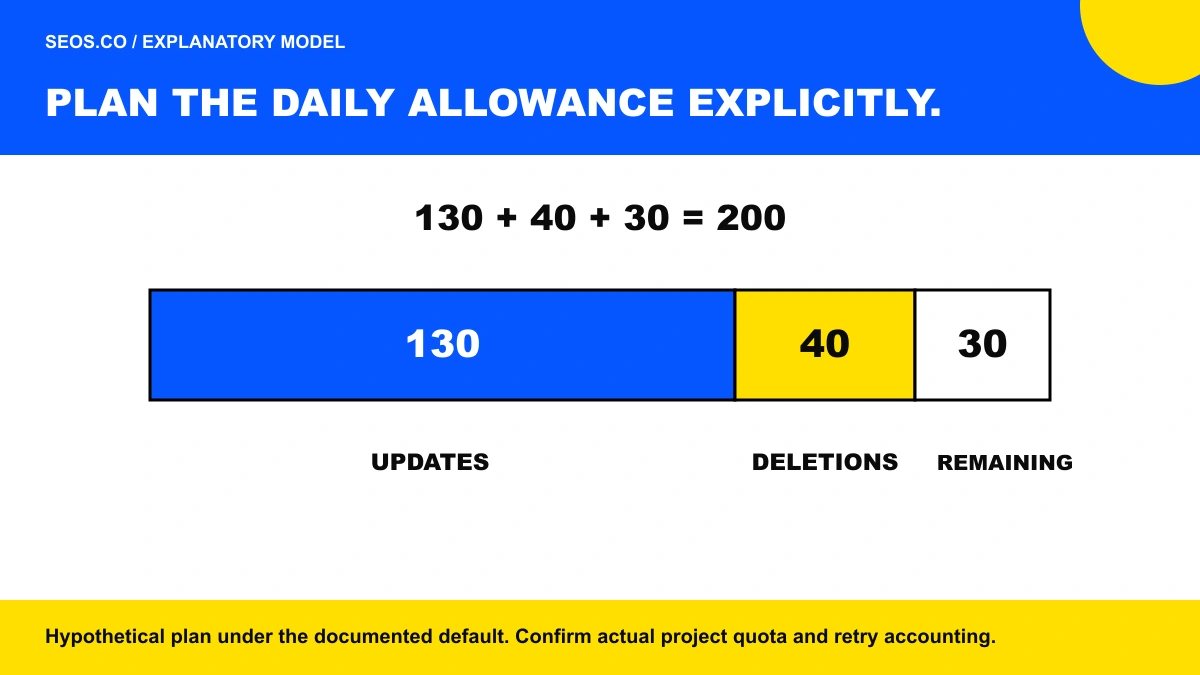
The current quota page lists a default of 200 publish requests per project per day, 180 metadata requests per minute, and 380 total requests per minute. The daily publish allowance includes update and deletion notifications and resets at midnight Pacific Time. These are the documented defaults checked on November 2, 2026, not a claim that every project's configured quota is identical.
The quickstart limits the API to pages with JobPosting or BroadcastEvent embedded in VideoObject. This article develops a proposed implementation model for eligible publishers. The examples are hypothetical, and no notification is submitted by the article.
Read the update without inventing a quota increase
A changed quota document can clarify limits or process without establishing that the allowance increased. Compare the actual documented values and your project's console configuration before describing a change.
The practical news is an opportunity to review assumptions in existing integrations. A runner may have inherited an outdated allowance, counted batches incorrectly, or treated every successful request as a completed indexing outcome.
Record the source review date beside operational configuration. Quota rules and supported workflows can change, so hardcoded values need an owner and refresh condition.
Do not respond to a limitation by creating extra accounts or projects to evade it. Google's quickstart warns against attempts to circumvent usage quotas. Capacity planning should operate within the supported service rather than hide excess volume behind another identity.
Eligibility is the first gate
For general discovery, review how XML sitemaps work rather than treating a specialized API as a universal submission route.
Classify the resource according to its actual content, not the markup a tool can add. A general article does not become an eligible job page because a plugin emits JobPosting.
Keep eligibility evidence with the stable content identifier. For a job, the page must genuinely represent the job posting and meet applicable requirements. For a livestream, the event representation must match the real resource.
Exclude unsupported general content from this queue and use appropriate discovery mechanisms for it. Accurate sitemaps and crawlable links remain relevant; the existence of an API does not remove the need for a coherent site.
Test the classifier with false positives. A career-advice article, an archived company profile, and an ordinary recorded video should not enter solely because their topic resembles an eligible class. Content meaning comes before serialization.
Define notification events from publication state
Generate an update event when an eligible page is newly published or meaningfully changes according to the integration's policy. Generate a deletion event only after the page reaches the supported removed or excluded state.
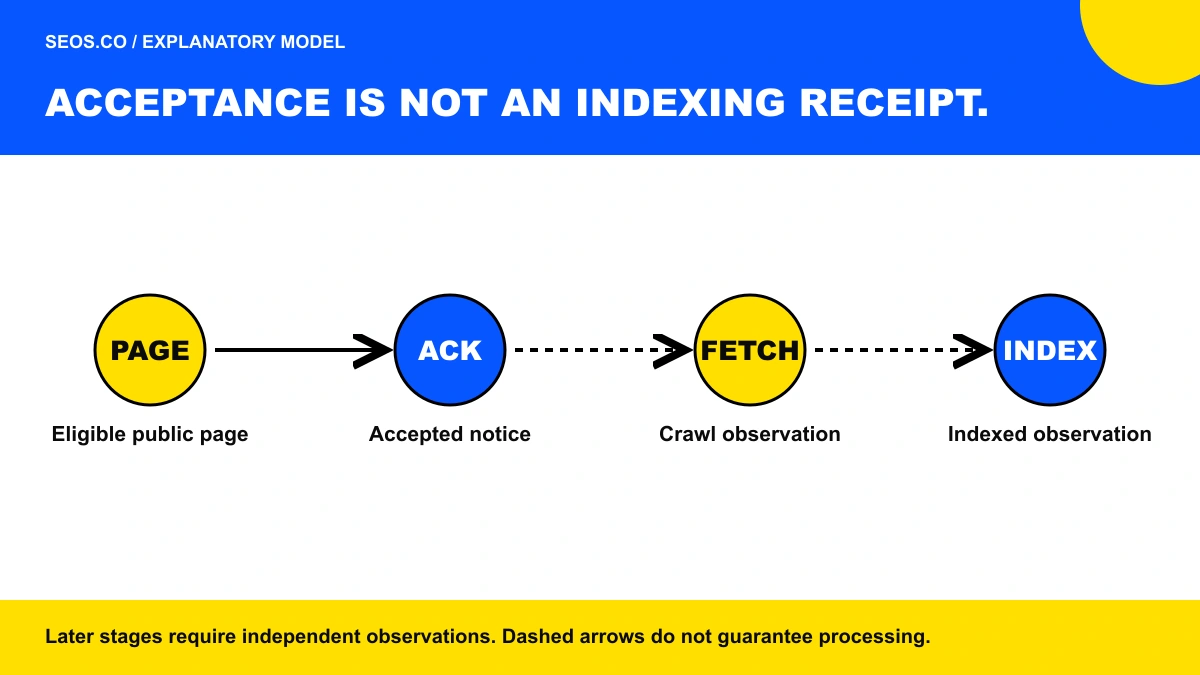
The API usage guide distinguishes update, deletion, and notification-metadata operations. It also explains that a successful response means a notification was received, not that indexing has completed.
Use stable event identifiers containing resource identity, published version, and event type. Retrying the same event should not create a new logical publication change.
Keep planned publication and completed publication separate. A scheduler can intend to publish at noon while a failed job leaves the page unavailable. Notify from the actual public state, not merely from the scheduled timestamp.
Design a durable queue
Store each event with resource identifier, canonical public URL, eligible content type, version, event time, state, attempt count, next retry time, and last response classification.
Useful states include pending, claimed, accepted, retryable failure, permanent failure, superseded, and held for review. These are proposed operational states, not API response values.
Claim work with an expiring lease or equivalent concurrency control. A worker restart should not leave an event permanently marked as running. At the same time, concurrent workers should not repeatedly submit the same claimed item.
Acknowledge acceptance only after the response is safely recorded. If a process crashes between sending and saving, the system needs a defined recovery policy. Preserve uncertainty rather than inventing a success or failure that was never observed.
Separate logical events from attempts
One page update retried five times is one logical update and five submission attempts. Report those counts separately.
This distinction matters for both impact and quota analysis. A retry storm can consume operational capacity without representing additional useful content. A dashboard that counts attempts as published pages can conceal the problem.
Retain the response and correlation information needed to diagnose each attempt, while avoiding sensitive credentials in logs. Store error class and relevant message rather than dumping authorization material.
Deduplicate unchanged source versions before submission. Repeated background saves or import retries should not continually generate fresh update notifications when the public resource did not change.
Plan daily capacity with explicit arithmetic
Suppose a fictional project has the documented default allowance and expects 130 eligible updates plus 40 eligible deletions in a day. That is 170 publish notifications, leaving 30 under the assumed 200-request allowance before retries or unexpected events.
This arithmetic is a planning example, not a recommendation to target the limit. The actual project configuration and accounting should be checked in the API console.
If another 80 eligible updates arrive, the total becomes 250 before retry overhead. A queue must defer work according to policy rather than pretending all notifications can be submitted immediately.
Track backlog age by event class. A deletion and a minor update may have different operational urgency. Establish that policy deliberately, then preserve fairness so one busy source cannot indefinitely starve another.
Batching reduces connection overhead, not logical accountability
The usage guide allows batches containing multiple individual calls within its documented limit. A batch is a transport grouping, so the integration still needs to record each constituent outcome.
Do not mark the entire batch accepted because the outer HTTP exchange succeeded. Parse and classify the individual responses according to the supported format.
Keep event identifiers attached to each member. If one fails, retry that member according to its error class rather than resubmitting every successful item.
Use bounded batches that fit practical payload and latency constraints. The largest allowed batch is not automatically the most reliable choice for every environment. Measure the integration's own behavior without treating batching as a way to bypass quota.
Classify errors before retrying
Authentication, authorization, malformed payload, unsupported content, quota exhaustion, and transient service failures require different actions.
A malformed request should not enter an endless exponential retry loop. A permission failure needs configuration review. A transient failure can justify bounded retry with backoff under the documented behavior.
Google's error reference provides the relevant response classes. Log the actual returned reason and domain where available rather than guessing from a generic failure label.
Define a retry ceiling and escalation path. A queue that retries forever can look active while never making progress. Report held events and their causes so an operator can resolve them.
Keep credentials and property ownership correct
The prerequisites guide covers project setup, service-account authorization, site ownership, and access tokens. Verify the current supported setup for the actual property.
Do not expose private keys in article code, browser scripts, repository history, or diagnostic output. Keep submission credentials in the appropriate server-side secret boundary.
Test ownership against the exact intended site scope. A valid token does not prove that the service identity is authorized for every submitted URL.
Record credential rotation and configuration changes as operational events. If submissions stop after a rotation, the timeline should let the team distinguish authentication failure from missing publication events or quota exhaustion.
Verify the page before notifying
The technical SEO guide connects public delivery with the broader eligibility path.
Fetch the actual public URL and confirm that it delivers the intended eligible resource. Inspect response status, canonical identity, required content, and relevant directives.
A notification cannot repair a page that requires employee authentication, returns an empty shell, or points its canonical elsewhere. Validate the resource before consuming submission capacity.
For deletions, confirm the supported removed or excluded state described in the usage documentation. The event producer and page-delivery system should agree about what happened.
Keep these checks bounded and reliable. If validation fails because the observer could not run, hold the event as unverified rather than declaring the page absent or valid without evidence.
A worked scenario: accepted notifications, stale public pages
Imagine a fictional job board where the notification worker reports success after every scheduled publishing run. New jobs still appear inconsistently in public inspection.
Tracing reveals that the publisher writes database records, queues notifications, and only later regenerates the public page cache. During a busy import, regeneration lags behind notification submission.
The API receives the URL, but a subsequent fetch can encounter the old page or an incomplete representation. The worker's success count describes notification acceptance, not public freshness or indexing.
The proposed repair emits the notification after public publication completes, records the page version validated, and monitors the age of unprocessed publication events. Verification reproduces the import workload and confirms that the notified version is already available.
This is a hypothetical failure mechanism. A real board should inspect its own publication and response chronology before assigning this cause.
Distinguish acceptance, crawl, and indexing
Review how indexing works before turning notification receipt into an indexed-state claim.
Notification metadata reports receipt history. The usage guide explicitly states that it does not tell you when a URL was indexed or removed.
Build separate fields for accepted notification time, authentic crawl observation where available, indexed observation, and search performance. Do not derive the later fields from an API 200 response.
Use URL Inspection for appropriate representative observations, keeping live and indexed views distinct. Sampling limits and reporting delay should remain visible.
If a page is not indexed, investigate eligibility, content, delivery, discovery, and processing rather than repeatedly submitting the same unchanged notification. Repetition can consume quota while leaving the actual problem untouched.
Monitor deadlines and recovery
Measure the time from public change to queued event, claim, accepted notification, and later observations. The total path matters more than a worker heartbeat.
Check whether one busy source, a long lock, or a stale lease can prevent independent events from being submitted. A system can be connected and running while its queue ages indefinitely.
After a restart, reconcile durable events with recorded outcomes. Do not discard pending work merely because its scheduled run was interrupted. Do not count a recovered retry as another unique changed page.
Alert on oldest eligible pending event, failure classes, repeated attempts, quota consumption, and unresolved authorization errors. Each alert should identify the affected events and owner, not merely say that activity decreased.
A practical release contract
Before deploying an integration, test eligible and ineligible content, new publication, meaningful update, supported deletion, duplicate event, quota exhaustion, transient failure, permanent failure, and worker interruption.
Verify that batching preserves individual results and that retries do not overwrite accepted outcomes. Confirm credentials remain outside logs and public code.
Use a known event sequence and compare the expected logical events with the recorded queue. This is stronger than checking that one request succeeds.
Document what the integration proves. It can establish that eligible public changes were validated and notifications were accepted. It cannot guarantee indexing, ranking, or traffic. The October quota guidance is most useful when it reinforces that clear boundary.
Preserve event order when content changes quickly
An eligible resource can be published, updated, and removed before the notification queue catches up. Store those events with versions so a delayed update cannot accidentally represent an obsolete state after retirement.
A proposed queue policy can supersede earlier unsent updates when a newer published version exists. It must still preserve an audit trail showing what changed and why an event was not submitted. Superseded is different from accepted, failed, or silently lost.
For a fictional job, version one publishes at 09:00, version two corrects the location at 09:05, and version three retires the posting at 09:20. If the worker begins at 09:30, it should validate the current public state before deciding which notification is appropriate under the supported workflow.
The exact coalescing policy depends on the integration and requirements. The important invariant is that the submitted event corresponds to a real, validated public state rather than whichever old queue row happens to be claimed first.
Use resource-level ordering without a global lock that blocks unrelated URLs. One problematic job should not stop notifications for every independent job on the board. A durable claim and version check can isolate work while preserving correctness.
After a failed attempt, recheck whether the event is still current before retrying. That avoids spending capacity on an obsolete version while the current state waits behind it.
Use an event ledger an operator can interpret
A concise ledger should let an operator answer what the page became, what the integration attempted, and what was actually confirmed. The following is a hypothetical design, not an API response schema.
| Field | Meaning | Example of a useful distinction |
|---|---|---|
| Resource and version | Which published state is involved | One job's second revision |
| Eligibility decision | Why the workflow applies | Genuine supported page type |
| Public validation time | When delivery was checked | Current version available before submission |
| Logical event state | What the queue knows | Pending, superseded, accepted or held |
| Attempt outcome | What one request returned | Accepted response versus retryable error |
| Later observation | Separate crawl or indexed evidence | Unknown until independently observed |
Do not populate later observations from earlier fields. A ledger that automatically sets indexed=true after accepted=true has encoded the wrong conclusion into its data model.
Keep reasons machine-readable enough for grouping but understandable to operators. “Held: source version changed before retry” describes a recoverable state. “Inactive” without an affected event or cause does not.
Practical answers
Can the Indexing API submit ordinary blog articles?
The current quickstart limits the service to the documented job-posting and livestream-event page types. Do not add misleading markup to make general content appear eligible.
Does an HTTP 200 mean the page is indexed?
No. It establishes successful notification handling under the documented workflow. Crawling and indexing require separate observations.
What should be fixed first in a quiet integration?
Trace publication events through eligibility, public freshness, queue ownership, quota, authorization, submission, and recorded acceptance. A running worker is not proof of progress. Preserve event identity so repeated evaluations and retries do not become invented additional opportunities.