
The Search Brief · News analysis
Query Fan-Out and Content Architecture: Decide Which Questions Deserve Their Own Page
Plan content for query fan-out with task ownership, clear split-and-merge tests, contextual links and a worked inventory-software architecture.
Development covered: Primary-source guidance checked November 2, 2026

Query fan-out changes how an SEO team should think about a complex search question, but it does not justify publishing a separate page for every possible subquery. The useful response is to map the customer’s decision, assign each substantive task a clear content owner and connect the supporting evidence. A coherent page can answer several related questions when they belong to the same decision.
Google explains that AI Overviews and AI Mode may issue multiple related searches across subtopics and data sources while developing an answer. It also notes that the experiences can use different models and techniques. That is documented behavior, not a list of the hidden subqueries used for your particular prompt. The architecture method below is an editorial planning approach to that uncertainty. Google AI features documentation.
An organization should therefore optimize for useful coverage and consistent ownership rather than attempting to reverse-engineer an imaginary fixed query tree. Start from what the buyer needs to understand. Then build pages that can stand alone, supply verifiable facts and lead to the next relevant task without creating a maze of nearly identical articles.
Translate the broad question into a decision graph
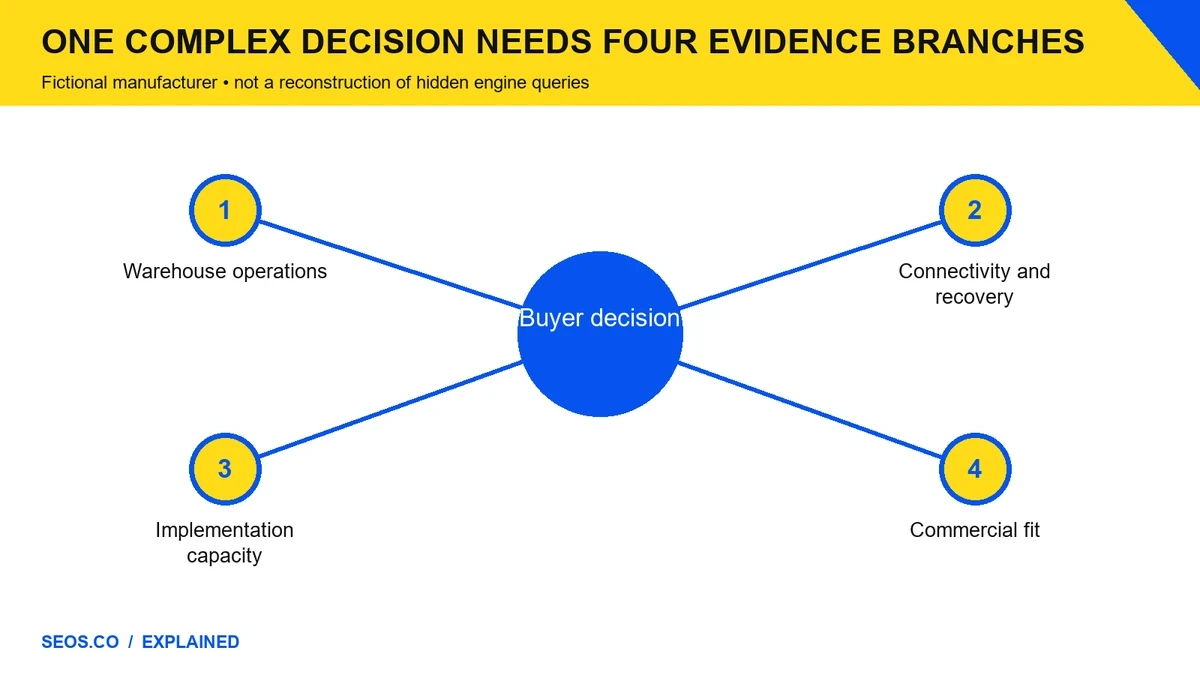
Consider a hypothetical manufacturer asking, “Which inventory platform fits three warehouses, intermittent connectivity and a small implementation team?” This is not just an inventory-software keyword. It combines operating scale, connectivity constraints, implementation capacity and a selection task. A useful answer requires evidence about each constraint and the trade-offs between them.
Use the search-intent improvement guide to frame the audience’s actual task. Draw the decision graph before listing titles. One branch concerns warehouse operations: transfers, stock reconciliation and location permissions. Another concerns connectivity: what works offline, what queues locally and how conflicts are resolved. A third concerns delivery: migration, training, implementation ownership and support. A fourth concerns commercial fit, including contract and service boundaries.
The graph is not a claim that Google will issue those exact searches. It is a representation of the customer’s information needs. Its purpose is to identify missing evidence and prevent a broad article from making unsupported promises. The same graph can improve a sales conversation, an on-site comparison tool or an implementation brief.
For each branch, write the decision it enables. “Offline mode” is a topic label. “Determine whether warehouse staff can continue receiving stock during a network outage” is a decision. The latter tells the writer what facts and examples the page needs, and it gives the reviewer a concrete completeness test.
Assign one primary owner to each substantive task
A primary owner is the page that gives the fullest useful answer for a task. Supporting pages can mention the subject and link to that owner, but they should not reproduce the same full explanation under a slightly different title. Ownership is about content responsibility, not a guarantee that an engine will choose the preferred URL.
In the manufacturer example, the platform’s multiwarehouse product page might own supported operations. A technical guide might own outage behavior and synchronization limits. An implementation guide might own migration responsibilities and preparation. A selection article can synthesize those facts without pretending to be the complete technical specification for every branch.
The topical authority checklist gives the wider coverage context. Store the assignment in a simple map: task, audience, primary owner, supporting evidence, next action and known limitations. Include existing pages before proposing new ones. A useful page that already answers the task should usually be strengthened rather than bypassed by a new article targeting a close keyword variation.
Ownership must reflect actual offer boundaries. If the vendor does not support offline receiving, the architecture should make that clear. Creating a page called “Best offline inventory platform” would not repair the missing capability. Content planning should help customers determine fit, including the cases where the product is unsuitable.
Use explicit split and merge tests
Split a topic when the reader faces a distinct decision requiring substantial evidence, a different workflow or a different audience. Merge topics when the proposed pages would answer the same question with the same facts and next step. Keyword wording alone is a weak reason to split a page.
On catalogs, faceted navigation policy adds a URL-state test before a filter combination becomes a separate discovery destination.
A detailed synchronization guide may deserve its own URL because it needs state transitions, failure examples and operating limits. “Offline inventory software benefits” may belong as a section of that guide if it contributes no separate task. A short page that merely points to the real explanation adds another destination without adding useful understanding.
Compare proposed outlines before commissioning manuscripts. If the decisive sections, examples and sources are substantially identical, examine whether one stronger page would serve the task better. Do not rely on a mechanical similarity threshold alone. Two pages can share terminology while serving different audiences, or use different wording while answering the same question.
Use the next action as a useful diagnostic. An operations manager checking outage behavior may need a technical assessment. A finance buyer comparing contract options may need a commercial discussion. Those can justify separate treatments even when they discuss the same product, because the evidence and decision criteria differ.
Work through a practical architecture
For the hypothetical inventory vendor, begin with a category guide explaining the selection criteria for multiple warehouses. It should clarify transfer workflows, reconciliation, access control, connectivity and implementation capacity. Its role is to help a buyer build a defensible shortlist, not to repeat a generic definition of inventory management.
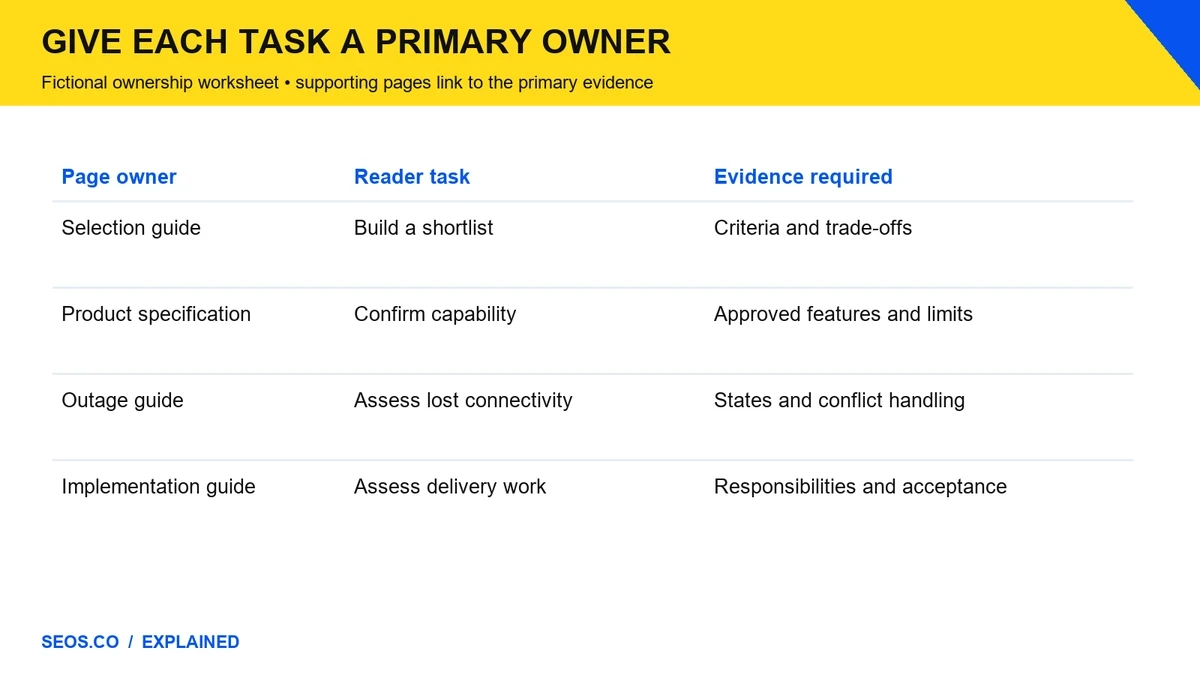
This fictional ownership worksheet makes the split test usable. Each row identifies the primary task and the evidence the owner must supply.
| Owner page | Reader task | Required evidence | Supporting link purpose |
|---|---|---|---|
| Selection guide | Build a shortlist for three warehouses | Current criteria, constraints and trade-offs | Introduce detailed capability and delivery evidence |
| Product specification | Confirm supported warehouse operations | Approved features, limits and package conditions | Verify the selection guide’s capability claims |
| Outage guide | Evaluate receiving during lost connectivity | Supported states, synchronization and conflict behavior | Explain the connectivity constraint in depth |
| Implementation guide | Assess work for a small delivery team | Migration tasks, factual owners and acceptance steps | Clarify preparation and responsibility |
The technical outage guide should explain local operations, queued updates, conflict handling and recovery behavior using a concrete sequence. For example, show two warehouse users changing the same item while disconnected and explain the supported resolution process. If no tested behavior is available, request it from the product owner rather than inventing a reassuring scenario.
The implementation guide should explain who exports source records, validates identifiers, reconciles opening stock and approves cutover. These facts answer a different branch of the selection question. A buyer with a small team needs to understand work allocation, not just feature availability. A useful guide can include a sample responsibility matrix without claiming that the sample describes every customer project.
Finally, a comparison page may be justified when the company can support a fair, current comparison of operating models. It should name the evaluation conditions and avoid inventing competitor limitations. If the necessary evidence is unavailable, a criteria-based worksheet may be more useful than a false head-to-head verdict.
Make each page independently understandable
A retrieved passage can be encountered without the surrounding navigation. Give important sections enough local context to identify the product, task, conditions and limitation. “It works automatically” is weak outside its original paragraph. “The scheduled connector imports approved purchase orders every fifteen minutes in this example” communicates a more useful operational statement.
Local context does not require repeating the whole introduction in every section. Use precise nouns and scope markers where ambiguity matters. A section about offline transfers should identify whether it concerns a real supported feature, a proposed workflow or a hypothetical example. The distinction should survive extraction.
Keep decisive facts in visible text. A diagram can explain a flow, but an image-only limitation table is difficult to quote and inconvenient for many users. Provide a readable text equivalent and ensure that column relationships remain clear when the table is read linearly. The architecture should serve people and machine retrieval together.
Historical long-context research found that the position of relevant information affected performance in its evaluated tasks. That does not establish a current commercial search layout rule, but it reinforces the value of testing whether essential facts survive the way your material is retrieved. Avoid converting a historical research finding into a universal instruction to place every keyword at the top. Lost in the Middle paper.
Link according to the decision sequence
Apply the internal linking checklist when implementing these paths. A link should explain why the next page is useful. From a selection criterion about connectivity, link to the outage guide with an anchor such as “how synchronization behaves during an outage.” From implementation capacity, link to the responsibility guide. These paths help readers resolve the constraint currently under discussion.
Avoid placing the same list of sibling links beneath every paragraph. Repeated navigation can obscure the answer and make the content feel like a directory. Use a small number of contextual links where they move the reader forward, plus a clear route back to the relevant hub.
Maintain inbound ownership as well. If an existing article discusses a task now served by a stronger guide, update the relevant passage and link rather than adding another unrelated “related articles” block. Record planned donor links separately from live changes when the assignment is draft-only. A link graph on paper is not proof of deployed discovery.
Check destination readiness before enabling links. A proposed sibling URL should not become a public link to an empty page. Stage the cluster coherently or activate links when the target exists. If a route changes, update its affected edges rather than running blind keyword replacement across every article.
Validate coverage with tasks rather than a keyword checklist
Ask a reviewer to complete the original manufacturer task using the proposed pages. Can they determine warehouse support, outage behavior and implementation burden? Can they identify unresolved questions? If they need to infer a material capability from promotional language, the architecture has not yet supplied adequate evidence.
Use a coverage matrix with task rows and evidence columns. Mark direct answer, supporting example, factual source, limitation and next action. A cell marked “mentioned” is not equivalent to “answered.” This simple distinction prevents a heading or keyword occurrence from being treated as substantive coverage.
Then test extraction on representative pages. Read the delivered HTML, the rendered page and a text-only version where appropriate. Confirm that headings identify the task, tables retain their labels and key qualifications remain attached to the claims they limit. A source document can be excellent while its published template strips out crucial context.
Finally, observe a defined panel of relevant search and assistant questions after release. Save the conditions and the cited URLs. If the preferred owner is not selected, inspect whether the observed answer found a more useful source or whether the page has an eligibility problem. Do not assume every different cited URL proves cannibalization.
Avoid architecture that outruns the evidence
The temptation is to scale from one broad prompt to dozens of articles. That can multiply weak assets before the team has resolved the underlying facts. A more efficient sequence is to complete the decisive evidence pages, validate their usefulness and add new destinations only when a distinct task remains unserved.
Treat a missing product fact as a product-information dependency. A writer cannot responsibly fill an unknown synchronization limit with a plausible number. Record the owner and the question, then continue work on sections that do not depend on the missing fact. This protects progress without turning assumptions into customer-facing promises.
Do not manufacture a special schema or machine-readable file as the central architecture solution. Google’s AI-feature documentation says there are no additional technical requirements or special schema needed for those experiences. The documented foundation remains useful, accessible content and ordinary search eligibility. That statement does not describe every other provider’s systems. Google inclusion requirements.
Maintain the map as the offer changes
Review the ownership map when capabilities, markets or delivery models change. A new offline capability may justify a detailed guide; a retired integration may require correcting multiple supporting pages. The map should reveal those dependencies so a change does not leave old promises circulating across the site.
Preserve useful historical material where it has a legitimate audience, but label version and time scope clearly. An old implementation guide can remain valuable for existing customers while being inappropriate for a new purchase decision. Its place in the architecture should communicate that boundary through links and visible context.
Query fan-out is best treated as a reason to understand the whole customer task. A strong architecture gives each meaningful decision a reliable owner, connects the necessary evidence and keeps unsupported claims out of the path. Its success is a buyer who can reach a well-informed conclusion, with subsequent search visibility measured as an outcome rather than assumed from the map.
Share facts without duplicating responsibility
An operations manager and a finance buyer may need the same capability fact for different decisions. The supported warehouse count can remain owned by one product specification while each guide explains its consequences for its audience. Record the shared field and its owner in the architecture map. When the limit changes, update the source and inspect dependent explanations. This distinction separates reusable facts from audience-specific reasoning and helps editors add new value instead of paraphrasing a specification into another competing article.