
The Search Brief · News analysis
Faceted Navigation SEO: Build a Selective Indexation Policy
A selective indexation model for ecommerce filters, with a policy matrix, combination arithmetic and a crawlable product-discovery graph.
Development covered: Primary-source guidance checked November 2, 2026
Faceted navigation SEO requires two coordinated policies: which filtered collections deserve search destinations, and which URL combinations the site should allow crawlers to explore. A useful filter for visitors does not automatically deserve an indexable landing page. Conversely, blocking every filter can hide collections that answer a distinct buying task.
The strongest implementation starts from an explicit inventory of searchable collection states. It then controls how those states are generated, linked, rendered, and retired. This article develops a practical policy with a fictional industrial-supplies catalog. The examples and calculations illustrate design decisions; they are not measured outcomes from a real store.
Why filter combinations become an architecture problem
A collection interface can combine product type, material, size, certification, brand, availability, price, sort order, and pagination. Each state may be useful during a shopping session. If every possible state becomes a crawlable URL, however, the interface also becomes a URL generator.
Google's faceted navigation guidance describes overcrawling and slower discovery as consequences of large filter spaces. It recommends preventing crawling when filtered URLs do not need search visibility, or following specific URL and response practices when they do. Those are choices about crawl behavior; they do not establish commercial demand for any particular collection.
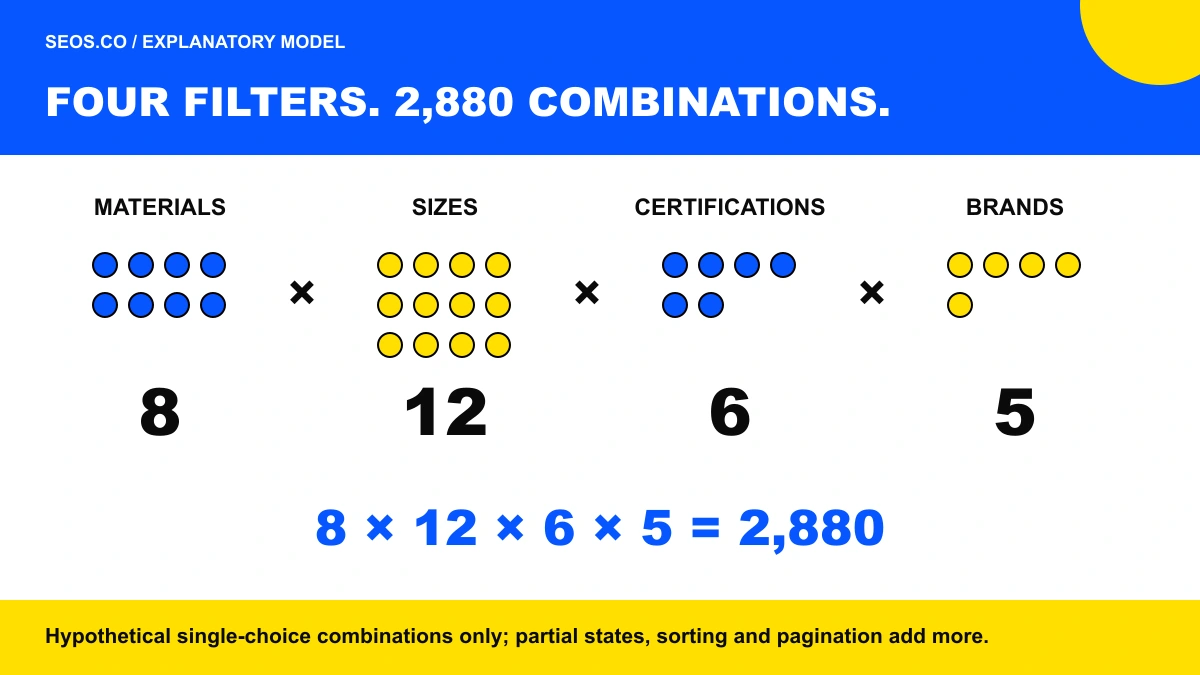
Consider a deliberately simplified catalog with eight material choices, twelve sizes, six certifications, and five brands. Allowing one choice from every dimension creates 2,880 fully specified combinations before accounting for partially specified states, sorting, pagination, or multiple selections. Many combinations may be empty or describe effectively the same inventory.
That arithmetic is a design warning, not a forecast of how many URLs a search engine will crawl. Actual discovery depends on links, generated states, external references, and crawler decisions. Still, it demonstrates why a filter feature needs an architecture owner before release.
Separate collection identity from interface state
Start by classifying each parameter according to what it changes. A material filter may change the actual set of matching products. A sort parameter changes their order. A tracking parameter records acquisition. A page parameter changes which segment is displayed. A display toggle changes presentation.
For faceted navigation, these distinctions matter because treating every parameter as content identity manufactures duplicates. Treating none of them as identity erases useful collections. Write a routing contract that identifies which states create a public collection and which remain session or interface state.
For example, a fictional safety supplier might designate /gloves/cut-resistant/ as an owned collection because it supports a clear selection task. A temporary sort state at ?sort=price-ascending need not become another independent collection. A material-and-certification combination may require review before receiving a durable route.
Store identity as a stable collection identifier, not an uncontrolled concatenation of request parameters. That identifier can own the heading, explanatory copy, inventory query, canonical route, and internal links. The interface can still support exploratory combinations without promoting all of them into the site's search architecture.
Build a selective indexation matrix
Use the site's architecture best practices to keep each approved collection's role coherent with its parent and siblings.
Evaluate candidates against four practical questions. Does the collection represent a distinct reader task? Can the business maintain an adequate relevant selection? Does the page explain the selection in a way the parent category does not? Can visitors reach it through a coherent navigation path?
These are editorial and merchandising decisions. Search data, sales questions, internal search logs, and competitor results can inform them, but no single keyword-volume threshold should automatically approve a collection. A specialized certification may be commercially important despite limited recorded demand, while a broad combination may duplicate an existing category.
Use a matrix containing the proposed collection, intended task, distinguishing attributes, inventory dependency, existing competing destination, source evidence, route owner, and review condition. Record approval or rejection with a reason. “No distinct task from parent” is more useful than “low SEO score.”
For an approved collection, specify what would invalidate its status. Permanent removal of the required product line is different from a temporary stock shortage. A page that explains a valuable specification may remain useful during an outage if it accurately communicates availability and alternatives. Avoid automatic deletion based solely on today's item count.
Make the canonical policy fit the content
The canonical-tag best-practices guide provides the broader representative-URL framework behind these collection decisions.
In faceted navigation, an approved landing page ordinarily needs a coherent public identity. Its preferred URL, internal links, heading, and sitemap inventory should agree. Sorting and tracking variations may express the same preferred representative when their main content remains substantially equivalent.
Do not point every filtered state to the parent by reflex. A narrow collection containing materially different products and selection guidance may not be equivalent to the broad parent. Canonical declarations communicate representative preferences for duplicate or similar content; they are not a mechanism for assigning a business value score to arbitrary pages. Google's canonical guidance.
Likewise, do not use a canonical tag as a promise that crawling will stop. A crawler must discover and evaluate signals, and repeated discovery can continue consuming resources. If the objective is to bound an unwanted crawl space, address link generation and crawl access deliberately.
Document the relationship for each URL class. Approved collection: independent destination. Equivalent sort variation: consolidate. Unsupported filter combination: meaningful invalid-state response. Exploratory combination without a search purpose: controlled according to the chosen crawl and indexing policy. This classification prevents several unrelated mechanisms from becoming one vague “SEO exclusion” setting.
Distinguish crawling controls from indexing controls
Robots.txt manages crawler access. Noindex instructs supporting search engines not to index a resource after they can fetch and read the rule. Blocking a URL before the crawler reads its noindex can defeat the intended removal workflow. Google's robots.txt introduction and noindex documentation explain that distinction.
For faceted navigation, a new, never-promoted exploratory filter space and an already indexed unwanted space may need different transitions. For the first, the priority may be preventing uncontrolled discovery. For the second, the team must consider how an exclusion rule will be observed before applying a broader crawl restriction.
Use a faceted navigation migration ledger for existing indexed variants. Record the current state, desired state, chosen mechanism, dependency, and observed result. Do not infer removal from the fact that a robots rule exists. Check the relevant indexed observations and preserve the chronology of changes.
Keep private information outside this discussion. Search directives are not access control. If a filter reveals customer-specific pricing or restricted inventory, authorization must protect the underlying data. A noindex tag cannot make an exposed private resource secure.
Normalize URLs before combinations spread
A faceted navigation implementation needs a stable ordering for filter dimensions and a consistent encoding. Reject repeated or nonsensical values rather than generating endless equivalent permutations. Keep tracking and display parameters out of collection identity.
For a fictional fastener catalog, material=steel&size=m8 and size=m8&material=steel can represent the same selection. If the application emits both freely, every additional dimension expands the number of equivalent arrangements. A deterministic serializer can produce one normalized route from an allowed state.
Normalization must preserve meaning. Do not lowercase values indiscriminately if the application treats identifiers as case-sensitive. Do not strip unknown parameters until their functional role is understood. Payment, cart, locale, and attribution behavior can break when an overly broad “clean URL” rule runs across the whole site.
Google's URL structure guidance recommends conventional parameter formatting and warns about unnecessarily large URL spaces. Use that as an interoperability baseline, then test the site's actual routing and encoding contract rather than assuming that visually tidy URLs are sufficient.
Preserve product discovery independently of filters
Review how internal linking works when turning the approved collection registry into actual paths to products.
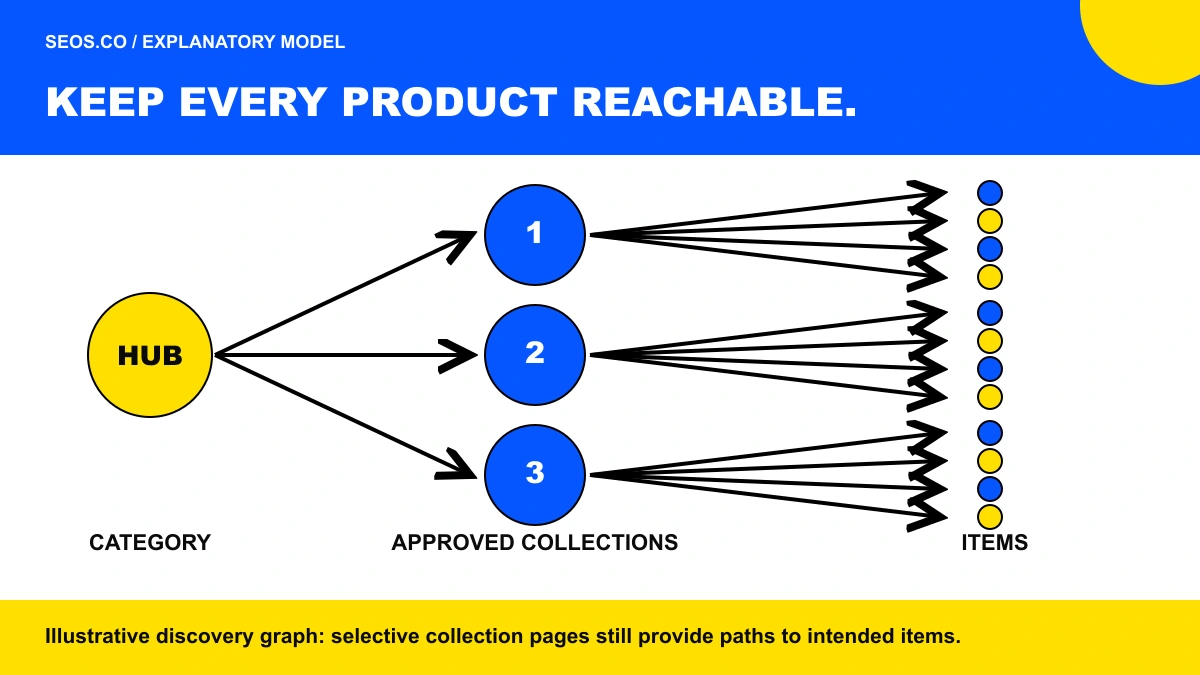
Every intended product destination needs a reliable crawlable path. A filter interface should not be the only route to inventory. A category can expose products through ordinary links and paginated collection pages even when most exploratory states are controlled.
Model the site as a graph. Collection pages are nodes, product pages are nodes, and links are edges. Ask whether every eligible product is reachable from the public category structure without entering a search term, selecting several controls, or relying on browser memory.
Then compare the graph against the inventory database. Products that exist in the database but never appear in accessible category segments are discovery gaps. Repeated links to the same popular products do not compensate for missing edges to the rest of the catalog.
Pagination deserves its own test. Google documents the need for crawlable URLs and links when content loads incrementally. Pagination and incremental loading guidance. A successful “load more” interaction in a manual browser session is not proof that a crawler can discover every item.
Test empty, invalid, and changing states
Test faceted navigation with explicit fixtures for an empty combination, an impossible combination, a duplicate filter, an unsupported value, and a pagination request beyond the available range. These states should not all silently display the parent category with a success response.
The faceted navigation documentation advises a proper not-found response for combinations with no results, duplicate or nonsensical filters, and nonexistent pagination. Implement the applicable behavior at the requested URL rather than redirecting everything to one generic error page. Consider application constraints carefully and verify the actual delivered status.
Temporary inventory changes require a separate product decision. A durable approved collection can have explanatory value beyond a transient empty result, but the page must accurately describe its state and avoid suggesting that unavailable items can be purchased. Document whether the URL represents a lasting collection resource or an arbitrary query result.
Test transitions as well as snapshots. Remove the final matching product, restore it, change its eligibility, and rebuild the collection. Check cache invalidation, counts, pagination, sitemap inclusion, and visible messaging. A policy that works only on creation will drift as the catalog changes.
Worked example: reducing the space without removing the interface
Suppose the fictional supplier has 600 products and 90 proposed filtered collections. Merchandising approves 18 because each represents a distinct selection task with maintained inventory and useful guidance. Forty duplicate existing categories, twenty are temporary campaigns, and twelve have no defensible independent purpose.
The policy creates durable routes for the 18 approved collections. Existing parent categories remain the primary inventory backbone. Sort order remains interface state. Campaigns use their intended lifecycle and attribution rules rather than being automatically promoted into permanent taxonomy.
The team then audits links and finds that a shared filter widget exposes every possible certification and size combination, including impossible ones. The repair constrains generated links to valid states and approved landing destinations, while preserving interactive filtering for users.
Success has several separate measurements. The number of generated crawlable states is bounded. Products remain discoverable. Approved collections deliver the intended content. Fresh logs show how crawler requests change. Search visibility and conversion performance require later observation. None of those outcomes should be substituted for another, and the fictional numbers do not imply a universal target.
Instrument the policy at production boundaries
The crawl-efficiency improvement guide adds context for interpreting request patterns after the filter policy changes.
Instrument faceted navigation by logging collection creation, approval, publication, inventory changes, and retirement. Include stable IDs so an analyst can join publishing events to URL observations. Track rejected states separately from server failures; a deliberate invalid-state response is not the same incident as an origin timeout.
Monitor unique requested URL states by class, not just total requests. One crawler repeatedly requesting a broken URL and thousands of distinct filter permutations are different mechanisms. Retain raw samples so aggregation does not erase parameter patterns.
Compare producer cadence with freshness expectations. If inventory changes every minute but collection pages rebuild daily, counts and availability can disagree for hours. The solution may involve event-driven invalidation or clearer freshness boundaries, not another canonical rule.
Give alerts an owner and a decision. “Unknown filter keys increased sharply” should lead to a reproducible sample and the responsible generator. “More excluded pages” without classes, timestamps, or intended policy creates noise. Use baselines appropriate to the catalog's normal campaign and inventory cycles.
Release criteria for faceted navigation SEO
Before a faceted navigation launch, verify the approved route inventory, normalization behavior, canonical relationships, crawler controls, invalid responses, product reachability, and interface usability. Include direct visits with clean storage and both cached and uncached delivery paths.
Review a sample of every policy class visually on mobile and desktop. Confirm that selected filters remain apparent, clearing them works, back navigation behaves sensibly, and the explanatory content matches the products. A technically controlled crawl space can still be a poor shopping experience.
Maintain one source of truth for policy. If the sitemap generator, filter widget, canonical component, and merchandising tool maintain separate approval lists, drift is predictable. Have those consumers read the same versioned collection registry.
Release reports should state which checks cover the whole inventory and which are sampled. Retain unresolved exceptions with affected routes and owners. Search engines may take time to revisit changed states, so distinguish verified implementation from later observed crawling and indexing behavior.
An implementable policy matrix
The faceted navigation policy should use a registry field for the approved collection identity and a separate field for interface state. The following is a proposed policy model, not a report of a deployed store.
| URL class | Reader purpose | Representative and indexing decision | Crawl and discovery treatment |
|---|---|---|---|
| Approved collection | A distinct maintained selection task | Eligible independent destination with its own preferred URL | Link from appropriate categories; include the approved route in the intended sitemap inventory |
| Equivalent sort variation | Reorder the same collection | Express the approved collection as representative when content is substantially equivalent | Avoid promoting every order as another landing page; verify the actual crawl policy |
| Exploratory combination | Help a visitor narrow a session | No automatic approval as a public search destination | Choose access and indexing controls deliberately; allow observation of removal instructions for already indexed states |
| Invalid or impossible state | No valid collection exists | Proper not-found outcome according to the documented state rules | Stop generating links to impossible combinations; do not redirect all failures to the homepage |
Keep the policy version with the generated output. A test can then compare the registry class, delivered response, declared representative, sitemap membership, and extracted links for the same URL. If those disagree, identify the consumer using an old or incorrect policy version.
Practical questions
Should every filter be blocked?
No. Some filters define useful independent collections, while others are temporary or duplicate interface states. Decide which tasks deserve destinations, then implement crawl and index behavior by URL class. A blanket rule may eliminate a useful landing-page opportunity or create a removal workflow that cannot be observed.
Is a minimum number of products enough to approve a landing page?
No. Item count is one operational input. The collection also needs a distinct purpose, relevant selection, accurate information, and a maintainable relationship to existing categories. Ten interchangeable pages with different adjectives can still duplicate the same task, while a narrow technical specification can justify careful explanation.
What should be measured after deployment?
Measure unique crawlable states, unexpected parameter classes, product reachability, delivery errors, and approved-page consistency first. Then observe authentic crawler behavior and indexed outcomes. Evaluate qualified visits and purchases separately. Faceted navigation SEO is successful when the architecture serves buyers coherently and the observed search behavior supports the intended policy.