
The Search Brief · News analysis
Google Updates Generative Content Guidance: Build Review Into Production
Build evidence, factual review and distinct page value into content production. Check claims across body, metadata, structured data and explanatory visuals.
Development covered: October 1, 2026 guidance update; checked November 2, 2026

Google's October 1, 2026 generative-content guidance reinforces a practical production requirement: verify the value and accuracy of the whole published asset, including metadata, structured data, and image descriptions. The useful response is a claim-review system and a distinct contribution for each page, rather than a promise that a particular writing tool is automatically safe or unsafe.
The updated generative AI content guide points readers to relevant quality-rater guidance and calls for fact-checking generated material. It distinguishes those evaluation guidelines from instructions for ranking first. Google's scaled-content policy concerns large amounts of low-value content created to manipulate search, regardless of production method.
This article proposes an editorial control system. The worked examples are hypothetical, and the suggested review methods are not a certification of future search performance.
Give every page a distinct job before drafting
The content-brief best-practices guide helps record task ownership and evidence needs before writing.
Write the reader's task in one sentence. “Understand how to diagnose a canonical mismatch” is more useful than “target canonical keywords.” The task defines what the page must explain and what a successful reader can do afterward.
Map that task against existing pages. If another destination already answers it well, the useful action may be updating that page rather than creating a near duplicate.
Record the planned contribution: a reproducible method, supported comparison, worked calculation, original dataset, clear decision model, or well-grounded explanation. A new title and different wording do not establish new value.
Google's people-first content questions provide a relevant self-assessment baseline. Use them to challenge the page's purpose, not to manufacture a checklist score that supposedly predicts ranking.
Separate research from fluent composition
A model can produce a confident explanation without a current supporting source. Keep the evidence packet separate from the manuscript so prose quality does not become a substitute for factual support.
For each source, retain URL, title, publication or update date, access date, relevant bounded notes, scope, and limitations. A provider document can establish what the provider says; it does not automatically prove a business effect.
Distinguish an announced feature from an observed account rollout. A public launch notice does not establish that every property, geography, or account has the same interface today.
Do not use a source list as decorative authority. Each consequential statement should have a clear supporting relationship. A link to a broad homepage rarely supports an exact date, limit, or claimed result.
Build a claim ledger
A useful claim record contains the statement, claim type, supporting source or original evidence, qualification, reviewer, and current status.
The AI citation audit provides a worked method for separating supported, partially supported and unsupported claims before assigning a correction.
Claim types can include documented provider behavior, measured experiment, descriptive observation, hypothetical example, and editorial inference. Those categories need different wording and evidence.
For example, “the documentation lists a default daily allowance of 200” is a bounded documentation claim. “Increasing submissions improves rankings” is a causal claim requiring very different support. Combining them in one paragraph can make the second appear sourced when it is not.
Review compound sentences carefully. One citation may support the first clause while the second introduces an unsupported implication. Split the claims when their evidence differs.
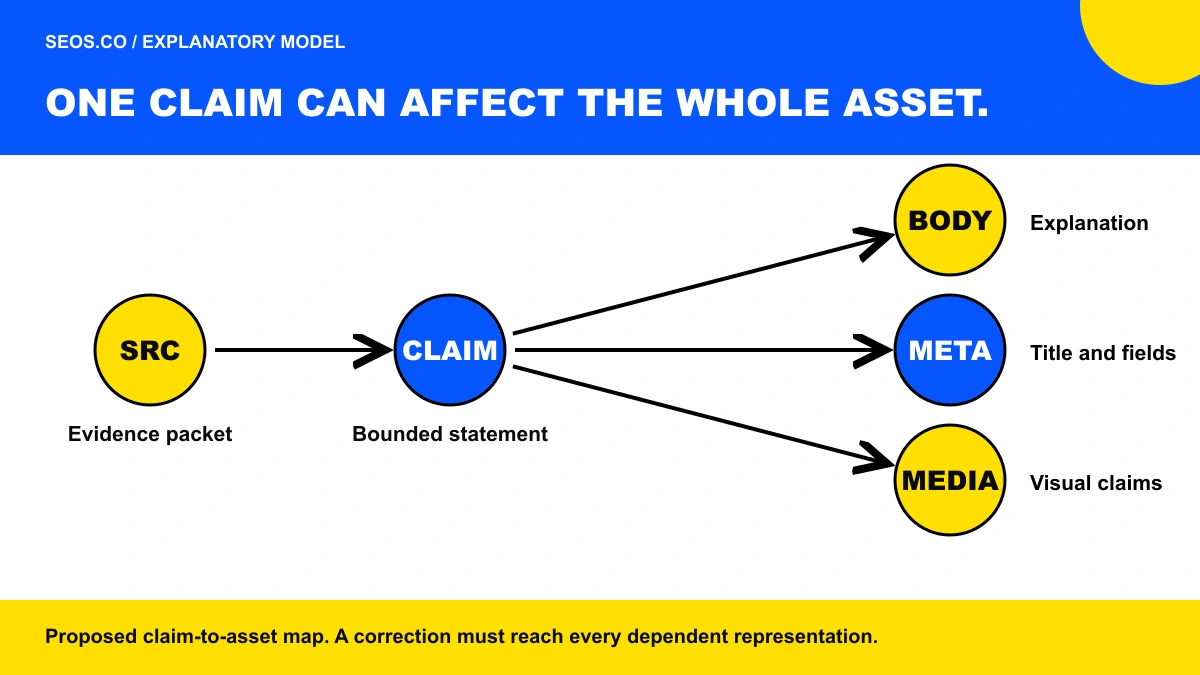
Check entailment rather than source reputation alone
Ask whether the source actually says what the manuscript claims. A respected source can still be cited incorrectly.
The RAGTruth analysis shows how a few unsupported words can change an otherwise plausible passage, with a worked span-level warranty audit.
Check population, geography, date, units, denominator, and comparison period for numerical claims. A study of one market cannot silently become a statement about all search users.
Keep confidence and causality separate. A large descriptive dataset can show a relationship without establishing that one factor caused another. A small controlled experiment can answer a narrower causal question while generalizing poorly.
Preserve the source's important limitations in the article. Removing them to make the headline stronger changes the claim. A reader should be able to understand the practical boundary without opening every reference.
Use worked examples honestly
A hypothetical example can teach a method when actual first-party evidence is unavailable. Label it clearly and choose inputs that make the reasoning inspectable.
Do not turn scenario inputs into market benchmarks. If a fictional catalog has 245 products, that number exists to demonstrate pagination arithmetic, not to imply a typical catalog size.
Show the calculation and units. If revenue equals orders multiplied by average order value, state both inputs and the comparison. Do not imply that a change was caused by SEO merely because the calculation concerns organic traffic.
Keep invented examples separate from claimed experience. “Imagine a publisher” is honest. “We tested this across clients” requires actual verified evidence and cannot be added because the paragraph sounds more persuasive.
Review the corpus, not only individual pages
Use the content SEO checklist to evaluate the page's role within the larger inventory.
Two useful articles can still compete for the same task if the overall map lacks ownership. Compare intent and actual answer structure across siblings.
Use deterministic checks to flag identical paragraphs and highly overlapping passages, then inspect the flagged pairs semantically. A similarity score is a triage aid, not a complete cannibalization diagnosis.
Shared definitions and sources can be legitimate. Reusing the same sequence of generic advice, examples, and conclusions across dozens of pages can indicate that the supposedly distinct tasks were never resolved.
Ask what a reader gains by opening both pages. If the answer is essentially the same explanation with another keyword, consolidate or redesign the contribution before release.
Treat metadata as factual content
The structured-data checklist provides companion implementation checks for machine-readable claims.
Titles and descriptions make claims too. A careful body can be undermined by a headline that invents a ranking guarantee, exaggerates a study, or calls an old clarification a new feature.
Check date language such as “new,” “now,” and “latest.” It must correspond to the actual development and publication context, not merely the day the article was generated.
Structured data should describe authentic visible facts. Author, review, rating, offer, and publication fields need provenance. A valid JSON block can still contain false information.
Image descriptions need the same discipline. Alt text should match what the image actually shows. Do not describe a generated illustration as a real customer result, actual experiment, or verified screenshot.
Make visuals carry information
Choose a visual role before production. A process diagram can explain dependencies, a chart can expose a numerical relationship, and an identification image can help a reader recognize an object.
Avoid producing several decorative pictures solely to satisfy an image count. Each supporting asset should answer a specific question more clearly than the surrounding prose alone.
Bind facts and labels to the source or scenario used in the article. A chart's numbers, units, categories, and baseline must agree with the text. A conceptual timeline should not imply measured duration.
Keep explanatory meaning in accessible text as well. Images can supplement retrieval and understanding, but essential qualifications should not exist only in tiny embedded labels.
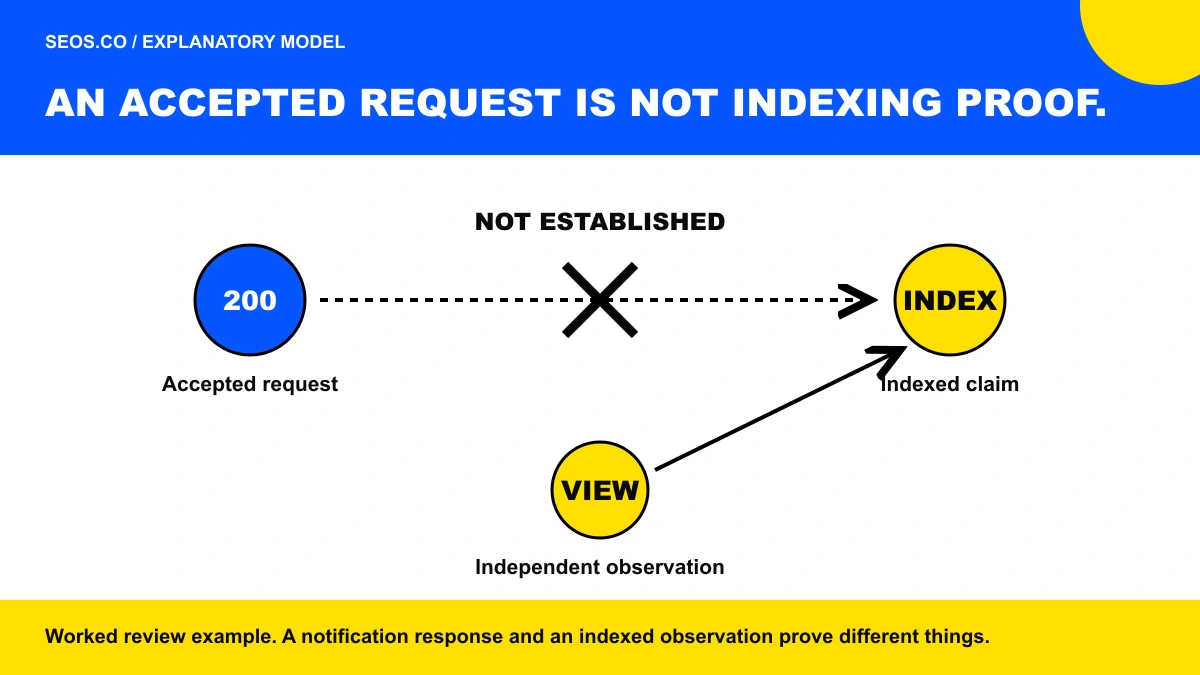
A worked review: the accepted-request claim
Consider a hypothetical draft saying, “The API returned 200, so Google indexed the page successfully.” The source actually says that a successful notification may lead to a later recrawl and does not confirm indexing.
The factual repair is not merely changing one verb. The article needs a model that separates notification acceptance, crawl observation, indexed state, and search performance.
The metadata must change too if the title promises instant indexing. Any diagram showing a single arrow from accepted request to guaranteed search visibility also needs revision.
A claim ledger links those affected fields to the same unsupported inference. The reviewer can then repair the actual claim family without rewriting unrelated sections. This example demonstrates evidence propagation, not a reported incident.
Establish review ownership and independence
Assign responsibility for factual review, technical correctness, editorial usefulness, and final implementation. One person or team may cover several roles, but the record should state what was actually reviewed.
A writer's self-check is useful but not independent evidence. For substantial production, have another qualified reviewer examine consequential claims and the page's distinct value.
Match expertise to risk. A technical routing guide requires someone who can assess the implementation examples. Medical, legal, or financial recommendations require an appropriately higher factual and professional standard.
Do not invent a reviewer or credential to fill a template. If qualified review has not occurred, retain that dependency privately and do not publish a claim implying it has.
Use mechanical gates for mechanical problems
Automate word counts, required fields, broken markup, unresolved placeholders, duplicate hashes, link syntax, image dimensions, and obvious numerical inconsistencies.
Keep extraction rules stable. Count substantive body content rather than navigation, metadata, source lists, alt text, or repeated boilerplate. A word floor is an editorial requirement, not proof of usefulness.
Run checks on the final rendered or stored artifact where possible. A Markdown draft can be correct while an importer truncates it, a sanitizer removes a table, or media bindings remain unresolved.
Do not ask a model to certify its own factual accuracy through a confidence score. Use sources, calculations, reproducible behavior, and qualified review for the claims that matter.
Test examples as behavior
When an article provides a command, query, formula, or code sample, identify what can be tested safely and meaningfully. A syntax check is different from exercising the intended behavior.
Use representative inputs and edge cases. A canonical diagnostic command should preserve the response information the method needs. A query should not accidentally exclude the very records the article says it finds.
State whether a sample was executed. An illustrative snippet can still be useful, but it should not be described as tested when no runtime check occurred.
Preserve the environment and result for reproducible examples. Library versions, input data, and relevant configuration can determine whether another reader obtains the same behavior.
Do not outsource judgment to an authorship detector
A detector score does not establish factual accuracy, originality, authentic experience, or compliance with search policies. It answers a different and uncertain classification question.
Do not add fabricated anecdotes, intentional mistakes, or invented personal experience to make prose appear more human. Those changes weaken the evidence and can mislead the reader.
Review language directly. Remove repetition, empty transitions, unsupported superlatives, and generic advice. Keep concrete reasoning, useful qualifications, and a clear next action.
If a detector is used under an explicit requirement, record the tool, version, input length, and result as a weak triage signal. Do not convert it into a claim that the article is guaranteed safe or genuinely human-authored.
Design a correction process
A published claim can become outdated or be found wrong. Keep enough provenance to locate the source, affected sections, metadata, visuals, and structured fields.
Distinguish a factual correction from a routine refresh. Preserve meaningful publication history rather than moving dates every time an automated build runs.
Update dependent assets. If a study's denominator changes, its chart, summary, title, and FAQ may all need review. A claim-to-asset relationship makes that scope visible.
Prioritize by reader consequence and exposure. A wrong current price or unsafe instruction deserves a different response from a minor wording error. Record the actual correction and verification without rewriting the whole corpus unnecessarily.
Measure production quality without rewarding filler
Track accepted pages, release-blocking defects, first-pass acceptance, rework, escaped errors, and review coverage. Raw generated word volume is not an adequate success metric.
Measure time and cost on comparable deliverables. A short unsourced draft without media cannot be compared directly with a long verified article containing diagrams, metadata, and working internal links.
Do not lower substantive standards to make a throughput target look achieved. A faster process is useful when it preserves the actual acceptance contract.
Keep future outcomes separate. A completed editorial review is not proof of indexing or citation inclusion. Search visibility and qualified business results need later observations with clear denominators.
An example acceptance packet
For a hypothetical technical guide, retain the intent brief, evidence packet, claim ledger, manuscript, metadata, media manifest, link graph, and verification receipt.
The receipt can state the substantive body count, source review date, calculation checks, example test results, image review coverage, and unresolved dependencies. It should not fabricate passes for work that remains unobserved.
Include a short independent finding: what distinct task the article answers, which original contribution it delivers, and which consequential claims were checked. This is more useful than a generic “quality approved” label.
If the page is imported into a CMS, compare the stored body and actual preview with the accepted artifact. Confirm headings, links, tables, images, and the reader's next action survive the publishing path.
A claim ledger in a reviewable format
A useful ledger makes unsupported inference visible before publication.
| Claim class | Evidence needed | Honest wording boundary |
|---|---|---|
| Provider behavior | Current applicable primary documentation | State the documented scope without inventing business lift |
| Measured outcome | Actual method, inputs and observed results | Preserve population, denominator and confounders |
| Hypothetical example | Explicit scenario inputs and correct reasoning | Do not present it as a client case or benchmark |
| Editorial inference | Named assumptions and supporting context | Label the reasoning rather than disguising it as observation |
| Authorship or expertise | Authentic identity and verified responsibility | Never fill a profile with invented credentials |
Link each claim to the title, body, metadata and visual fields that depend on it. That lets a correction repair the actual scope without rewriting unrelated material.
Practical answers
Did the October update announce a blanket AI-content penalty?
The cited guidance focuses on usefulness, accuracy, review, and low-value scaled production. It does not support a universal claim that all content created with one tool is automatically penalized.
Is a long article automatically helpful?
No. Length can satisfy a production requirement while the article remains repetitive or unsupported. The page needs a distinct task, substantive explanation, and evidence appropriate to its claims.
What is the best immediate change to a content workflow?
Connect each consequential claim to its evidence and dependent fields, then review the complete published asset. The October guidance becomes useful when accuracy and original value are built into production, rather than checked only after a large batch has already gone live.