
The Search Brief · News analysis
An AI Citation Audit That Checks What the Sources Actually Prove
Audit whether AI citations support buying advice with atomic claims, source checks, a worked integration example and a practical severity-based repair process.
Development covered: Primary-source guidance checked November 2, 2026
An AI citation audit should test whether the cited evidence supports the material claims in an answer. Counting links is useful for visibility reporting, but it cannot establish that a recommendation is accurate. The practical unit of review is a claim connected to a source, a scope and a consequence if the claim is wrong.
Begin with the questions that matter to your customers: service availability, compatibility, operating limits, geography, price conditions and implementation requirements. Preserve the exact answer before opening its sources. Then divide the answer into statements that can be checked independently. A sentence with a plausible link can still combine one supported fact with two unsupported conclusions.
The historical ALCE benchmark evaluates fluency, correctness and citation quality as distinct dimensions. It provides a research basis for separating a convincing answer from a well-supported answer; it does not provide a current commercial assistant error rate. The workflow here applies that distinction to an operational marketing audit. ALCE research paper.
Choose the questions and the risk boundary
The AI search visibility mistakes guide supplies broader diagnostic context. A useful audit begins with a defined panel, such as ten questions about selecting a warehouse management platform for a small distributor. Include neutral discovery questions and branded accuracy questions, but label them separately. The first reveals unaided selection behavior. The second reveals whether an assistant describes a particular business correctly when asked.
Define what constitutes a material error before collection. An invented integration can cause a buyer to choose an unsuitable product. A minor wording difference in a company description might have little practical effect. A price quoted without its annual billing condition can matter more than an omitted adjective. The severity scale should reflect those consequences.
Record collection conditions, including engine, date, language, locale, visible model and whether search was enabled. Capture the complete answer and the displayed citations. If the assistant exposes no sources, record that as an evidence limitation. Do not fabricate a citation by searching afterward and attaching whichever page seems compatible with the answer.
Separate answers that could not be collected from answers that were collected without useful evidence. A timeout is not a false claim. A completed answer that invents a service is not a scheduler failure. These distinctions make the resulting action list much more useful than a blended quality score.
Break compound sentences into atomic claims
Consider this hypothetical answer: “StockBridge supports real-time Shopify and SAP integration, has a $99 monthly equivalent on annual billing, offers the same unqualified monthly price and includes implementation in all plans.” That sentence contains several independently checkable claims: Shopify support, SAP support, real-time behavior, price, billing conditions and implementation inclusion. One source link at the end cannot be assumed to establish all six.
An atomic claim ledger gives each statement its own row. Store the exact claim, its location in the answer, the cited URL, the relevant source passage, the support classification and the practical consequence. Include qualifiers such as market, product version, plan and date. A claim may be correct for one package and wrong for another.
Avoid reducing the source passage to a keyword match. A page containing “SAP” might discuss an integration request that is not yet supported. A page containing “$99” might refer to an old promotional plan. The reviewer must read enough surrounding material to determine whether the answer preserves the source’s meaning.
Keep the original wording alongside any normalized claim. Normalization helps compare repeated errors, but the original answer is the evidence of what a customer could have seen. If the assistant says “included” and the source says “available for an additional fee,” that difference should remain visible in the audit record.
Use a support taxonomy that leads to action
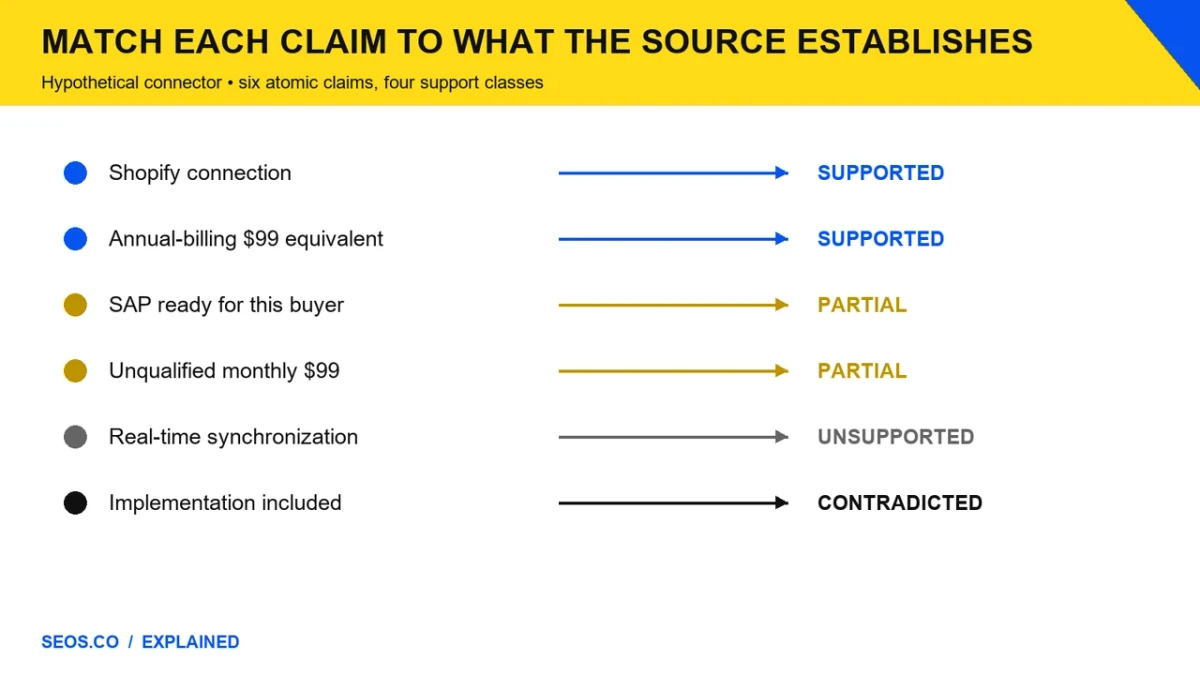
Supported means the cited source establishes the claim within the answer’s stated scope. Partially supported means some essential qualifier is missing or the citation supports only part of the assertion. Unsupported means the inspected source does not establish the statement. Contradicted means the source gives materially incompatible information.
Unavailable means the source could not be inspected under the audit conditions. It is not automatically equivalent to unsupported. A temporary access error, subscription requirement or missing historical version can prevent verification without establishing that the statement is false. Preserve the distinction and identify what additional evidence would resolve it.
Outdated is best recorded as a separate freshness attribute. A claim can have been supported when its source was published and still be unsafe for a present buying decision. Conversely, a historical answer can correctly describe an old product state. The audit question determines which date matters, so include the answer’s time frame explicitly.
For the broader sourcing and review process, see AI SEO best practices. A source can also be relevant but non-authoritative for a particular fact. A review site might be useful evidence of user experience while the official plan table is stronger evidence of current package inclusion. Authority is claim-specific. A company cannot establish an independent customer satisfaction result merely by repeating its own promotional language.
Work through a complete illustrative answer
Imagine a hypothetical assistant recommends StockBridge to a distributor needing two warehouses and SAP connectivity. Its answer cites a product page and a pricing page. The product page confirms Shopify connectivity but says SAP work requires a custom integration assessment. The pricing page lists a $99 monthly equivalent only with annual billing and excludes onboarding services.
The Shopify claim is supported if the answer preserves the relevant product and market conditions. “Real-time” remains unsupported unless the cited material defines that behavior. The SAP claim is partially supported at best because the source describes a conditional assessment rather than ready-to-use support. The $99 statement omits an essential billing condition. Included implementation is contradicted by the pricing exclusions.
The six-row ledger below makes the illustrative scoring explicit. The annual-billing equivalent and an unqualified month-to-month availability claim are separate assertions; a supported numerical value does not establish every purchasing condition.
| Atomic claim | Inspected fictional evidence | Verdict |
|---|---|---|
| Shopify connectivity is supported | Product page explicitly confirms the relevant connection | Supported |
| Annual billing has a $99 monthly equivalent | Pricing page states that value and billing basis | Supported |
| SAP connectivity is ready for this buyer | Product page offers a custom assessment, not unconditional readiness | Partially supported |
| The same $99 price is available without the annual condition | The amount is documented, but this purchasing condition is not established | Partially supported |
| Synchronization is real-time | Neither inspected page defines or supports real-time behavior | Unsupported |
| Implementation is included in all plans | Pricing page explicitly excludes onboarding services | Contradicted |
The business response should follow the claim consequences. Correcting the implementation inclusion error and clarifying SAP availability matter more than polishing a generic product description. If the official pages are already clear, the team can collect further observations and use available correction mechanisms. Rewriting accurate pages just to make the brand appear more often would not address the observed error.
Check completeness as well as citation correctness
A correctly supported claim does not mean the answer supplied all information necessary for the decision. An answer could accurately describe a product’s features while omitting a mandatory minimum contract or an unsupported market. Citation correctness asks whether the links support what was said. Decision completeness asks whether essential constraints were left out.
Define a task-specific checklist before scoring completeness. For a software shortlist, it might include required integration, operating geography, plan eligibility, implementation dependency and material cost conditions. Do not demand every possible detail in every answer. The checklist should reflect what could change the customer’s choice at that stage.
An answer can be concise and complete for a definition question but inadequate for a purchase recommendation. Score against the user’s actual task rather than a universal length requirement for the assistant. A long answer can still omit the one constraint that determines suitability, while a short answer can communicate it clearly.
Document whether the missing information exists in the cited sources. If the source lacks it, the content gap belongs partly to the publisher’s evidence. If the source states it clearly and the answer drops it, the observed problem is a synthesis or presentation failure. That distinction helps decide whether to improve the page, gather more evidence or escalate the answer itself.
Verify the source destination and its historical state
Record both the displayed citation and the destination after redirects when access permits. A cited URL can lead to an updated page whose current text differs from what the assistant retrieved earlier. The audit should not pretend to know the retrieval timestamp unless that evidence is available. Save the inspected date and the source version you actually observed.
Check canonical ownership when the same material appears on multiple sites. A syndicated copy may preserve an outdated plan table while the original source has changed. The assistant may be faithfully repeating the copy, but the customer still receives stale advice. The correction strategy can then include improving distribution and update consistency rather than only editing the canonical page again.
If a source returns an error, record the response and try a bounded later check. Do not repeatedly hammer it or substitute a different page without marking the substitution. The ledger should make clear whether support was verified directly, inferred from another version or left unresolved.
Treat snippets as previews, not complete source inspection. A search preview can omit qualifications and may not reflect the full current page. Open the source where possible and verify the relevant passage in context. If only a snippet is accessible, label the evidence boundary instead of giving the claim a full-support score.
Prioritize incidents by consequence and recurrence
Combine severity with recurrence across distinct task opportunities. Ten repeated runs of one question should not automatically count as ten separate commercial incidents. Group the same underlying false claim into one issue, attach its observations and report how many relevant task families were affected. This prevents a noisy collection schedule from inflating the apparent problem size.
A practical severity order begins with claims that could cause a materially unsuitable purchase or misleading commitment. Next come facts likely to waste evaluation time, such as invented integrations or geographies. Lower-priority issues include wording that is imprecise but does not change the decision. Explain the reason for each priority so the audit can be reviewed.
Assign an owner to the repairable evidence. Product operations may own integration status, finance may own price conditions and legal may own certifications. Marketing can improve presentation, but it should not guess the underlying fact. The audit becomes operational when the factual owner confirms the correct state and the relevant publishing surfaces agree.
Keep unsupported allegations out of the remediation process. An assistant’s incorrect description does not prove that a competitor manipulated it, that a platform deliberately suppressed the brand or that a hidden optimization tactic will fix it. Act on observed source and answer failures rather than inventing a causal story around an uncomfortable result.
Repair publisher evidence in a claim-centered way
Place decisive facts near the relevant answer, including the qualifiers needed to interpret them. If SAP connectivity requires an assessment, state that condition on the integration page and any pricing or service page that discusses it. Avoid burying the qualification in an unrelated policy page while the main offer reads as unconditional.
Use a consistent field ledger for volatile facts. Each record should include value, scope, effective date, owner, supporting source and all publishing locations. When the fact changes, update the known locations and preserve the previous value in an internal history. That approach reduces contradictory evidence without requiring repetitive promotional copy across the site.
Support technical claims with useful examples. A description of a scheduled export can clarify its cadence, latency and failure handling. A plain statement that an integration is “real-time” leaves too much room for interpretation. Precision improves customer understanding even if an assistant never cites the page.
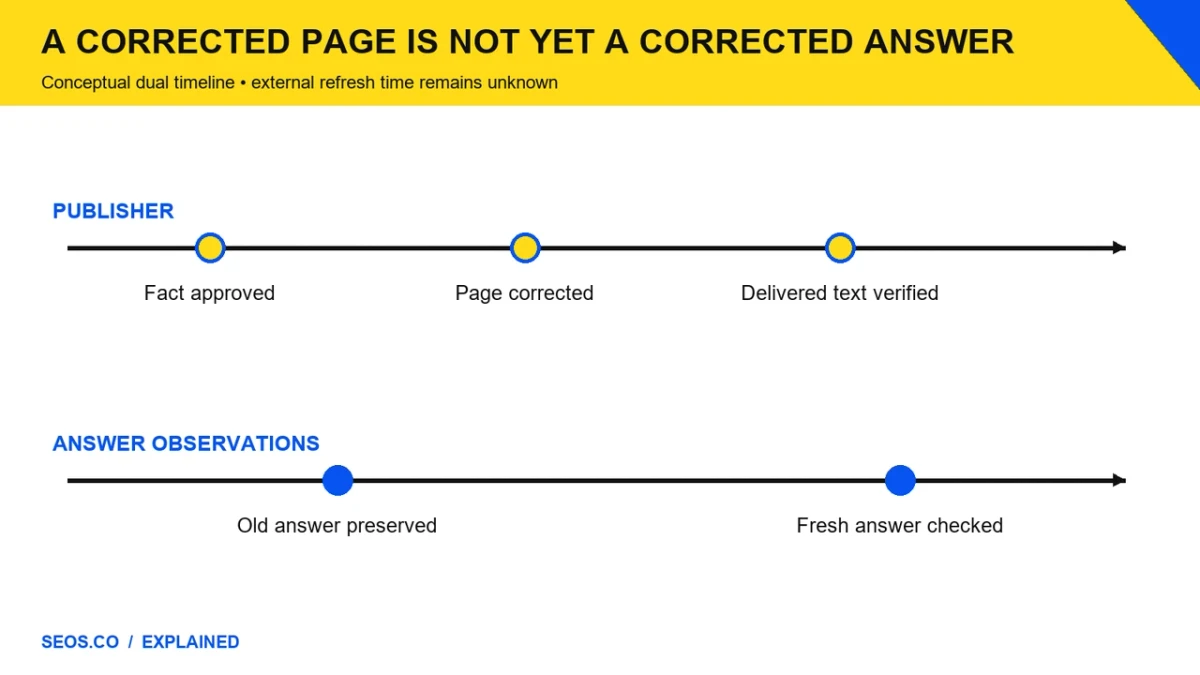
Use the complete SEO audit guide to connect this check with delivery and eligibility. After changes, verify the delivered pages, not just the editing interface. Confirm that the material qualifiers appear in visible text and survive text extraction. Then collect fresh answer observations over the defined panel. A published correction is a completed publisher action; a corrected answer is a separate observed outcome that may occur later or remain unverified.
Turn the audit into a durable evidence record
A useful report contains the sampled tasks, completed answers, material claims, support classifications, freshness limits and grouped incidents. Include a few complete worked examples so readers can understand the scoring. A percentage without the claim ledger makes it difficult to detect inconsistent standards or explain why a serious error received a low priority.
Maintain two timelines: publisher corrections and observed answer behavior. This prevents a team from declaring the whole issue resolved when only the source page changed. It also prevents repeated rediscovery of the same stale claim from being counted as a new defect each day. The history should show recurrence without multiplying the underlying incident.
The final question is practical: can a customer use the answer to make the intended decision without being materially misled? A citation audit supplies evidence for that judgment. Its success is a clearer source record, fewer unresolved material errors and better understanding of the remaining uncertainty—not merely a larger number of links beside the brand name.
Check agreement on consequential classifications
Where available, have a second qualified reviewer independently classify a few ambiguous claims. Compare the reasons, not just the labels. A missing billing condition needs a consistent rule tied to its customer consequence. Preserve disagreements until adjudicated and update the scoring guide with the resolved example. If independent review is unavailable, label the assessment as single-reviewer judgment and retain the source evidence. A spreadsheet or model score does not supply independent factual assurance merely because it produces a precise number.