
The Search Brief · News analysis
Content Freshness for AI Search: Trace the Fact From Its Owner to the Answer
Diagnose stale AI-search facts with field ownership, freshness budgets, cache checks, safe expiry and a worked timeline separating publication from answers.
Development covered: Primary-source guidance checked November 2, 2026

Content freshness is an operational property, not a date decoration. A page can display today’s update date while serving last month’s price, and an assistant can cite a current page while repeating an old condition. The useful response is to trace the fact through its owner, publishing pipeline, caches, discovery and observed answer, recording what is known at each stage.
A business can control its approved facts and delivery systems more directly than an external assistant’s refresh schedule. Maintain that distinction. Publishing a correction is a completed action. Verifying a current public response is a second milestone. Observing the corrected fact in a fresh assistant answer is a third, separate outcome. None should be inferred from the others.
The workflow below is an editorial and operational method for time-sensitive offers, availability and technical limits. It uses hypothetical examples rather than a conducted SEOS.co study. The goal is to keep customers from acting on expired facts while giving the team a precise way to investigate stale information without guessing at an engine’s hidden behavior.
Define freshness at the field level
A fact needs an effective time, a permissible age and an expiry policy. “Current price” is incomplete without a currency, billing basis, market and plan. “Available appointments” is incomplete without a date and service location. Define the field precisely before deciding how frequently to refresh it.
See how often SEO content should be updated for the broader editorial decision. Different facts have different freshness requirements. A company founding year may remain useful for years. A temporary discount can become wrong at a specific minute. An inventory quantity can change faster than a public page should promise availability. The publishing process should match the business consequence of staleness, not apply one universal weekly review cycle.
Assign a factual owner and an update trigger. A price change should originate from an approved commercial decision, not a writer noticing a competitor’s offer. A product limit should originate from a verified specification. Marketing then owns faithful publication and distribution, while the source team remains responsible for the underlying fact.
Keep an internal previous-value history. It helps explain why a cached response or partner profile differs from the current page. The old value is evidence of a transition, not proof that the system failed before the change became effective. Distinguishing validity time from observation time is essential when reconstructing an incident.
Map the clocks in the delivery path
The first clock is the source update: when the approved fact changes. The second is the collection or synchronization clock: when the publishing system receives it. The third is the publication clock: when a new page version is built or stored. The fourth is the cache clock: when that version becomes the response customers actually receive.
For discovery signals, the sitemap lastmod pipeline shows how to derive a timestamp from a meaningful content change without treating every rebuild as a revision.
External discovery and retrieval add more clocks that the publisher may not fully observe. A crawler can visit later; a search system can process the material later still; an assistant can use a source at a time it does not expose. Avoid inventing timestamps for those stages. Record observed fetches, source references and answers, and label the gaps.
HTTP cache behavior has defined mechanisms for freshness and validation. RFC 9111 specifies cache controls and the use of freshness information, including age-related concepts. It is a technical basis for investigating delivered responses, not a guarantee about an assistant’s internal retrieval cache. Use the standard for the systems it actually describes. HTTP caching specification.
Draw the whole path before changing a refresh interval. A fast content feed does little if a page build waits six hours or a stale edge response persists through the customer’s deadline. Conversely, a long-lived cache may be safe for an immutable historical document. The field’s validity and the actual delivery design determine the risk.
Calculate a freshness budget with explicit assumptions
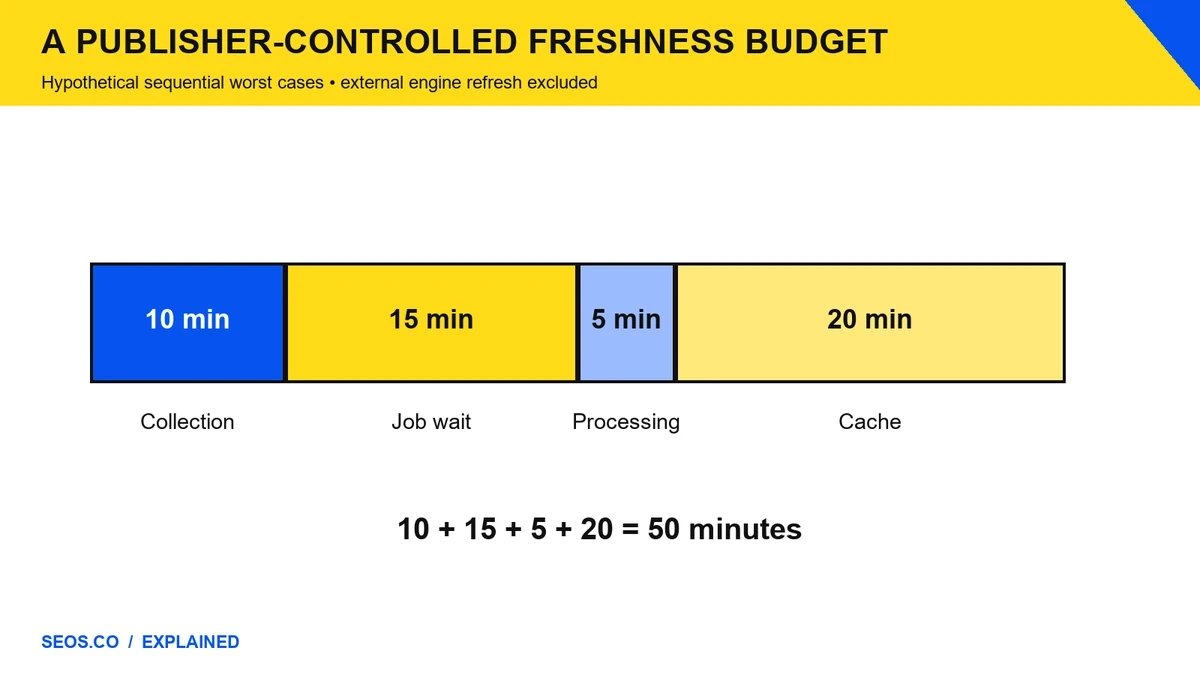
Imagine a hypothetical consultation offer that expires at 5 p.m. Its source system updates every ten minutes. The publishing job runs every fifteen minutes and can take five minutes to complete. The page cache may retain a response for twenty minutes unless invalidated. Under a simple worst-case sequential model, the publisher-controlled delay can reach fifty minutes.
| Publisher-controlled stage | Hypothetical maximum wait or duration | What must be verified |
|---|---|---|
| Collection | 10 minutes | Source change reaches the publishing input |
| Wait for publication job | 15 minutes | Scheduled job starts within its interval |
| Processing | 5 minutes | New page version completes successfully |
| Cache persistence | 20 minutes | Ordinary public response becomes current |
| Simple sequential total | 50 minutes | Assumes the stated worst cases align; excludes external-engine refresh |
The operational conclusion is that an update made at 4:50 p.m. cannot safely be assumed visible before 5 p.m. under that design. The repair might involve scheduling expiry earlier in the pipeline, serving a truthful expired state based on the offer’s validity time or implementing reliable invalidation. Merely changing the visible update date does not solve the timing problem.
External assistant refresh remains outside this fifty-minute budget unless there is verified evidence of its timing. Do not add an invented “one-hour AI delay” and call the end-to-end path measured. Report a publisher delivery budget plus an external observation gap. This gives management a useful constraint without claiming control that the team does not have.
Work through an expired-offer incident
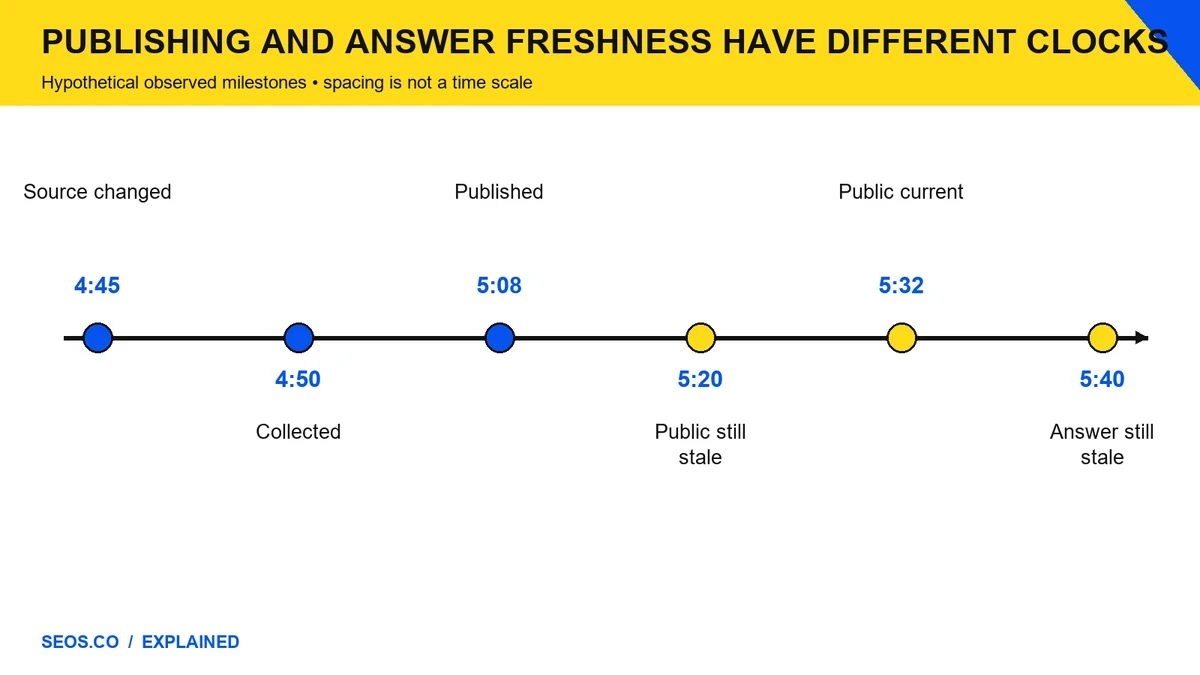
Suppose a hypothetical offer ends at 5 p.m. The source owner changes its status at 4:45. Collection records the update at 4:50, publication finishes at 5:08 and a public response still shows the offer at 5:20. At 5:32, a fresh response shows the expired state. An assistant observed at 5:40 still describes the offer as available.
The publisher can confirm that delivery remained stale until at least 5:20 and was current by 5:32. Without more observations, it cannot identify the precise transition within that interval. The assistant’s 5:40 statement is a separate stale-answer observation. Its cause could involve an older retrieval, another source or answer synthesis; the evidence does not yet distinguish them.
Inspect the cited URL if one is exposed. If it points to an old partner page that still advertises the offer, the distribution gap is concrete. If it points to the now-current page, preserve that fact and avoid assuming when the assistant retrieved it. If no source is available, record an unresolved provenance gap rather than inventing a cache diagnosis.
Count the underlying expired-offer incident once, with multiple affected observations attached. Ten repeated checks do not prove ten distinct customers acted on the offer. If actual customer inquiries reference it, record those separately as observed impact. Missing conversion or visitor evidence is a gap, not proof that no one was affected.
Make expiry safe when refresh fails
A time-bounded offer should have an expiry behavior independent of the next successful editorial update wherever the platform supports it. The public page can stop presenting the offer as available after its validity window and instead show a current alternative or an invitation to confirm eligibility. The fallback must reflect the actual business policy.
Do not keep displaying the last successful value indefinitely when that value has a known end time. A stale quantity, price or appointment slot can create a misleading promise. For facts that cannot be confirmed, communicate the uncertainty precisely: the page can explain that availability requires confirmation rather than inventing a reassuring status.
Separate evergreen explanation from volatile fields. A detailed guide can remain useful while a small offer module updates independently. This reduces the need to rebuild an entire article whenever a commercial condition changes. It also makes ownership clearer: the technical explanation and the current offer can have different verification processes.
Preserve historical pages when they have a legitimate purpose, but label them clearly and remove misleading current-action paths. A page documenting last year’s program can remain valuable as history. It should not present an expired enrollment button as though the program remains open. History and current availability need different templates and links.
Inspect caches without confusing them with source truth
Compare the approved source value, stored page version and delivered response. Where available, inspect response headers, cache status and age information alongside the body. A current database record does not establish that every public variant is current. Likewise, a stale browser view does not prove the origin server still holds the old fact.
Test relevant variants such as mobile, language, region and authenticated state when they affect delivery. A correction may reach the default page while a localized variant remains stale. Use the actual variant rules and preserve the conditions of each check. Randomly adding query parameters can bypass a cache during diagnosis but does not verify what ordinary users receive.
Check whether invalidation targets the right object. A content system might purge a product page but leave a category card, feed or downloadable document unchanged. The fact ledger should identify dependent surfaces so the update process can verify all material copies. A successful purge request is an action receipt; the subsequent current response is the outcome evidence.
After a restart or failed job, verify recovery. Does the next run process updates missed during downtime, or only changes since its own start? Does a stale lock prevent publication? Can one long rebuild delay independent expiry work? These questions matter because a nominally running process can still miss the time window that makes a fact useful.
Publish truthful modification signals
The guide to refreshing old content addresses the wider repair workflow. Use modification dates to describe meaningful content changes, rather than automatically refreshing them on every page view. A new date attached to unchanged stale facts misleads readers and makes internal auditing harder. Store the actual content change and the responsible field update so the date can be explained.
Google’s sitemap guidance says a lastmod value should reflect the last significant update to the page, and that consistently verifiable accuracy affects whether the value is used. This supports truthful change signals; it does not promise immediate recrawling or a ranking benefit from a timestamp. Google sitemap guidance.
Coordinate visible dates, structured data and sitemap values where they describe the same publication event. They need not all represent identical concepts, but their meaning should be clear. An original publication date and a later substantive review date can both be useful when the page explains what changed.
Do not treat a recrawl request or change notification as proof that an external answer is current. Preserve the request receipt, then inspect available crawl or indexing evidence and collect fresh answer observations. Each stage reduces uncertainty, but none should be substituted for a later stage that has not been observed.
Monitor the right deadlines and failure states
The complete SEO audit helps place freshness checks within the delivery path. A freshness monitor should compare age and validity, not simply test whether the page returns a successful response. A 200 response containing an expired price is operationally unhealthy for that field. Define the expected value or validity condition, the check cadence and the allowed delay.
Distinguish stale source data, failed synchronization, delayed publication, stale delivery, blocked retrieval and stale external answer observations. These failures belong to different owners. A single red “AI freshness” light provides little guidance if the team cannot tell whether to fix a feed, a cache or an external profile.
Schedule independent time-sensitive checks so a slow background job cannot silently prevent them from running. Record scheduled, started and completed times. Alert on missed deadlines and exhausted retries as well as incorrect values. A monitor that never executes cannot legitimately report that no stale event occurred.
Explain what has actually been fixed
A useful incident report states the affected fact, validity window, observed stale intervals, corrected surfaces and unresolved external evidence. It should distinguish verified current delivery from pending assistant behavior. Keep the historical observations even after the issue appears resolved, because they explain both the impact and the repair’s limits.
The immediate improvement is often modest and concrete: one verified fact owner, one accurate expiry rule, one corrected delivery path and a bounded observation panel. Content freshness improves when those controls work together. A current date is useful context; a traced and verified fact is the evidence customers need.
Rehearse recovery before a deadline matters
A non-production rehearsal can reveal failures that a successful routine run never exercises. Use a harmless test field with a known effective time, interrupt its update process and confirm how the system resumes. Record whether pending changes replay, duplicates are suppressed and stale locks prevent the next job. Disruptive tests against live offers require the relevant operational authorization.
Compare the recovered response with both the approved value and its validity window. A process that catches up eventually can still miss a time-sensitive deadline. Measure completion and timeliness separately, and distinguish the test environment from production. Passing a rehearsal supports the tested path; it does not establish that every actual incident has been resolved. Repeat the affected test when a scheduler, synchronization or cache dependency changes, preserving the earlier evidence rather than overwriting it.