
The Search Brief · News analysis
Sitemap Lastmod: Build a Trustworthy Publishing Signal
An event-based lastmod model with a timestamp decision table, publishing pipeline and a visual distinction between builds and meaningful page edits.
Development covered: Primary-source guidance checked November 2, 2026

Sitemap lastmod should describe a meaningful modification to the page, not the moment a build happened or an exporter ran. A reliable implementation connects real content events to a selective URL inventory, publishes complete sitemap files atomically, and verifies that the page and timestamp describe the same version.
The hard part is usually data ownership. A CMS may know when an editor saved a record, while the actual page combines that record with product data, embedded media, and cached fragments. This guide proposes an event-based method for technical teams. The examples are hypothetical and do not claim measured improvements in crawling or rankings.
What lastmod can and cannot communicate
The XML sitemap guide explains the broader inventory and discovery role around this timestamp pipeline.
Google's sitemap documentation says it uses lastmod when the value is consistently and verifiably accurate and reflects significant updates. The sitemap protocol defines the field as the modification date of the linked page. Sitemaps protocol.
That makes lastmod a statement about a resource version. It is not a demand to crawl immediately, a guarantee of indexing, or a way to make old content appear newly published. Treat the timestamp as evidence the site produces, with the same care given to other public facts.
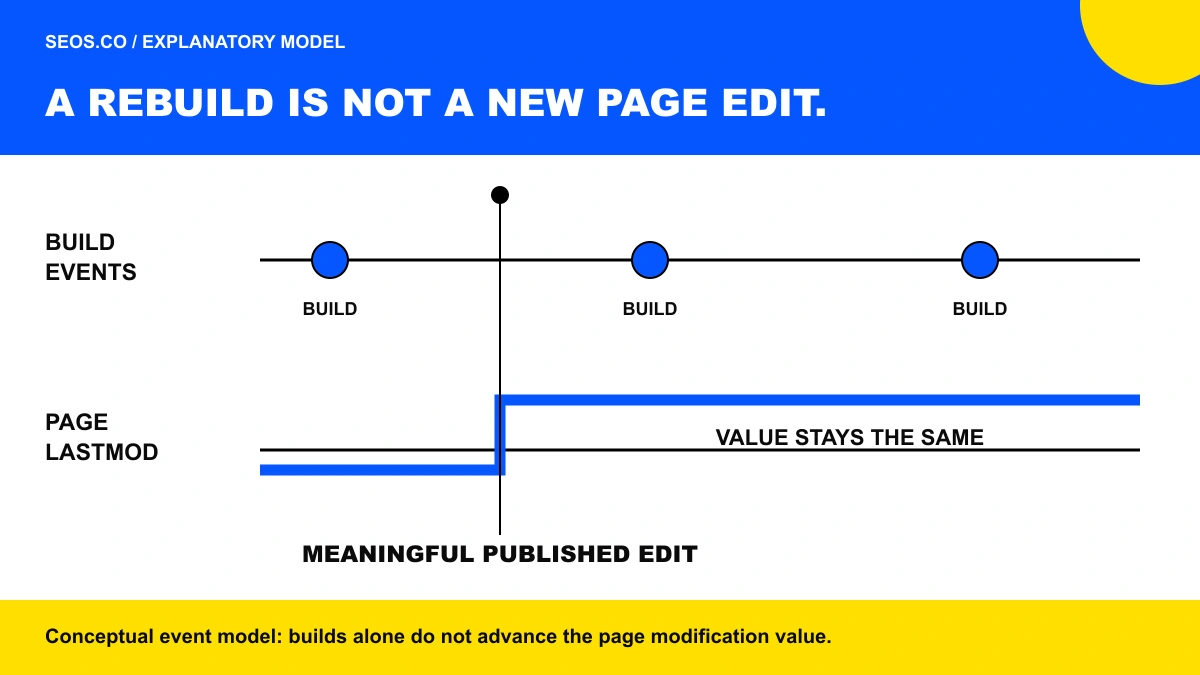
Separate publication date, modification date, export time, and deployment time in the data model. They can occasionally coincide, but they represent different events. A daily deployment that changes no substantive article content should not automatically move every article's lastmod to today.
Also distinguish a sitemap file's own modification from the modification of each page listed inside it. An index entry describing a child sitemap has a different referent from a page entry. Mixing those meanings produces plausible-looking XML that says the wrong thing.
Define a significant change for each template
Write a content-change policy by page type. An article might change significantly when its explanation, recommendation, supporting evidence, or important media is updated. A product page might change when consequential specifications or offer information change. A category may change when its useful selection or guidance changes.
Do not assume every database write qualifies. An internal note, editorial assignment, view counter, background synchronization marker, or unrelated analytics field can update a generic modified_at column without changing the public page.
Conversely, some public changes bypass the CMS record. A shared pricing service can change an offer, or a structured data generator can correct a consequential fact. If those changes matter to the page's public representation, the lastmod producer needs a way to observe them.
The policy is a proposed operating convention, not an engine-prescribed list of qualifying fields. Document the reasoning and test it against actual pages. The goal is consistency and truthfulness, not manufacturing constant freshness.
Establish content identity before timestamps
Use canonical-tag best practices to keep the approved sitemap inventory aligned with preferred routes.
Assign a stable page identifier independent of its current URL. The resource may move while preserving its substantive content. A route change should not erase the history needed to understand what was modified.
Map that identifier to the current approved canonical URL. Generate the sitemap from the approved public inventory rather than from every database row with a slug. Drafts, private objects, redirects, and duplicate utility routes should not enter by accident.
Google's canonical declaration guidance describes sitemap inclusion as a representative signal. Keep the sitemap inventory coherent with the site's preferred URLs, while recognizing that inclusion alone cannot establish representative selection.
Version the inventory. An export should record which publication state and routing policy it used. If a page appears in a sitemap after retirement, the team can then determine whether selection, export, caching, or publication lag produced the disagreement.
Produce events from meaningful changes
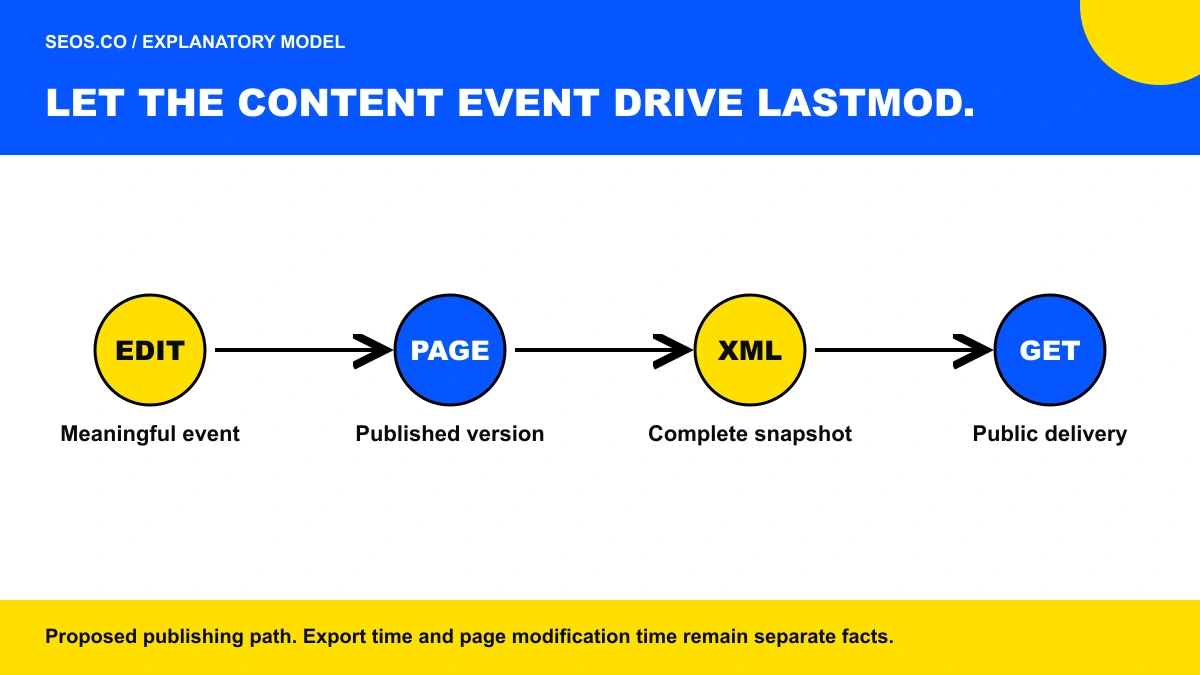
Create an event when a qualifying public change is committed. Include page identifier, content version, event time, change class, source system, and a reference to the published version.
The event time should represent when the change became part of the public resource according to the chosen publication model. A draft save three days before publication is not the same event as making the revision publicly available.
For scheduled publishing, retain scheduled time and actual completion time separately. If a job runs late, reporting only the planned time conceals the delay. The sitemap should describe the version actually available, not a future state that a scheduler intended to create.
Make events idempotent. Retrying publication should not continually advance lastmod when the content version is unchanged. Use a stable version or event key so duplicate processing preserves the original modification fact.
Decide how shared dependencies affect pages
A page can depend on reusable information such as a legal notice, navigation, manufacturer specification, or pricing feed. These dependencies differ in significance. A menu label change should not necessarily refresh every article's substantive modification time.
Build a dependency map for consequential shared facts. If a corrected specification affects 200 products, those page versions may need regeneration and corresponding modification evidence. If a footer changes, the body content may remain unchanged.
Avoid an all-or-nothing rule that invalidates the whole site for every shared update. It creates unnecessary work and weakens the relationship between lastmod and meaningful change. Use template-specific field ownership instead.
Test the dependency fan-out. Record the intended affected page identifiers and compare them with regenerated pages and sitemap changes. Missing fan-out leaves stale facts; excessive fan-out makes the signal noisy. Both are producer defects that XML validation alone cannot detect.
Generate sitemap files as complete snapshots
Select the inventory and timestamps from a consistent snapshot. If the exporter reads while publication updates several tables independently, it can combine a new URL with an old timestamp or include an object before its page is ready.
Write files to a temporary location, validate them, and publish the complete set atomically where the infrastructure supports that pattern. A crawler should not encounter a half-written file because the export process was interrupted.
Partition large inventories deterministically. Stable partitioning helps operators compare versions and limits unnecessary file churn. Keep records of included URL counts, excluded classes, generation version, validation results, and publication time.
The sitemap protocol specifies size and URL-count limits. Enforce current limits in the exporter rather than relying on an operator to notice oversized files. Compression and sitemap indexes do not remove the need for correct page-level data.
Validate the actual timestamps
Check format, timezone handling, future values, impossible chronology, and consistency with public content versions. A timestamp can be syntactically valid while referring to an unpublished revision.
Keep time handling explicit. Store a canonical internal time representation and serialize according to the supported format. Avoid local-time strings without timezone context when the system spans multiple regions.
Test clock skew and imported records. A legacy system may contain future modification dates or dates representing the source-system export. Do not automatically treat them as accurate public modification evidence.
Compare a sample of lastmod values with the version history and delivered page. Include unchanged pages, recent edits, scheduled releases, shared-data updates, imported content, and retired objects. Each class exercises a different part of the producer.
A worked example: the nightly rebuild that refreshed everything
Imagine a fictional publisher with 8,000 articles. A nightly static build writes the build completion time into every sitemap entry. Only 25 articles changed substantively that day. The numbers are scenario inputs, not a reported study.
The XML is valid, the sitemap loads successfully, and the build job is green. Yet the public timestamps do not describe the actual modification pattern. Checking only availability and syntax would incorrectly mark the pipeline healthy.
The proposed repair stores the last qualifying published content event per article. The exporter uses that value while keeping its own generation time in an operational receipt. Unchanged articles retain their previous modification evidence.
Verification compares the before-and-after set of changed lastmod entries with the known 25 content events. It also tests a duplicate job retry and an interrupted export. Search-engine crawling may later change, but that observation is separate from proving the timestamp producer is now accurate.
Trace freshness from source to consumer
Measure the time between a meaningful source change, publication, page regeneration, cache invalidation, sitemap generation, and sitemap availability. The total delay matters more than whether each component has a nominal schedule.
If content publishes every five minutes but sitemaps rebuild once a day, lastmod can lag the page for nearly a day even when all jobs run as configured. That may be an accepted operating choice, but it should be explicit.
Check whether background work blocks the exporter. A long import holding a shared database lock can delay both content and sitemap jobs. A scheduler that skips a run when a previous job remains active needs a durable catch-up mechanism.
Monitor the age of the newest successfully published snapshot and the oldest unprocessed qualifying event. A process heartbeat proves the worker is alive; it does not prove the consumer has received current data.
Make restart recovery observable
Use durable checkpoints for events and exports. After a restart, the system should know which content versions have been included in a successfully published sitemap snapshot.
Do not advance the checkpoint before the complete snapshot becomes available. Otherwise, a crash between acknowledgment and publication can permanently omit events until an unrelated future update happens.
Handle retries without changing facts. Regenerating the same content version should reproduce the same page-level lastmod values, even though export receipts receive new operational timestamps.
Retain failed snapshot artifacts for diagnosis within appropriate storage limits. A failed XML file, selected inventory, and error record can reveal whether the problem involved encoding, size, permissions, or inconsistent input. A generic “job failed” message loses that evidence.
Verify delivery through caches and redirects
Fetch the public sitemap URL after publishing. Check status, content type, decompressed size where relevant, parsed inventory, and the expected version marker or hash in the operational receipt.
Inspect redirect behavior. A sitemap URL that points through an unexpected authentication or hostname transition may not deliver what the exporter produced. Test the public route rather than only reading the file on disk.
Compare cached and fresh delivery paths using legitimate operational controls. A new file at the origin does not prove an edge cache has refreshed it. Conversely, indiscriminate purging can conceal a broken invalidation policy.
Check representative listed pages at the same time. If the sitemap announces a new version while the page still serves an old cached body, the two consumers disagree. Repair the publication sequence or freshness contract rather than moving the timestamp again.
Use search reports for the questions they can answer
The crawl-budget guide separates crawling capacity and demand from merely publishing a fresh sitemap.
A sitemap submission or successful fetch does not guarantee that every listed page is indexed. Google's sitemap overview describes sitemaps as a discovery aid. Keep submission, crawl, processing, and visibility as separate stages.
Segment sitemap reporting by meaningful inventory groups when helpful. A product sitemap and an article sitemap may have different publication cadence and failure patterns. Avoid excessive fragmentation solely to create more dashboard rows.
Investigate excluded-page classes against intended policy. A duplicate utility URL absent from the index can be expected. An approved substantive article missing because of an accidental directive is a different condition.
Use URL Inspection for representative indexed and live observations. Record the dates and distinguish the page version inspected from the latest sitemap snapshot. An older crawl is not evidence that the current exporter failed.
Set an acceptance contract for sitemap lastmod
The producer should pass unchanged-content, meaningful-edit, scheduled-release, duplicate-retry, shared-dependency, retirement, interrupted-export, and restart-recovery cases. Use fixtures with known page versions and expected timestamps.
The public delivery check should parse the actual sitemap, confirm the approved inventory, reject future or invalid dates, and compare selected values with published content evidence. Keep internal generation receipts separate from public page facts.
Define thresholds for operational freshness according to the site's cadence. The appropriate delay for a weekly editorial archive differs from a fast-changing catalog. These are service objectives for the site's own pipeline, not promises about crawler response times.
Assign ownership across CMS, content services, exporter, and delivery infrastructure. A shared source of truth is valuable only when someone is responsible for disagreements and can trace them to the producing event.
A timestamp decision table
Use page-version evidence to decide whether an event changes sitemap lastmod. The following is a proposed publishing policy, not a claim about a deployed exporter.
| Event | Does the public substance change? | Proposed timestamp treatment | Verification |
|---|---|---|---|
| Published correction to the article's explanation | Yes | Use the qualifying published-change event | New body and recorded version agree |
| Nightly rebuild with identical substantive content | No | Retain the prior page modification value | Unchanged content fingerprint and version |
| Duplicate delivery of the same publication event | No new change | Preserve the original event time | Retry does not advance lastmod |
| Consequential shared product-data correction | Depends on affected public fields | Apply the documented field-level policy | Only genuinely affected page versions change |
Keep export completion time in the operational receipt. It answers when the sitemap job ran, which is a different question from when each linked page changed.
Practical answers
Should lastmod change every day?
Only when a qualifying meaningful page change occurred under the documented policy. A daily build or export is not itself proof that every page changed. Preserve separate operational timestamps for those jobs.
Can a content hash replace event history?
A substantive-content fingerprint can detect changes and help validate events, but it needs careful extraction and field selection. It cannot explain why a change occurred or whether it was actually published. Use it as supporting evidence rather than the sole history.
What proves the repair succeeded?
Known content events produce accurate page-level timestamps, unchanged pages retain theirs, complete snapshots survive retries and restarts, and the public sitemap agrees with delivered pages. Later crawl and indexing observations can establish additional outcomes. Sitemap lastmod becomes useful when it is a trustworthy consequence of publishing, rather than an automatically refreshed decoration.