
Franchise SEO
Franchise SEO Checklist: A Complete System for Every Location
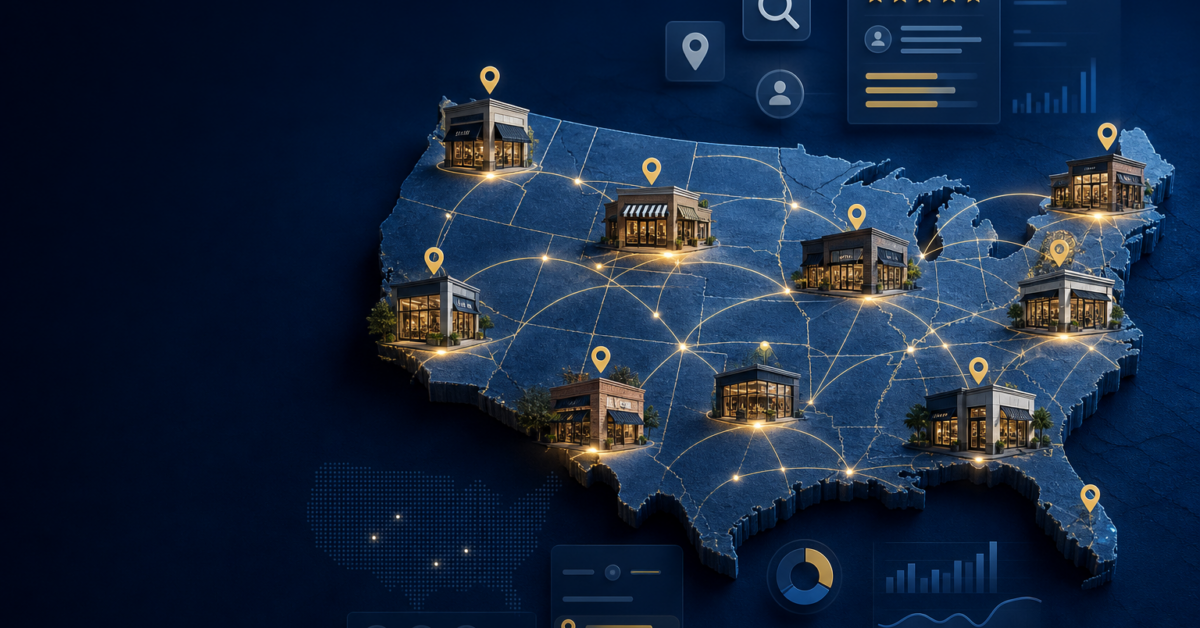
Franchise SEO coordinates national brand authority with local relevance for every eligible franchise location. The essential checklist is to maintain one trusted location data source, create useful and indexable location pages, connect each eligible location to an accurate Google Business Profile, earn reviews and local links, control duplication and canonicals, and measure leads by location. Success depends on centralized standards plus authentic local evidence, not hundreds of pages that merely replace one city name with another.
TL;DR
Key Takeaways
- Create a location data master before changing pages, profiles, citations or tracking.
- Give every eligible location one useful page and one correctly governed Google Business Profile.
- Differentiate location pages with staff, services, constraints, photos, reviews and local proof.
- Connect national, service, state, city and location pages through a deliberate internal linking graph.
- Measure qualified calls, bookings and leads by location, not rankings or traffic alone.
- Use structured data to clarify visible facts, never to claim information absent from the page.
- Treat AI visibility as an extension of sound SEO, entity clarity and extractable answers.
- Resolve ownership, approval and escalation rules before franchisees create conflicting assets.
The franchise SEO checklist in priority order
A franchise program should be implemented as a controlled system, not as a collection of unrelated local campaigns. Complete foundational work first because incorrect business data, ownership disputes and duplicate assets can undermine later content or link investment.
Foundation
- Inventory every operating, planned, relocated and closed location.
- Create a master record containing canonical business name, address, phone, hours, coordinates, territory, services, owner, page URL and Google Business Profile identifier.
- Assign ownership for websites, domains, profiles, analytics, call tracking, reviews and listings.
- Document rules for openings, closures, relocations, ownership transfers and emergency updates.
Local visibility
- Publish one substantial page for each eligible location.
- Create or verify one eligible Google Business Profile per physical location.
- Use location-specific appointment, order or booking links.
- Standardize core categories and attributes while preserving legitimate local differences.
- Correct major citation inconsistencies and suppress duplicate profiles.
Growth and measurement
- Build service, location and informational topic clusters around demonstrated demand.
- Acquire locally relevant links, mentions, reviews and partnerships.
- Track organic landing pages, map visibility, calls, bookings and qualified leads by location.
- Review crawl, indexation, conversion and content decay on a recurring schedule.
Build an architecture that serves people and search systems
A durable franchise structure normally starts with a national service hub, a location finder and crawlable regional paths such as /locations/state/city/location/. The exact folder pattern matters less than consistency, stable URLs and short internal paths. Every indexable location should be reachable through normal links, not only a search box or map interface.
Create a topical graph rather than isolated pages. National service pages should link to relevant regional or location options. State and city hubs should summarize available coverage and link to real locations. Location pages should link back to their parent region, locally available services and genuinely relevant guidance. Breadcrumbs reinforce these relationships.
Do not force every possible city and service combination into the index. Create a separate page only when it satisfies distinct intent and contains enough local evidence to be useful. Otherwise, consolidate the material into a stronger location or service page. This rule controls crawl demand and reduces doorway-page risk.
Minimum location page specification
- Canonical name, address, phone, hours and service area.
- Services actually available at that location.
- Booking, quote, call or direction action specific to the location.
- Original exterior, interior, team or work photos when appropriate.
- Staff, accessibility, parking, appointment or service constraints.
- Local testimonials or review excerpts used with permission and proper context.
- Nearby landmarks, neighborhoods and directions that help customers.
- Locally answered questions rather than a duplicated corporate FAQ.
Google Business Profiles, citations and local identity
Google permits one Business Profile for each eligible location. Authorized franchisees may use the underlying brand name, but virtual offices, invented addresses and keyword additions that are not part of the real-world name are not eligible. Service businesses with distinct locations, service areas and staff may qualify separately. Google’s guidance says service areas generally should not extend beyond about two hours of driving time.
Each profile should point to its corresponding location page, not the home page or another branch. The same principle applies to appointment and ordering actions: Google requires a URL associated with the specific location. Select the most accurate primary category, then add secondary categories only when they describe real operations.
Audit name, address, phone, hours, categories, website, coordinates, opening status and duplicates across Google and important industry platforms. Exact punctuation differences are rarely the strategic issue. Material contradictions that confuse customers or represent different entities are. Call tracking numbers can be used carefully when the permanent local number remains part of the profile and master record.
Corporate should retain durable administrative access while granting the correct local operating roles. Never let a departing employee, agency or franchisee become the sole owner. Define who may edit categories, respond to reviews, upload photos and approve profile changes.
Create local proof, reviews and natural link demand
Location differentiation should reflect actual operational differences. Useful inputs include manager interviews, common customer questions, project examples, service limitations, local hiring, sponsorships, charitable work, neighborhood logistics and seasonality. A page is not local merely because a city name appears repeatedly.
Build a compliant review process into completed transactions. Ask all eligible customers through consistent workflows, avoid incentives or review gating, and route alerts to trained responders. Track review velocity, rating, recency, response time and recurring complaints at both brand and location levels. Independent consumer research from BrightLocal indicates that customers validate businesses across multiple review and discovery environments, so reputation management should extend beyond a single platform.
Assets that can earn links and mentions
- Original regional demand, pricing or service trend reports based on aggregated internal data.
- Statistics pages that clearly explain methodology and update dates.
- Local guides developed with identifiable specialists.
- Expert contribution programs involving technicians, operators or franchise owners.
- Scholarships, events or partnerships with a real community purpose.
- Comparison assets that help buyers choose between service models without misleading claims.
Use link-intersect analysis to find organizations mentioning or linking to comparable businesses but not the franchise. Monitor unlinked brand mentions and request a link only when it improves the cited resource. Avoid paid link networks, fabricated local news and mass-produced sponsorship pages.
Control technical SEO, indexation and structured data
Large franchise sites commonly waste crawl capacity on locator parameters, duplicate regional paths, internal search pages, tracking URLs and obsolete locations. Crawl the site, compare submitted and indexed URLs, and inspect server logs when scale justifies it. Logs can show whether important new or refreshed location pages are being requested while low-value URL patterns consume crawler attention.
Use self-referencing canonicals on unique location pages. Canonicalize true duplicates only when the preferred page satisfies the same intent. A canonical tag is not a substitute for merging thin pages, fixing internal links or removing obsolete URLs. Redirect permanently closed location URLs to a genuinely relevant successor only when one exists. Otherwise, provide a useful closure notice temporarily and eventually return an appropriate removal status.
Add the most specific applicable LocalBusiness subtype to each location page. Mark up visible facts such as name, address, telephone, hours, URL, coordinates and accepted services. Validate syntax, but remember that valid schema does not guarantee a rich result. Do not add hidden reviews, unsupported ratings or a service area that contradicts the page.
Quarterly technical controls
- Indexed location pages compared with active eligible locations.
- Orphan pages and links pointing to redirects or errors.
- Duplicate titles, canonicals and near-duplicate body content.
- Sitemap accuracy and last modification discipline.
- Mobile speed and conversion failures on high-value templates.
- JavaScript or consent behavior blocking directions, calls or forms.
Expand national authority without creating doorway pages
National SEO and local SEO should reinforce each other. Build authoritative service hubs that explain the brand’s methods, qualifications, pricing factors, limitations and customer decision criteria. Support them with focused articles, comparisons, case studies and regional pages. Then route authority to locations through contextual links based on actual service availability.
Query fanout reveals the full journey around a franchise service: definition, cost, alternatives, urgency, qualifications, maintenance, local availability and brand comparison. Map each meaningful intent to the best existing page before commissioning another URL. Consolidate competing pages, refresh declining winners and redirect only where intent aligns.
For snippet and answer-system visibility, place a direct definition or recommendation near the beginning, followed by evidence, exceptions and steps. Tables should make explicit comparisons. Procedures should use ordered lists. Important entities, locations and service relationships should be stated clearly rather than implied through marketing language.
Controlled title testing can improve relevance and click response, but change one major variable at a time and retain an observation window appropriate to traffic. Measure by page group and query class. Do not interpret a temporary rank fluctuation as proof when seasonality, local pack changes or algorithm updates may be responsible.
Prepare franchise content for AI search and answer engines
Google states that AI Overviews and AI Mode are grounded in its core Search quality systems. There is no separate AI schema shortcut. Franchise sites improve retrieval eligibility by making pages crawlable, useful, well linked, factually consistent and explicit about the relationship between the brand, service and location.
Create answer-first passages that can stand alone when extracted. State who serves an area, which services are available, what conditions apply and where the customer can verify or book. Follow the concise answer with evidence, operational detail and exceptions. This also supports likely query rewrites such as cost, nearest provider, opening hours, reviews, comparisons and service availability.
Track conventional Search Console page and query performance alongside Google’s generative AI reporting where available. The 2026 report covers page impressions from AI Overviews and AI Mode, but visibility should not be confused with business value. Pair AI impressions with assisted visits, branded demand and location-level conversions.
Bing, Copilot, ChatGPT and other answer systems may retrieve pages or citations differently. Maintain accessible HTML, stable URLs, clear authorship, dates where relevant and source-supported claims. Do not publish unsupported superlatives merely to appear quotable. Emerging academic research is examining AI citation quality, activation and publisher effects, but findings are not yet settled enough to guarantee a universal optimization formula.
Choose the right franchise operating model
Pure centralization produces consistency but can suppress local knowledge. Uncontrolled decentralization creates duplicate profiles, conflicting data and uneven quality. Most networks need a federated model: corporate controls infrastructure, data definitions and risk, while franchisees supply authentic local information and handle approved community activity.
| Responsibility | Corporate control | Local contribution | Decision rule |
|---|---|---|---|
| Website and schema | Templates, hosting, canonicals, validation | Local facts, photos and approvals | Centralize anything that can damage the full domain |
| Business Profiles | Ownership, categories, naming policy | Hours, photos, local updates | Use role-based access and an escalation log |
| Reviews | Policy, tooling and response standards | Fast factual responses | Escalate legal, safety and discrimination issues |
| Content | Quality rules and final publishing | Expert interviews and local proof | Do not publish a page without unique customer value |
| Reporting | Definitions and executive dashboard | Lead disposition and revenue outcomes | Judge visibility against qualified demand |
When selecting an agency or platform, ask who owns accounts and data, how duplicates are resolved, whether reporting reaches location-level leads, how content uniqueness is verified, and what happens when a franchise closes. Beware of guaranteed map rankings, bulk profile creation, undisclosed link acquisition or reporting that combines every location into one flattering average.
Diagnose performance with signals, not assumptions
Use the following framework before rewriting pages or buying more content. Start with eligibility and indexation, then relevance, prominence and conversion. A visibility problem and a lead-quality problem require different remedies.
| Observed signal | Likely diagnosis | Next check | Priority action |
|---|---|---|---|
| Location page is not indexed | Thinness, duplication, crawl or canonical conflict | Inspect URL, internal links, logs and canonical | Improve, consolidate or remove competing URL |
| Organic rankings exist, map visibility is weak | Profile, proximity, category or local prominence gap | Audit eligibility, grid visibility, reviews and citations | Correct profile and build legitimate local proof |
| Map visibility drops near territory edges | Proximity or service-area limitation | Compare grid positions with real operating coverage | Improve local relevance, do not invent an office |
| Traffic rises but leads do not | Intent mismatch or conversion failure | Review queries, forms, calls and mobile experience | Align offer and repair the conversion path |
| Several locations rank for the same city | Territory overlap or unclear page differentiation | Compare pages, profiles and internal anchors | Clarify coverage and consolidate true duplicates |
| Impressions decline across a page group | Content decay, demand shift or sitewide issue | Segment by query, device, region and date | Refresh evidence and test intent alignment |
Core KPIs include indexed coverage, nonbrand local impressions, map-grid visibility, calls, direction requests, bookings, qualified leads, review velocity, citation accuracy and conversion rate by location. Use location landing URLs, analytics events and controlled call tracking. Report medians and distribution, not just network totals, because a few dominant branches can conceal widespread underperformance.
What is proven, what is consensus and what remains uncertain
Supported by official guidance
Eligible locations may maintain individual Google Business Profiles, profiles and action links should represent the correct location, LocalBusiness structured data should describe visible business facts, and scaled low-value doorway pages violate Google’s spam policies. Google’s public AI guidance also says established Search quality practices remain applicable to AI features.
Strong practitioner consensus
Experienced local practitioners generally agree that accurate source data, clear ownership, useful location pages, local reviews and authentic community evidence outperform city-name substitutions. Community reports also repeatedly identify duplicate profiles, inconsistent business information and vague corporate versus franchisee responsibilities as common failure points. These reports are useful operational evidence, not controlled experiments.
Still uncertain or context dependent
No fixed review count, content length, schema type or citation volume guarantees local pack placement or AI citation. Proximity can limit service-area visibility even when optimization is strong. Research into AI-generated result activation, citation behavior and publisher traffic is developing rapidly, so forecasts should be presented as scenarios rather than promises.
A practical first 90 days
- Days 1 to 30: inventory locations, secure account ownership, establish the data master, identify duplicates and benchmark indexation, rankings and leads.
- Days 31 to 60: repair high-value profiles, location pages, internal links, canonicals, booking links and conversion tracking.
- Days 61 to 90: publish priority local proof, launch review workflows, reclaim relevant mentions and establish monthly franchise scorecards.
FREQUENTLY ASKED QUESTIONS
SEO Questions Answered
What is franchise SEO?
Franchise SEO is the coordinated optimization of a franchisor’s national website and independently operated locations for organic results, map results, branded searches, nonbranded searches and local-intent queries. It combines central standards with location-specific relevance, trust and conversion paths.
Does every franchise location need its own page?
Usually, yes, when the location is active, eligible and useful to customers. The page should contain unique operational information and a location-specific action. Do not create separate pages for every city or service combination unless each page satisfies distinct demand with substantial local value.
Can every franchisee have a Google Business Profile?
An eligible, staffed location may generally have one profile. Authorized franchisees can use the real brand name. Virtual offices, invented addresses and duplicate profiles are not acceptable. Separate service locations need distinct staff, locations and legitimate service coverage.
Should a franchise Google Business Profile link to the home page?
It should normally link to the corresponding location page because that is the most specific representation of the business. Appointment, order and booking links should also lead to the correct location rather than a generic or unrelated branch page.
How much unique content does a location page need?
There is no reliable word-count threshold. Include enough original information to resolve local intent: services, staff, hours, constraints, photos, proof, directions, customer questions and a working conversion path. If a page cannot provide distinct value, consolidation is safer than padding.
How should franchises handle overlapping territories?
Document real operating boundaries, clarify coverage on relevant pages and profiles, and avoid making identical location claims. Compare which branch actually serves each area. Do not create fake offices or extra profiles to compensate for proximity limitations.
What franchise SEO metrics matter most?
Track indexed location coverage, nonbrand impressions, map-grid visibility, qualified calls, bookings, leads, conversion rate, review velocity and citation accuracy by location. Rankings are diagnostic indicators, while qualified demand and revenue outcomes determine business value.
Does schema markup improve franchise rankings?
Structured data helps search systems interpret visible business details, but it does not guarantee rankings or rich results. Use the most specific LocalBusiness subtype that applies, keep it consistent with the page and never mark up unsupported reviews, services or locations.
Is AI search optimization different from franchise SEO?
The foundation is the same: crawlable pages, clear entities, useful answers, factual consistency, authority and strong internal links. AI-oriented improvements include extractable answer passages, explicit location and service relationships, source-backed claims and coverage of likely follow-up questions.
RESEARCH SOURCES
Sources and Verification
- Google Business Profile guidelinesOfficial eligibility, naming, address, service-area and franchise profile guidance.
- Google LocalBusiness structured data documentationOfficial guidance for business types, properties and location structured data.
- Google AI Overviews and AI Mode guidanceOfficial explanation that core Search quality systems underpin Google's AI search experiences.
- Google Search AI Mode updatePrimary product update describing the development of AI Mode.
- Rio SEO 2025 Local Search Consumer Behavior StudyMulti-location local-search research based on more than 1,000 United States consumers.
- BrightLocal Local Consumer Review Survey 2025Independent research using a representative panel of 1,026 United States adults.
- International Franchise Association search strategy paperFranchise industry perspective on multi-location visibility in AI and zero-click search.
- Academic research on AI Overview citations and publisher impactEmerging academic work on AI Overview activation, citation quality, behavior and publisher effects.
- United Kingdom fair ranking conduct requirementGovernment publication providing regulatory context for ranking transparency and conduct.
- Le Monde report on Google AI Overview expansionIndependent reporting on the 2026 expansion of AI Overviews and publisher concerns.
- Prosper Media Local SEO guidePractitioner reference covering current local SEO implementation considerations.
- Google Business Profile community discussionAnecdotal practitioner observations about service-area profile setup, proximity and local proof.
- Research sourceConsulted during live web research for this page.
- Google Business Profile action linksOfficial requirements for location-specific business and action URLs.
- Google Search spam policiesOfficial policy covering doorway abuse and scaled low-value content.
- Google AI in SearchGoogle overview of AI features within Search and their user-facing operation.
- Research sourceConsulted during live web research for this page.
- BrightLocal Local Consumer Review Survey 2026Current consumer review research addressing rating, recency and platform expectations.
- Academic research on generative searchRecent research relevant to generative search behavior and retrieval, treated as developing evidence.
- Google Search Console generative AI reportOfficial documentation for page impressions associated with AI Overviews and AI Mode.
SEOS.CO EXPERT MATCH
Ready to Find the SEO Partner That Can Win Your Market?
Tell us your market, goals and growth targets. SEOS.co will help narrow the field and connect you with a serious SEO partner built for the opportunity.