
The Search Brief · News analysis
SEO Migration Testing: Build a URL Contract Before Launch
A route-contract method for site moves, with a mapping table, fictional inventory classification and separate delivery, crawl and search milestones.
Development covered: Primary-source guidance checked November 2, 2026

SEO migration testing should prove what happens to every important old URL and what each new destination actually delivers. A successful homepage redirect is not a migration acceptance test. The useful unit is a URL contract connecting an old resource to an intended outcome: equivalent destination, preserved task, correct response, coherent discovery, and a recoverable deployment.
The method below is a proposed operating framework for teams changing domains or paths. It uses fictional examples and calculated test scenarios rather than claiming an observed migration result. It distinguishes implementation checks from later search processing, so a launch report can be useful without promising uninterrupted rankings.
Define the migration before building the mapping
Record exactly what is changing. A domain move, path restructure, CMS replacement, redesign, hosting change, and content consolidation introduce different mechanisms. If several happen together, list them separately even when the business calls the work one project.
A URL migration changes resource addresses. A hosting move may preserve addresses but change delivery. A redesign can preserve both while removing content or internal links. Testing only redirects misses those differences.
Google's site move documentation describes preparing the destination, mapping old URLs, implementing redirects, and monitoring the move. Treat that guidance as a baseline, then write assertions for the actual application.
Define the visitor's task for each important template. A product page should still identify the right model and allow its intended purchase path. A technical article should still provide its explanation and supporting references. “Destination returns 200” proves neither of those outcomes.
Preserve a baseline that can answer later questions
Capture the old inventory before changing production. Combine CMS records, sitemaps, internal-link crawls, analytics landing pages, known external links, and operational logs where available. Each source has gaps; none should be assumed to contain every valuable URL.
Store the original URL exactly and assign a stable content identifier. Preserve status, canonical, robots directives, title, main-content extract, important media, internal links, and relevant business state. A screenshot helps with presentation but cannot substitute for these fields.
Retain evidence for high-value and unusual routes, including parameters, legacy hosts, localized pages, documents, and pagination. Historical variants may still receive visits even if they no longer appear in navigation.
Date every observation. If a route disappears after launch, the team needs to know whether it existed at baseline, was intentionally retired, or was never observed. Missing historical evidence is a gap; it is not proof that a resource had no value.
Build mappings from identity and task
Use the redirect best-practices guide when turning an approved resource relationship into a permanent route transition.
Join old and new resources by stable content identifiers where possible. Slug matching alone is fragile because a rename can change wording while preserving the resource, and two different resources can share similar names.
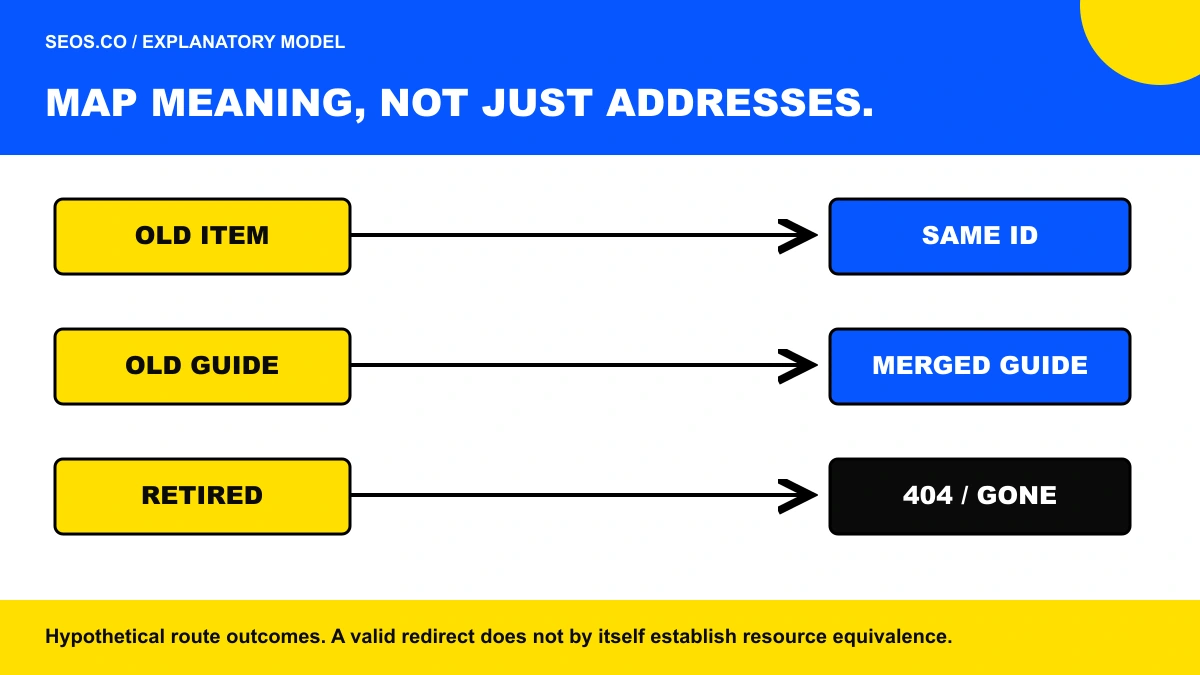
For each mapping, record the intended relationship. One-to-one replacement is different from several genuinely redundant articles merging into one stronger explanation. A retired product with no equivalent may need a meaningful not-found outcome rather than a redirect to a broad category.
Have content and product owners review ambiguous mappings. Engineering can validate that a destination exists, but only the appropriate business owner can establish whether it preserves the offer or explanation.
Keep a reason field. “Equivalent product, same manufacturer identifier” is defensible. “Closest slug” is a review flag. “Homepage fallback” is usually evidence that the mapping has not been resolved. Do not disguise unresolved cases by producing a technically valid redirect for every row.
Specify a route-level contract
A useful contract contains the old URL, intended final URL or retirement outcome, expected status sequence, destination content identifier, required facts, canonical, robots state, discovery sources, and verification owner.
Include a maximum redirect-path expectation appropriate to the implementation, ordinarily a direct route to the final destination where possible. Google's redirect guidance supports permanent server-side redirects for permanent URL changes. Do not treat a long chain as acceptable merely because a crawler might eventually follow it.
Make required content fields explicit. For an article, this could include the opening answer, substantive body, diagram captions, and cited sources. For an offer, it could include identifier, price state, availability, shipping constraints, and the actual next action.
Separate a contract failure from a pending external outcome. A wrong destination is a deployment defect. A correct destination awaiting a new crawl is a processing observation. A ranking change with no proven technical regression requires another investigation.
Test domains and infrastructure boundaries
A migration can fail before the application sees the request. Check DNS, TLS, host routing, edge rules, authentication, rate limits, and origin capacity for both old and new hosts.
Exercise the actual old host variants users and crawlers may request. An HTTP route, a www hostname, and a legacy subdomain can traverse different infrastructure. One working preferred host does not prove every variant reaches the intended destination.
Ensure the old infrastructure remains capable of serving the redirects for the planned transition. If its certificate expires or its hosting is removed, the mapping can exist in a spreadsheet while visitors receive a connection failure.
Google's move guidance also addresses domain variants in the Change of Address workflow. Use the supported tool where applicable and verify current requirements. A tool submission complements working redirects and coherent content; it cannot repair broken transport or an inaccurate destination map.
Verify content parity and intentional differences
Review site architecture when a redesign changes relationships and discovery paths as well as addresses.
Compare extracted main content by stable sections and facts. Exact hashes are useful when a body should remain identical. They are less useful when a new layout legitimately changes wrappers, ordering, or explanatory material.
Record intentional differences before launch. If an article is being consolidated, specify which unique information must survive. If product specifications move into tabs, verify they remain present and usable in the delivered and rendered document.
Check images and documents. A page can preserve its prose while losing diagrams that carry essential meaning. An old PDF may continue ranking or receiving direct links independently of its HTML landing page. Include those resources in the contract.
Review mobile content and interaction. The new page may show complete desktop content but omit tables or hide the next action on a small screen. Migration testing should preserve the visitor's actual task, not just the appearance of the top viewport.
Test crawl and index signals as one consistent set
The canonical-tag checklist helps review representative signals on the new destinations.
Review canonical declarations, robots directives, internal links, hreflang where relevant, and sitemap membership on the new destinations. These outputs should agree with the intended route map.
A staging noindex is a familiar launch hazard, but look beyond the CMS checkbox. Headers can be added by a proxy, authentication middleware can restrict public access, and cached HTML can preserve a prelaunch directive.
Google's noindex documentation explains the need for crawler access to observe the rule. Google's canonical guidance describes representative preferences. Neither should be changed casually as a substitute for resolving the destination's actual purpose.
Generate sitemaps from the approved new inventory. Update navigation and contextual links to point directly to new destinations. Redirects preserve old entry paths, but the site's own discovery graph should not depend indefinitely on the old architecture.
Include capacity and contention in launch rehearsal
A migration changes request patterns. Old URLs can continue receiving requests while new URLs are discovered and fetched. A cache that was warm on the old host may be cold on the new one.
Rehearse representative concurrent traffic with realistic content dependencies. Include redirect requests, cold destination requests, asset delivery, and background publishing. A lightweight homepage benchmark can miss the expensive product or search template.
Inspect shared locks, database pools, job queues, and cache regeneration. If a sitemap export holds a lock that destination rendering needs, one background task can produce intermittent failures even while ordinary health checks remain green.
Google's crawl troubleshooting guidance addresses overload behavior. Use appropriate response semantics during genuine incidents, but repair capacity and contention rather than trying to force activity by changing unrelated SEO settings.
A worked mapping example
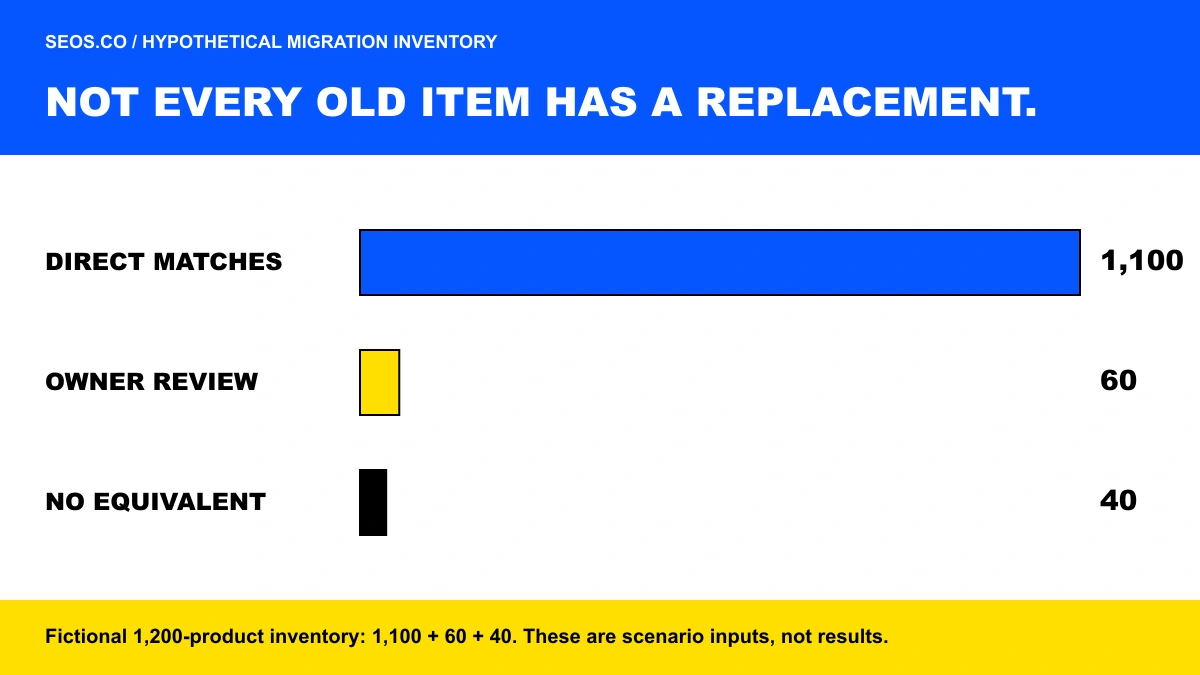
Imagine a fictional industrial supplier moving 1,200 products and 180 guides to a new path structure. The inventory finds 1,100 straightforward product matches, 60 replacements requiring owner review, and 40 discontinued items with no equivalent. Those are scenario inputs, not observed counts.
The first group can be mapped by product identifier. The second needs comparison of compatibility and offer meaning. The third should not be blindly redirected to the homepage merely to make the redirect coverage metric reach 100 percent.
For guides, the editorial team identifies 20 redundant pages that will merge into five destinations. Each merge record lists unique explanations, diagrams, and references to retain. Testing confirms those elements, not just the new titles.
The release scorecard reports resolved outcomes, unresolved mappings, failed assertions, and sampled visual checks. It does not equate “all old URLs return a redirect” with a successful migration. That distinction prevents a superficially clean spreadsheet from concealing lost content.
Stage deployment and rollback as explicit decisions
Define a launch sequence with dependencies. Destination content must be ready before old routes redirect. Public access and correct directives must be in place when the move becomes live. Discovery outputs should switch coherently with the intended release.
Retain the previous routing configuration, content snapshot, and deployment artifact. A rollback should restore a known state. Reversing a few redirects manually while other signals remain changed can create a second inconsistent migration.
Write concrete rollback triggers. Examples include widespread wrong product identities, a destination template returning incomplete content, or a critical transaction path failing. Short-term ranking fluctuation alone is not a precise technical rollback trigger.
Have the incident owner distinguish stop, repair forward, and rollback. Some faults can be corrected safely without reversing the move. Others affect enough of the contract that restoration is appropriate. Make that decision from observed impact and recovery time rather than anxiety about a dashboard.
Monitor old and new URLs together
After launch, collect request outcomes for both inventories. Old URLs should exhibit the planned transition. New URLs should deliver the intended document and user action. A decline in old-host traffic can be expected, but only if the corresponding destination path works.
Join observations by stable content identifier. Otherwise, a path change can make analytics look like a loss on the old page and a gain on an unrelated new page. Preserve the mapping in reporting so the resource remains traceable.
Segment by template, locale, host variant, and mapping class. A migration-wide average can conceal a broken product family or language region. Compare recent evidence with the baseline while accounting for reporting delay and normal demand variation.
Retain unique affected-resource counts. Repeated failures for one old URL are repeated observations of one affected resource, not dozens of separate missing pages. Report request volume and resource scope separately.
Interpret search observations without overclaiming
A successful deployment test establishes current delivery. An authentic crawler fetch establishes that the new state was observed. Indexed inspection provides evidence about processing. Search impressions, clicks, and conversions measure later outcomes with their own limitations.
Record dates and denominators. “Eighty percent of sampled important destinations show the intended indexed canonical” is interpretable if the sample and observation window are stated. “Migration complete” is too broad when only a few routes were inspected.
Google's URL Inspection documentation distinguishes live tests from indexed information. Keep both when diagnosing a disagreement. A live success does not overwrite an older indexed observation; the chronology is part of the explanation.
If traffic drops, rule out measurement changes, broken tracking, consent changes, and altered conversion events before attributing everything to ranking. Then examine affected queries and destinations. A migration can coincide with other changes, so timing alone does not identify the cause.
Common shortcuts that weaken migration testing
Do not use homepage success as a proxy for every template. Do not accept a redirect because its destination contains similar words. Do not remove old infrastructure before verifying the intended redirect service.
Avoid changing content, taxonomy, branding, and URLs simultaneously without recording each intervention. Sometimes the business requires a combined release, but the test plan should still separate the mechanisms.
Do not delete historical evidence after a clean launch day. Delayed failures, certificate expiry, stale caches, and background jobs can emerge later. The baseline and mapping remain useful operational records.
Do not promise that an error-free technical migration guarantees stable rankings. Technical consistency preserves important conditions; it does not control competing content, demand, or search-system decisions.
A route contract in a reviewable table
The following is a hypothetical mapping model. Replace the example paths and content identifiers with the real inventory before implementing any redirect.
| Old resource | Intended outcome | Required delivery check | Required meaning check |
|---|---|---|---|
| Existing product with the same replacement identifier | Direct permanent transition to its new product URL | Old route reaches the final intended destination | Model, specifications and purchase task remain correct |
| Guide consolidated into a stronger equivalent | Transition to the approved merged guide | No loop or unrelated fallback | Unique explanations, diagrams and references survive |
| Retired product with no meaningful replacement | Deliberate not-found outcome | Correct response at the requested route | No false implication that the old item is available |
| Unchanged public document | Preserve its working address or an explicit equivalent | File and access policy remain correct | Essential document content remains retrievable |
This table separates transport success from resource equivalence. A reviewer should sign off the intended relationship before engineering marks the route check complete.
Practical answers
Does every old URL need a redirect?
Every important old URL needs a deliberate outcome. A meaningful equivalent generally supports a redirect. A genuinely retired resource without a replacement may need a proper not-found response. The decision should preserve user meaning rather than maximize one coverage statistic.
How much should be tested?
Run deterministic route and content assertions across the intended inventory where access and scale permit. Visually inspect each template and material variation, plus exceptions. State exactly which checks are complete and which are sampled.
When is a migration verified?
The implementation is verified when the deployed URL contracts pass, public delivery remains correct under relevant conditions, and fresh operational evidence supports that behavior. Search processing and business outcomes require subsequent observation. A useful handoff names those remaining observations without leaving known implementation defects hidden behind a successful launch message.