
The Search Brief · News analysis
Pagination SEO: Prove Every Item Has a Crawlable Path
A graph-and-inventory audit with a 245-item worked example, explicit coverage ledger and stable segment-route checks.
Development covered: Primary-source guidance checked November 2, 2026
Pagination SEO is a discovery problem before it is a page-numbering problem. The implementation must give every intended item a stable, retrievable route and a connected path from useful collection pages. A visitor successfully scrolling through a list does not prove that non-interactive retrieval can discover the same inventory.
This guide proposes a graph-and-inventory audit for paginated lists, load-more interfaces, and infinite scroll. It uses fictional catalog examples and explicit arithmetic rather than reported search experiments. The objective is to preserve both an efficient interface and reliable discovery without manufacturing an unlimited URL space.
Define the collection and its inventory
Start with the collection's actual membership rule. Record the eligible item identifiers, ordering, visibility requirements, and update cadence. A database count alone is insufficient if the public page filters out unavailable or unpublished objects differently.
Separate a durable category from an internal search result. A category can be an important public destination with its own explanation. A visitor's arbitrary query may have no intended independent search role. Both can use pagination, but they need different publication policies.
Establish a stable collection identifier and a public route. Page numbers or cursors then represent segments of that collection, not unrelated resources. This identity helps join inventory, rendering, analytics, and discovery observations.
Google's pagination documentation describes pagination, load more, and infinite scroll as different user experiences that still require deliberate content discovery. Choose the interface according to users while preserving the underlying retrieval contract.
Model discovery as a graph
The internal-linking guide explains why inventory needs useful paths as well as URLs.
Represent collection segments and item pages as nodes. Links create edges. Begin from the public category entry points and traverse only links that a crawler can extract and request.
Compare the reachable item set with the eligible inventory set. Missing items are discovery gaps. Extra items can indicate stale membership, retired products, or an overly broad route generator.
Keep reachability separate from indexability. A reachable item can still have an intentional exclusion or a technical fault. Conversely, an item listed in a sitemap can lack a coherent human navigation path. Both observations matter, but they answer different questions.
Store shortest path depth and the sources of incoming links for diagnostics. Do not turn one arbitrary click-depth target into a universal ranking rule. The useful question is whether important content has reliable and sensible paths, especially as the inventory changes.
Give every segment a durable URL
A segment URL should work on direct navigation and reload without requiring prior scrolling, cookies, or in-memory state. The same request should expose the intended collection segment under the documented ordering policy.
For a fictional archive, /guides/?page=4 should not require visiting pages one through three first. A copied URL should preserve useful context for another visitor.
Relative time states such as “yesterday” can be unstable when used as durable segment identity. Google's lazy-loading guidance recommends persistent unique URLs for chunks and sequential discovery links.
Cursor-based APIs can serve the interface, but opaque or expiring cursors need careful treatment when used as public discovery URLs. A token that expires after a session is not a durable address. Consider stable public segments or another reliable collection path rather than exposing transient implementation state.

Use real links for discovery
Inspect the delivered and rendered document for anchor elements with usable href destinations. A button can be appropriate for a load-more interaction, but it does not automatically expose the same discovery path as a link.
Google's link best practices describe the reliable anchor-and-href pattern. Framework routing components should produce that public markup rather than relying solely on click handlers.
Extract links automatically, then fetch their destinations directly. A route can look valid in markup while the server returns an error outside client navigation. Test both the link representation and destination behavior.
Use meaningful labels and state. Visitors should understand where “next” leads and which segment is active. Keyboard and assistive-technology behavior are part of the interface contract, not optional polish after crawl checks pass.
Keep segment identity and canonical signals coherent
Review canonical-tag best practices when deciding which segment and sorting states are genuinely equivalent.
Distinct collection segments usually contain different items. Do not automatically declare every later segment a duplicate of page one simply because they share a heading and template.
Evaluate the actual main content and preferred URL policy. Sort variations, tracking parameters, and equivalent route forms are separate questions from distinct pagination segments. Google's canonical guidance concerns duplicate or similar resources, not a general mechanism for suppressing every less-important URL.
Make the current segment visible in the route and interface. Breadcrumbs can preserve the category relationship while pagination controls preserve sequence. Metadata should accurately describe the collection without manufacturing a separate keyword target for each page number.
Avoid adding unique filler paragraphs solely to make segments appear different. The item membership already supplies the meaningful distinction. Invest explanatory content in the collection's actual selection task.
Test ordering and boundary behavior
Choose a deterministic order with a tie-breaker. Sorting only by a non-unique field can cause items to appear on multiple pages or disappear between requests when equal values are returned in different orders.
A fictional catalog sorted by price can use a stable item identifier as a secondary order. The exact rule depends on the database and product requirements, but the public behavior should be explainable.
Test the first segment, a middle segment, the final segment, one beyond the end, an invalid value, and a duplicated parameter. Verify the delivered status and message for unsupported states.
Do not silently return page one for every invalid page number. That can generate many equivalent successful URLs and conceal a broken link generator. Google's HTTP status guidance provides the relevant response semantics; apply them to the intended resource behavior.
Account for inventory changes between requests
A changing catalog can shift items across numbered segments. An item inserted near the beginning can move later items backward; deletion can move them forward. Stable ordering helps but does not freeze membership across time.
Define the expected behavior for your use case. A live shopping category can accept some movement. An exported report or research archive may require a snapshot. Do not claim immutable segment contents when the application intentionally serves a live collection.
For auditing, compare the crawl against a documented inventory snapshot or a sufficiently bounded observation window. Otherwise, a legitimate inventory change can look like a missing-item defect.
Record item creation and retirement times. When an item is absent from a traversal, check whether it was eligible during the observation period. Historical gaps should remain gaps rather than being silently assigned to crawler failure.
Make infinite scroll progressive rather than exclusive
An infinite-scroll interface can enhance a durable segmented collection. The initial segment and subsequent segment URLs should remain independently retrievable, while the browser can append content for a smoother journey.
Update browser history deliberately so refresh and sharing retain useful context. Avoid rewriting the URL for every small scroll movement; the policy should reflect the primary segment the visitor is viewing.
Preserve a way to reach the footer and other page functions. Infinite loading can make navigation frustrating, especially with keyboard use or assistive technology. Test the actual task rather than assuming less clicking always improves experience.
Keep content loading independent of assumptions about human interaction when retrieval depends on it. A crawler may not scroll or click as a visitor does. The public segment graph should therefore exist even when enhancement never runs.
A worked audit: the unreachable final products
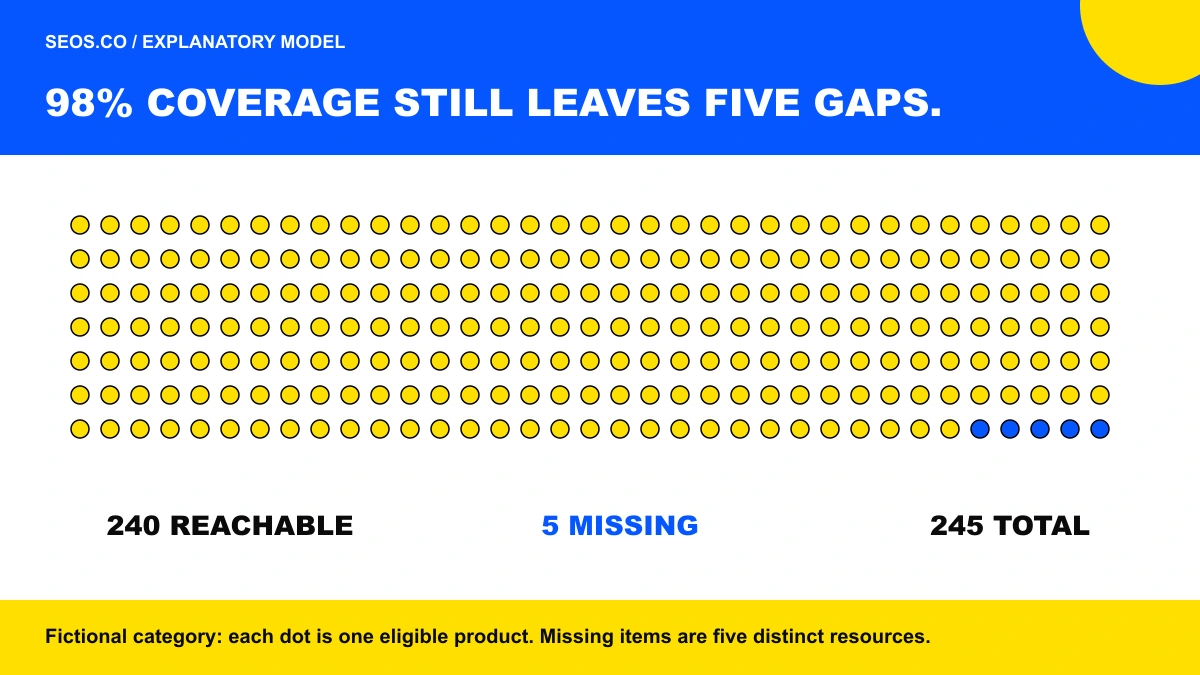
Imagine a fictional category containing 245 eligible products displayed in segments of 24. Basic arithmetic gives eleven segments: ten full segments and a final segment containing five items.
The interface loads the first ten successfully. Its next-segment control uses an incorrect condition that stops when the current count reaches 240, so the last five products never receive a collection path.
A sitemap still lists all 245 products, and the database count is correct. Those checks pass while the public graph remains incomplete. A traversal joined to the inventory reveals the five missing identifiers.
The proposed repair uses the actual next-segment availability returned by the collection query and tests the final partial segment. Verification repeats the inventory comparison and direct route checks, then confirms the interface can reach the same products. The scenario is hypothetical and does not imply a particular search impact.
Quantify coverage without inflating it
Define discovery coverage as reachable eligible item identifiers divided by the eligible inventory in the audit's stated snapshot. Report the numerator, denominator, and observation time.
In the fictional example, 240 of 245 products are reachable, approximately 98.0 percent. That percentage can sound reassuring while five independent products remain undiscoverable through the collection. Always retain the actual missing set.
Count duplicate appearances separately. A traversal that extracts 300 links may still reach only 240 distinct products. Raw link volume is not inventory coverage.
Also record segment coverage and failed requests. If one segment could not be fetched, the missing inventory may reflect an observation gap rather than a confirmed graph defect. Rerun the specific failed observation without rewriting history.
Inspect rendering and caching
Compare initial HTML, rendered DOM, and extracted links for representative segments. A server may deliver correct page-one items while hydration replaces them with a cached prior segment.
Cache keys must include meaningful segment identity. If ?page=2 and ?page=3 share a path-only cache entry, the interface can appear inconsistent or repeat products. Verify the requested segment and returned item identifiers together.
Check empty and error states. A transient API failure should not populate the normal cache with an empty successful collection. Recovery needs to invalidate or bypass the defective representation according to the system's policy.
Use a clean direct visit during testing. A warm browser may preserve previously loaded items and conceal a broken segment request. Test the data path that a first-time visitor or retrieval system actually uses.
Coordinate filters, sorting, and pagination
Changing a filter can reduce the number of segments. A visitor on page ten who selects a narrow filter may now request a nonexistent segment. Define whether the interface resets to the first segment and how the resulting URL is normalized.
Sorting can change membership order without changing the underlying collection. Keep that state separate from approved public collection identity where appropriate. Do not generate an uncontrolled cross-product of every sort, filter, and page value.
Google's faceted navigation guidance addresses the resource cost of large filter spaces. A pagination policy should cooperate with the filter policy rather than solve discovery by exposing every conceivable state.
Test parameter order, repeated values, unsupported combinations, and transitions from broad to narrow collections. The generator, router, canonical component, and cache should agree on the normalized state.
Integrate the audit with publishing
The XML sitemap checklist offers a companion inventory check without replacing the pagination graph.
Run graph-to-inventory checks after significant catalog or template changes. A new widget, merchandising rule, or pagination library can alter discovery without changing any item URL.
Record a durable audit receipt with inventory version, renderer version, start and end times, failed observations, reachable set, missing set, and exception decisions.
Do not allow a long crawl job to silently skip its next scheduled run because a stale lock remains. Monitor completion age and unprocessed inventory changes, not only whether the process is alive.
Keep the audit independent of the component it tests where practical. If the same broken pagination function supplies both production links and the expected test inventory, the test can reproduce the defect rather than detect it.
Build an independent expected set
The expected inventory should come from the publication registry or authoritative membership query, not from the pagination links being tested. Give that query its own review and save its version with the audit.
A useful comparison produces four sets: eligible identifiers, reachable identifiers, missing eligible identifiers, and reachable identifiers that should no longer be public. The last set can expose stale category caches or retirement propagation failures that a simple coverage percentage misses.
Retain duplicates as a separate multiset. An item repeated on several segments may indicate unstable ordering, an offset calculation defect, or ordinary movement during a live inventory change. The timestamps and snapshot policy help distinguish those explanations.
Bound traversal deliberately. Keep a visited-URL set, normalize according to the real routing policy, and stop on repeated states or a documented safety limit. If the limit is reached, report incomplete observation rather than declaring the remaining inventory absent.
For cursor-based interfaces, save the cursor chain and response identifiers needed to reproduce a gap. A cursor can be valid at one time and expire later, so operational evidence should include when it was issued and used. Avoid putting private tokens into public reports.
Finally, inspect a sample of apparently healthy collections. A validator can miss a shared assumption, such as an eligibility query that excludes the same legitimate product family as production. Independent review of the expected inventory is what makes the graph comparison a test rather than a mirror.
A coverage ledger for the fictional category
The article's 245-product example can be recorded without confusing link volume with unique inventory coverage.
| Measure | Hypothetical value | Interpretation |
|---|---|---|
| Eligible distinct products | 245 | Expected inventory in the stated snapshot |
| Full segments at 24 products | 10 | 240 products before the final partial segment |
| Final partial segment | 5 products | Requires an eleventh retrievable segment |
| Reachable distinct products before repair | 240 | Observed graph in this fictional defect |
| Missing distinct products | 5 | Specific identifiers to investigate |
| Coverage | 240 / 245, about 98.0% | A high percentage still conceals five independent gaps |
Save the actual missing identifier set in a real audit. A percentage alone cannot tell the team which resources need attention or distinguish a confirmed gap from a failed observation.
Practical answers
Is a sitemap enough to compensate for missing pagination links?
It can provide an additional discovery route, but it does not establish a coherent public browsing path or prove every item has been processed. Keep sitemaps and collection links accurate rather than treating one as permission to break the other.
Should later segments be blocked from crawling?
That decision depends on the collection's discovery and publication policy. Blocking the only path to important items can create gaps. First model the graph and alternatives, then choose controls with observable consequences.
What proves pagination SEO works?
Every eligible item has a retrievable route and an intended crawlable path, segment behavior is stable enough for its use case, invalid states are meaningful, and the deployed interface completes the browsing task. Later crawl, indexing, and search-performance observations add separate evidence. The implementation should be judged by reachable inventory and truthful delivery before a dashboard label declares it healthy.