
The Search Brief · News analysis
JavaScript SEO: Test the Entire Rendering Dependency Chain
A rendering-dependency audit with a field-level test table, direct-route checks and a worked cache-contention scenario.
Development covered: Primary-source guidance checked November 2, 2026

JavaScript SEO succeeds when a public URL reliably delivers its intended identity, substantive content, metadata, and discovery links across the full rendering path. A page that works after an employee signs in, warms the cache, and navigates through the application may still fail on a clean direct visit. Diagnose the dependencies that produce the page, rather than asking only whether Google can execute JavaScript.
This guide proposes a release method for application teams: define the content contract, trace the dependencies, inject controlled failures, and compare delivered evidence. The examples are hypothetical engineering scenarios. They demonstrate how to investigate, without claiming that any particular framework inherently prevents indexing.
Start with a content contract
Start a JavaScript SEO content contract by writing down what must be available at a specific public URL. For a product page, that may include the product identifier, name, substantive specifications, current offer state, representative images, category relationship, and useful links. For an article, it may include the actual article body, title, publication identity, and supporting media.
Separate required information from enhancement. A recommendation carousel can fail without changing what the page is about. A primary product API cannot fail silently while the page keeps presenting a generic success state. This distinction determines which dependencies deserve release-blocking tests.
Record the contract in terms of user-visible facts, not framework components. “ProductSummary mounted” does not prove that dimensions or availability were populated. “The extracted body contains the expected model identifier and specification values” is a more observable assertion.
Version the contract with the template. If a design moves specifications into an interaction, the contract should trigger a deliberate review of how those facts remain accessible. Otherwise, an apparently cosmetic redesign can change the content that non-interactive retrieval exposes.
Understand the stages without inventing a rendering deadline
The broader guide to how JavaScript SEO works explains the rendering and indexing context for this dependency audit.
Google documents crawling, rendering, and indexing as separate processing stages. It can execute JavaScript, but rendering may occur after the initial fetch, and not every crawler has equivalent capabilities. Server-rendered or prerendered content can therefore reduce dependencies for users and retrieval systems. Google's JavaScript SEO documentation.
That description is not a guarantee that a client-rendered page will fail or that a server-rendered page will be indexed. Use the stages to locate evidence. A successful HTML fetch establishes transport success. A rendered DOM establishes a resulting document in a particular test. An indexed observation establishes a later search-system state.
Avoid universal claims about how many seconds a crawler will wait. Instead, test whether essential content depends on unnecessary delays, long dependency chains, or actions a retrieval system may never perform. Remove avoidable fragility based on the application itself.
A practical design question is: what meaningful document exists if enhancement does not complete? If the answer is a logo and a spinner, the initial response has a very different failure profile from a document containing the core article with optional interactive tools.
Draw the dependency graph
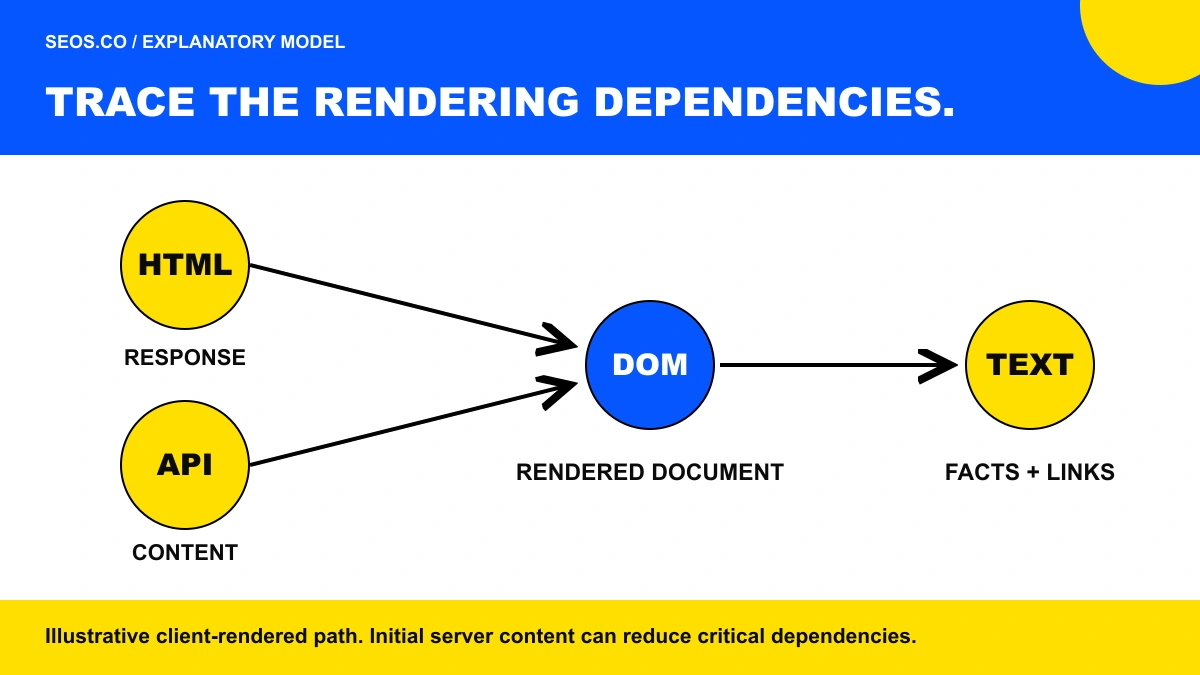
For JavaScript SEO, list the requests and state transitions needed to produce essential content. A fictional product route might depend on HTML, a JavaScript bundle, route resolution, a product API, a pricing service, and an inventory service. Some steps run in parallel; others wait on prior results.
Give each dependency an owner, expected output, timeout behavior, cache policy, and fallback. Include services that look unrelated to content but gate it indirectly. Consent initialization, experimentation platforms, localization, authentication checks, and tag managers can become accidental prerequisites.
Then identify shared points of failure. If one personalization service blocks every template, a service outage can hide most of the site even while the origin responds successfully. If content APIs share a limited connection pool with background exports, publishing activity may create intermittent empty renders under load.
The graph should show where identity is established and where it can change. A route may resolve to a stable content object on the server but be replaced by a stale client object during hydration. Capturing only the final screenshot can conceal that transition.
Compare three representations of the same URL
A JavaScript SEO comparison should retain the initial response HTML, the rendered DOM, and a text-and-link extraction from that DOM. Each answers a different question. The response reveals what was delivered before browser execution. The DOM reveals what the test environment produced. Extraction reveals whether the important meaning survives outside the visual layout.
Compare stable content fields instead of whole-document hashes alone. A timestamp, advertising slot, or randomized experiment can change the document hash without changing the article. Conversely, a shared template can remain nearly identical while the actual article body disappears.
Use a small comparison table for required fields: expected value, initial representation, rendered representation, extracted representation, and result. A missing optional widget is not equivalent to a missing product identifier. Mark the difference clearly.
Save screenshots as complementary evidence. They help locate overlays, collapsed content, and visual failures, but they do not replace document inspection. A screenshot can display text painted by a canvas or generated styling while the accessible document lacks the same information.
Reproduce direct navigation in clean state
Test JavaScript SEO through direct entry: open the URL with no previous application navigation. Use a clean session without saved authentication, local storage, or a warmed service worker. Check whether the route works after a hard reload, not just after clicking from the homepage.
Single-page applications can conceal server routing failures. The browser's in-app router knows how to display /products/model-a/, while the server returns an error for that same route on a direct request. Alternatively, every route may return the shell successfully, including nonexistent products.
Test a valid route, an unknown route, a retired content object, and a malformed identifier. Make sure the application does not present the same generic page for all four. Google's HTTP response guidance distinguishes transport responses from the content subsequently available for processing.
Repeat on the actual public host. Development environments often bypass edge rules, authentication middleware, regional routing, and caching. A local test can demonstrate a code path; it cannot establish that production delivery uses the same path.
Test assets and APIs as content dependencies
For JavaScript SEO, inspect required resource access and response types. A JavaScript URL returning an HTML login page may have a successful transport status but fail as a script. An API can return an application error inside a success response. A content endpoint may work for employees because their cookies grant access.
Record requested URL, final URL, status, content type, response size, cache outcome, and the relevant error. Inspect redirect chains. A third-party resource that intermittently redirects by geography can produce a failure that one office never sees.
Google's JavaScript troubleshooting guidance recommends inspecting rendered output, loaded resources, and JavaScript errors through supported testing tools. It also explains why client-side analytics is not a complete record of rendering activity. Use server and edge observations where available rather than declaring that absent analytics events prove no crawl occurred.
Protect private endpoints appropriately, but do not make public content depend on employee authorization. The right boundary is often an explicitly public content representation with carefully scoped data, not a broad relaxation of access controls across the application.
Stabilize metadata through hydration
Review how canonical tags work when assigning one stable route identity across server and client output.
A JavaScript SEO release check must compare the title, canonical declaration, robots rules, description, and supported structured data before and after execution. A correct response can become contradictory if a client component computes metadata from an outdated route or a default content object.
Assign ownership. The server and client may share a canonical resolver, but they should not independently invent different identities. Have both consume the same stable content identifier and routing contract. Test transitions between two similar pages so stale state becomes visible.
An initial noindex that JavaScript later attempts to remove is particularly important to investigate. Do not rely on a favorable final browser state to establish that indexing rules were interpreted as intended. Google's robots specifications and JavaScript guidance should govern the chosen implementation.
Structured data also needs a consistency assertion. If the page displays one product while JSON-LD describes the previous route, syntax validation can pass while the facts are wrong. Compare identifiers and consequential values against the visible content contract.
Make discovery work without interaction
Use internal-linking best practices to keep the extracted paths meaningful to readers as well as retrieval systems.
JavaScript SEO discovery checks should inspect links as actual document links. Google's link guidance identifies anchor elements with usable href attributes as the reliable crawlable pattern. A click handler attached to a card is not an equivalent discovery contract.
Extract all intended product, article, category, and pagination links. Confirm that their destinations resolve directly and that link text explains the destination. Test the rendered document as well as initial HTML when links are inserted during execution.
For incremental lists, verify a durable URL for each content segment and a connected discovery path. A person scrolling successfully through every item demonstrates one interactive journey; it does not demonstrate that the same inventory is discoverable without scrolling.
Google's lazy-loading guidance specifically addresses non-interactive retrieval and persistent chunk URLs. Apply those principles to the actual interface. Do not lazy-load the core title or essential opening content merely because the design system exposes one universal lazy wrapper.
Inject failures instead of waiting for an outage
Build controlled test cases for a slow content API, a missing bundle, an inventory timeout, a localization failure, and an unavailable optional service. Select the cases that correspond to the dependency graph; indiscriminate fault injection without a hypothesis creates noise.
Observe what the user receives and what the document exposes. Does the page preserve a truthful partial state? Does it show an explicit error? Does a retry duplicate content or change identity? Does a background operation hold a shared lock that blocks the request until its deadline passes?
Check recovery. A successful retry should replace the error state and preserve route identity. A failed response should not remain cached for the same duration as a complete document. A page that recovers only after a manual purge needs an invalidation repair.
Keep failure modes distinct in reporting. A deliberate not-found response for a missing product is expected. An API failure that incorrectly looks like a missing product is an execution defect. A correct rendered page absent from a delayed reporting interface is a different investigation.
A worked scenario: the catalog that rendered only after a warm visit
Imagine a fictional catalog where direct product visits intermittently show a spinner. Navigating from the homepage usually works. The application team sees the server running and the content API connected, so isolated health checks pass.
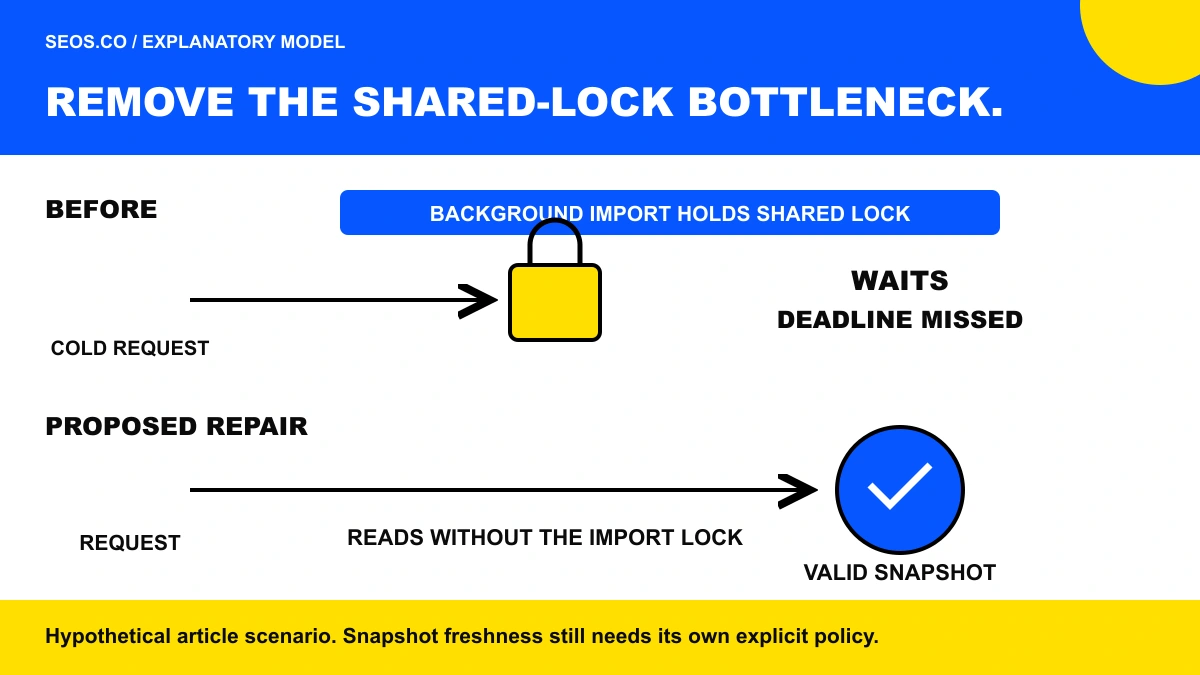
The dependency trace reveals that a category visit warms a shared product cache. Direct product requests depend on a background cache-population job holding the same lock. When a large import runs, a cold request waits past the browser's content-fetch deadline and the shell never receives the product.
The proposed repair separates request-serving reads from the long import lock and publishes a complete cache snapshot atomically. Requests can use the last valid snapshot while a replacement is prepared, with availability-sensitive fields handled according to their own freshness requirements.
Verification must reproduce the import workload and a cold direct request. Passing a normal warm request would miss the original mechanism. Fresh operational evidence should show both content availability and acceptable data age while background work runs. Only later indexed observations can establish what search systems processed.
Decide what belongs in the initial response
Essential stable content is a strong candidate for server delivery. Interactive calculators, filters, personalization, and live updates may still run in the client. The architecture should reflect content importance and failure tolerance, not a rule that all JavaScript is bad.
Evaluate the cost of moving a dependency. Server rendering can shift work to the origin and increase response latency if it waits on several slow services. Caching can improve delivery while introducing staleness. Streaming can expose useful content earlier but still needs stable metadata and clear failure behavior.
Define freshness per fact. An article's main explanation may remain valid for months. A price or stock state may have a much shorter acceptable age. Treating the whole page as one undifferentiated cache object can produce either unnecessary regeneration or stale commercial facts.
Choose the simplest design that preserves the content contract under realistic conditions. Document which facts are initial, which are enhanced, and what happens when enhancement fails. That makes JavaScript SEO an application reliability decision with observable evidence.
Release and monitoring criteria
The JavaScript SEO checklist provides a companion release inventory for the rendering checks described here.
A JavaScript SEO release should pass valid and invalid direct routes, clean-state rendering, metadata stability, required-field extraction, discovery-link extraction, and the selected dependency failures. Run the important workload case as well as the happy path.
Monitor the ratio of complete to incomplete public responses using privacy-conscious signals. Join failures to application version, template, route class, and dependency error. Retain bounded response samples so a spike can be reproduced without logging sensitive data.
Use supported search inspection tools for representative URLs after deployment, and record observation times. A successful test establishes that a specific environment rendered a page; it does not prove every crawler has processed every URL. State sample coverage honestly.
A rendered-field test table
A useful fixture specifies expected facts before running the browser. The following table describes a hypothetical test contract; it does not claim these observations were collected from a live catalog.
| Field | Expected fixture value or relationship | Initial response check | Rendered and extracted check |
|---|---|---|---|
| Resource identity | The requested product identifier | Identity is correct wherever initially emitted | Hydration preserves it; extraction identifies the same product |
| Main specifications | Known dimensions and compatibility facts | Record whether the delivery design supplies them initially | Required facts are present without a user-only action |
| Canonical | The approved public route | One coherent declaration where server supplied | No conflicting or stale replacement after hydration |
| Discovery link | A real related category or item URL | Inspect any initial anchor destination | An anchor with usable href survives rendering and extraction |
| Failure state | Truthful response when required data fails | No misleading generic product document | Error or fallback remains consistent with route identity |
Record actual observed values beside this contract rather than checking a box because the component mounted. Test both direct entry and navigation between two similar products.
A crawlable link can use ordinary HTML like the following illustrative fixture:
<a href="/products/torque-driver/">Torque driver specifications</a>
The href must resolve through the real server route. A click handler may enhance navigation, but it should not be the only place the destination exists.
Is client rendering automatically bad for SEO?
No. Reliability depends on delivery, dependencies, content access, and discoverability. Test the actual application rather than assigning success or failure by framework label.
What should be fixed first?
Fix any dependency that removes essential content, changes identity, or prevents direct navigation. Then address inconsistent metadata and missing discovery links. Performance improvements should preserve truthful, complete content rather than hide it.
What is the strongest proof of improvement?
A reproducible former failure no longer occurs, deployed responses meet the contract, and fresh operational observations remain correct under the relevant load. Indexed and search-performance outcomes are later evidence. Keeping those stages separate prevents a passing browser check from becoming an unsupported claim of full recovery.