
The Search Brief · News analysis
HTTP Errors and SEO: Diagnose Crawl Failures Under Load
A request-path diagnosis method with a failure-classification table and an explicit queue-growth calculation for a hypothetical overloaded system.
Development covered: Primary-source guidance checked November 2, 2026

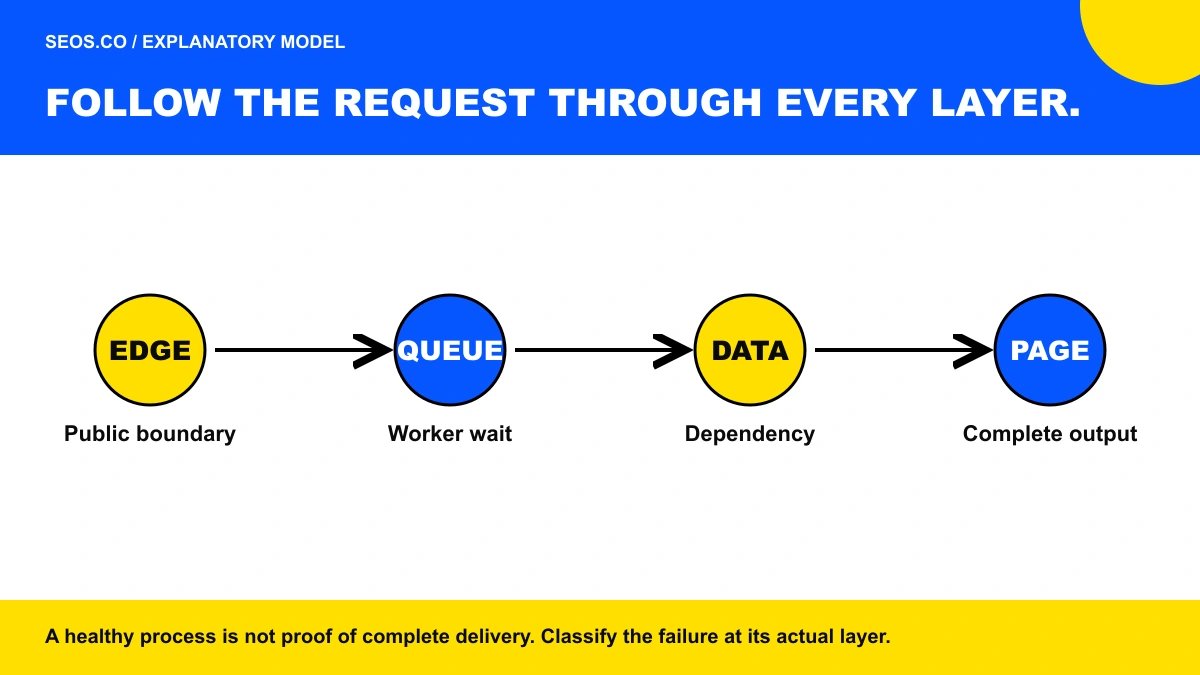
HTTP errors become an SEO problem when the delivered response prevents a crawler or visitor from receiving the intended public resource. Diagnosis must connect edge delivery, origin execution, dependencies, and capacity. A healthy application process or one successful fetch does not explain intermittent failures during a busy publishing window.
The right investigation separates expected rejection from transport failure, application failure, stale output, and reporting delay. This guide proposes an operational method with a hypothetical overloaded catalog. It does not claim that every traffic decline is caused by server errors or that repairing availability guarantees more crawling.
Start with the resource and expected outcome
Choose a representative affected URL and define what it should deliver. Record the content identifier, intended response, essential body fields, public access requirements, and normal freshness. Without that contract, a success code can hide an empty document.
Distinguish an intentionally removed resource from a temporarily failing one. A correct not-found response for a nonexistent route is not an availability incident. An existing product incorrectly returning not found because its database timed out is a defect.
Google's HTTP status documentation explains that successful responses can be considered for processing without guaranteeing indexing, and that an error-looking success response can become a soft 404. It also distinguishes ordinary client errors from overload responses.
Use those semantics to classify what happened, not to assign blame prematurely. An edge-generated error and an origin-generated error can look identical to the visitor while requiring different repairs.
Preserve observations before changing settings
Capture requested URL, observation time, final URL, response code, headers, content type, body sample, request identifier, cache outcome, and relevant deployment version. Retain the raw response where appropriate and safe.
Correlate across layers using a request or trace identifier. If the edge reports a failure but the origin has no corresponding request, investigate routing, connection establishment, access rules, or upstream termination. If the origin received it, continue through execution and dependencies.
Keep timezone handling explicit. A five-minute incident can be impossible to reconstruct when edge logs use UTC, the application uses local time, and a dashboard silently rounds to the hour.
Do not overwrite failed evidence with a later successful retry. Store retries as separate observations linked to the same resource and incident. Otherwise, the system's own monitoring can erase intermittent failures and falsely suggest the report was mistaken.
Classify failures before counting impact
Use categories that support decisions: expected policy rejection, missing resource, authentication or authorization error, rate limit, origin timeout, dependency failure, incomplete success response, stale cache, and display/reporting issue.
Count both requests and unique affected resources. One URL failing 200 times is different from 200 independent URLs failing once. Neither count alone describes user impact, and repeated monitoring evaluations should not become invented missed opportunities.
Record scope by template and route class. A product API failure may affect all products while articles continue working. A homepage health check can therefore remain green during a significant content incident.
Track incomplete successful responses as their own class. An API error caught by the frontend may leave a 200 shell with no product facts. If monitoring only counts 5xx responses, the most consequential failure can disappear from the availability report.
Separate crawl capacity from crawl demand
Review how crawl budget works before interpreting lower request volume as a capacity defect.
Google's crawl budget documentation distinguishes what a crawler can fetch from what it wants to fetch. Repairing server availability removes one limitation; it does not establish that demand will increase.
This matters when interpreting a quiet period. Lower requests can reflect response to overload, changed demand, duplicate consolidation, altered discovery, or other factors. Investigate the evidence before claiming that a server change will restore a previous request volume.
Google's crawl troubleshooting guide recommends correlating availability observations with site issues. Use the relevant reports alongside operational logs, rather than substituting one isolated dashboard for the full request path.
A useful incident report states the observed failures, the repaired mechanism, and the later request behavior separately. “Origin timeouts stopped” is a stronger supported statement than “crawl budget recovered” when only origin evidence is available.
Trace the edge-to-origin path
The redirect and HTTP guide provides context for transitions encountered along the request path.
Check DNS resolution, TLS negotiation, hostname routing, redirect rules, firewall decisions, rate limits, connection pools, and origin response. Some failures occur before application logging begins.
Review whether a verified crawler class receives different treatment from ordinary public traffic. A user-agent string alone is easy to imitate. Use provider-supported verification methods when identifying authentic crawler requests, and label simulated requests as simulations.
Inspect response generation at every layer. A security product may return a challenge page with a success status. A proxy may replace the origin's meaningful error with a branded page. A cache may serve an obsolete error after the origin recovers.
Test the actual public hostname and affected routes. Requests to a private origin address can help isolate layers, but they do not establish that public delivery is correct. Preserve both observations and explain their different scope.
Examine queues, locks, and shared dependencies
List the resources a request needs: application worker, database connection, cache read, API call, file access, or rendering service. Record wait time separately from actual execution time where instrumentation permits.
A request can spend most of its life waiting for a shared lock while the CPU remains lightly used. Adding compute without addressing contention may therefore leave the same failure intact.
Compare background work with visitor deadlines. Imports, exports, sitemap generation, cache warming, and scheduled publication may contend for the same pools. A job that runs successfully for ten minutes can still cause short-lived public requests to fail throughout that period.
Inspect restart behavior. If a worker dies while holding a lease, does the lease expire? Are queued requests retried safely? Can a stale “job running” marker suppress future work indefinitely? These are availability mechanisms even when the application process remains alive.
Use overload responses deliberately
When genuine overload occurs, return a response that communicates temporary inability rather than pretending the resource is missing. Google's HTTP guidance treats 429 as an overload signal and describes server errors separately from ordinary 4xx responses.
Do not use authentication or forbidden responses merely to slow crawling. Those statuses communicate a different condition. A broad firewall rule can convert an availability problem into apparent permanent inaccessibility.
Temporary overload handling is a containment measure. It needs an owner, time limit, recovery test, and monitoring. Leaving it active indefinitely can create a different search problem even if it protects the server.
Read the current provider guidance before implementing crawl-specific controls. Avoid assuming that all crawlers interpret every status, retry instruction, or access policy identically. The site's operational policy should preserve correct semantics for ordinary users as well.
Diagnose the cache as part of recovery
Determine which response classes are cached, for how long, and under which key. A temporary dependency failure can outlive the incident if a page cache stores the resulting empty success document.
Cache keys must reflect meaningful variants without allowing uncontrolled fragmentation. Host, locale, authorization, and selected content state can matter. Tracking parameters may not. The correct key follows the application contract rather than a universal list.
Keep a complete last-known-good representation where the content's freshness policy permits it. An article can often tolerate older explanatory text better than an empty page. A live price or inventory fact may require a different fallback.
Do not call a purge the complete repair unless the cause was a one-time operational event with a documented explanation. If the same failure can repopulate the bad cache entry, the system remains vulnerable. Test the failure and recovery sequence explicitly.
A worked scenario: healthy workers, missing catalog pages
Imagine a fictional catalog where article pages work but product pages intermittently return empty successful shells every hour. The application and database health endpoints pass. A scheduled inventory import also reports success.
Tracing shows that the import holds a transaction lock needed by the product query. Public requests wait until their application deadline, then a catch handler returns a generic shell with status 200. The edge caches that response for fifteen minutes.
The mechanism contains three defects: contention between background and request work, misleading error handling, and caching of incomplete content. Fixing only the cache shortens symptoms but leaves the producer failure.
The proposed repair publishes inventory snapshots without holding the serving path's lock, returns truthful temporary failure behavior where no valid representation is available, and prevents incomplete documents from entering the normal page cache.
Verification reproduces the import window with cold requests and controlled dependency delay. It then confirms recovery without manual intervention. The example is hypothetical; a real incident requires its own trace before assigning this cause.
Design monitoring around complete outcomes
A useful public-content probe checks more than status. It validates expected content identity and a few essential fields, then records latency and freshness. Keep the assertion small enough to be stable while meaningful enough to detect a shell.
Choose probes across templates and dependencies. One route per important content system is more informative than several cosmetic variations of the same homepage.
Run an independent observer that does not share the same lock or queue as the work it monitors. If the exporter blocks both public rendering and its own health check, the monitor may fail to record the most important interval.
Store missed observations as gaps. Do not replace an unavailable sample with a presumed success. A monitor that could not run during a busy period cannot prove that the site was healthy during that period.
Reproduce the failure under realistic conditions
Construct a bounded workload based on observed request classes and background cadence. Include cold caches, representative expensive templates, and the relevant concurrent jobs.
Change one mechanism at a time when possible. If the repair combines connection-pool changes, cache policy, and query restructuring, retain enough instrumentation to determine which former failure conditions are now covered.
Test thresholds around the observed boundary. A request that succeeds at low concurrency may fail just above a queue limit. A background job that runs quickly on a small dataset may behave differently at production scale.
Avoid claiming that a laboratory workload proves every real-world condition. State the tested traffic shape, data volume, failure injection, and observation period. Then inspect fresh deployed evidence to establish that the production path uses the repair.
Verify deployment and ongoing behavior
Use the technical SEO guide to connect availability evidence with the remaining discovery and indexing stages.
Confirm the deployed version at the actual public route. A passing test against a local branch does not establish that an active process or edge configuration contains the change.
Observe at least the next relevant background cycle when practical. If the defect occurred during hourly imports, a five-minute quiet period outside that cycle does not test the original trigger.
Compare unique affected resources and incomplete-response rates before and after on equivalent windows. Report missing data and confounding deployments. Do not use a change in total requests alone as proof of improved availability.
Check the user task. A complete product page that cannot add the intended item to the cart remains broken for visitors. Content availability and transaction completion are related but separate verification layers.
Explain remaining uncertainty precisely
If errors stop after a repair but no authentic crawler has revisited the affected URLs, say so. The delivery repair can be verified while search processing remains unobserved.
If logs were missing during the incident, preserve that limitation. Do not estimate nonexistent pages, missed crawls, or lost revenue without a defensible method. Historical gaps cannot be filled by a favorable current test.
If a traffic decline continues, broaden the investigation to discovery, indexing, canonicalization, content, demand, and measurement. Do not keep changing server controls merely because one availability defect was found.
The standing objective is reliable intended output. More requests are not inherently better, and forcing crawler activity is not a substitute for useful public resources.
Quantify the waiting window
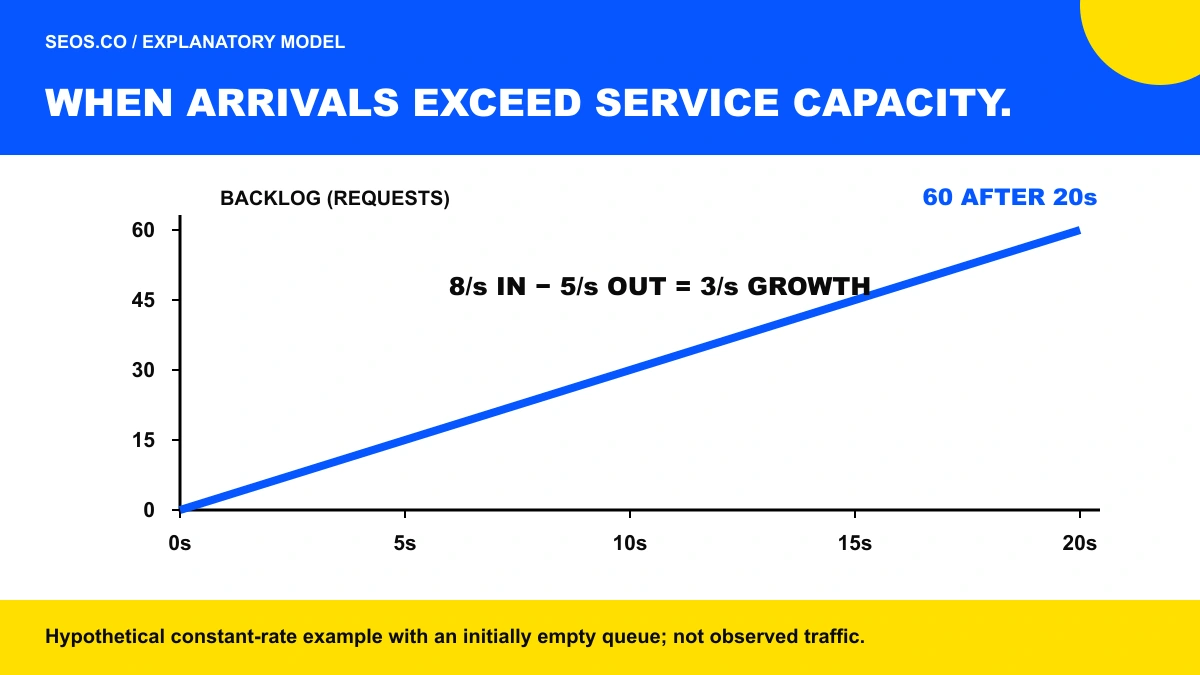
A simple capacity worksheet can make a vague overload report concrete. Suppose a fictional pool has ten workers and each request occupies one worker for two seconds. Ignoring variation and overhead, that represents five completed requests per second. If arrivals remain at eight per second, the queue grows by roughly three requests each second while those assumptions hold.
After twenty seconds, the additional backlog is about sixty requests. With no spare capacity, that backlog cannot disappear until arrivals fall or service capacity improves. A timeout may then terminate waiting clients without removing every underlying operation, depending on cancellation behavior. Measure that behavior rather than assuming the timeout frees resources.
This arithmetic is an illustrative bound, not a production sizing model. Real workloads have distributions, parallel dependencies, retries, cache hits, and burstiness. Its value is to expose which assumptions need measurements: arrival rate by class, worker occupancy, cancellation, queue length, and background consumption.
Use percentiles and time series alongside averages. A small fraction of very slow requests can occupy the pool long enough to delay many otherwise cheap requests. Separating queues or bounding expensive work may therefore improve predictability without changing the normal page's execution speed. Validate the proposed isolation with the actual workload before attributing an improvement to it.
A diagnostic classification table
Classify the observation before assigning an incident or changing crawler controls.
| Observed outcome | Plausible classification | Next discriminating check |
|---|---|---|
| Not-found response for a nonexistent identifier | Expected resource behavior | Confirm no valid resource was intended |
| Not-found response for a valid published product | Incorrect delivery or source-state failure | Compare authoritative identity and dependency result |
| Successful response containing only a spinner | Incomplete document despite transport success | Inspect required fields and failed content dependencies |
| Temporary overload response during an import | Capacity or contention incident | Correlate queue wait, shared locks and background cadence |
| Correct current page but older report state | Possible processing or reporting lag | Compare observation and crawl timestamps |
These are investigation branches, not automatic causes. Retain the actual request path and evidence before choosing a repair.
Practical answers
Is a 200 response proof that a page is healthy?
No. It can contain an empty shell, an error message, a challenge, or the wrong content. Validate identity and essential fields alongside status and latency.
Should 404 errors always be eliminated?
No. A proper not-found response is appropriate for a nonexistent resource. Investigate when valid resources incorrectly return it, when discovery generates invalid URLs, or when retirement behavior fails to preserve a meaningful user journey.
What proves an availability repair worked?
The original failure can be reproduced, the repair prevents it under relevant conditions, production uses the change, and fresh observations remain correct through the triggering workload. Later crawler and search outcomes add evidence, but a connected service or one passing probe cannot establish end-to-end recovery.