
The Search Brief · News analysis
Google Clarifies URL Word Boundaries: When Slug Changes Are Worth the Migration
Read Google's URL separator clarification without inventing a ranking update. Compare naming benefits, identity collisions and the cost of changing working URLs.
Development covered: October 23, 2026 documentation clarification; checked November 2, 2026

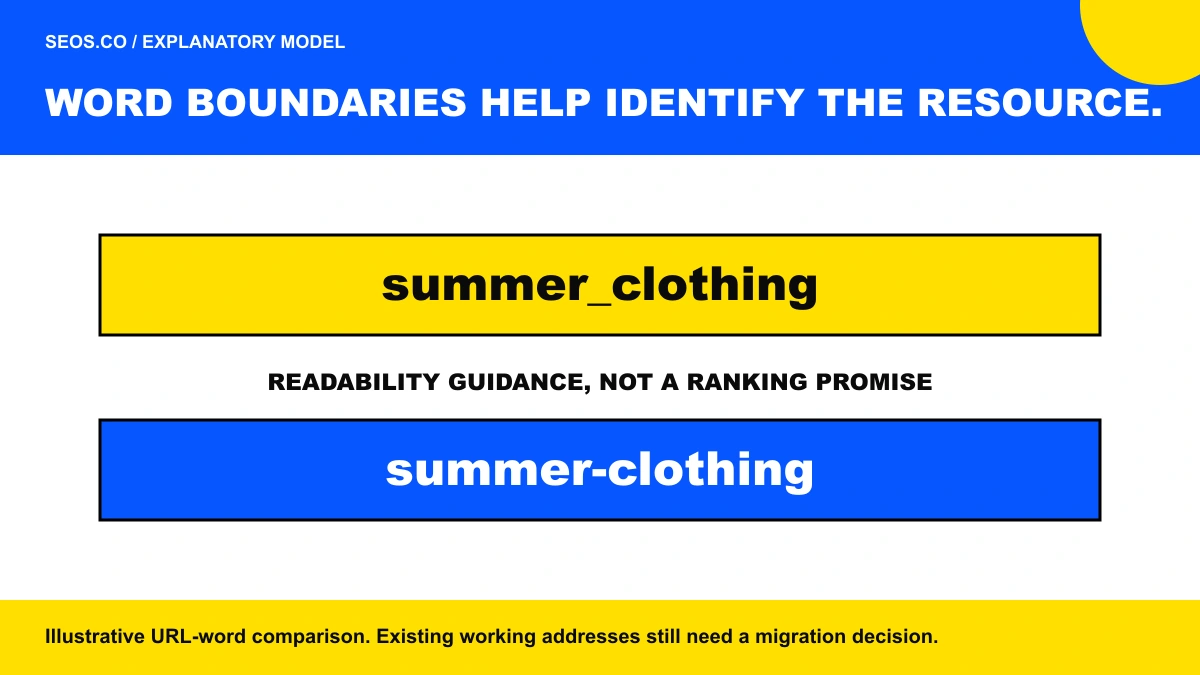
Google's October 23, 2026 URL-structure clarification supports hyphens as word separators; it does not establish that established underscore URLs should be urgently migrated. For a functioning site, the decision should weigh readability and architectural consistency against the cost of changing addresses, redirects, internal links, reporting, and external references.
The current URL structure documentation recommends hyphens rather than underscores and explains the historical distinction in how word boundaries are expressed. Google's documentation changelog describes the October item as a clarification synchronized with its explanatory video series. It does not announce a new ranking factor or quantify a ranking gain from replacing separators.
This analysis develops a decision framework for that specific change. The examples are hypothetical. They illustrate when a naming improvement can fit a planned architecture project and when the evidence supports leaving a working URL alone.
Read the change as a clarification
A documentation edit can clarify existing behavior, announce a new capability, or change a requirement. Those categories have different operational consequences.
Here, the observed update concerns word separation guidance. Treating it as proof of a sudden algorithm change would add a claim the source does not make. A page whose traffic moved that week still requires a separate investigation.
Record the source date and the exact decision it informs. “Use readable hyphenated words when creating new public slugs” follows directly from the guidance. “Migrate every underscore URL immediately to recover traffic” does not.
This distinction matters because URL changes create real work while their specific benefit may be uncertain. A sound editorial recommendation should preserve that uncertainty rather than turn a minor clarification into a mandatory emergency project.
Distinguish a new naming rule from a migration
For new pages, choosing a clear naming convention is inexpensive. The resource has no established address to preserve, and the team can generate a descriptive slug consistently.
For existing pages, a rename changes a public reference. Bookmarks, external links, campaign assets, feeds, integrations, and reporting may still use the old address. The new URL needs a meaningful transition.
Google's site move guidance describes mapping, redirects, destination preparation, and monitoring for URL changes. Those obligations remain relevant even when the only visible edit is an underscore becoming a hyphen.
Do not confuse a small textual change with a small operational scope. One character pattern can affect a million routes, while a substantial title rewrite can preserve the same URL. Scope follows the number and role of public references, not the size of the string difference.
Evaluate readability at the actual point of use
A URL can appear in search results, copied messages, printed material, browser history, analytics, and support conversations. Readability can help people identify and communicate a destination.
Compare representative strings in those contexts. A short slug with clear word boundaries can be easier to read than a long identifier or joined words. That is a usability observation to assess, not a quantified promise about search performance.
Avoid overloading slugs with every target phrase. A path should identify the resource. Repeating services, locations, and marketing adjectives can make it longer without making its purpose clearer.
Keep durable identity in mind. A title may evolve as an article is updated. A stable slug should not need to change with every headline adjustment. Descriptive does not mean the URL must reproduce the current title exactly.
Inventory dependencies before proposing renames
The site-architecture checklist helps identify route generators and public references before a naming change.
List the systems that generate, store, or consume the affected routes. Include the CMS, application router, canonical resolver, sitemap exporter, navigation, structured data, feeds, redirects, analytics, and any supported API references.
Check whether external systems depend on exact paths. A partner integration may parse a slug, even if that dependency was never formally designed. Changing the URL can reveal undocumented coupling.
Separate path separators from identifiers. An underscore inside a product code or technical identifier may carry meaning. Do not apply a global text replacement to URLs without understanding each route's semantics.
Retain the old-to-new map and stable content identifiers. If a rename is approved, every downstream verification should join by resource identity rather than assume that similar-looking slugs refer to the same object.
Use a decision table rather than a blanket rule
A new article with no prior public route usually supports the preferred naming convention directly. An established successful article with working references may justify preservation unless a broader problem exists.
A route already scheduled for a necessary architecture change can adopt the convention as part of that scoped move. A broken or ambiguous route may also benefit from correction when the user task and operational plan support it.
A route containing meaningful technical identifiers needs careful review. The separator recommendation should not erase an identifier's actual spelling or break an integration.
| Situation | Useful decision | Evidence to retain |
|---|---|---|
| New public page | Apply the agreed readable convention | Slug policy and resource identity |
| Established working page | Preserve unless a concrete benefit justifies change | Existing references, delivery and performance baseline |
| Planned necessary restructure | Include separator cleanup in the approved map | Full route contract and migration tests |
| Identifier-bearing route | Review semantics before editing | Identifier rules and consumer dependencies |
The table is a proposed operating framework. It is not a provider scoring system or a claim that any row guarantees a search outcome.
Keep canonical signals coherent if a move is justified
Review canonical-tag best practices when the approved route changes.
When a resource changes address permanently, the old and new routes need a consistent relationship. Update internal discovery and preferred URL signals rather than relying on one isolated tag.
Google's redirect documentation recommends permanent server-side redirects for permanent URL changes where possible. Its canonical guidance describes the signals used to express representative preferences.
Verify the final destination contains the intended resource. A redirect to a broad category or homepage may technically work while losing the specific explanation or offer.
Avoid a chain of historical separator cleanups. If an older URL already redirects to a route being renamed, review whether it can point directly to the final intended destination. Preserve the complete map so the repair does not strand older references.
Do not use the clarification to explain an unrelated decline
If traffic changes around October 23, begin with the actual onset, affected queries, pages, and delivery evidence. A coincident documentation update is not causal proof.
Check measurement changes, indexing, canonical selection, availability, content changes, and competing results. A separator migration could itself introduce errors, so changing URLs before diagnosis may make the original issue harder to understand.
Compare affected and unaffected route classes. If both hyphen and underscore pages decline similarly, that weakens a simple separator explanation. It does not establish another cause, but it guides the next investigation.
Preserve historical evidence. A current successful response cannot prove what a crawler received during the decline. Missing logs should remain a stated limitation rather than becoming a confident story about an algorithm preference.
A worked decision: 400 established guides
Imagine a fictional publisher with 400 established guide URLs using underscores. They have coherent canonical declarations, working navigation, and no observed route-level delivery problem. The team reads the clarification and proposes replacing every underscore.
The proposed benefit is cleaner word separation. The operational scope includes 400 mappings, redirects, sitemap changes, navigation updates, analytics continuity, and review of known external references. No source provides a quantified gain for this particular inventory.
A defensible decision could preserve the existing routes and apply hyphens to new pages. If a necessary taxonomy restructure is planned later, the team can reconsider the convention within that project.
Another publisher might have ambiguous joined-word slugs, inconsistent generators, and a planned CMS move. There, adopting a coherent convention can be part of a justified architecture repair. The decision depends on the actual problem, not a universal command to rename.
These are hypothetical decisions, not reported outcomes. They show why the same documentation can reasonably inform different actions on different sites.
Quantify implementation cost honestly
Estimate the number of unique resources, route generators, integration classes, and test cases affected. Do not count repeated redirects as separate content opportunities.
Identify one-time and ongoing costs. Mapping and launch testing are one-time work; maintaining old redirects and monitoring references can continue afterward.
Leave ranking benefit unquantified when no defensible evidence supports it. A business can still choose readability or consistency as a benefit, but those should be named directly rather than converted into invented traffic projections.
Use a rough decision worksheet: concrete user benefit, architecture benefit, evidence confidence, implementation effort, failure impact, and rollback feasibility. The worksheet helps compare options without pretending to calculate a scientifically precise return.
Test the generator before multiplying the convention
A slug policy should define word separation, case handling, reserved characters, transliteration where applicable, collision handling, and stability after publication.
Test meaningful boundary cases. Titles can contain punctuation, symbols, repeated words, non-ASCII characters, or only a product identifier. Two titles can normalize to the same slug.
Do not silently change an existing slug when a title changes unless the publication workflow intentionally performs a migration. Keep public identity and editable headline separate.
Google's URL guidance also addresses encoding and parameter conventions. Apply current supported rules, then test the actual router. A visually clean slug can still fail because of decoding, case sensitivity, or inconsistent normalization.
Preserve language and identifier meaning
Use the audience's language where appropriate, but do not assume every non-English route must be transliterated into English. The correct choice depends on the site's audience and established architecture.
Keep percent encoding and Unicode normalization consistent across generation, storage, links, and routing. Two strings that look identical can differ internally, which can produce duplicate or inaccessible paths.
For technical products, retain recognizable model identifiers when they help users. A general separator preference should not mutate a meaningful code into a different identifier.
International variants need their own coherent identity and alternate relationships. A separator cleanup should not accidentally remove locale prefixes, merge distinct markets, or redirect every language to the default version.
If you proceed, stage the change as a controlled release
Use the redirect checklist to verify old entry paths and final destinations.
Freeze the intended mapping and preserve baseline responses. Prepare the new destinations before switching old routes. Verify content identity, public access, canonical declarations, internal links, and sitemaps.
Test representative legacy forms, including older redirects and relevant parameters. A rule based only on the current preferred path can miss historical entry points.
Define rollback conditions around observable failures: wrong resource, missing content, redirect loops, inaccessible destinations, or broken user tasks. Short-term ranking movement alone is not a precise technical trigger.
After deployment, confirm the active process and delivery layer use the new rules. A correct map in a repository does not prove that cached public responses have changed.
Monitor resources across the old and new addresses
Join reporting by stable content identifier so the same article remains traceable across the move. Otherwise, the old URL can appear to lose all visits while the new one looks like an unrelated page.
Separate redirect success, destination availability, crawler observations, indexed selection, and visitor outcomes. They are different stages of evidence.
Use URL Inspection where available for representative indexed and live observations. Retain crawl and observation dates rather than treating an older indexed view as a current delivery failure.
Do not declare a separator convention successful because a handful of new URLs appear in results. A useful evaluation includes the original reason for changing them and the complete operational scope.
What teams can do now without renaming anything
Document the convention for new routes. Audit whether different generators follow it. Find accidental duplicates, unstable title-driven renames, and ambiguous identifier handling.
Review high-value existing URLs only when there is a concrete issue or planned project. This keeps the clarification connected to useful work without manufacturing a sitewide emergency.
Educate editors about title and URL independence. A clearer headline can often be published while preserving the established address. That avoids turning routine editorial updates into unnecessary moves.
Record the source review date and revisit the policy if provider guidance or the site's architecture materially changes. A stable convention is easier to maintain than repeated reactions to every documentation edit.
Test collisions before approving a convention
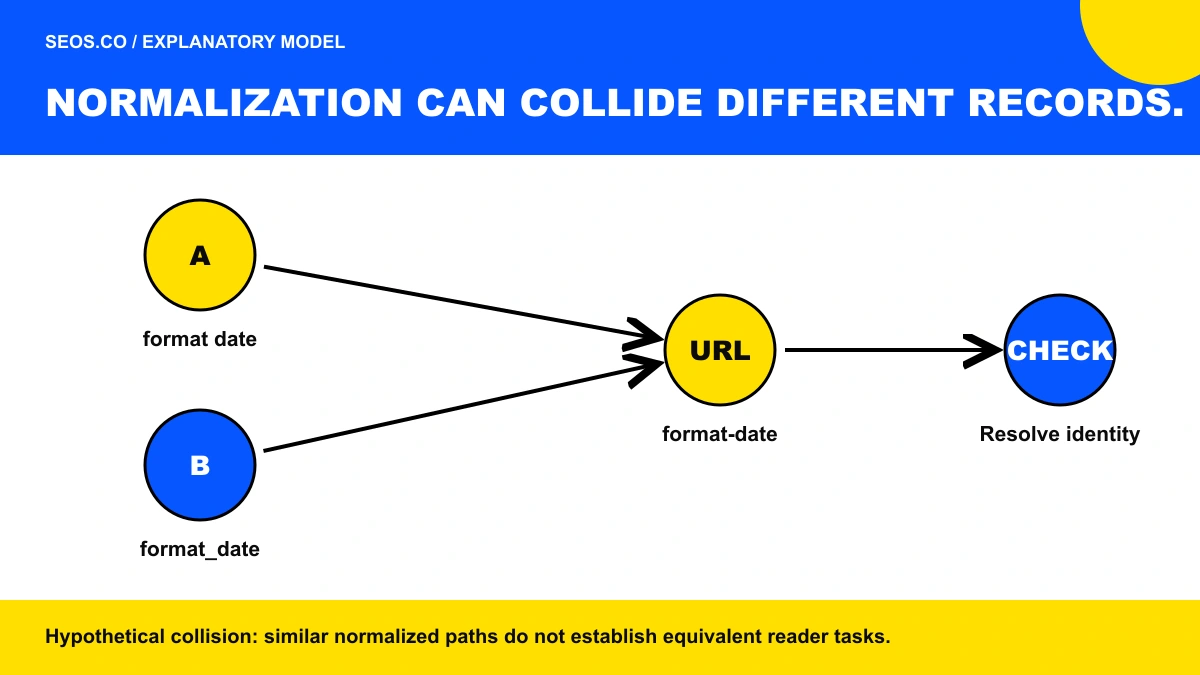
Separator changes can create collisions when different legacy strings normalize to the same path. A migration generator should group proposed destinations and flag any destination claimed by more than one independent resource.
For example, two fictional records called “format date” and “format_date” might represent a natural-language guide and a programming identifier. A simplistic normalizer could turn both into the same slug even though their reader tasks differ. The mapping needs a deliberate resolution rather than whichever record writes last.
Check redirects for loops and self-targets after normalization. A broad rule that changes underscores to hyphens can interact with an older application rule that restores an internal identifier spelling. Each rule can look sensible alone while the combined route oscillates.
Use the public router as the test boundary. A string transformation unit test cannot establish what an edge redirect, CMS rewrite, and application route will do together. Preserve the sequence of responses for representative conflicts.
Finally, reserve approved public slugs before publication where the platform supports it. That prevents concurrent imports from choosing the same destination and silently adding unstable numeric suffixes. Naming consistency is useful when it preserves identity; it becomes harmful when the convention overrides the resource model.
Practical answers
Did Google announce a new hyphen ranking factor?
The cited October item is a documentation clarification about URL word boundaries. It does not quantify a new ranking effect or establish that underscore pages suddenly became ineligible.
Should working underscore URLs be changed?
Only when a concrete user or architecture benefit justifies the operational move. Apply the preferred convention to new pages, and evaluate existing routes in their real dependency context.
What is the useful next action?
Choose representative new and existing routes, document a stable slug policy, and identify genuine generator inconsistencies. If a move is warranted, use a complete URL contract. The clarification is valuable guidance for naming; it is not evidence that every established address needs to change.