
The Search Brief · News analysis
Google’s October UGC Spam Guidance: Indexation Must Follow Publication Intent
Turn Google's October UGC guidance into a publication-state contract. Separate sharing, public search eligibility, moderation and actual delivered controls.
Development covered: October 26, 2026 documentation update; checked November 2, 2026
Google's October 26, 2026 update to its UGC spam prevention guidance makes a practical distinction for platforms: a page created for direct sharing is not automatically a page intended for search discovery. The operational response is to assign publication intent at creation, make that state control delivered directives, and monitor the resulting public URL inventory.
The revised Google UGC spam prevention guide discusses shared pages, generated outputs, and interactive tools alongside more traditional user content. It recommends appropriate default indexing or crawling controls for pages intended for direct access, plus monitoring of creation, indexing, and abuse patterns. This is guidance about controlling exposure and abuse, not an announcement that every platform-generated page has become spam.
The following framework is editorial analysis for platform and SEO teams. It uses hypothetical workflows to show how a publication policy can become testable software. It does not claim that a particular set of controls guarantees rankings or prevents all abuse.
The important change is the boundary between sharing and publishing
A user can create a document, dashboard, conversation, calculator, or temporary page and share its link with a colleague. That action establishes a sharing intent. It does not necessarily establish consent to public search discovery or demonstrate that the result provides a useful independent destination.
Many platforms blur those states because both produce an accessible URL. The database stores a visibility flag, the frontend renders a page, and the sitemap job later treats every accessible object as publishable. An SEO problem then appears downstream even though the originating product decision was ambiguous.
Separate at least three questions: who can access the resource, whether the owner intends public discovery, and whether the resource has passed the platform's publication requirements. These are different states. An unlisted page can be publicly accessible to anyone with its link while remaining outside the intended search inventory.
Make the distinction visible to the owner in plain language. A control labeled “Share link” should not quietly perform the same action as “Publish for public discovery.” Product copy, authorization behavior, and indexing behavior should agree.
Design publication as a state machine
Review site architecture when separating link-shared utilities from the approved public inventory.
A proposed state model might include private draft, link-shared, pending public review, public approved, quarantined, and retired. The exact names can vary, but transitions need owners and consequences.
For each state, specify access requirements, crawler access, indexing directive, sitemap membership, internal discovery, and moderation status. A pending page should not become publicly promoted merely because an asynchronous job has not yet finished reviewing it. The safe default should follow the intended policy.
Transitions need atomicity where several outputs depend on the same decision. If approval updates the database but the page cache still serves a noindex response, intended publication is delayed. If quarantine removes a sitemap entry but cached HTML remains indexable, the exposure persists.
Use a publication version or event identifier so every consumer can report which decision it has processed. That makes it possible to distinguish an intentional policy state from a stale cache, delayed job, or failed invalidation.

Understand the limits of search directives
The indexing guide explains why crawler access and indexed appearance need separate evidence.
Noindex is an indexing instruction that supporting crawlers must be able to fetch and read. Robots.txt controls access to URLs and is not a reliable way to ensure an already known page disappears from search. These are separate mechanisms described in Google's noindex documentation and robots.txt introduction.
A platform therefore needs an explicit transition plan when changing an existing public URL to an unlisted state. Merely adding a disallow rule may prevent observation of the removal instruction. Record the selected mechanism, the expected observation, and the actual indexed result where accessible.
Neither mechanism protects confidential material. Private content requires authentication and authorization at the resource and data layers. Search exclusion cannot prevent someone with access from retrieving or sharing an exposed URL.
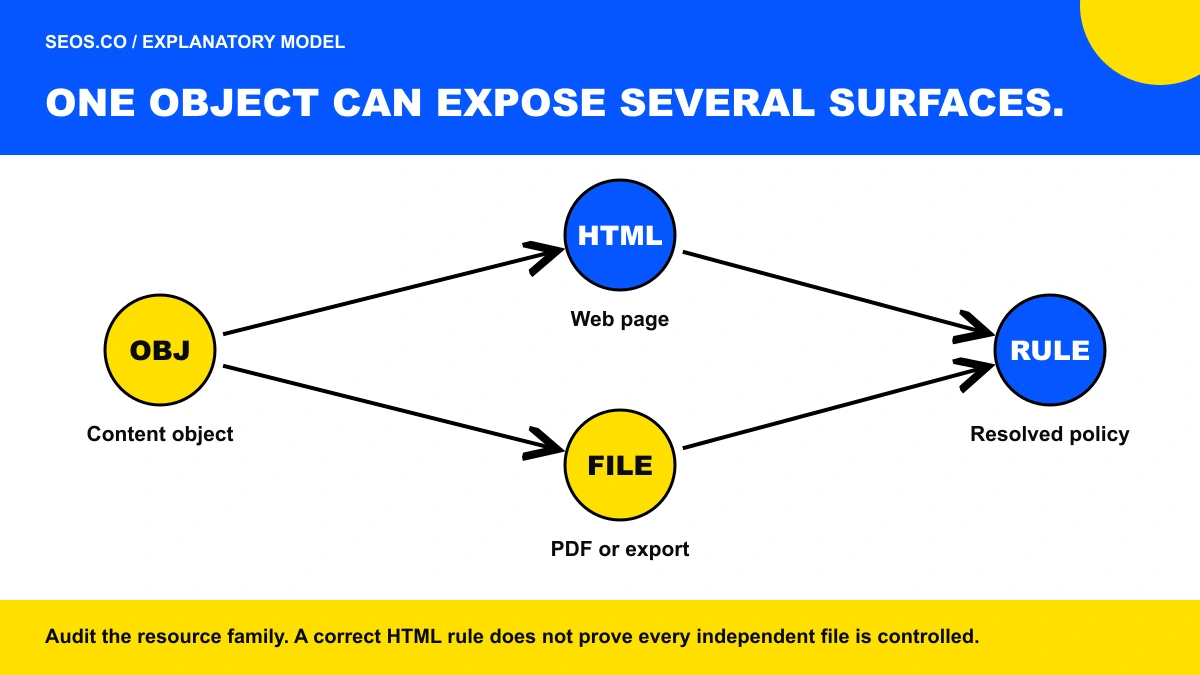
Apply policy to every representation. An HTML page can correctly declare noindex while a PDF export, preview endpoint, or alternate hostname exposes the same content differently. Inventory the resource family rather than testing only the most visible route.
Threat-model the creation path
Begin where users create public objects. Identify anonymous creation, new accounts, established accounts, bulk import, API submission, templates, cloning, and third-party integrations. Different entry points may bypass different checks.
A fictional collaborative-page platform might moderate its web form but allow its import API to publish directly. Another might limit individual creation while permitting one template to generate thousands of derivative URLs. A review limited to the ordinary browser form would miss both paths.
Record the actor, object, publication state, source channel, and rate context. Avoid collecting more personal data than the operation requires. The goal is to identify abuse patterns and reproduce unexpected publication, not to build an unrestricted surveillance record.
Test permissions at the server boundary. Hiding a “publish” button from a new account is insufficient if the underlying endpoint accepts the same state transition. The authorization check should enforce who may promote an object into the searchable inventory.
Use reputation as an input, not an exemption
Account age or prior activity can inform review, but no single reputation score should bypass all checks. Established accounts can be compromised, transferred, or automated. New accounts can also publish valuable legitimate content.
A practical policy combines signals with explicit publication requirements. For example, a new account may need review before public promotion. An established account may publish directly until unusual creation volume or a content-policy violation triggers a hold.
Keep the reason for a hold observable to operators. “Rule P17: newly public object with repeated outbound destination pattern” is actionable internally. “Low trust” without evidence makes appeals, debugging, and tuning difficult.
Measure false positives as well as detected abuse. Review a bounded sample of held content and record why it was released or rejected. Otherwise, a stricter system may appear successful because it suppresses legitimate publication along with spam.
Build moderation into the publication workflow
Moderation needs a queue with durable ownership, retry behavior, and recovery after interruption. A task that exists only in process memory can disappear during a deployment while the content remains public.
Record one job per object version, not one job per repeated evaluation. If a page is retried ten times, that is still one publication decision until its content changes. Deduplication prevents inflated moderation counts and conflicting outcomes.
Define what happens when the reviewer or service is unavailable. A pending-public state should remain pending according to policy. Do not silently promote content because a timeout occurred unless the business has explicitly chosen that behavior and accepts its consequences.
Human review and automated checks can complement each other. Automation can detect known patterns and route cases. A reviewer can assess context and genuine usefulness. Neither should fabricate certainty about content that has not actually been inspected.
Monitor the public inventory, not just requests
Count new searchable objects by creator cohort, creation channel, template, and publication state. Compare those counts with approved publication events. If public URLs appear without corresponding approval events, the inventory pipeline has a gap.
Track the concentration of new URLs. A small number of accounts producing a large share of newly searchable objects can be a useful investigation signal, but it is not proof of abuse. A legitimate import or organizational rollout can produce the same pattern.
Join public inventory observations with indexing and performance reports where available. Unexpected query themes or rapid growth in indexed URL classes can help locate an issue. Those signals are delayed and incomplete, so they should complement platform-level records rather than serve as the only detector.
Retain representative URLs and timestamps when an alert fires. A dashboard that says “publication spike” without the affected objects forces the incident team to reconstruct evidence after the content has changed or disappeared.
A worked scenario: the unlisted page that entered the sitemap
Consider a hypothetical platform offering link-shared project summaries. The product interface calls them unlisted. The HTML initially includes noindex, but a nightly sitemap exporter selects every object with a public URL.
A later template update moves robots directives into a client component. On an API timeout, the component never inserts the rule. The sitemap continues advertising the objects, and search reports eventually show unfamiliar query themes.
This is not one isolated tag defect. The full path includes ambiguous publication semantics, an overbroad export query, fragile directive delivery, and monitoring that waited for search exposure. Repairing only the client component leaves the other mechanisms intact.
The proposed fix creates a distinct approved-public state, generates directives from that state in the initial response, restricts sitemap selection to approved objects, and alerts when delivered pages disagree with the registry. Verification includes direct requests, failed API conditions, a nightly export, and a restart during queued work.
The example illustrates a failure mechanism, not a reported incident. Real platforms should reproduce their own path before claiming the same cause.
Handle quarantine and retirement deliberately
When content is quarantined, distinguish an access restriction from a search removal request. The correct behavior depends on whether the material is harmful, private, invalid, or simply outside the public-search policy.
Preserve evidence before destructive cleanup. Retain the minimum necessary content version, publication events, moderation reasons, and response observations under the platform's retention rules. Deleting every trace can make it impossible to understand how the exposure occurred.
Retired legitimate pages need an outcome appropriate to their purpose. A replacement may justify a meaningful redirect. A removed object may require a proper not-found response. A temporarily unavailable resource may need a different status. Avoid a global rule that sends every removed page to the homepage.
Google's HTTP status documentation explains how response classes affect processing. Apply the relevant semantics, then confirm the platform actually delivers them through its cache and edge layers.
Keep outbound-link handling separate from publication approval
Use internal-linking best practices to preserve coherent discovery paths for genuinely approved content.
Untrusted user links can require appropriate relationship attributes, but link attributes do not make an otherwise abusive page useful. Likewise, an approved page can still contain links that need accurate relationship disclosure.
Store the link relationship with the content where possible, then render it consistently across web pages, previews, and exports. A sanitizer that strips attributes during one transformation can undo the intended behavior.
Inspect the delivered result, not just the editor's stored markup. Rich-text processors, Markdown renderers, and link decorators may each modify links. A small set of representative fixtures can reveal where relationship information is lost.
Google's link best practices cover crawlable links and relationship annotations. Treat those as part of a broader content contract that includes honest context, useful destinations, and visible meaning.
A release checklist that tests the boundary
Test one object in each publication state through direct navigation, API access, preview, export, sitemap generation, and public listing. Confirm that every surface derives behavior from the same versioned state.
Exercise transitions: private to shared, shared to approved, approved to quarantined, quarantined to restored, and approved to retired. Repeat one transition after an interrupted job to verify idempotency. Check cached and uncached delivery so stale promotion cannot survive unnoticed.
Inspect mobile controls and keyboard behavior as well. Owners must be able to understand and change publication intent. A correct backend state machine is incomplete if the interface makes a public-publishing action look like a private share.
Record whole-inventory checks separately from sampled visual checks. A handful of screenshots cannot establish that millions of objects have correct directives. Conversely, an inventory query cannot demonstrate that the owner-facing control communicates the right meaning.
What SEO teams should ask product and engineering
Ask who owns public-search eligibility and where that decision is stored. Ask which jobs consume it, how long they may lag, and what happens when they fail. Ask whether a page can become indexable through an alternate route without the intended transition.
Ask how creation and moderation cadence compare. If public objects appear immediately but review runs once a day, the platform has chosen an exposure window. That may be unacceptable for its risk model even if each component works exactly as configured.
Ask what evidence demonstrates recovery. A correct response today proves delivery now. Fresh crawler observations and indexed reports answer later questions. Do not call historical exposure resolved merely because a setting was changed.
Finally, ask whether legitimate public content still has a coherent path to readers. Abuse prevention should preserve useful approved publishing, with clear review and restoration paths. Otherwise, a successful suppression metric can conceal a broken product.
A publication-state contract
The following is a proposed platform policy model. Access and search eligibility are separate fields, not one visibility flag.
| State | Access decision | Search publication decision | Required transition evidence |
|---|---|---|---|
| Private draft | Authorized users only | Outside public search inventory | Resource and data authorization |
| Link-shared | According to the sharing policy | No automatic public-search approval | Delivered policy matches the sharing state |
| Pending public review | According to the product policy | Not promoted before required review | Durable moderation decision and version |
| Approved public | Public access intended | Eligible for intended discovery | Page, listings and sitemap consume approval |
| Quarantined | Appropriate restriction for the actual issue | Remove public promotion according to policy | State change propagates and is observed |
Use the same versioned decision across consumers. A successful database write is not proof that every public representation has received it.
Practical answers
Does the October update mean all generated pages should be noindexed?
No. The relevant distinction is purpose, usefulness, and publication policy. A generated resource can be valuable, while a link-shared utility may have no intended search role. Assign that role explicitly and verify the delivered behavior.
Is robots.txt enough for unlisted content?
It controls crawling, but it is not privacy protection and does not by itself establish removal of a known URL. Choose the mechanism according to access and indexing goals, and preserve evidence that it was observed.
What is the first useful action?
Inventory every way an object becomes publicly accessible and compare it with the approved searchable inventory. Any mismatch gives product, engineering, and SEO a concrete boundary to repair. The October guidance is most useful when it becomes a clear, testable publication contract rather than another setting applied after exposure.