
The Search Brief · News analysis
Google Updates Search Sharing Controls: Build a Directive Policy by Content Type
Match access, indexing, snippets and Search-AI participation to the right controls. Audit scope, inheritance, files and cached delivery before claiming success.
Development covered: October 21, 2026 documentation refresh; checked November 2, 2026
Google's October 21, 2026 sharing-controls documentation refresh is a reason to audit which control serves each publishing goal. Removing a resource from search, limiting a preview, excluding generative Search features, restricting crawling, and protecting private information are different decisions. A blanket “block AI” or “hide from Google” setting can obscure those differences.
The updated control-what-you-share guide brings existing options together, including robots metadata, data-nosnippet, response headers, and the Search generative AI control. The refresh does not mean every listed mechanism was newly introduced that day.
This analysis proposes a policy model for publishers and product teams. It focuses on selecting, implementing, and verifying the intended control. Hypothetical examples are labeled; no account setting is changed by this article, and no ranking outcome is promised.
Start with the intended outcome
Write the goal in ordinary language before selecting a technical mechanism. Examples include “only authorized customers can open this document,” “this public utility should not appear in search,” or “keep the page searchable but exclude one passage from snippets.”
Those statements imply different enforcement boundaries. Privacy must be enforced when the resource is requested. Indexing instructions are interpreted by supporting retrieval systems. Preview restrictions govern how retrieved information may be presented.
Add the affected scope. A passage, page, file, directory, property, and whole site are not interchangeable. An account-level change can affect more content than an editor intended.
Record who owns the decision and who implements it. Editorial, product, privacy, search, and infrastructure teams may share responsibility, but one person or role needs to resolve contradictory requirements.
Separate access control from search exclusion
Private information needs authentication and authorization. A public URL carrying noindex remains retrievable by people and systems that can access it. Search exclusion cannot make an exposed resource confidential.
Test authorization at the data boundary as well as the page. A protected HTML route can still reference an unprotected PDF, image, export, or API response.
Use an access matrix with anonymous, authorized, unauthorized, and expired-session states. Verify the actual response and content for each. A hidden link or disabled button is not equivalent to server-side enforcement.
Google's sharing guide explicitly distinguishes password protection from search directives. Apply that distinction throughout the resource family, including alternate hosts and preview endpoints, rather than only on the primary page.
Choose indexing behavior for public resources
The indexing guide establishes the processing context behind these public-resource decisions.
A resource can be public without being intended as a search destination. Internal search results, shared utilities, temporary outputs, and duplicate views need deliberate treatment according to their purpose.
Noindex is an instruction that supporting crawlers must be able to fetch and observe. Blocking access before observation can prevent the instruction from being read. Google's noindex documentation explains that dependency.
For an existing indexed resource, write a transition plan. Record the prior state, desired state, selected mechanism, expected observation, and actual result. Do not infer removal solely from a setting in the CMS.
Keep urgent removal workflows separate from the long-term source policy. A temporary search-result removal request does not by itself repair the underlying public exposure or establish the desired future indexing behavior.
Use preview controls at the appropriate granularity
A publisher may want the page to remain eligible while controlling how much text or media appears in previews. That is a different goal from removing the page entirely.
Google's robots and snippet specifications describe page-level rules and data-nosnippet for supported text elements. The same documentation explains interactions and limitations, so consult the current specification before applying a broad rule.
Define which passage needs control and why. Do not wrap the entire main article in a passage-level exclusion merely because one sensitive quotation requires different treatment. Conversely, do not assume a narrow passage rule protects information in image text, exports, or other representations.
Preserve valid markup. A malformed or unclosed wrapper can extend the intended boundary and exclude more text than expected. Test both the delivered and rendered document around the affected section.
Understand the Search generative AI control separately
The current Search Console help page documents inclusion, exclusion, and inheritance for Search generative AI features. It distinguishes this control from AI training and from inclusion in other parts of Search.
That distinction should appear in the internal policy. A business decision about generative Search visibility is not automatically a training preference, a crawler-access rule, or a decision to remove ordinary web results.
Inventory the properties and inheritance that affect the intended scope. A child property can have a different effective setting from the parent. Record the effective choice rather than only the top-level account screenshot.
Do not make a sitewide change merely because one page needs different preview handling. Choose the smallest supported scope that fulfills the actual goal, and verify its current documented behavior before implementation.
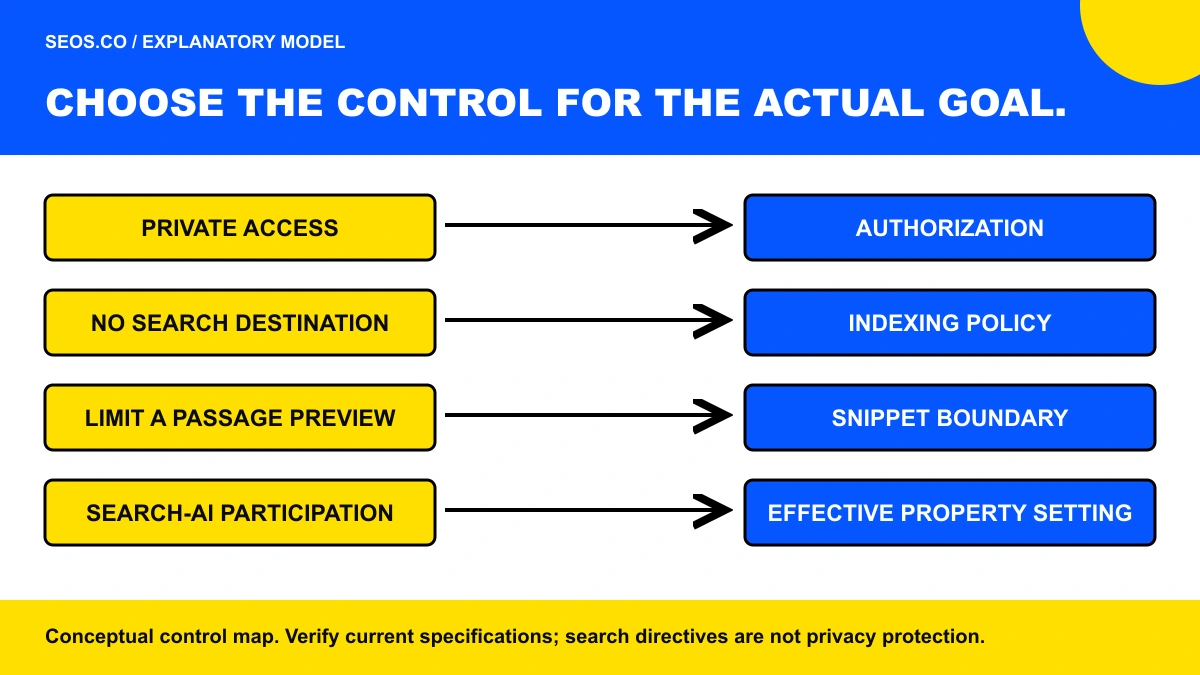
Build a control matrix
Create one row per resource class and intended outcome. Include access, indexing, previews, generative Search participation, training preference, and owner as distinct fields.
For a hypothetical publisher, public analysis articles may allow ordinary discovery and selected previews. A link-shared planning tool may remain public to its recipients but outside the intended search inventory. A customer report may require authorization regardless of search settings.
| Resource class | Primary goal | Enforcement boundary | Verification |
|---|---|---|---|
| Customer report | Authorized access only | Resource and data authorization | Anonymous and unauthorized requests fail appropriately |
| Public utility | Direct use without search discovery | Supported indexing policy | Delivered instruction and later indexed observation |
| Public article passage | Limit specified preview text | Valid passage-level markup | Exact boundary in response and rendered document |
| Site Search-AI participation | Implement the owner's participation choice | Effective supported property setting | Scope, inheritance and later feature observations |
This is a proposed design matrix, not a substitute for the provider's current specification. Its purpose is to prevent one vaguely named control from silently serving several incompatible goals.
Assign one source of truth for directives
A CMS plugin, theme, edge header rule, and client component can all emit restrictions. If they independently decide policy, the public result may be more restrictive or contradictory than any individual owner expects.
Store the intended policy in a versioned registry or equivalent authoritative configuration. Let the relevant renderers consume it. Keep representation-specific implementation separate from the underlying decision.
Record overrides explicitly. A page exception should state its reason, owner, scope, and review condition. Hidden overrides in template code are difficult to audit and can survive long after the original need ends.
Generate a resolved policy view for each resource. Operators should be able to see which source contributed each effective rule. A single CMS checkbox cannot explain a conflicting response header added by infrastructure.
Apply controls to files and alternate representations
Use the indexing checklist to review representations that a page-only audit can miss.
HTML metadata cannot govern every independent file merely because that file is linked from the page. PDFs, images, video, feeds, and exports may need their own delivery policy.
The robots specification documents response-header mechanisms for appropriate non-HTML resources. Verify the actual public response for each file class rather than assuming the CMS setting propagates.
Check generated derivatives. A protected original can have a publicly cached thumbnail or text extraction. A correctly controlled web page can link to an older export with different rules.
Map the resource family by stable object identifier. That helps an audit find every representation when policy changes. Without the map, teams often fix the obvious page while leaving alternate access paths unexamined.
A worked scenario: the article stayed searchable but lost its useful preview
Imagine a fictional publisher wanting to exclude a short licensed passage from snippets. A template-level change applies a page-wide restriction to every article using that component.
The pages remain accessible and the editors see the passage-level requirement as completed. Later, the team notices that useful previews have disappeared more broadly. The error lies in scope selection, not necessarily in crawling or content quality.
The proposed repair removes the unintended page-wide rule and applies a valid boundary to the specific passage. The policy record distinguishes the licensed excerpt from the surrounding original analysis.
Verification compares the effective response headers, document metadata, passage wrapper, and rendered output. Later search observations can show how presentation changes after processing. The example is hypothetical; a real preview change requires its own evidence before assigning this cause.
Test contradictions across delivery layers
The JavaScript SEO checklist provides companion checks when rendering can change delivered directives.
Fetch the public resource and retain headers plus body. Inspect all applicable metadata, not only the first tag a crawler reports. Compare response and rendered states where client execution can modify the document.
Test clean sessions and relevant variants. Authentication, locale, host, and cache state can alter the effective policy. A private editor preview is not the same response as an anonymous public request.
Google's specifications describe how conflicting restrictions are interpreted. Use that guidance, then repair the source of the conflict rather than adding a permissive tag that may not override a restrictive one.
A simulation with a chosen user agent can help reproduce delivery rules. It does not prove that an authentic provider fetched or processed the same output. Keep operational delivery evidence separate from provider observations.
Verify cache invalidation and propagation
When policy changes, identify which caches can retain the prior response. Include full-page caches, edge delivery, file storage, and generated derivatives.
A correct origin response does not prove that public delivery has converged. Record cache outcome, response age where available, and content version during verification.
Do not continually toggle controls to force visible change. Repeated changes make the observation timeline difficult to interpret and can leave different systems on different versions.
Define an expected internal propagation window for the site's own infrastructure. External processing has separate documented expectations and uncertainty. Distinguish a site cache failure from a provider that has not yet revisited the resource.
Preserve historical evidence during an incident
Capture the effective policy, scope, affected resource set, and public responses before changing them. Keep the minimum appropriate record under the organization's retention rules.
Count unique affected resources, not repeated evaluations. One mistaken template restriction can create many failed checks on the same set of pages. Report both resource scope and request observations without inflating them into invented lost opportunities.
If historical responses were not retained, state that gap. A current configuration cannot prove what users or crawlers received during an earlier period.
Separate the incident outcome from commercial attribution. A preview restriction can plausibly affect presentation, but a revenue estimate needs actual measurement and a defensible method. Do not turn technical scope into a fabricated loss figure.
Measure the intended consequence
For privacy, verify unauthorized access is prevented. For public indexing exclusion, verify delivered instructions and later indexed observations. For snippet control, inspect the relevant presentation with query and observation context.
For generative Search participation, record effective settings and use the relevant reports or observations within their limitations. A zero count can reflect several conditions, including eligibility, demand, processing, or reporting coverage.
Keep training preferences outside these outcome metrics. A search-visibility report cannot prove compliance with an unrelated training control.
Define review dates for exceptions and changes. A temporary licensing condition or campaign may end, while a forgotten restriction continues. Policy maintenance should follow the actual reason for the control.
An implementation packet teams can review
A useful change packet contains the requested outcome, affected resource classes, authoritative policy record, chosen mechanism, exact scope, known interactions, implementation owner, and rollback condition.
Add representative before-and-after responses, file checks, rendered boundaries, and account-scope evidence where applicable. State which observations cover the entire inventory and which are samples.
Keep a short explanation for editors. They should understand the practical effect of the control they select without needing to interpret every technical token.
The October documentation refresh is most valuable when it produces this clear contract. A list of available controls is only the beginning; reliable publishing depends on choosing the correct one and verifying the real output.
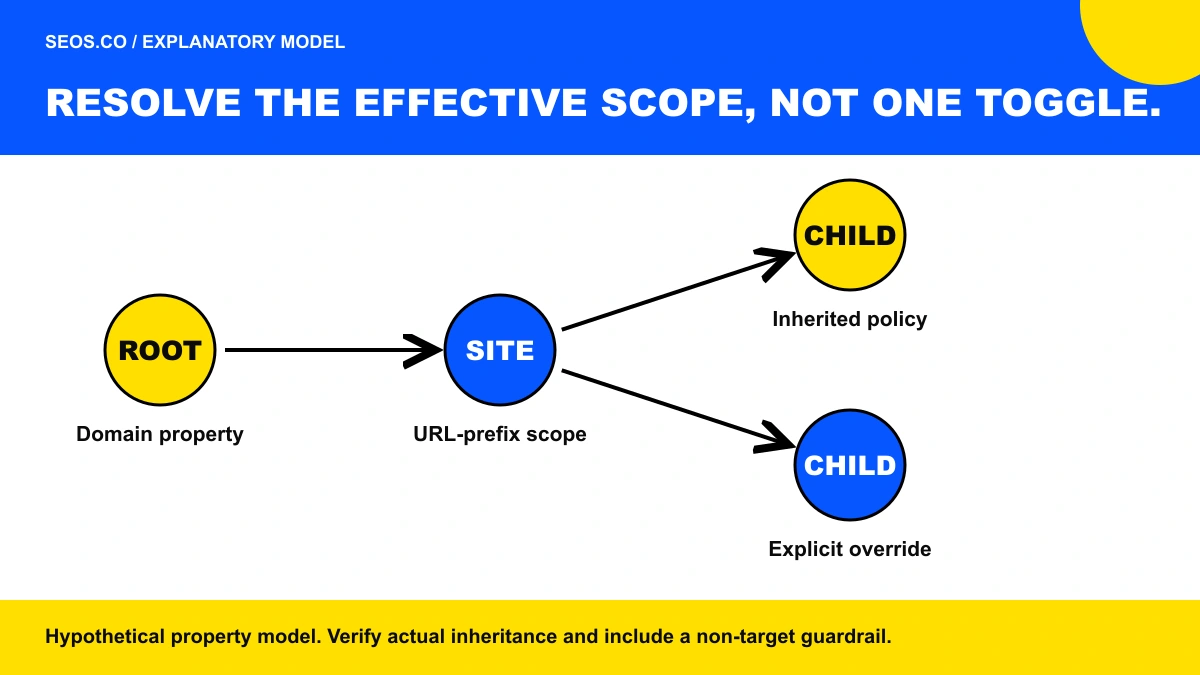
Resolve scope with a concrete example
Consider a hypothetical organization with a domain property, a main-site URL-prefix property, and a nested research-section property. The intended business policy applies to the research section only.
Before changing anything, list the three properties and record each one's explicit choice, inherited source, effective choice, owner, and observation time. The important output is the resolved state for representative research and non-research URLs.
Then check an unrelated section as a guardrail. A configuration change that fulfills the research requirement but also changes the store or support center has exceeded the intended scope.
If the organization later changes its parent policy, review the child override deliberately. An old explicit exception can remain effective while operators assume everything inherits the new parent decision. The registry should make that difference visible.
This example is a policy-resolution exercise, not an instruction to create additional properties or change a live account. Use the current supported scope and inheritance rules for the actual property structure.
The same reasoning applies at page level. A reusable component may need a passage restriction in one article without imposing it on every page that uses the component. Keep the policy attached to the specific content instance when that is the intended boundary.
A guardrail test should therefore include both the requested target and a nearby non-target. Testing only the target can prove that a restriction was applied while missing that it was applied too broadly.
Practical answers
Does blocking crawling guarantee removal from search?
No. Crawling control and indexing exclusion serve different purposes. Choose a transition that allows the relevant instruction to be observed, and verify the later result rather than relying on the configuration alone.
Is the Search generative AI control an AI-training control?
The current help documentation distinguishes them. Record the business decision for each separately and implement the supported mechanism that matches it.
What should be audited first?
Start with one important resource from each policy class and resolve its effective controls across access, headers, HTML, files, caches, and account settings. Then expand by shared implementation. Search controls work best when their scope and evidence are explicit, rather than hidden behind one ambiguous toggle.