
The Search Brief · News analysis
Google Documents Search Profile Badges: Audit the Identity Journey Before Adding One
Verify a claimed Search profile and its identity journey before adding a badge. Test accessible placement and report clicks separately from follows and discovery.
Development covered: September 16, 2026 documentation introduction; checked November 2, 2026
Google's September 16, 2026 Search profile badge documentation gives publishers a way to direct existing readers to a claimed Search profile. Before adding the badge, verify the destination identity, choose a placement that fits the reader's task, and measure clicks separately from follows or later discovery.
The Search profile guide describes a profile as a destination bringing together content across the web and social platforms. It says following can make linked content more likely to appear for that audience in Discover. That is not a quantified traffic guarantee, a universal ranking boost, or proof that every badge click creates a follower.
This analysis proposes an implementation and evaluation framework. Examples and calculations are hypothetical. No profile is claimed, message sent, or account setting changed by the article.
Understand the action the badge invites
A badge on the publisher's website is an invitation to visit a profile. The visitor may inspect it, follow it, leave, or take another action.
Keep those stages distinct in product language and measurement. Labeling an outbound click as “follow completed” would claim an action the website may not observe.
Explain the value in terms of the actual audience relationship. A reader interested in the publisher's work across channels may find a unified profile useful. Someone trying to complete an urgent service task may not benefit from another promotional control in the way.
The badge should support a relevant next step rather than displace the page's main purpose. Placement and surrounding copy matter more than simply adding another icon to every template.
Verify the profile belongs to the intended identity
Check the claimed profile through the actual official workflow and confirm its public destination. Do not infer ownership from a similar handle or familiar display name.
Review the linked channels and site identity. A profile containing outdated, unrelated, or incorrect destinations can send readers away from the intended publisher.
Record a stable internal identity owner and the approved public URL. Display names can change, and a manually typed handle can introduce mistakes.
Keep personal and organizational identities distinct. An author profile, publication profile, and corporate profile can serve different purposes. The correct destination depends on which identity the page actually represents.
Separate Search profiles from Preferred Sources
Search profile following and selecting a publication as a Preferred Source are different user actions with separate documentation.
Google's Preferred Sources guide describes its own supported features and implementations. Do not label one badge as if it performs the other action.
If both are present, make the labels clear and follow the applicable brand guidance. Two similar icons without explanatory text can confuse readers about what each does.
Measure them as separate journeys. Combining their clicks into one “Google followers” metric would hide the difference in destination and user intent.
Choose placement from reader behavior
The content SEO strategy guide connects an audience invitation with the reader's actual page task.
Consider bylines, article endings, author pages, about pages, newsletters, and channel directories according to the real use case. A placement should appear where a reader has a reason to continue following the work.
Avoid interrupting the opening answer with an oversized promotion. The page first needs to fulfill the task that brought the reader there.
Test whether the control competes with a more important action, such as booking, purchasing, or accessing a document. The appropriate prominence can differ across editorial and commercial templates.
Keep the visible label specific. An unexplained logo can be less useful than a concise text link that states the destination. The official documentation includes a text-link alternative, so an image badge is not the only possible implementation.
Follow the official asset guidance
Use the supported assets and current brand rules for the badge itself. A site's own visual style does not authorize distorting a third-party identity mark or making the action look like an endorsement.
The Search profile guide includes guidance on logo integrity, accessible targets, and distinguishing the control from Preferred Sources. Verify the current requirements before shipping.
Keep promotional artwork separate from the functional badge. An editorial feature image can use the publisher's creative style, while the actual control must accurately communicate its official destination.
Do not generate a lookalike official badge merely because it matches the site's palette better. Use the documented option or an appropriate text link and preserve clarity.
Implement a normal, inspectable destination
A straightforward anchor link can be easier to validate than a complex click handler. The public destination should remain visible and correctly encoded.
Store the approved URL in one maintained configuration rather than repeating hand-typed handles across templates. That reduces drift when an identity changes.
If a component constructs the URL from a handle, validate the input and constrain the host. Do not let an arbitrary user-controlled value turn the badge into an open redirect or unrelated outbound link.
Test the final rendered href, not only the configuration. Template escaping, localization, and link decorators can alter the output.
Preserve accessibility and usable context
The control needs a meaningful accessible name, adequate target size, visible focus, and understandable behavior. A screen-reader user should know where the link leads.
Avoid using an empty alt attribute when the image is the only content identifying a functional link. Conversely, do not repeat the same label redundantly through several nested accessibility mechanisms.
Test keyboard navigation, zoom, high-contrast conditions where relevant, and a narrow viewport. A badge can be visually attractive while becoming too small or clipped on mobile.
If the link opens a new browsing context, use the site's established and accessible convention. Do not surprise the reader merely to protect an analytics session.
Define a measurement funnel
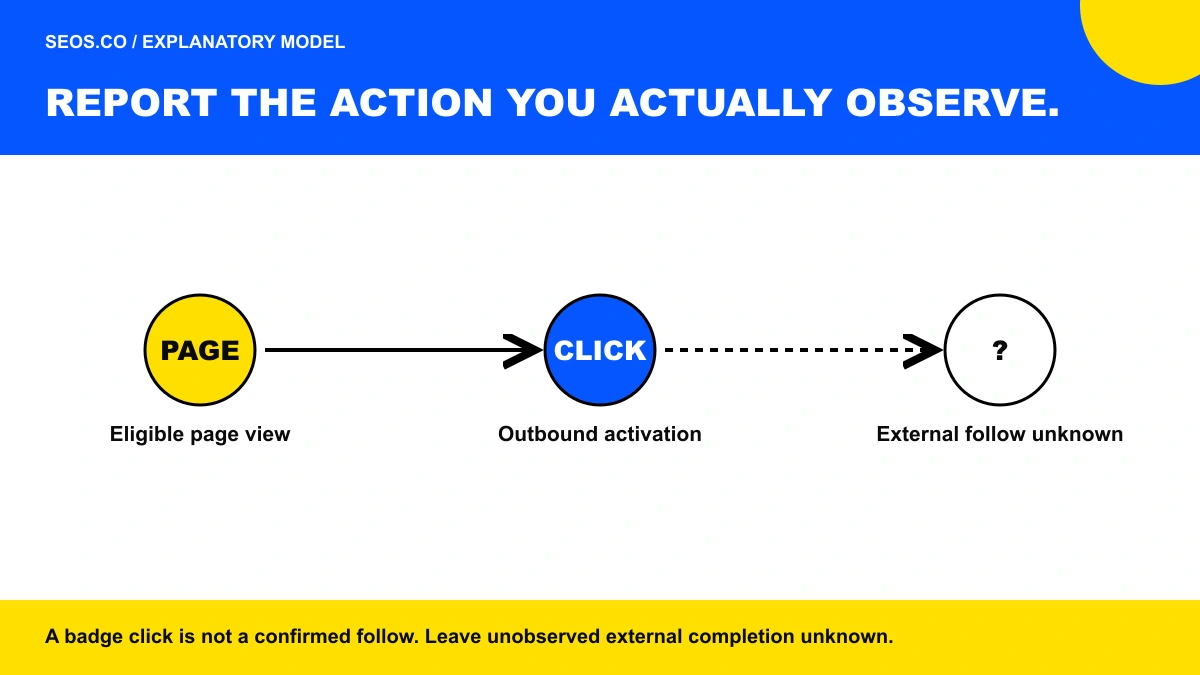
A proposed funnel can separate eligible page views, badge visibility where measured, outbound clicks, observable profile actions if legitimately available, and later referred visits.
Only populate stages the available systems can actually observe. An external action may remain unknown. Do not infer it from the preceding click.
Record placement, template, device, and campaign version with privacy-conscious event data. Avoid capturing unnecessary personal identifiers or unrelated user behavior.
Keep event names literal. “search_profile_click” is a clearer description than “new_follower” when the website only observed a click.
A hypothetical click-through calculation
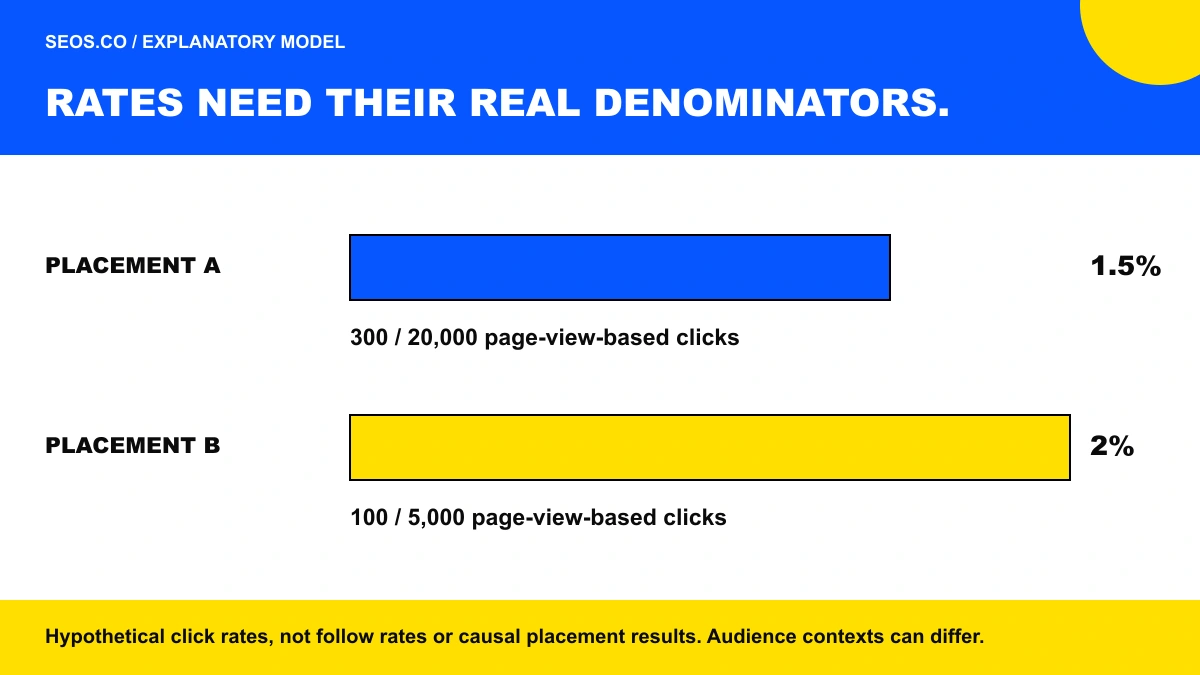
Imagine a placement receives 20,000 eligible page views and 300 outbound badge clicks during a defined interval. The page-view-based click rate is 1.5 percent.
That is not a follow rate. If no verified follow-completion data is available, the number of new followers remains unknown.
Suppose another placement receives 5,000 views and 100 clicks, a 2 percent click rate. It may have a more engaged audience or different page context. The higher rate does not automatically prove the design caused better performance.
Retain numerator, denominator, interval, and audience context. The scenario numbers are invented to teach the calculation, not a benchmark for publishers.
Evaluate placement with appropriate controls
If testing placements, define the intervention and desired outcome before launch. Change a bounded set of variables and retain comparable audience groups where practical.
Do not move the badge, rewrite the article, launch a newsletter promotion, and redesign the header simultaneously, then attribute every difference to the badge.
Track guardrails such as task completion, page usability, accidental clicks, and performance. A more prominent control may produce more clicks while making the primary journey worse.
A small experiment can support a local decision without establishing a universal best placement. Preserve sample limitations and avoid precise causal claims from unstable data.
Do not infer Discover impact from one favorable result
A follower relationship and later content exposure are different stages. Discover behavior depends on context and other factors outside the publisher's control.
Record the available reporting and its limitations. A rise in Discover traffic after adding a badge can coincide with new content, seasonality, news demand, or other distribution changes.
Compare appropriate periods and content cohorts. A single viral article can dominate a site-level trend and obscure whether the broader audience relationship changed.
The official guide's description of following is useful product information. It is not permission to promise a fixed percentage increase or guarantee that every future article reaches every follower.
A worked implementation failure: the wrong handle in one template
Consider a fictional publication with a correct Search profile link in its footer. A separate author template contains a manually copied handle from an old staging example.
Most checks pass because the homepage footer is correct. Readers entering through author pages are sent to an unrelated destination.
The proposed repair centralizes the approved identity configuration, validates every component's rendered href, and tests representative templates rather than only the homepage.
Verification includes direct entry, mobile layout, localized templates, and a future configuration change. The scenario is hypothetical; it illustrates why a tiny badge still needs a complete identity and delivery path.
Test route and asset failures
Check a missing badge asset, an unavailable configuration value, an invalid handle, and a blocked external navigation where relevant.
The page should remain usable if the badge image fails. A meaningful accessible label or text alternative can preserve the intended action.
Do not substitute a generic homepage or unrelated profile when the configured identity is missing. A visible omission or operational error is preferable to a misleading destination.
Monitor the maintained destination periodically as part of the site's normal identity upkeep. Profile and channel changes can outlive the original developer who added the control.
Keep the profile's content relationships current
Related analysis of social and video channel measurement separates channel visibility from owned-site outcomes.
A unified profile is only useful if its linked channels genuinely represent the intended publisher. Audit rebrands, retired social accounts, migrated domains, and changes in organizational ownership.
Maintain a source-of-truth identity record that connects the official website and approved public channels. Do not let a marketing campaign's temporary destination become the permanent identity by accident.
Review who can change the profile and badge configuration. Access should match the organization's actual ownership and editorial responsibilities.
Preserve change history. If readers report an incorrect destination, the team needs to know what changed, when it became public, and which templates consumed the old value.
A release packet for the badge
Use the page-speed checklist when checking asset loading and layout behavior around the new control.
A compact packet can include the verified profile URL, identity owner, chosen asset or text option, intended placement, exact accessible label, tracking event definition, and representative render checks.
Add desktop and mobile screenshots plus the final rendered href. Confirm the page's primary action still works and that the control does not create layout shift or obscure content.
Record the source review date and any unobserved external stages. A click event can pass testing while follow completion remains outside available measurement.
The packet makes a small change concrete without pretending it requires a complex growth program. The useful standard is a correct identity journey with honest measurement.
Write a literal event contract
A small event contract prevents reporting from claiming more than the site observed. For a hypothetical publisher, the event can include the approved profile destination, placement identifier, template class, device class, experiment version, and event time.
Do not include the reader's Google account, personal profile, or other information the website does not legitimately possess. The measurement should describe the site's own interaction.
| Reported field | What it can establish | What it cannot establish alone |
|---|---|---|
| Eligible page view | A page carrying the placement was viewed | The badge was noticed |
| Measured badge visibility | The chosen visibility condition was met | The reader understood or wanted the action |
| Outbound click | The site observed activation of the profile link | A follow was completed |
| Confirmed external action, if available | The supported system observed that action | Every later exposure was caused by the badge |
| Later referred visit | A visit arrived through an observable route | Incremental long-term audience growth |
The contract should specify duplicate handling. Repeated clicks from one page visit may be separate interactions, but they should not automatically become separate acquired followers or people.
Test the analytics callback under blocked scripts and navigation timing. An event can fail to send when the link navigates away, or it can fire twice if both a component and a global listener observe the same click. Neither condition should be mistaken for audience behavior.
Interpret self-selection carefully
People who choose to visit or follow a publisher's profile may already be more interested in its work. Comparing their later activity with everyone else can therefore exaggerate a causal effect.
A placement experiment can help answer whether one invitation produces different observed behavior under the test conditions. It still may not identify the effect of following itself if completion remains unobserved or users choose whether to act.
Keep the question narrow. “Did this placement increase observed profile-link clicks without harming the article task?” is answerable with the site's own data. “Did the badge cause all later Discover growth?” generally requires more evidence.
Record content launches, major news events, other promotions, and changes to the profile during the evaluation. Those can influence both clicks and later traffic.
A modest but well-defined result is more useful than a dramatic claim built from incompatible stages. The point of the badge is to help readers continue a genuine relationship; the reporting should preserve that meaning.
Practical answers
Does adding the badge improve rankings automatically?
The cited documentation does not establish a universal ranking boost. The badge directs readers to a Search profile and supports an audience relationship; later visibility and business effects require evidence.
Can badge clicks be counted as followers?
Only if a supported, legitimate observation actually confirms the follow action. Otherwise, report outbound clicks as clicks and leave the external completion stage unknown.
What should publishers do first?
Verify the profile identity and linked channels, then test a relevant placement with clear labeling and literal event measurement. The September documentation is most useful when the badge leads to the right identity and its results are described accurately.