
The Search Brief · News analysis
SEO Case Study Checklist: Verify Agency Traffic and Revenue Claims Before You Hire
Verify the baseline, revenue definition, release date and attribution behind an SEO agency case study.
Development covered: Guidance reviewed November 22, 2026

An SEO case study that promises a 200 percent increase can describe growth from one sale to three, or from ten thousand sales to thirty thousand. It can describe revenue credited by an analytics model, revenue booked in a CRM or cash retained after refunds. Before you compare agency results, establish the unit, starting value, period, source and business decision behind the percentage. A credible provider should be able to explain the calculation without revealing a client’s private details.
The best use of a case study is to decide whether a team can diagnose, implement and verify work under conditions similar to yours. The reported outcome is part of that decision. So are the starting inventory, approvals, development capacity, paid media environment and length of the sales cycle. A result can be genuine while telling you very little about what a provider can accomplish on a different account.
Which five numbers should appear beside the headline?
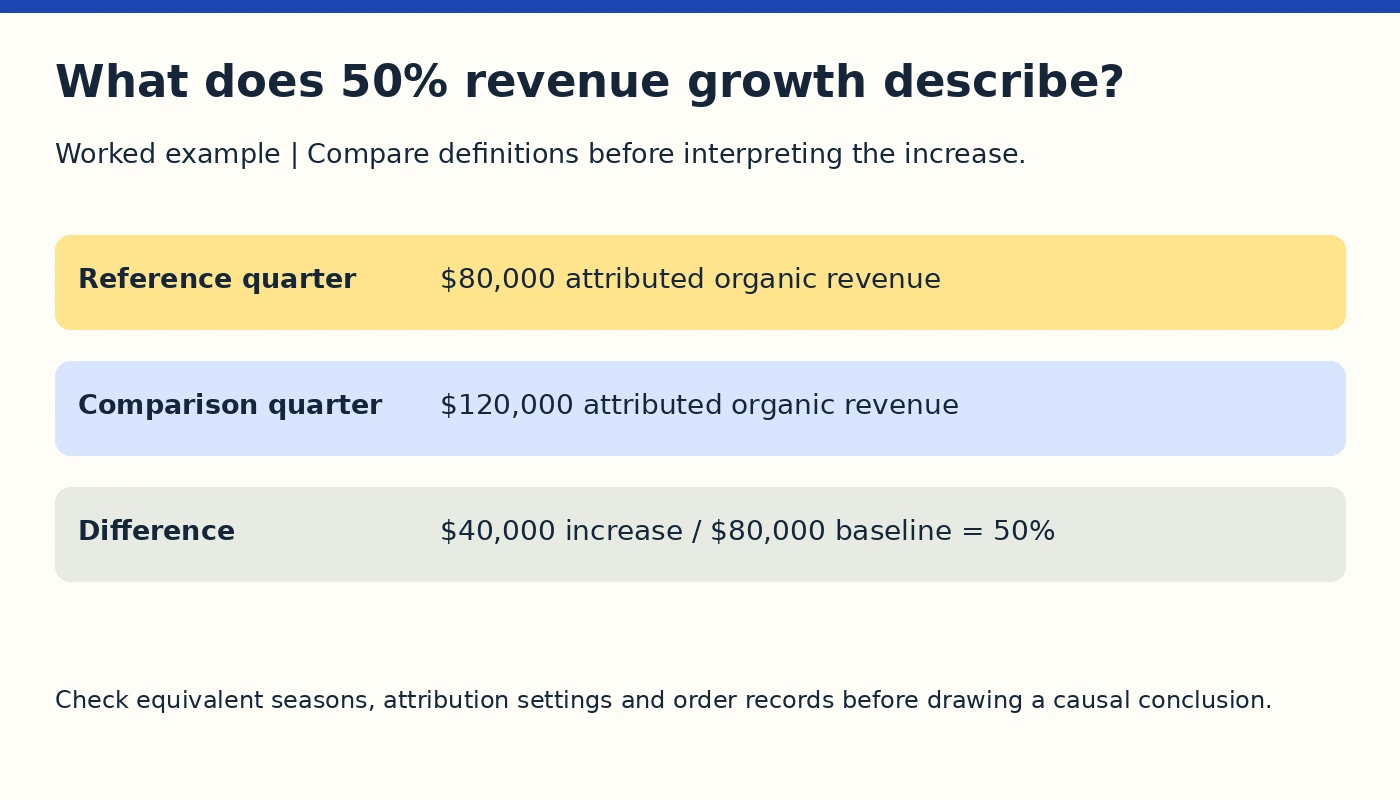
Ask for the baseline, end value, absolute change, relative change and length of each comparison period. For a fictional retailer with $80,000 in attributed organic revenue in one quarter and $120,000 in the next, the absolute gain is $40,000 and the relative gain is 50 percent. That arithmetic is simple. The difficult questions are whether the periods are comparable and whether attributed revenue is the right measure of the commercial result.
Ask for equivalent periods in the prior year if seasonality is material. A winter equipment retailer can grow from late summer to the holiday quarter without gaining organic market share. A younger site may have no meaningful prior year. In that case, compare appropriate page groups, annotate promotions and consider other ways of assessing change. A provider that identifies the limits of the available baseline is more useful than one that selects the most dramatic available date range.
Read the chart from the raw values outward
Request a small anonymized table behind one headline graph. Include the dates, units, filters and values needed to recompute the calculation. A screenshot cropped above the axes can make small movements look enormous. A cumulative chart can make a declining daily rate look like continuous growth. Change the display to ordinary daily or weekly values and inspect the trend before accepting the narrative. Check for missing intervals that a charting tool may have connected with a line.
Return to the fictional retailer. Suppose a sitewide discount began midway through the second quarter and the order-management team changed how returns were recorded. Both changes matter when interpreting the $40,000 increase. Ask whether the revenue numbers use the same definition before and after. Then ask what happened to the subset of pages receiving SEO work compared with similar pages that did not. A strong case study can accommodate competing explanations without making the claim so broad that it becomes meaningless.
Distinguish traffic, leads, opportunities and revenue
For a lead generation business, an analytics form submission is a recorded event. A CRM lead may be a unique person, an account or a sales record created by an integration. A qualified opportunity requires a definition used by the sales organization. A closed transaction has a contract date and a value. Before accepting a headline about growth in leads, ask the provider to draw the path between these stages and show where records are merged, rejected or left unresolved.
Consider a worked example with 150 recorded submissions, 120 identifiable leads, 36 qualified opportunities and nine signed deals. If an agency reports 150 new opportunities, the submitted event count has been given the wrong name. If it reports nine signed deals from a mature, traceable cohort, the claim is narrower and commercially stronger. Record the cohort dates and time allowed for maturation. A proposal signed this quarter can originate from a search visit in an earlier reporting period.
Reconcile online revenue with the order ledger
For ecommerce, ask whether the figure is purchase event value, gross booked revenue, net sales, margin or collected cash. If the study reports GA4 purchase revenue, ask for the tracking implementation, transaction identifiers and treatment of refunds. Google’s transaction ID guidance explains how purchase event deduplication works. A plausible looking report can still include instrumentation gaps or a changed definition that the case study should identify.
A practical exercise is to select a short period and reconcile anonymized identifiers and totals with the store’s records. Finance may use a different timezone, recognize sales on fulfillment or separate tax and shipping. These differences are often explainable. Write down the bridge between the systems rather than editing the workbook until the totals match. An agency that can show which amounts are reconciled, which are explained and which remain open has demonstrated a valuable operating capability.
What attribution model produced the result?
Google’s analytics attribution settings documentation describes how reporting choices affect credit and which earlier touchpoints can qualify. Ask the agency what the model attributes, which channel definition it used and whether those settings changed across the study. Two reports can use identical transaction values while assigning a different amount to organic search. A positive attributed result can be informative, but it is different from a measured incremental gain.
Consider a customer who learns about a product at a trade show, reads a buying guide from search, clicks a remarketing ad and buys later from a bookmarked page. Several teams contributed to that journey. An attribution model distributes credit according to its rules and available data. It cannot recreate a parallel world in which the SEO work did not happen. A provider claiming incremental revenue should explain the comparison used to estimate what would otherwise have occurred.
Match the intervention to the pages and dates
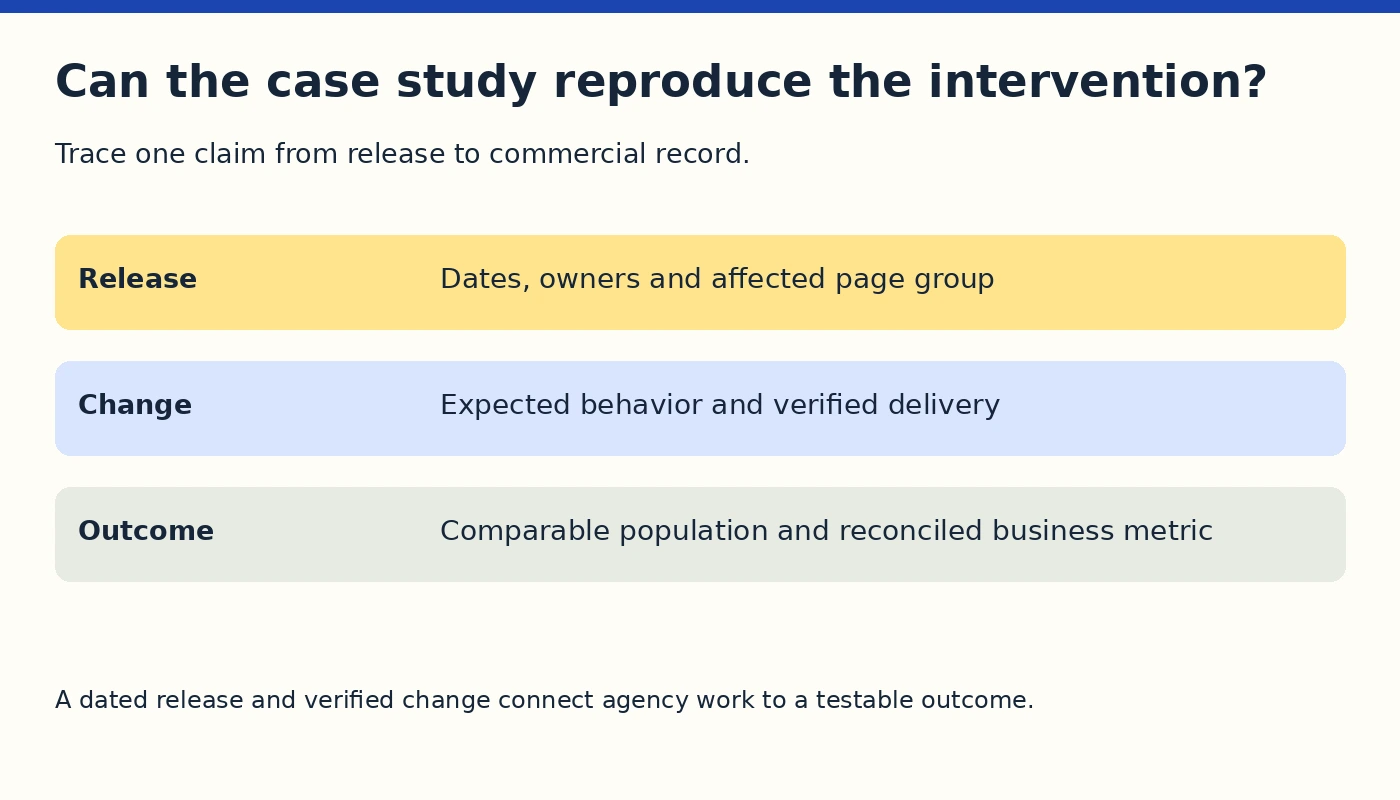
Ask for a release timeline. When did the provider gain access? When did it deliver recommendations? When did the client actually deploy the fix? Which URLs changed and which remained outside the rollout? A case study may begin the success window on the date a contract was signed even though the relevant template shipped two months later. If the improvement clearly precedes deployment, that specific change cannot explain the early part of the increase.
A phased release can strengthen the analysis. Suppose a navigation fix reached one category before a second, similar category. Compare both before and after while recording differences in stock and promotions. A staggered sequence is stronger evidence than a single sitewide before-and-after chart when other conditions support the comparison. It is still necessary to inspect preexisting trends. If the first category was already growing faster, a larger subsequent gain is not by itself proof of an intervention effect.
Verify the population inside the search report
A large site can show a sharp increase if a reporting property expands to include a new subdomain. A change from a mobile-only view to an all-device view can produce a similar illusion. Ask for the exact search property, type, country, device, page group and query filters. An agency does not need to share privileged access to explain them. A redacted request definition or controlled walkthrough can establish whether both periods use the same population.
Be careful when a study claims complete keyword coverage from the returned rows of a detailed search export. The SEOS.co Search Console API guide explains why the sum of visible query clicks can differ from the property total. If the study calls a subset “all clicks,” its conclusion may be a change in reporting coverage. Reconcile headline property data first, then inspect detailed page and query examples for the mechanism behind the change.
Ask which parts of the work were repeatable
A national brand that already has a large editorial team, established product demand and developers available every week can move quickly on a technical recommendation. A regional business relying on a vendor for quarterly releases may not. Ask how recommendations became shipped changes. Which steps belonged to the agency? Which required the client’s engineering team, executives, product experts, photographers or sales operations staff? Those dependencies affect the true cost and the likelihood of reproducing the process.
Ask the agency to show one deliverable from the project in anonymized form. A ticket connecting a diagnosed problem to a release, acceptance criteria and verified output can be more informative than a list of 200 activities. A content brief that includes the buyer’s task, missing evidence and approval owner provides a concrete test of editorial competence. Compare the artifact with the result claimed. Producing an excellent technical audit is different from shipping and verifying its recommendations.
How to check branded demand and paid campaigns
Growth in branded searches can reflect product launches, press coverage, distribution changes and paid advertising. That growth can benefit organic search, and SEO can help the brand serve it effectively. The study should name the role it claims. Did the agency generate new nonbranded discovery, capture more existing demand, or improve conversion after prospects arrived? Each is a legitimate commercial outcome, but the investment decision differs.
Ask for a dated list of large demand changes and one analysis that tests their scope. A national TV campaign could plausibly affect many branded product searches at once. A technical indexation repair might produce its clearest effect in a specific template with previously excluded URLs. Do the improved pages, queries and dates line up with the proposed explanation? The most useful evidence often comes from where the expected pattern fails, because that is where a rival cause becomes visible.
Evaluate survivorship and client selection
A case study is a selected example. Ask why this one was chosen and which conditions made it unusually successful. A team that corrected years of accidental exclusion on an established store may show enormous growth in the first engagement. That is valuable experience in recovery work. A healthy store seeking steady acquisition growth may have little of the same opportunity. Purchase the capability that matches your problem rather than the highest percentage in the portfolio.
Ask for a second example with a more ordinary outcome or a narrower challenge. A small change that reliably improves the identification of qualified leads can be more relevant to your decision than a dramatic traffic recovery on a much larger site. Evaluate how the agency handled uncertainty. Did it change course when an early hypothesis failed, preserve baseline data, or stop a rollout when the customer experience worsened? Those actions are evidence about how the team will treat your budget during a difficult quarter.
Score the evidence before discussing the retainer
Build a simple review sheet with separate columns for verified facts, reasonable interpretations and open questions. Score the provider on measurement clarity, relevance to your business, implementation ownership and reproducibility. Use anchored descriptions. For example, a strong implementation score requires a dated release and evidence that the intended URLs changed. A vague list of recommendations can earn credit for diagnosis but does not earn the same credit for execution.
Keep price separate during the first reading. A polished low-cost proposal can appear more persuasive when its extraordinary claim has not been tested. Once you know which capabilities are demonstrated, compare the total work required from both sides, including development, analytics changes and internal reviews. A higher retainer with a clear path to implementation can cost less overall than a lower fee that leaves every material dependency with an already overloaded client team.
The three questions to ask on the final call
Speak to a reference about the most difficult stage of the project. Ask who found the problem, who owned the delay and whether the reporting changed after the team discovered it. Those details often reveal more than an unqualified endorsement. A client able to reconstruct the work from its own records provides stronger practical evidence of a repeatable engagement than a testimonial that mentions only a final percentage and the friendliness of the account team.
Ask what happened in absolute numbers, what changed in the customer’s journey and which evidence could weaken the agency’s preferred explanation. Let the candidate work through one real example rather than reciting a methodology slide. Then ask it to define the first success measure it would establish for your account. Its answer should follow from your business model, baseline quality and ability to implement changes. Copying the previous client’s headline target into your proposal is a poor substitute for diagnosis.
Use the SEOS.co agency review directory to shortlist providers by specialization, industry and market. Check the agency rating methodology alongside redacted work samples and reference conversations. A strong SEO case study does more than show an attractive result. It gives a buyer enough detail to verify what the team did, judge which parts apply to the next engagement and budget for the work needed to make that outcome possible.