
The Search Brief · News analysis
Self-RAG Research: Retrieval Decisions Need Evidence, Too
Read Self-RAG research through routing errors, evidence channels, self-critique limits and a worked cost-quality evaluation for answer applications.
Development covered: October 17, 2023 paper; primary source checked November 2, 2026
Self-RAG research examines a useful question: should a language model retrieve evidence for every request, and how should it assess the evidence and answer segments it uses? The practical lesson is to evaluate retrieval decisions alongside answer quality. Searching indiscriminately can add irrelevant context and cost, while skipping retrieval can leave a current factual question dependent on unsupported prior knowledge.
For publishers, the research does not identify a new ranking requirement. For teams building answer applications, it suggests a richer evaluation than simply checking whether the final response sounds confident. The system’s decision to retrieve, its choice of passages, its use of those passages, and its final output can each succeed or fail independently.
The historical research contribution
Asai and colleagues introduced Self-Reflective Retrieval-Augmented Generation in their 2023 paper. The framework trains a model to retrieve on demand and use special reflection tokens to assess retrieved passages and its own generated text. The paper reports improvements on its evaluated tasks and models. Those findings are historical research results, not a current comparison of every commercial assistant or proof that ordinary prompting implements the same trained method. Self-RAG primary paper.
The distinction between a trained research framework and a loosely described self-checking workflow matters. Asking a general assistant to reconsider an answer can be useful, but it does not establish equivalence to the paper’s method. The examples below are original operational illustrations of adaptive retrieval decisions, not reproductions of the researchers’ experiments.
Decide what the task requires
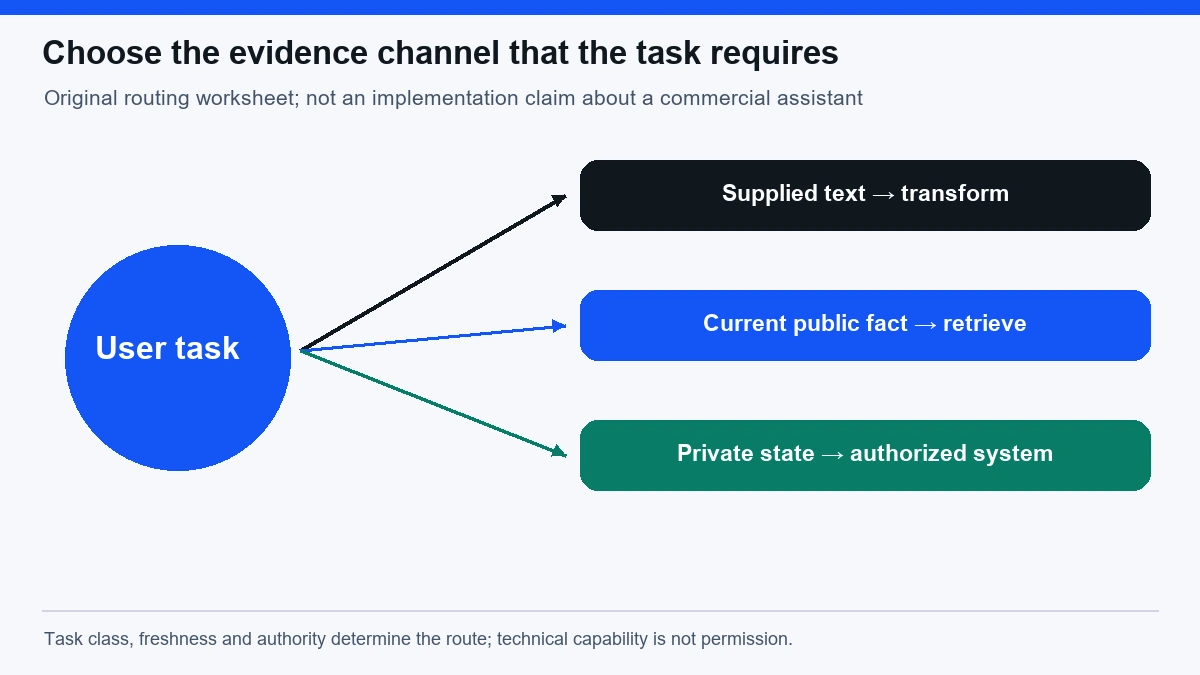
A request to rewrite supplied text may need no external retrieval. A request for a current price usually needs suitable current evidence. A question about a private account may require an authorized account system rather than public web search. A calculation may need a reliable computation tool and verified inputs. The word “search” should not collapse these different evidence needs into one generic action.
Define task classes using the information required to answer correctly. For each class, specify suitable sources, freshness limits, permission boundaries, and acceptable nonanswers. These rules provide a basis for evaluating routing. Without them, a model’s decision to skip retrieval can be judged only by whether the resulting answer happens to look plausible.
The classification should preserve uncertainty. A short request can be ambiguous about whether the user wants current facts or a conceptual explanation. The application can ask a targeted question or provide a clearly bounded answer. It should not silently assume a historical explanation is adequate for a present-day purchase decision.
For a publisher, the corresponding content task is to make scope visible. A conceptual guide, a current offer page, and an account action screen serve different purposes. Clear dates, entities, permissions, and next actions help readers understand which asset can establish which facts.
The search intent improvement guide helps express the user’s task before a routing rule chooses its evidence channel.
Retrieval has false positives and false negatives
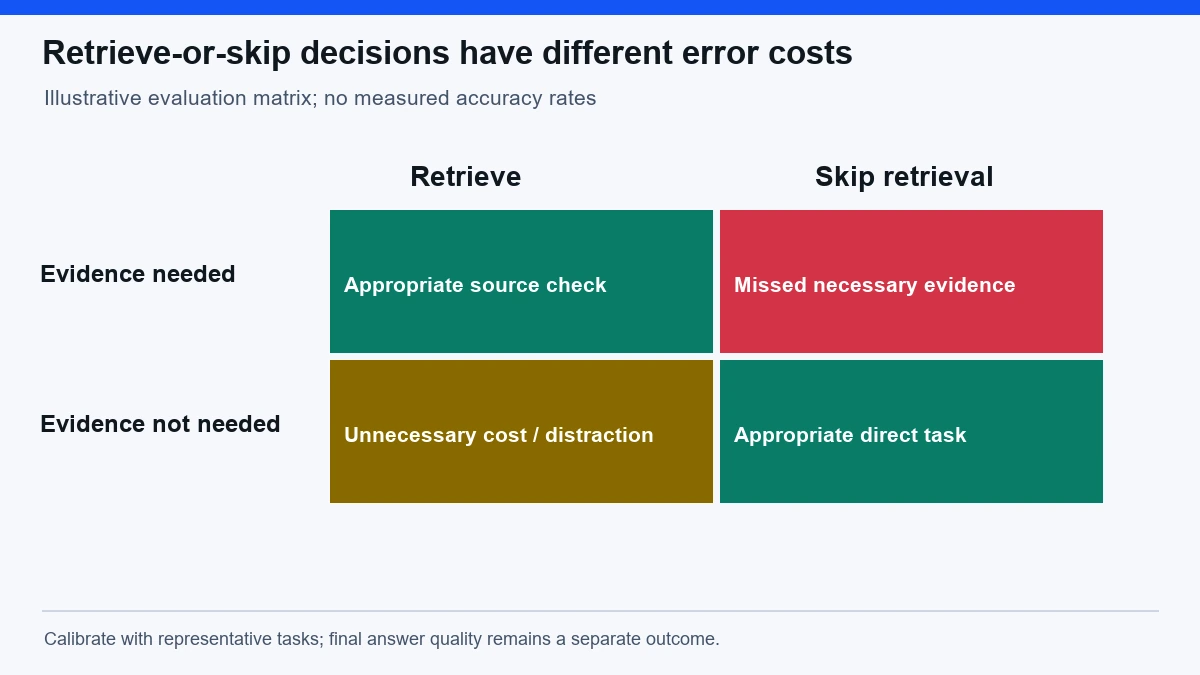
A false positive retrieval decision searches when the task does not need it. The cost may be latency, unnecessary expense, distraction, or exposure to irrelevant and conflicting material. A harmless rewrite can become worse if unrelated search results introduce facts the user never requested. More evidence is useful only when it is evidence for the task.
A false negative skips needed retrieval. The resulting answer may rely on stale prior knowledge, guess a product feature, or invent a current status. These errors can be especially consequential when the user asks about changing prices, availability, policy, or personal account state.
The two error types need different weights. An extra search for a low-stakes explanation may be tolerable, while skipping an authoritative check before making a price commitment may not be. A routing policy should reflect those consequences rather than maximizing a generic percentage of correct retrieve-or-skip labels.
Evaluate the source choice as well as the binary decision. A system can correctly decide that evidence is needed and then search the wrong place. Public marketing pages cannot establish a user’s private subscription status. An old comparison article cannot establish a vendor’s current contractual terms. Correct routing includes the appropriate evidence channel.
A worked routing example
Imagine a hypothetical set of 100 requests. Forty are supplied-text transformations, thirty ask current product facts, twenty ask conceptual questions, and ten concern authorized account state. A baseline searches publicly for all 100. An adaptive system skips searches for transformations and uses an account connector for account questions.
Suppose a public retrieval costs one illustrative unit of work. The baseline spends 100 units, while the adaptive system might spend 50 public-retrieval units if it searches the product and conceptual questions. The apparent saving is not the whole evaluation: account queries have a different cost, and the quality of skipped or rerouted answers still needs review.
Now imagine the adaptive system mistakenly routes five current-product questions to the supplied-text transformation path and answers without current evidence. A lower retrieval bill can coexist with a worse user outcome. The team must inspect those five cases, their consequences, and whether the policy has a systematic boundary problem.
These numbers are teaching examples, not measured Self-RAG results. Their purpose is to show why cost, routing accuracy, evidence sufficiency, and final answer quality belong in separate fields. A single efficiency claim cannot establish that an application made the right tradeoff.
Reflection is a model judgment
A model can assess whether a passage appears relevant or whether its answer seems supported. That assessment can be useful as a control signal. It remains a fallible judgment produced by a system with its own limitations. Confidence and self-critique should not be treated as independent external verification merely because they appear after the initial answer.
For example, a generator may assume that Cedar Basic includes archive export, then evaluate its own answer against a passage about exports generally. Both stages can preserve the same mistaken assumption. A separate support check must inspect the actual plan limitation rather than accept the model’s assurance that the answer is consistent.
Calibrate critique decisions on labelled cases. Include partial support, explicit contradictions, wrong versions, absent evidence, and seemingly authoritative but irrelevant passages. Inspect whether the model recognizes the difference between topical relevance and factual entailment. A passage about the right product is not automatically support for every claim about that product.
Keep critique outputs and their evidence available for review. A final approved label without the question, passage, and asserted claim is difficult to audit. The record should let another reviewer identify whether a failure came from the evidence, the interpretation, the acceptance policy, or the final wording.
Define stopping and escalation rules
An adaptive system can retrieve again when the first evidence is insufficient. That can help resolve a missing condition, but an unrestricted loop can waste time or reinforce an incorrect premise. Define limits based on task needs, evidence quality, cost, and response deadlines. The correct outcome may be an explicit unresolved answer.
Distinguish insufficient evidence from a technical failure. A search that returns no suitable current policy differs from a connector timeout. Both may prevent an answer, but they require different repairs. The first can indicate a source gap; the second is an execution problem that should be monitored and retried under a controlled policy.
For consequential decisions, specify when human review or an authoritative live system is required. A model’s repeated self-approval should not override a missing permission, absent source, or unresolved conflict. Escalation is useful when it connects the user to the actual dependency rather than merely announcing generic uncertainty.
Verify what happens when the deadline expires. If the system returns a partial answer, it should preserve its evidence boundary and avoid presenting an unconfirmed state as confirmed. If it fails closed, the user should receive an actionable explanation. A silent empty response is an operational failure, not a successful cautious decision.
Test adaptive behavior under realistic load
A routing policy can perform well offline and behave poorly when shared services are busy. Retrieval may queue behind indexing, account checks may time out, or critique may finish after the answer has already been sent. Measure the complete sequence from request receipt through confirmed user-visible output.
Record timestamps for routing, retrieval start, evidence arrival, critique completion, and delivery. Compare those with the task deadline and freshness limit. A useful passage arriving too late should not count as successful evidence use. Likewise, a post-delivery critique is monitoring unless the application actually withholds output until the check passes.
Test restart recovery and repeated requests. A retry should not accidentally bypass a required source check because an earlier route decision was cached. Cache entries should identify the relevant input, source version, and policy version. Otherwise, an old decision to skip retrieval can survive after the question or governing information changes.
Separate expected rule-based rejection from failure. If a task requires account access the user has not authorized, refusing that action can be correct. If authorized access exists but a shared lock prevents the check from running, the same visible noncompletion has a different cause. Operational records should preserve that distinction.
What publishers can improve
Publish evidence that answers real questions and keeps important conditions together. A current product page should distinguish plans, regions, dates, and exclusions. A conceptual article should explain mechanisms without pretending to establish live account status. Those boundaries help a reader and provide a more coherent source for any retrieval-based application.
Use explicit links between overview material and authoritative details. A broad explanation can introduce a feature, while the current specification establishes exact limits. Avoid making an old article the only place where a changing commitment appears. Keep the source of truth identifiable and maintain the historical record separately.
Do not claim that a reflection-friendly format guarantees citations. A model’s decision to retrieve or reuse a page depends on an external system the publisher may not observe. Evaluate actual answers under recorded conditions and report source inclusion, accuracy, recommendations, referrals, and conversions as different outcomes.
When observed answers repeatedly omit the same qualification, inspect whether the source makes that qualification clear and accessible. Repair a real source ambiguity when found. If the source is already explicit, preserve the downstream error evidence rather than generating many redundant pages that repeat the same correction.
For a publisher-controlled improvement sequence, consult the GEO guide and distinguish useful source work from unobserved downstream model behavior.
Questions for an adaptive retrieval review
Should every factual answer search the public web? Not necessarily. Suitable evidence can be supplied in the conversation, stored in a governed corpus, or available only through an authorized account system. The policy should match source choice to the task and make freshness requirements explicit.
Does self-reflection prove an answer is true? No. It is a system judgment that can help guide behavior when calibrated. Truth and suitability still depend on evidence, correct interpretation, source validity, and the user’s actual question. Independent checks are especially valuable for consequential claims.
Can a lower retrieval rate be described as an improvement? Only alongside quality and task outcomes. A lower rate can reflect efficient routing or skipped necessary checks. Report the request mix, costs, failure cases, and final answer evidence so that the interpretation can be assessed.
What should the first pilot include? Choose representative tasks, expected sources, explicit routing labels, unanswerable cases, and timing limits. Save complete traces and inspect mistakes individually. A pilot should establish which decisions work, which fail, and what remains unknown before the policy is applied broadly.
How should the team revise a routing policy? Change the narrow rule supported by observed failures, retain the prior version, and retest affected categories plus a stable comparison set. Avoid changing unrelated thresholds merely to force more activity. A useful repair improves appropriate evidence use rather than maximizing searches or confident answers.
If the application monitors ChatGPT-supported discovery separately, use the ChatGPT SEO measurement explanation as platform context rather than a routing specification.
Keep authority attached to actions
Retrieving information and executing an action require different decisions. A request to explain a cancellation policy does not authorize cancelling an account. A request to compare products does not authorize placing an order. An adaptive evidence system should preserve the user’s intended task and route consequential actions through the appropriate confirmation and permission boundaries.
Test those boundaries with realistic transitions. A user may begin with research and later request an action, or may revise a constraint after evidence has been retrieved. The application should use the current instruction and relevant confirmed state, while retaining a record of what was actually authorized. Successful retrieval should never be treated as implicit approval for a separate external mutation. This distinction keeps evidence gathering useful without turning a source-selection decision into unintended execution.
A useful acceptance record also identifies who owns unresolved routing errors. A content owner can repair missing source explanations, an application owner can repair evidence selection, and an operations owner can repair missed deadlines. Assigning the actual dependency prevents the same failure from circulating between teams while each reports that its isolated component passed. Confirm the corrected request path with a fresh observed output before closing the incident.
Adaptive retrieval decision worksheet
Self-RAG’s trained reflection mechanism concerns retrieval and assessment during generation. The following weather-versus-writing tasks are an original evaluation aid, not evidence that ordinary self-check prompting reproduces the trained framework.
| Task | Appropriate evidence channel | Routing error to inspect |
|---|---|---|
| Rewrite supplied invitation text | User-supplied text under its constraints | Unnecessary external facts introduced |
| Report current local weather | Suitable current weather evidence | Prior knowledge substituted for a live condition |
| Explain a stable concept | Appropriate supplied or retrieved evidence for scope | Irrelevant search context overwhelms the explanation |
| Inspect private account status | Authorized account system | Public page mistaken for private current state |
| Evaluation field | Record before the test | Why it matters |
|---|---|---|
| Retrieve or skip label | Required evidence and task class | Makes false positives and false negatives assessable |
| Passage assessment | Relevance and support judgment with actual input | Self-approval remains a fallible model judgment |
| Cost and deadline | Full path, including critique and queues | Lower search cost cannot conceal missed current checks |
| Final result | Current, supported and suitable answer or appropriate nonanswer | Routing success is not answer correctness |