
The Search Brief · News analysis
HyDE Query Expansion: What Hypothetical Documents Can and Cannot Tell Publishers
Understand HyDE query expansion, fabricated intermediate details and a controlled evaluation that separates retrieval gains from answer correctness.
Development covered: December 20, 2022 publication; primary source checked November 2, 2026
HyDE retrieval uses generated hypothetical text as a bridge between a question and real documents. Its value is a retrieval hypothesis: an answer-shaped description may express useful relevance patterns that a short query does not. The hypothetical document is not evidence, and any invented detail inside it must not be promoted into a factual answer without support from real sources.
For publishers, the research helps explain why exact query wording is only one part of information discovery. A useful page should connect ordinary customer language with precise entities, tasks, constraints, and terminology. The paper does not establish that Google or ChatGPT uses HyDE for a particular query, and it does not justify publishing fabricated examples as if they were customer results.
The historical research mechanism
Gao and colleagues’ December 2022 paper introduced Hypothetical Document Embeddings. The method generates a hypothetical document from a query, encodes it, and retrieves real corpus documents through vector similarity. The authors explicitly describe the generated document as unreal and potentially containing false details. Their reported retrieval improvements apply to the tested tasks and configurations, not every current search product. HyDE primary paper.
The conceptual separation is important: generation proposes a relevance representation, while retrieval supplies actual documents. A reader should not confuse an intermediate search aid with a verified source. The practical examples in this article are original explanations of that distinction and do not reproduce experimental results from the paper.

Why a short query can be underspecified
A customer asking “move old records out” may mean exporting archived account data, migrating an entire database, downloading an audit trail, or transferring ownership. The words alone leave several plausible tasks. A retrieval system has to resolve enough of that ambiguity to find useful evidence, and a human editor must do the same when planning a page.
A hypothetical answer can introduce terms associated with a likely task: archive export, administrator permission, data format, retention policy, and migration limits. Those terms may help locate relevant documentation. They can also introduce assumptions the customer never made. If the generated text assumes an enterprise plan or a particular country, the search can drift away from the real need.
The source page should therefore make its actual scope explicit. A guide titled “Export archived records from Cedar” should identify which plan, permissions, record states, and formats it covers. It should also explain when the guide does not apply. Clear boundaries help users decide whether the page answers their task, regardless of the retrieval mechanism that brought them there.
Do not create one page for every imagined wording of the same task. Connect the vocabulary naturally within one useful destination. Separate URLs should correspond to distinct decisions or procedures, such as an administrator archive export versus a customer invoice download, rather than mechanically multiplying synonyms.
A hypothetical document can contain a dangerous seed
Imagine a fictional query asking whether Cedar Basic can export archived records. A generated intermediate paragraph says, “Cedar Basic provides a CSV archive export from the administrator settings page.” The real documentation says archived-record export is available only on Enterprise. The intermediate text now contains a false plan assumption and a false procedural detail.
If the retrieval stage finds the Enterprise documentation, the real source can correct those assumptions. If the generator later repeats its own intermediate paragraph instead, the pipeline can produce a confident but unsupported answer. The defect is not merely that the source list lacks a link. The system has allowed a search aid to become factual authority.
A robust local evaluation should preserve the hypothetical text separately from retrieved passages. Reviewers need to see which details originated in the query, which were generated, and which were established by the corpus. Without that separation, a fluent final answer can make invented details appear to have come from documentation.
For content operations, apply the same rule to research drafts. An outline generated to explore possible questions can contain useful hypotheses. Before publication, every factual commitment must be checked against suitable evidence. The fact that an idea appeared early in the drafting process does not give it a privileged claim on the final manuscript.
Compare retrieval conditions fairly
A local test can compare a baseline query representation with a hypothetical-document representation. Keep the corpus version, retrieval cutoff, relevance labels, and downstream answer policy fixed. If the expanded condition also receives a larger candidate budget and a new reranker, the experiment measures a bundle rather than the isolated value of the hypothetical text.
Choose questions covering the actual task distribution. Include short ambiguous queries, exact identifiers, complex comparisons, and cases where the corpus lacks the answer. A method that improves broad conceptual retrieval may still damage exact product lookups. Per-category results reveal whether an aggregate gain hides a commercially important regression.
Record the generation prompt, model identifier where available, randomness settings, and intermediate output. Repeat suitable cases to observe instability. If two hypothetical documents for the same query lead to different evidence, that variation belongs in the evaluation. Reporting only the most successful generated version would overstate the reliability of the method.
Judge the retrieved passages, not the attractiveness of the hypothetical paragraph. A polished intermediate explanation can be completely wrong. The evaluation should ask whether the returned real evidence is relevant, sufficient, current, and aligned with the user’s constraints. Answer fluency is a separate downstream measure.
Work through a small retrieval example
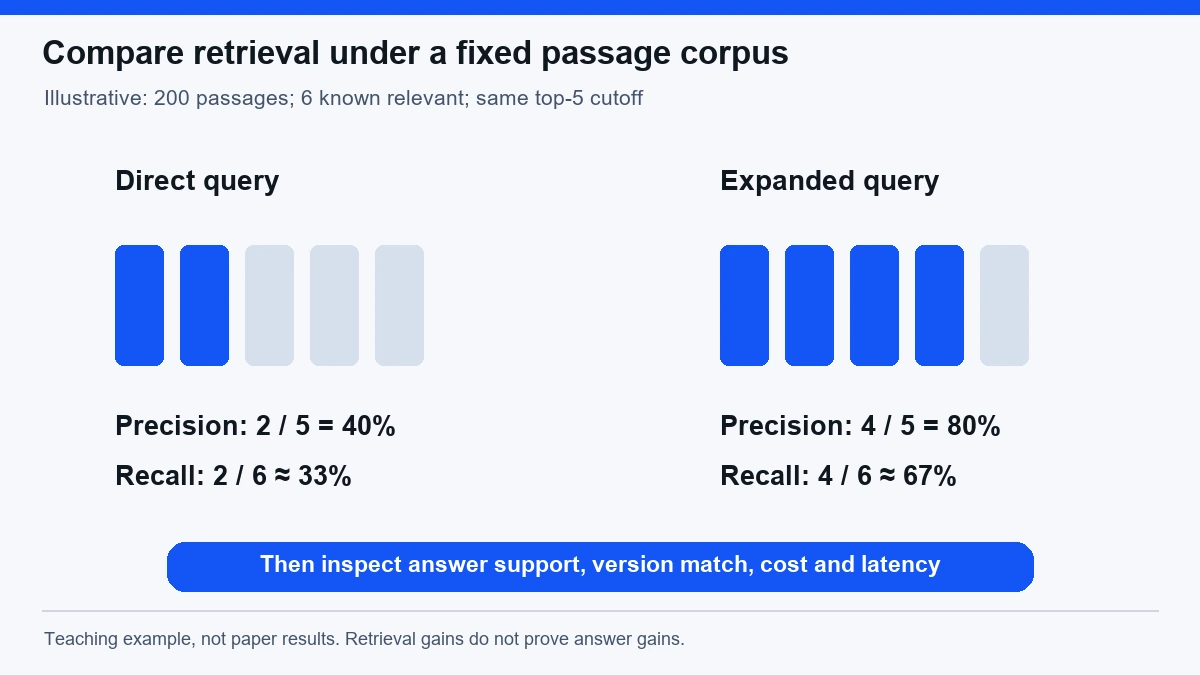
Suppose a hypothetical corpus contains six relevant archive-export passages among 200 passages. A direct query retrieves five passages, including two relevant ones. An expanded representation retrieves five passages, including four relevant ones. Precision at five rises from 40% to 80%, and recall against the six known relevant passages rises from about 33% to about 67%.
These invented numbers illustrate metric definitions. They do not show that HyDE doubles retrieval performance in production. The test still needs to inspect which passages improved. Four passages from the wrong product version may score as superficially relevant while failing the actual task. A relevance policy that ignores version can manufacture a gain.
Now suppose the expanded condition retrieves the correct Enterprise exclusion but the final answer still says Basic includes the feature. Retrieval improved while answer correctness failed. This distinction identifies the next repair: constrain evidence use and remove the unsupported assumption. Adding more retrieval candidates may not address the generator’s reliance on its intermediate text.
Alternatively, the expanded query might retrieve only Enterprise pages and miss a Basic-specific migration workaround. The system has narrowed the search too aggressively. A useful investigation would inspect the intermediate assumptions and compare alternative query formulations, rather than conclude that the corpus contains no suitable answer.
Content that supports real task matching
Write the page around the reader’s decision and the conditions that determine it. Explain the everyday problem, introduce the formal feature or procedure name, identify prerequisites, and show the actual steps or comparison. A page that defines terminology without helping the user act may match broad topics while remaining weak evidence for a specific answer.
Preserve exact identifiers where they distinguish real entities. Product names, model numbers, error codes, version strings, and standard references can be essential. Explain them rather than replacing them with generic language. A semantic description and an exact identifier perform complementary roles in a useful technical article.
Include meaningful negative cases. If a procedure does not apply to archived records, say so near the procedure. If a workaround requires administrator access, state that requirement before the steps. Negative conditions often prevent an answer from overgeneralizing a superficially similar process to the wrong user or plan.
Use examples that demonstrate the task without inventing performance claims. A fictional account can illustrate a file-format decision or permission boundary when clearly labelled. It should not be described as a tested customer migration, and its imagined outcome should not become a claim about the product’s actual speed, reliability, or commercial success.
Use search intent alignment to decide whether different customer wording represents one task or genuinely distinct destinations.
Avoid speculative algorithm targeting
A research paper can inspire a test without identifying an external provider’s implementation. Do not claim a page is “optimized for HyDE” in the sense of satisfying a documented Google requirement unless the relevant provider actually establishes that requirement. The safer description is that the page makes its concepts and constraints clear for readers and information retrieval.
Similarly, do not publish blocks of imaginary answer text solely to attract vector similarity. If those blocks add no reader value or contain unverified assumptions, they weaken the asset. A useful answer-shaped passage explains a real question accurately and connects to the detailed evidence that supports it.
Do not infer hidden query expansion from a surprising citation alone. An answer can cite a page whose wording differs from the prompt for many reasons. The observation establishes source selection under the recorded conditions. It does not reveal which internal representation or retrieval technique produced that selection.
Keep research claims separate from service positioning. A business can explain that it tests content clarity, evidence accessibility, and observed answer accuracy. It should not promise privileged control over an engine’s undisclosed retrieval process. Honest scope makes the work easier to evaluate and avoids turning technical terminology into an unverifiable sales claim.
The ChatGPT SEO explanation supplies platform context without turning a retrieval research method into a guaranteed publishing requirement.
Evaluate operational costs and stale evidence
Generating intermediate text adds work to a pipeline. Measure its latency, failure rate, and cost under realistic load alongside retrieval quality. A method that improves a quiet offline benchmark may fail a production deadline when generation queues are busy. Inspect the full path from query receipt to confirmed answer rather than timing only the retriever.
Caching can reduce repeated work but needs an explicit validity policy. A cached hypothetical document can preserve an old product assumption after the corpus changes. It may still retrieve useful material, or it may steer retrieval toward obsolete concepts. Record cache creation time, input identity, model configuration, and conditions that require regeneration.
The real evidence needs freshness controls too. If a correct passage is replaced by a new policy, the index and downstream context must update. A hypothetical query representation cannot repair an outdated corpus. Trace source publication, collection, indexing, retrieval, generation, and output so that stale answers are assigned to the stage that actually failed.
Monitor failures separately from expected nonanswers. If the corpus genuinely lacks a requested fact, an explicit evidence gap is appropriate. If a time limit prevents retrieval from finishing, the same nonanswer has a different operational cause. Keeping those categories distinct prevents an infrastructure defect from being mistaken for a content opportunity.
Questions publishers and builders should ask
Does HyDE prove that keywords no longer matter? No. It demonstrates one way to represent a query for retrieval under tested conditions. Precise terminology still helps establish what a page means, while ordinary language helps connect the reader’s task to that terminology. Neither should be reduced to mechanical repetition.
Should a publisher add hypothetical documents to its public site? Only when the material has a real reader purpose and factual status is clear. A transparent scenario can teach a process. An invented factual answer presented as documentation is misleading. The intermediate representation in a retrieval method is not a publishing recommendation.
Can a generated search aid be cited as a source? It should not establish external facts merely because it was generated confidently. The factual answer needs suitable real evidence. If the intermediate text is retained for debugging, label its role and keep it separate from source passages and final claims.
What is the most useful first test? Select a small representative question set, annotate sufficient evidence, compare retrieval under fixed conditions, and inspect failures individually. Include latency and final answer support. The result should identify which tasks benefit, which regress, and which assumptions require correction before any wider rollout.
What should an editor do when the system repeatedly assumes a nonexistent feature? Check whether the public source clearly distinguishes plans and versions, then inspect the local intermediate text and retrieved evidence where available. Clarify an ambiguous source when justified. If the source is already explicit, record the downstream error rather than adding redundant pages in an attempt to force agreement.
If expanded coverage creates overlapping pages, review the internal linking checklist after deciding which destination actually owns the task.
Keep query expansion reversible
A local application should retain the baseline query path during a bounded pilot. If expansion damages exact-identifier questions, the team needs a tested way to route those tasks appropriately or roll back the change. Save the configuration and the examples that triggered the decision. A reversible rollout allows useful experimentation without treating a promising research idea as a mandatory permanent dependency. The rollback check should confirm the actual returned evidence and answer, rather than merely reporting that a configuration flag changed.
Retrieval mechanism and test worksheet
The HyDE mechanism uses hypothetical text as a retrieval representation, then searches real material. The following camping-stove task makes that separation concrete without treating generated details as evidence.
| Stage | Illustrative content | Factual status |
|---|---|---|
| User query | Which fuel fits this stove model? | Actual task constraint |
| Hypothetical document | Generated answer-shaped description of fuel compatibility | Search aid, may contain false details |
| Encoded representation | Vector used to locate similar corpus passages | Retrieval operation, not source authority |
| Real source | Manufacturer compatibility specification | Evidence requiring model and version alignment |
| Final answer | Supported compatible fuel and relevant exclusions | Must follow real evidence, not generated assumptions |
| Fixed test corpus | Direct query | Expanded representation |
|---|---|---|
| 200 passages, 6 known relevant | Same corpus and labels | Same corpus and labels |
| Relevant among first 5 results | 2 | 4 |
| Precision at 5 | 2 / 5 = 40% | 4 / 5 = 80% |
| Recall at 5 | 2 / 6,about 33% | 4 / 6,about 67% |
| Required downstream review | Inspect answer support and current model match | Inspect the same criteria, plus invented expansion details |
These numbers are illustrative. Keep cutoff, corpus, labels and answer policy fixed; record intermediate text and cost. A retrieval gain does not establish an answer gain.