
The Search Brief · News analysis
Branded vs Nonbranded Search: How to Separate Demand From Query Coverage
Branded search and nonbranded search answer two different commercial questions.
Development covered: Guidance reviewed November 22, 2026
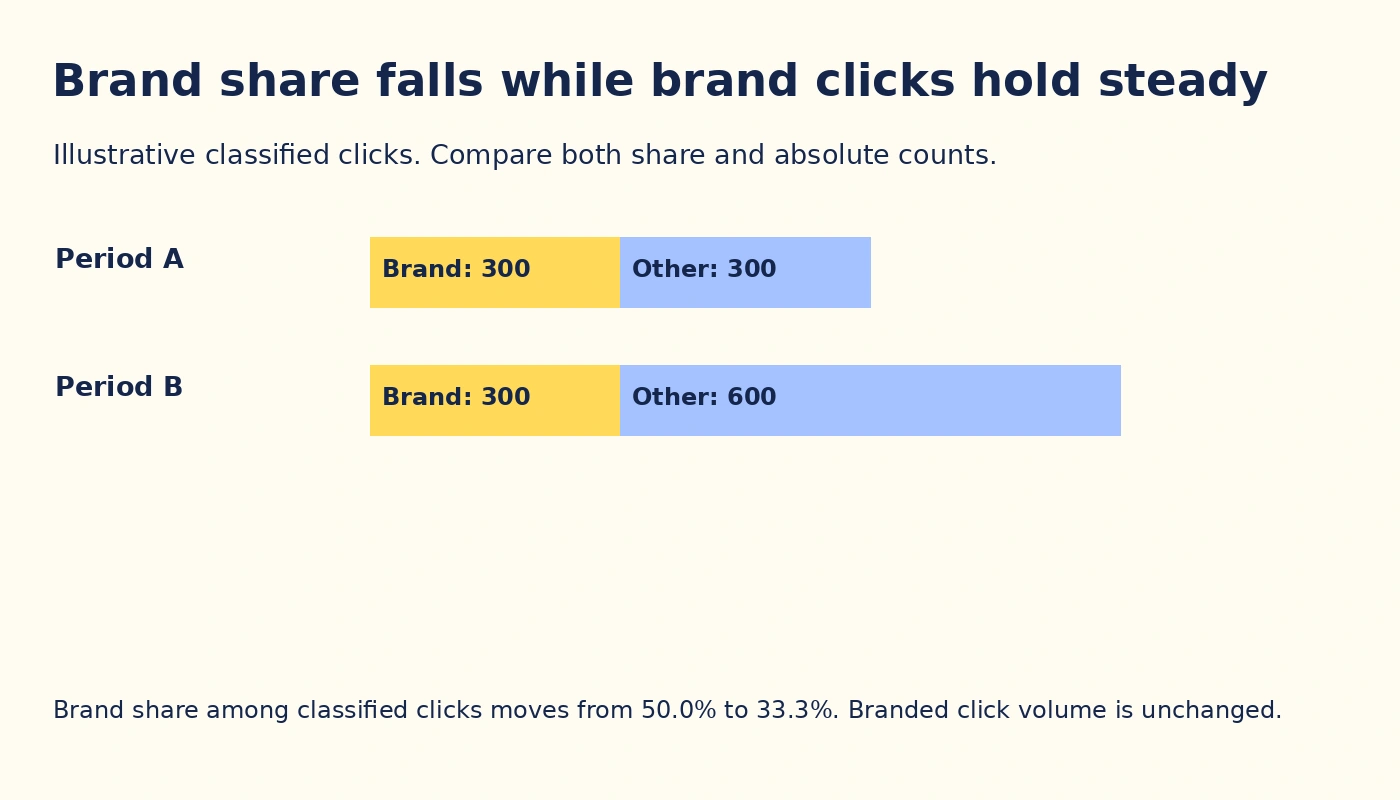
Branded search and nonbranded search answer two different commercial questions. Did people who already knew a name look for it, and did the site earn attention when people searched for a need? A percentage alone cannot tell you which changed. If brand clicks hold at 300 while generic clicks grow from 300 to 600, the brand share falls from one half to one third. The site attracted more search traffic, and the number of branded clicks held steady.
There is a timely reason to revisit the calculation. On November 16, 2026, Google announced new Search Analytics API filtering capabilities, including branded query segmentation. Teams that previously maintained lists of misspellings can now bring Google’s classification into reports through the API where supported. Before replacing a historical series, decide what your business means by a brand and which past decisions depended on the older definition.
What is a branded search query?
Google’s announcement introducing its branded queries filter describes a branded search as one involving a brand name, related names or associated products and services. A literal text search for the precise corporate name captures only part of that concept. Someone can ask for a proprietary model name without naming the company that makes it. A customer can misspell a store and still have an unmistakable destination in mind.
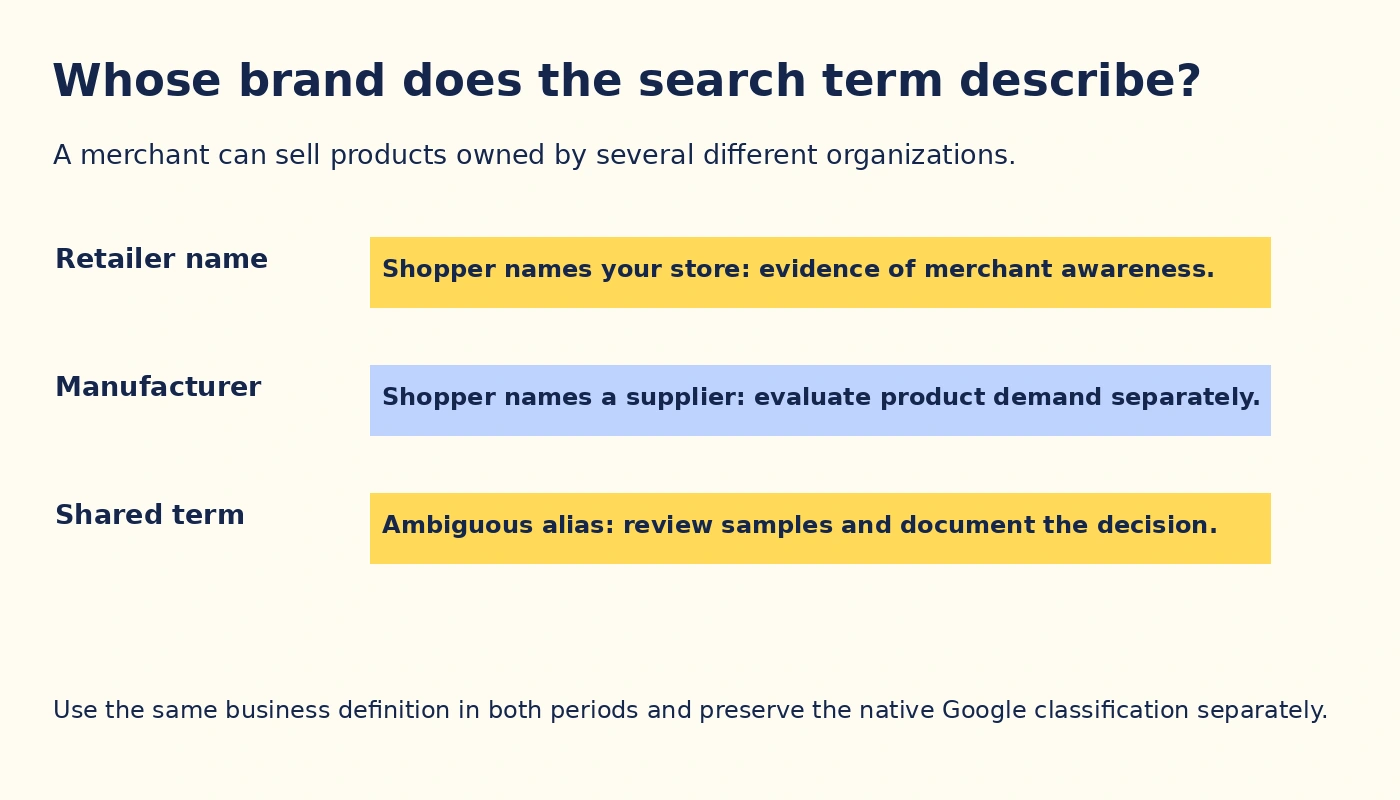
The business definition can be different. A home appliance retailer might want to know how many people searched specifically for its stores. The operations team will care whether someone asked for the retailer’s name, a manufacturer it carries, or a generic appliance category. All three may lead to a product page. Only one is direct evidence that the shopper named the store. Preserve Google’s native classification and build a separate business view for questions like this. Writing over the original classifications makes it difficult to explain disagreements later.
Build a split you can reproduce next quarter
Begin with one site property, a completed period, one search type and a defined market. Record how each measure was obtained. A dashboard should say whether branded clicks came from Google’s classification or from the organization’s own query rules. Keep a third series for the property control total. Store dates and filters alongside the counts. If an agency changes from a desktop-only export to all devices, a sudden change in brand share may reflect the wider population even if customer behavior is unchanged.
Extract the two classified segments with the same parameters wherever possible. Check whether their sum reconciles to a separately observed control. If there is a gap, keep it visible and investigate the aggregation, filters, privacy treatment and retrieval limits relevant to those requests. Do not silently distribute every missing click across visible queries. A large customer that often searches through obscure model numbers can have a different query mix from the list the reporting system returns. The SEOS.co Search Console API export guide gives a worked example of this reconciliation.
Which denominator belongs in the headline?
Name the denominator explicitly. Suppose you identify 300 own-brand clicks, 600 other classified clicks and 100 clicks outside the comparable breakdown. Own-brand share among classified clicks is 300 divided by 900, or 33.3 percent. Identified own-brand clicks as a share of all 1,000 clicks are 30 percent. Both figures are valid if they carry those labels. Neither establishes the actual brand classification of the 100 unallocated clicks. A reporting review should catch a percentage whose label does not name its population.
The same arithmetic can expose false celebrations. Imagine branded clicks drop from 300 to 250 while nonbranded clicks fall from 600 to 250. Brand share rises to 50 percent, yet both parts of the business lost search visits. A marketer who reports the bigger share as evidence that a campaign built recognition has skipped two important observations. A good executive slide displays both click counts, their absolute changes, classified coverage and a one-sentence account of which series drove the movement.
Handle manufacturer names, resellers and private labels
Build a short ownership register. Give each trading name an owner, a market, a date range and a reason for inclusion. A brand acquired in July may matter to the corporate portfolio after the deal closes, while analysts still need a like-for-like view excluding the acquisition. A private label can mean the same thing as the retailer in one market and have independent distributors elsewhere. Put those distinctions in the mapping table so a regional analyst can reproduce the decision without guessing from search results.
Use mixed queries as a separate diagnostic where the sample permits it. A search that names both the store and a supplier might represent someone checking stock at a preferred retailer. A search that names the supplier and a city might represent someone who has not yet chosen a retailer. These are plausible interpretations to test against landing pages and store outcomes. They are not personal identities visible inside a query report. Where several reasonable interpretations remain, keep a mixed or unresolved bucket rather than pretending a regular expression can read intent.
Why a regex and Google’s filter can disagree
A text rule is only as good as the words, boundaries and exceptions it contains. A company called Pine could accidentally match words containing the same letters or pull in searches for the tree. A distinctive model code can match a retailer’s own brand without containing its name. Write tests for these cases when maintaining a custom classification. Give each rule a positive example that should match, a negative example that should stay out, and a mixed example requiring a decision by the reporting owner.
During a transition, run the old and new approaches side by side on the same completed dates. Compare total clicks and inspect important disagreements using the query detail available to you. Tag the likely reason, such as an alias, a competitor comparison, a newly launched product or a rule that matched inside an unrelated word. A small batch of high-volume disagreements can explain much of a large aggregate difference. Retain the prior series as a dated baseline so the new method does not create a fictitious step change in a multiyear trend.
Can nonbranded traffic prove an SEO agency created demand?
Growing nonbranded search clicks can indicate that the site reached more category shoppers. It does not tell you by itself whether the organization increased total demand for the category, improved its share of existing search activity, benefited from a competitor’s inventory shortages, or met a temporary seasonal spike. Start the investigation with impressions, clicks and eligible landing pages. Then look for evidence that distinguishes these explanations. A dated category expansion, for example, changes the number of products available to match relevant searches.
Suppose a running retailer publishes a guide to training shoes for wet pavement. The guide attracts generic queries, but traffic to two older pages declines after it launches. Measure the combined pages before calling every new guide visit an incremental gain. If the group grows, check whether product visits or qualified purchases also increased. If traffic simply moves to a better page and conversions improve, that may still be a successful change. The customer benefit and the incremental traffic benefit are separate claims and deserve separate evidence.
How to connect brand search with paid media and publicity
Mark important campaign dates on the branded trend. Include broadcast placements, store openings, publicity, promotions and product announcements. Ask what the business expected each event to change and in which market. A regional campaign lends itself to a comparison with regions where it did not run, provided those markets were reasonably comparable beforehand. If both exposed and unexposed locations show the same increase at the same time, the campaign-only explanation becomes weaker. Consider seasonality and any national activity before assigning credit.
Pay attention to changes in paid coverage for the company’s own name. An increase in organic branded clicks can coexist with a decrease in paid branded clicks. Build a view of both channels with consistent periods, geography and brand definitions. If the combined response is flat, a redistribution of clicks is one plausible explanation. Check costs, orders and contribution before altering budgets. The organic report alone cannot establish the incremental value of a paid impression or tell you what the customer would have clicked in its absence.
What about conversions from branded search?
A single product page can receive visitors who named the brand and visitors who searched for a generic feature. Search Console’s aggregate query counts do not identify the query behind an individual checkout. Avoid multiplying a page’s total revenue by branded click share and presenting the product as observed branded revenue. Such a calculation assumes the groups have identical commercial behavior. Someone looking for an exact model and someone learning about the category may have very different purchase probabilities.
If finance needs an estimate, expose the assumptions. Imagine 300 branded clicks and 600 generic clicks. At two orders per hundred clicks for both groups, you would expect six branded and twelve generic orders. If branded clicks instead convert at four per hundred while generic stays at two, expected orders become twelve and twelve. The example shows why a change in assumed conversion can shift the interpretation substantially. Label these numbers as scenarios and compare the combined result with actual order volumes to keep the estimates grounded.
How should a local or multi-location company use the split?
Keep location names and geographic filters conceptually separate. A person can search for a Chicago store while physically outside Chicago. A query that contains a city is evidence about the phrase used, while a geographic dimension describes an aspect of the reported audience. Preserve both when available. Create a table for location-page performance and another for explicit location terms. Joining them on the city name alone can assign the wrong demand to a branch or disguise that several branches share the same metropolitan service area.
Distinguish navigational needs from commercial ones. Branded queries about hours, returns, order tracking and customer support often reflect customers already in the relationship. The right action may be to make holiday hours easier to find or repair an outdated returns link. Higher traffic to a support page after a delivery problem is hardly the same achievement as more first-time buyers looking for a flagship product. Ask the operations team about unusual contact reasons before describing every branded search spike as healthy demand.
What should the monthly agency report contain?
Request four rows: observed own-brand clicks, observed nonbrand clicks, unallocated clicks when applicable, and the independently extracted control. Put actual counts beside percentage changes and use the same filters across months. Add a short explanation of classification changes, recent campaigns and the landing-page groups that drove movement. Provide enough detail for another analyst to reproduce the headline. A chart that is visually persuasive but lacks a property, dates and denominator creates avoidable work each time somebody challenges its meaning.
At planning time, ask which decision the split changes. If generic category clicks rise but critical product pages remain unavailable, merchandising may own the highest-value fix. If branded searches for support spike, customer operations may need a clearer order-status page. If competing retailers routinely serve buying questions the company could answer better, the content team has a documented brief. Connecting the observation to a responsible owner prevents branded versus nonbranded reporting from becoming a monthly argument over who deserves credit.
Maintain a clean history when the company changes its name
During a rebrand, track old-name and new-name searches separately as well as together. Demand for the old name can remain meaningful after a logo changes, particularly when customers have long renewal cycles or find the business through earlier press coverage. A falling old-name series and a rising new-name series can indicate a migration between terms. Evaluate the total portfolio before concluding that awareness fell. Record the launch date, the redirect date and when key partners changed their listings. Those events rarely happen on the same day.
Finally, agree on a date to retire the transition view. Keep the original definitions and a frozen historical export available to anyone comparing annual results. Document which subsidiaries and product families the new reporting perimeter includes. Without that record, a change in ownership can look like an SEO improvement, and a divestiture can look like a loss of share that the search team could have prevented.
How to compare agencies on brand and category measurement
Give prospective partners the same sample with a private label, a manufacturer name, a common-word brand, a competitor comparison and a group of unknown clicks. Ask them to explain the classification rules, denominator and business action for each. A good answer preserves uncertainty where the data ends and still identifies a decision worth making. Use the SEOS.co agency rankings by specialty to compare reporting and organic search expertise, and review the agency rating methodology when assembling the shortlist.