
The Search Brief · News analysis
BEIR and AI Search: Why One Retrieval Benchmark Cannot Choose Your Content Strategy
Use BEIR’s heterogeneous evaluation lesson to test relevance, recall, ranking, task coverage and operational limits without universal ranking claims.
Development covered: October 21, 2021 revision; primary source checked November 2, 2026

The BEIR benchmark is useful because retrieval quality changes across tasks and domains. A method that retrieves good evidence for one kind of question may struggle with another. Content teams should take this as a reason to test their actual information needs, rather than assuming that embeddings, keyword matches, or a single aggregate score can predict how every answer engine will discover a page.
For a publisher, the immediate task is to make the information genuinely useful and assessable. For a team building its own search application, the additional task is to evaluate retrieval against representative questions and relevance judgments. These are related activities, but a local retrieval result is not a ranking factor claim about an external commercial search product.
What the historical benchmark contributes
Thakur and colleagues assembled BEIR to evaluate retrieval across diverse datasets and domains. The 2021 paper describes 18 datasets and compares ten retrieval systems. It reports BM25 as a robust baseline and stronger average zero-shot performance for some reranking and late-interaction approaches at higher computational cost. Those are findings from the benchmark’s evaluated systems and conditions, not a November 2026 ranking of every available retrieval model. BEIR primary paper.
The important methodological contribution is heterogeneous evaluation. An average can conceal tasks where a system fails badly. A content strategy based on one narrow test can therefore optimize the wrong thing. The worked examples below are original teaching examples designed to show how a team can expose those differences without claiming to reproduce BEIR’s results.
A retrieval result is an ordered evidence set
A retriever receives a query and returns candidate documents or passages. The useful question is whether the returned set contains the information needed for the task, and whether the most useful evidence appears early enough for the next stage to use. A document that merely shares terminology with the question may be relevant in a loose sense but inadequate as answer evidence.
Suppose a reader asks whether the Cedar Basic plan supports archived-record export. A general Cedar overview may mention exports many times. A short plan-limitations page may contain the decisive exclusion once. For this task, the limitation page is more useful than a verbose overview even if the overview looks more topically comprehensive.
Relevance judgments should therefore describe the task. A page can be relevant to “what is Cedar?” and insufficient for “can Basic export archives?” If the evaluation labels every brand-related document relevant, it will reward retrieval that cannot answer the real question. This is a dataset design error rather than a defect that better prose alone can solve.
Keep document relevance and passage sufficiency separate when useful. A long manual may contain the answer somewhere, while the selected passage omits it. A document-level metric can look successful even though the generator never receives the decisive section. For applications using passages, inspect both the source document and the exact returned text.
Work through precision and recall
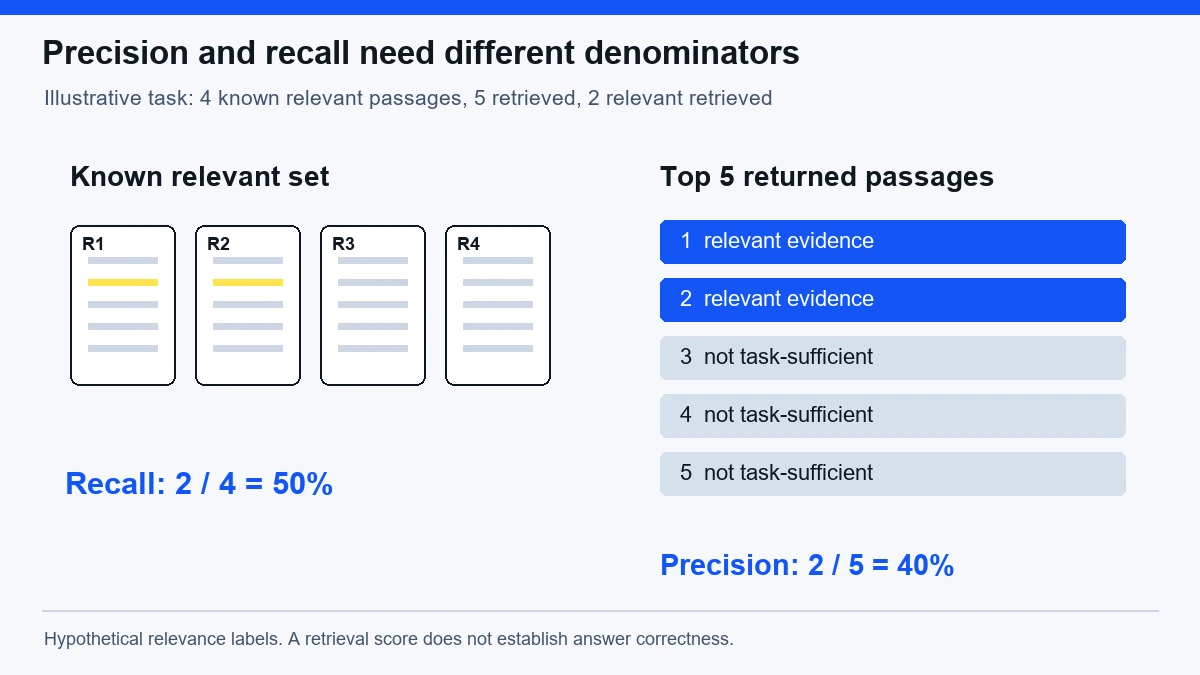
Imagine a small corpus with four passages that genuinely support a question. A retriever returns five passages, of which two are relevant. Precision at five is two divided by five, or 40%. Recall at five is two divided by four, or 50%. The denominators differ: returned items for precision, all known relevant items for recall.
Neither measure describes answer quality directly. Two relevant passages may fully establish a simple answer, while four relevant passages may still omit an essential condition. The relevance policy determines what the metric means. A system can improve recall by returning many more passages and simultaneously make the context less focused or more expensive to process.
For this reason, report the cutoff alongside the metric. “Recall improved” is incomplete if the candidate set grew from five to 100. That change may be worthwhile, but it alters latency, cost, and downstream selection. A reader needs to know whether the result reflects better ordering, broader retrieval, or simply a larger search budget.
If the corpus has incomplete relevance labels, apparent precision can also be misleading. A returned passage marked unjudged is not necessarily irrelevant. Keep unjudged items visible and review a suitable sample. Turning all missing labels into negative judgments can penalize a system for finding useful material outside the original annotation pool.
Rank matters when the budget is small
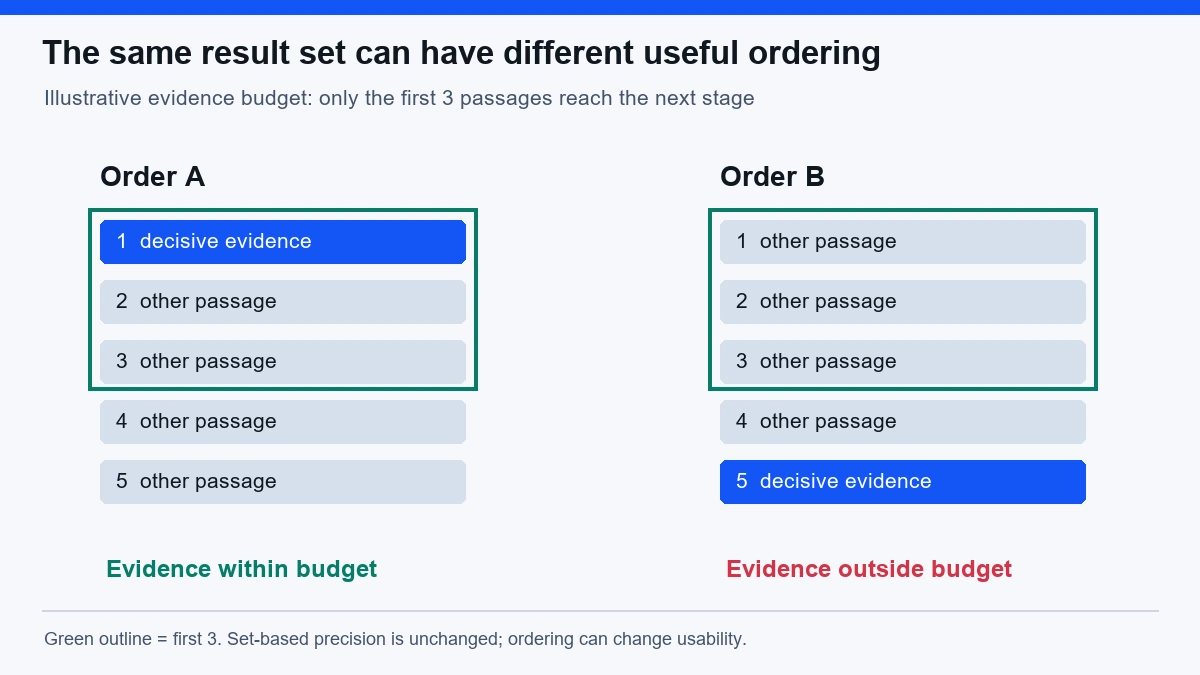
A generator may receive only a limited number of passages. If the decisive evidence appears at rank 12 and the context includes the first five, document discovery alone does not help. Rank-sensitive measures can describe this issue, but their meaning still depends on the task and relevance judgments.
Consider two illustrative retrieval outputs. System A places a decisive policy passage first and four loosely relevant pages afterward. System B returns the same five items but places the decisive passage fifth. Set-based precision is identical. A reader or generator operating under a tight attention budget may find the first ordering more useful.
Now change the task to a comparison requiring three independent constraints. One early decisive passage is no longer enough. Evaluation should reward the evidence combination needed to answer completely. This is why a metric selected for navigational search may be inadequate for multi-part technical advice, even when both applications search the same corpus.
Avoid reporting a sophisticated ranking metric without explaining its decision relevance. A business audience may need a plain-language interpretation such as “the required evidence appeared within the first five passages for 72 of 100 questions.” That statement is often more actionable than a decimal score whose scale and limitations are undocumented.
Build a representative evaluation set
Collect questions from real user tasks where available: support requests, search logs, sales questions, documentation feedback, or customer interviews. Remove sensitive information and record the selection rationale. If real queries are unavailable, create a clearly labelled synthetic set based on known tasks, then validate whether those tasks occur in practice before claiming population coverage.
Stratify by meaningful differences. Product identification, exact error codes, conceptual explanations, comparisons, and current policy questions can stress different retrieval behavior. A panel dominated by easy product names may hide failures on nuanced limitations. Keep enough examples in commercially important categories to inspect their outcomes separately.
Record the expected evidence and the conditions that make it sufficient. For a version-sensitive question, include the applicable release. For a geographic question, include the market. For a comparison, identify which attributes are necessary. These annotations make the test more reproducible and expose gaps in the source corpus before a model is blamed for missing an answer.
Include unanswerable questions. A search application should not always present a plausible result as an adequate answer. If the corpus contains no current information about a requested feature, the correct behavior may be to say the evidence is unavailable. Evaluate unsupported confidence separately from successful retrieval so that a high recall score does not conceal hallucinated conclusions.
The search intent improvement guide can help translate broad keyword groups into the actual decisions your evaluation should represent.
Exact identifiers and semantic language coexist
An exact error code, model number, or legal identifier can be essential to relevance. Preserve those identifiers in clear visible text and explain them in ordinary language. A page that replaces every exact term with a broad paraphrase may become easier to read superficially while losing the precise distinction the user needs.
Semantic descriptions matter too. A customer may ask about “getting old records out” while the documentation says “archived-record export.” A useful article can connect the everyday task with the formal feature name. This is better editorial work than adding a disconnected list of synonyms at the bottom of the page.
For a local search application, compare lexical, semantic, and combined approaches under equal conditions where practical. Keep corpus versions and evaluation sets fixed, and account for any reranking stage. The point is not to declare a universal winner. It is to identify which errors each approach makes on the actual tasks the application must serve.
A publisher usually cannot choose an external engine’s retrieval architecture. It can still make entities, versions, constraints, and relationships explicit. That improves the source’s clarity and provides a stronger evidence basis without pretending to know whether the destination system uses a particular embedding model or ranking pipeline.
Cost and latency belong beside relevance
Suppose a hypothetical baseline returns useful evidence for 80 of 100 questions with a median retrieval time of 100 milliseconds. A more expensive configuration succeeds for 86 questions at 600 milliseconds. Those invented numbers illustrate a tradeoff, not a benchmark finding. Whether the change is worthwhile depends on which six questions improved, the user experience, and operating costs.
Averages can hide deadline failures. Record tail latency and the proportion of requests that exceed the application’s usable budget. A retrieval result arriving after the answer has already been generated may count as successful in an isolated test while contributing nothing in production. Trace collection, queueing, retrieval, reranking, generation, and output confirmation together.
Check shared dependencies under load. If a background indexing task monopolizes a resource, independent queries can miss their deadline even though the retriever passes a single-request test. Record contention, timeouts, retries, and restart recovery. A benchmark score measured on a quiet machine does not establish reliable end-to-end behavior during normal operation.
The same principle applies to freshness. A fast result from an outdated index can be operationally wrong. Include the source version and index update time in the evaluation record. A latency improvement achieved by serving stale evidence should not be described as an unqualified quality gain.
Avoid benchmark-driven content distortion
Do not rewrite an entire site to imitate the documents that performed well in one test corpus. A benchmark can reveal retrieval behavior without specifying the best format for every reader. The source still needs accurate facts, useful explanations, transparent evidence, and a coherent relationship to the actual offer.
A sensible content repair follows an observed failure. If users cannot distinguish two similarly named products, clarify their identifiers and differences. If a limitation is detached from its feature description, bring the relevant conditions together. If the answer is absent, add it with a reliable source. These changes have a concrete reader rationale beyond a hoped-for metric increase.
Keep successful pages stable unless the evidence supports a change. Frequent bulk rewrites can erase useful details, break links, and make comparison difficult. Preserve versions and repair specific gaps. If a broad template change is necessary, test representative page types and inspect whether tables, code examples, and qualifications survive the new representation.
Where the repair involves connecting a detailed source to an overview, apply the internal linking checklist rather than adding indiscriminate cross-links.
Questions to ask before accepting a retrieval claim
Does a higher benchmark average mean the system will find our content more often? It does not establish that. Transfer depends on the corpus, questions, models, infrastructure, and evaluation rules. Treat the benchmark as evidence about studied conditions and as a model for better testing, then investigate the application’s actual environment.
Are keyword methods obsolete because semantic retrieval exists? That conclusion does not follow from heterogeneous retrieval research. Exact terms can be crucial, while semantic similarity can help with different wording. The right comparison is empirical and task-specific. Publishing useful language and precise identifiers serves both needs without requiring an unsupported universal prediction.
Can a retrieval score prove an answer is correct? No. The generator can misunderstand excellent evidence, omit a qualification, or combine incompatible versions. Evaluate answer support and task completion separately. A pipeline should show where the evidence was found and whether the final response used it faithfully.
What should a content leader request from a vendor? Ask for representative questions, relevance rules, corpus dates, per-category results, latency under load, failure examples, and the relationship between retrieval scores and completed user tasks. A single leaderboard position or favorable demonstration cannot establish that the system serves the organization’s actual information needs.
For the publisher-facing discovery sequence beyond this local benchmark, see the practical GEO guide.
Preserve the negative result set
A retrieval evaluation should retain queries that no tested configuration answers well. Those cases may expose missing documentation, contradictory policies, or labels that cannot be applied consistently. Assign each failure a reason and an owner. Some require a better source page; others require a change to retrieval, extraction, or the application response. Keeping the distinction prevents the content team from being asked to solve an infrastructure problem with more articles.
Review the negative set after each material corpus update. If a new page supplies the missing evidence, verify that it was indexed, retrieved, and used in a correct answer. Publication alone is an intermediate event. Confirming the full path provides stronger operational evidence than checking that the document exists or that the search service remains connected.
Preserve question ownership when expanding the panel. New questions should be added with their selection rationale and expected evidence, rather than replacing difficult older examples until the score improves. A stable comparison set reveals regressions, while a separately reported expansion set broadens coverage. Both are valuable when the report makes their different purposes explicit.
Ranked evidence and metric worksheet
This original printer-troubleshooting example uses four known relevant passages and five returned passages. It illustrates the task-specific judgments a benchmark needs, not BEIR performance data.
| Rank | Returned passage | Relevance for the specified printer error |
|---|---|---|
| 1 | Current exact-model error procedure | Relevant |
| 2 | General product marketing overview | Not sufficient for this task |
| 3 | Current exact-model recovery limitation | Relevant |
| 4 | Similar error on another model | Not relevant under the defined model constraint |
| 5 | Old unrelated driver announcement | Not relevant |
| Metric or check | Example result | What remains unproved |
|---|---|---|
| Precision at 5 | 2 / 5 = 40% | Whether the final answer uses evidence correctly |
| Recall at 5 | 2 / 4 = 50% | Whether unjudged useful passages exist |
| Rank usefulness | Decisive procedure appears first | Whether another task requires multiple conditions |
| Experiment worksheet | Fix corpus, labels, cutoff and model; report categories and latency | Transfer to an unrelated commercial engine |