
The Search Brief · News analysis
ALCE Explains Why More AI Citations Can Still Mean Less Evidence
Use ALCE research to audit AI citations claim by claim, separating correct references, missing support, source validity and consequential errors.
Development covered: October 31, 2023 revision; primary source checked November 2, 2026
AI citation quality has at least two separate questions: does the cited material support the claim, and are the answer’s important claims supported at all? Counting links answers neither question reliably. A polished answer can contain many references while attaching them to the wrong assertions, omitting support for decisive qualifications, or citing material that is itself obsolete.
For a content team, the useful response is a claim-level evidence audit. Read what the answer asserts, locate the exact supporting passage, and record where support is complete, partial, contradictory, or missing. This approach improves both AI answer evaluation and ordinary editorial review. It also prevents a citation dashboard from treating a misleading mention as a successful outcome.
What the historical ALCE research contributes
The ALCE paper, revised in October 2023, introduced an evaluation benchmark for systems that retrieve evidence and generate answers with citations. Its evaluation distinguishes fluency, correctness, and citation quality. The authors reported substantial remaining limitations under their tested conditions, including incomplete citation support in their ELI5 evaluation. Those findings describe the studied systems and datasets; they are not a current error rate for every answer engine. ALCE primary paper.
The enduring editorial lesson is the separation of dimensions. A readable answer can be unsupported. A supported statement can fail to answer the question. A relevant statement can cite the wrong passage. Treating these as distinct defects makes repairs more precise and reporting more honest. The detailed workflow below is an original operational interpretation, not a claim that ALCE mandates this particular spreadsheet or scoring policy.
Break the answer into assessable claims
Suppose a hypothetical answer says, “The Cedar backup plan includes 30 days of retention, restores all files within one hour, and is suitable for regulated financial records.” That is not one indivisible fact. It contains a retention claim, a restoration performance claim, a universal scope claim, and a suitability claim that may depend on regulatory requirements and contractual controls.
A reference after the sentence can create the impression that all four claims are verified. If the source only says “30-day retention,” it supports one component. The remaining components need other evidence or revision. Citation position should not be allowed to expand what the cited passage actually entails.
Split claims at meaningful factual boundaries while preserving context. Over-splitting every adjective into a row wastes effort and can hide the practical issue. Under-splitting a long paragraph makes partial support look complete. A useful unit is an assertion that a reviewer could reasonably classify as supported or unsupported without needing to give two conflicting answers.
Keep qualifications attached. “Restoration can begin within one hour” differs from “restoration finishes within one hour.” “Selected files” differs from “all files.” A system can retain the main nouns and number while changing the meaning through a verb, quantifier, or condition. Those small changes often determine whether the answer is safe to use.
Citation correctness is about entailment
For each citation, ask whether the cited material supports the associated claim as written. This is stricter than topical relevance. A page about backup software is relevant to backup software, but it does not necessarily support a claim about a particular product’s recovery commitment. A domain’s reputation does not fill that gap.
Open the precise destination, including any fragment or document version. Find the supporting passage and preserve a bounded excerpt or a clear locator in the audit record. Record the date and source version when the claim is volatile. If the page has changed since the answer was generated, distinguish the original observation from the source’s current state rather than silently judging historical output against new text.
A citation can be incorrect because it points to contradictory evidence, because it supports only a weaker claim, or because it supports nothing relevant. These categories deserve separate notes. A contradiction may require urgent correction; an overbroad paraphrase may be repaired by restoring a qualification; an irrelevant source may indicate retrieval or attribution failure.
Correctness also has a source reliability boundary. A claim can accurately repeat a source that is wrong. Entailment asks whether the answer follows the cited material. Verification asks whether the material is a suitable basis for the factual assertion. Both matter, especially for changing product terms, legal requirements, health information, and financial decisions.
Completeness is about unsupported assertions
Now inspect the answer’s important factual claims whether or not they have citations. An answer with three accurate references and seven unsupported claims should not receive a clean evidence review merely because every visible citation is valid. The missing support is part of AI citation quality, not an unrelated formatting concern.
Define which claims require support before scoring. Common knowledge and transparent calculations may be treated differently from product commitments or empirical findings. A practical policy can require sources for externally verifiable facts, identify calculations as calculations, and label hypothetical examples explicitly. The policy should be consistent across competing brands and answer variants.
Completeness should reflect scope rather than citation density. Adding the same source after every sentence may increase the number of references without supporting additional facts. Conversely, one well-placed citation can support a tightly connected set of claims if the referenced passage genuinely establishes all of them. The reviewer should evaluate evidence coverage, not reward punctuation.
Missing caveats can create an additional completeness problem. If a plan excludes archived data but the answer recommends it for an archive migration, the answer may need the exclusion to be useful. A technically correct affirmative sentence can still leave a decision materially incomplete. Record that as a missing decision condition rather than inventing a contradictory claim that was never written.
A worked evidence matrix
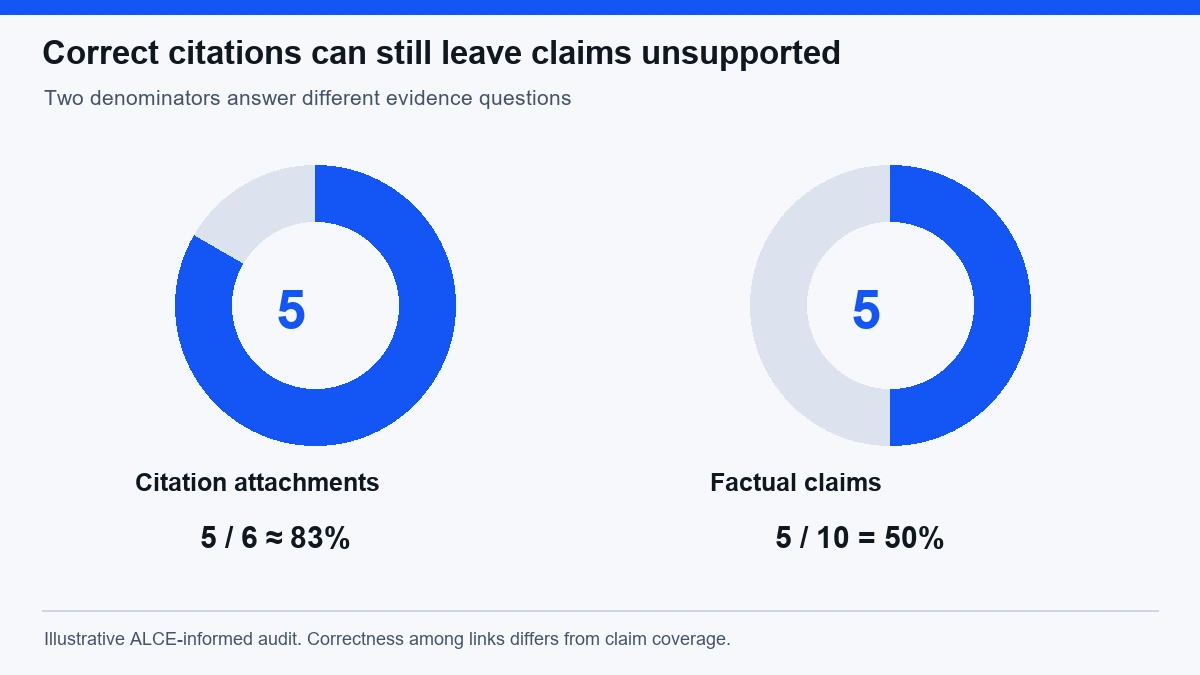
Consider a purely illustrative answer containing ten assessable factual claims and six citation attachments. Five attachments support their associated claims; one points to a page that discusses the topic without establishing the assertion. On an attachment-based definition, citation correctness is five divided by six, or about 83%. This describes the audit example, not a benchmark result.
Suppose only five of the ten factual claims receive adequate support. Claim-level completeness is then 50%. The answer can therefore have relatively strong correctness among its visible citations and weak overall support coverage. Reporting only the 83% result would conceal the unsupported half of the answer.
Now imagine that two supported claims are minor background details, while three unsupported claims concern price, eligibility, and a guaranteed deadline. A simple claim count treats all ten equally. An editorial decision should also inspect severity. The equal-weight score is useful for consistency, while the severity review identifies whether the answer can be relied upon for the actual task.
A transparent matrix might record claim text, source URL, supporting passage, support classification, required qualification, source date, and impact. Do not replace the underlying rows with an unexplained weighted score. A reader should be able to see why a high-scoring answer was held because its only unsupported assertion was commercially decisive.
Repair the smallest meaningful defect
If the source says retention lasts “up to 30 days depending on plan,” repair the answer to reflect that condition. Do not merely add another citation after the unchanged universal claim. An additional link cannot rescue wording that overstates the evidence. The first repair belongs in the assertion itself.
If no reliable source supports the proposed deadline, remove the guarantee or state that the deadline is not established. An editor should not search indefinitely for a convenient supporting sentence while ignoring stronger contrary evidence. The purpose of evidence review is to determine what can be said accurately, not to decorate a preferred conclusion.
If an answer combines sources from different product versions, rebuild the relevant section around one coherent version. A feature from an old enterprise plan and a price from a new basic plan may each be sourced correctly in isolation while producing a nonexistent offer together. Version alignment is part of substantive correctness.
Preserve the rest of a useful answer when repairing a local defect. Rewriting the entire piece makes it harder to compare before and after evidence and may introduce new unsupported claims. Maintain a change log identifying the original assertion, the supporting evidence, the revised wording, and the reason for the change.
For a wider source-improvement workflow, the GEO improvement guide connects evidence clarity with access and observed answer behavior.
Use automated reviewers as triage
An automated judge can help identify assertions and suggest support classifications, particularly in a large answer corpus. Its output remains another model’s assessment. It can miss negation, confuse partial with complete support, or accept persuasive but irrelevant text. A confidence number does not remove those failure modes.
Calibrate the judge on a labelled set representative of the content you actually review. Include partial support, contradictions, outdated sources, multi-source claims, tables, and unsupported numerical statements. Compare its decisions with human adjudication and inspect the disagreements. A judge that performs well on simple biographical facts may fail on conditional product commitments.
Keep the judge configuration, prompt, model identifier where available, and source inputs fixed during a measurement run. Changing the evaluator between periods can create an apparent quality improvement that reflects the evaluator rather than the answers. When updating the judge, rerun an overlap set so that the resulting series has an interpretable bridge.
Automated triage should prioritize risky errors rather than mechanically approve everything above a threshold. A low-severity background issue and an unsupported contractual guarantee deserve different actions. Route uncertain consequential claims to a person who can assess the actual source and decision context, and retain unresolved status when suitable expertise or evidence is missing.
Publisher visibility and answer correctness are separate
A publisher may be pleased to see its URL cited, yet the surrounding answer can misstate its offer. Record the citation as observed inclusion and the statement as an accuracy defect. Combining them into one success score makes it difficult to choose the right response: improve discoverability, clarify source content, or correct a misunderstanding.
Inspect whether the published page makes critical conditions easy to retrieve together. A price buried in one tab and its eligibility condition hidden in another can be difficult to assess even for a human. Consolidating related facts in visible text helps readers and creates a clearer evidence basis. It does not guarantee that an external system will preserve the qualification.
When submitting a correction through an available provider process, preserve the exact answer, prompt, time, destination, and source passage. A vague statement that “the AI is wrong about us” supplies little reproducible evidence. The correction record should show which assertion conflicts with which current authoritative fact and whether the issue persists in later observations.
Use the AI search visibility mistakes guide when a cited URL looks successful in reporting but the surrounding brand description remains inaccurate.
Questions for an evidence review policy
Must every sentence contain a citation? No. A useful policy works at the level of support needs rather than sentence count. Transparent arithmetic, clearly marked examples, and the writer’s own reasoning can be explained directly. Externally verifiable factual assertions should have an appropriate evidence path, especially when a reader’s decision depends on them.
Can a citation to an authoritative institution establish a claim that the institution never made? No. Authority and entailment are different. A reliable domain is a good starting point for research, but the supporting passage must still match the assertion. Review the actual text rather than relying on the source’s logo, reputation, or page title.
Is a perfectly supported answer necessarily useful? No. It might answer the wrong question, omit an essential option, or explain facts at the wrong level for the reader. AI citation quality belongs beside relevance, completeness of the decision, readability, and current accuracy. It cannot replace those editorial dimensions.
How should the team report unresolved evidence? Name the precise claim and missing dependency. “Source does not establish the one-hour guarantee” is actionable. “Citation quality uncertain” is too broad to guide repair. The final review should distinguish corrected claims, unsupported claims removed, and remaining questions held for a suitable source or qualified reviewer.
When applying this policy to one platform, read how ChatGPT SEO works alongside the claim-level audit rather than assuming every engine behaves identically.
Retain disagreement as evidence
Two careful reviewers can disagree about whether a passage fully supports a claim, especially when the answer compresses several conditions. Preserve their initial labels before adjudication. Discuss whether the disagreement concerns the source, the claim boundary, or the support policy. That distinction helps improve the review process without pretending that the task has no judgment involved.
For example, one reviewer may treat “available in selected regions” as sufficient support for “available nationally” because the page lists several major markets. The second reviewer may correctly require evidence covering the entire country. Resolving that disagreement produces a more precise rule about geographic scope. Simply averaging the labels would conceal the reason the broader assertion failed. Maintain an adjudication note and add the example to the calibration set, while keeping the final manuscript’s factual wording clear and appropriately qualified.
A claim-evidence matrix a reviewer can use
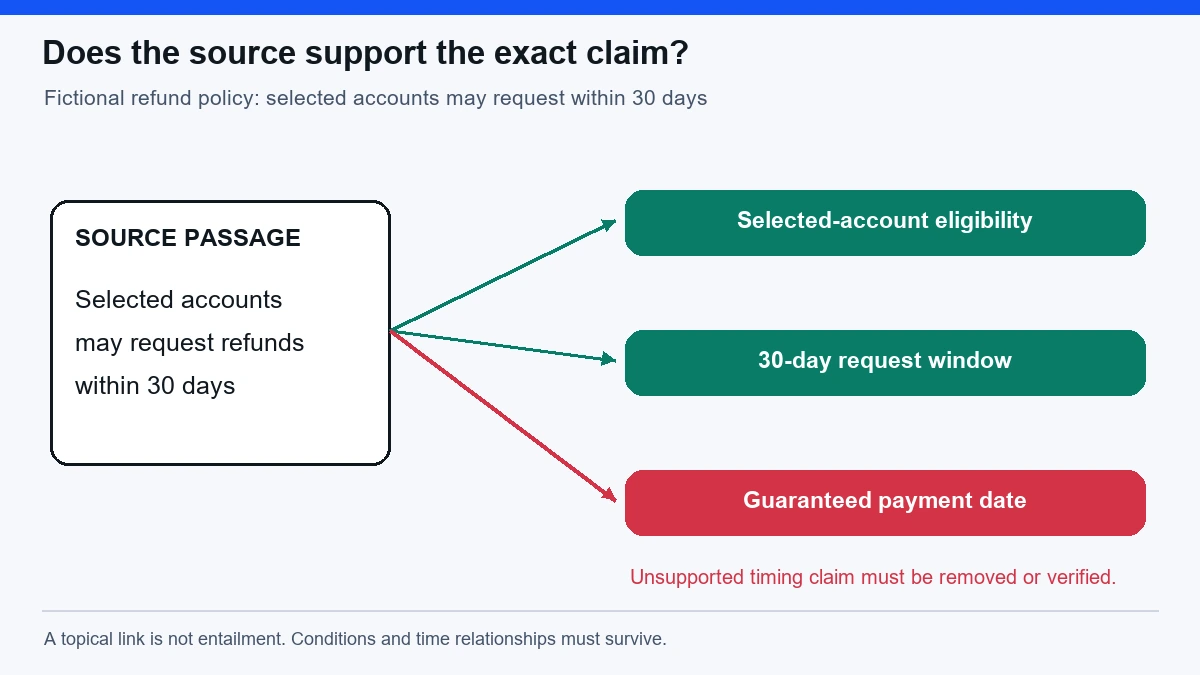
This fictional refund-policy example separates citation attachment from support coverage. It is an original worksheet, not an ALCE dataset result. The source says selected accounts may request a refund within 30 days; the answer must not widen that policy.
| Draft claim | Cited passage establishes | Support decision | Repair |
|---|---|---|---|
| Selected accounts may request a refund | The same eligibility and request condition | Supported if the source is current and applicable | Retain conditions |
| All accounts automatically receive a refund | Neither universal eligibility nor automatic payment | Unsupported expansion | Restore selected accounts and request process |
| Refund requests are possible within 30 days | A30 day request window | Supported with correct scope | Retain the actual time relationship |
| Funds arrive within 30 days | Request deadline only, no settlement deadline | Unsupported timing inference | Remove or obtain suitable evidence |
| Audit denominator | Illustrative numerator | Calculation | Interpretation |
|---|---|---|---|
| Six citation attachments | Five support their associated claims | 5 / 6,about 83% | Correctness among attached references |
| Ten factual claims | Five have adequate support | 5 / 10,50% | Completeness of claim coverage |
| Consequential claims | Review individually | No invented universal weight | A small unsupported guarantee can block publication |