
The Search Brief · News analysis
A Technical Content Brief That Resolves Evidence Before the Writing Starts
Build a technical content brief with task ownership, claim-level evidence, focused expert questions and acceptance tests, illustrated by an integration guide.
Development covered: Primary-source guidance checked November 2, 2026

A technical content brief should define the reader’s decision, the evidence needed to answer it and the conditions that would make the finished page acceptable. An outline and a keyword list are not enough. If the writer must guess product behavior, invent a calculation or decide which of three overlapping pages owns the task, the assignment has begun too early.
The useful brief is short enough to use and specific enough to prevent avoidable rework. It records what is known, what remains unresolved and who can resolve it. It also distinguishes a verified product fact from a hypothetical teaching example. That distinction should survive the manuscript, diagrams, metadata and final publishing template.
The worked brief below concerns a fictional purchase-order integration guide. It demonstrates a commissioning method rather than describing a real product or a tested SEOS.co implementation. The aim is to make the evidence and acceptance conditions concrete before asking anyone to produce polished prose.
Name the exact reader and the decision
“Write about ERP integration” is a topic assignment. “Help an operations manager decide whether scheduled purchase-order synchronization fits a receiving process” is a reader task. The second version identifies the practical decision and exposes the facts needed to answer it.
Specify the reader’s starting knowledge and constraints. An operations manager may understand purchase orders but not the connector’s retry model. An engineer may need identifiers, error codes and state transitions. A finance buyer may need cost boundaries and implementation responsibilities. One page can support related audiences, but it needs a primary task rather than an unfocused promise to serve everyone.
Record the desired next action. The page might enable a compatibility assessment, a safe configuration step or a shortlist decision. That action determines which unanswered questions matter. A generic contact button is not a substitute for understanding what the reader needs to provide or decide next.
Use the search-intent improvement guide to check that the proposed format fits the task. A procedural guide, a comparison worksheet and a product capability page can share terminology while requiring different evidence and structure.
Establish ownership before proposing another URL
Inventory existing pages that answer the task or contain decisive facts. Record the preferred owner, useful supporting resources and any overlap that needs resolution. A new article should contribute a distinct decision, explanation or evidence set rather than paraphrase a guide already present.
For the fictional integration assignment, the product specification owns supported records and limits. The implementation guide owns setup responsibilities. The proposed operations article owns the timing and recovery decision. It can summarize capability facts while linking to their authoritative owner instead of becoming a competing specification.
Define what the article will not attempt because it belongs elsewhere. This is an internal scope control, not a repetitive customer-facing disclaimer. It helps the writer avoid expanding a focused operational explanation into a generic encyclopedia of software integration.
The topical authority checklist provides a broader coverage model. In the brief, translate that model into a concrete ownership map: one task, one primary destination, relevant supporting pages and clear reasons for any new URL.
Build an evidence table by consequential claim
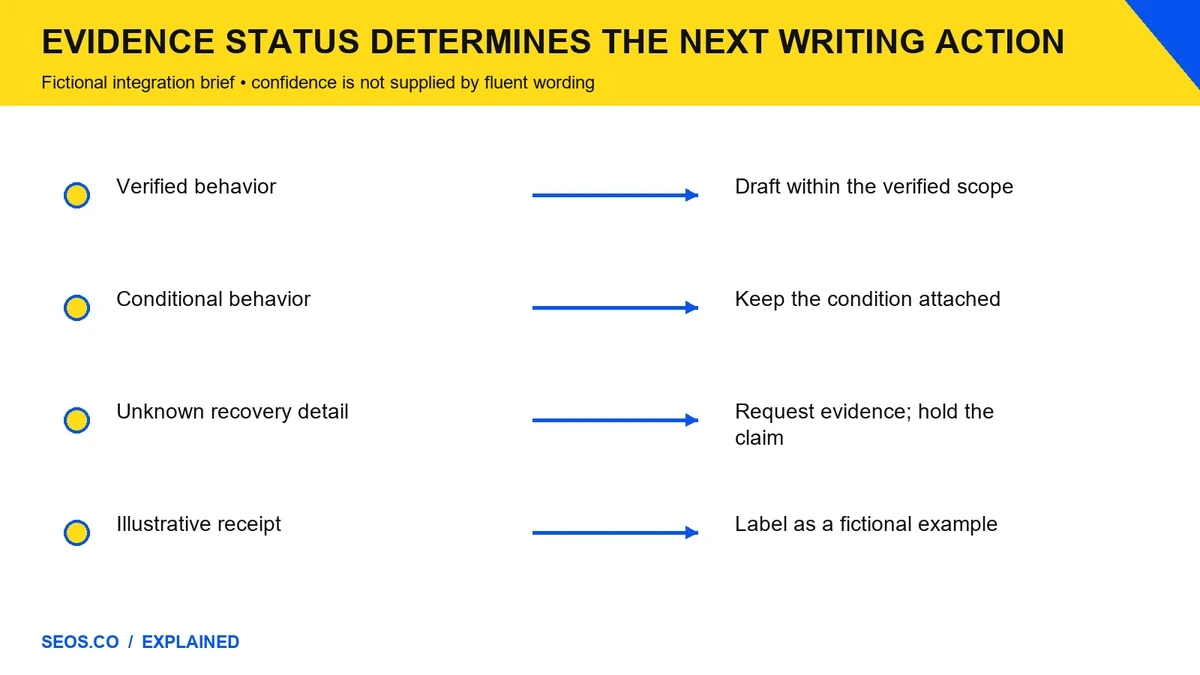
List the statements that could change the reader’s decision. For the sample connector, these include supported source records, destination states, synchronization direction, collection interval, processing latency, retry behavior, duplicate handling and recovery after downtime. Each claim needs a source or a named evidence dependency.
Store the source title, version, date, relevant passage and factual owner. A link to a large documentation homepage is often insufficient for a precise technical behavior. The reviewer should be able to find what establishes the claim without searching an entire product archive.
Mark evidence states clearly: verified, conditional, unknown or illustrative. Conditional facts require their conditions. Unknown facts remain unresolved rather than becoming a plausible paragraph. Illustrative values can support a worked example only when the example is visibly hypothetical and cannot be mistaken for a product promise.
Record conflicts. If a sales page says real-time while a specification says scheduled collection, the brief should not let the writer choose the more attractive phrase. Assign the conflict to the factual owner and preserve both sources until the approved meaning is established.
Work through the fictional assignment
The sample reader is an operations manager at a distributor using two warehouse systems. The decision is whether scheduled synchronization can support receiving without unacceptable stock discrepancies. The page’s direct answer should explain the supported workflow and the conditions requiring a different approach.
Assume the evidence packet verifies one-way import of approved receipts, a fifteen-minute collection schedule and a retry queue. Processing latency and restart recovery remain unknown. The writer can explain the verified fields immediately, but the timing calculation and recovery example are blocked until product operations supplies evidence.
The fictional evidence packet can be recorded before drafting:
| Claim or field | Current evidence state | Required source or action | Factual role |
|---|---|---|---|
| Approved receipts move one way | Verified within sample assumptions | Current specification | Product operations |
| Collection runs every fifteen minutes | Verified within sample assumptions | Approved cadence definition | Product operations |
| Processing duration | Unknown | Bounded test or specification | Engineering |
| Restart recovery | Unknown | Replay behavior and confirmation | Operations |
| Teaching receipt identifier | Illustrative | Label as fictional | Editorial |
The brief requests a bounded test or approved specification for the unknowns. It asks when a receipt becomes eligible for collection, how long processing takes under stated conditions and whether downtime changes are replayed. These questions are more useful than asking an expert to “review the article when finished.”
For the teaching example, the brief permits a clearly fictional receipt created just after a collection. The manuscript can show how waiting time and processing time differ, using verified values when available or explicitly hypothetical values for a conceptual demonstration. The diagram must preserve the same status labels.
Acceptance requires that a reviewer can identify record scope, direction, timing definitions, retry limits, manual responsibility and material exclusions. A page containing the words integration, automation and efficiency does not pass merely because it sounds comprehensive. The decision criteria should be answerable from the finished asset.
Write an answer outline rather than a heading quota
Start with the direct answer, then follow the reader’s decision sequence. For the sample, useful sections cover eligible records, timing, failures, restart recovery, duplicate prevention, implementation responsibilities and the next assessment step. The sequence reflects the workflow rather than an arbitrary number of headings.
Assign each section an evidence purpose. A timing section needs definitions and an example. A recovery section needs behavior under interruption. A responsibility section needs an approved owner or role. This keeps the outline from becoming a list of topics that every generic article could include.
Add relevant natural-language questions and map them to actual answer sections. “Is this real-time?” requires a clear definition of schedule and latency. “What happens after an outage?” requires recovery behavior. “Who fixes a rejected item?” requires ownership and resubmission procedure. A question map should reveal gaps before drafting.
Choose the substantive depth required for the task. Use enough substantive explanation to resolve the decision, including evidence, worked examples and meaningful exceptions. A commissioning standard can define a minimum depth, but it should not be confused with an engine-prescribed ranking word count. Remove repetition that adds length without improving understanding.
Plan examples, tables and media as evidence tools
An example should expose a likely misunderstanding. The receipt timing sequence clarifies why a collection interval is different from end-to-end delay. A failed-identifier sequence clarifies why retries cannot repair invalid source data. These examples add more value than a decorative illustration of two systems connected by an arrow.
A table should compare like attributes and retain units. Separate collection interval from processing duration. State whether a value is observed, contractual, typical or illustrative. The brief should tell the designer which relationships must remain understandable in text-only reading.
Plan a feature image that attracts attention without inventing results. A vibrant illustrated receipt moving through distinct timing gates can express the subject. The explanatory diagrams should show the actual method and conditions. Do not ask an image generator to fabricate a product screenshot or a successful performance chart.
Record alt-text intent with the media brief. Alt text should explain the meaningful relationship rather than repeat a keyword. A diagram showing a failed record and its correction owner needs that relationship expressed in accessible text. The manuscript should also explain decisive facts outside the image.
Define contextual links before drafting
Select existing destinations because they help the reader complete a related task. The integration article might link to the product’s supported-record specification, an implementation responsibility guide and a relevant troubleshooting resource. Preserve verified URLs and natural anchor intent in the brief.
For editorial implementation, the internal linking checklist helps connect the planned paths to crawlable destinations. Do not enable a sibling link merely because a proposed slug appears in the content calendar. The destination must exist and serve the promised task.
Record inbound donor opportunities as well. An existing selection guide can point to the new timing explanation at its connectivity criterion. That is more useful than adding a generic related-post block everywhere. The brief can specify the donor passage while leaving live mutation to the authorized publishing owner.
Keep link verification separate from subject review. A correct URL can lead to a page that no longer supports the intended claim. A useful destination can still be broken by an incorrect fragment or redirect. Both meaning and delivery need checking before release.
Assign factual review without inventing expertise
Name the role responsible for each uncertain fact. Product operations might verify recovery behavior; implementation leads might verify responsibilities; finance might approve cost conditions. If no reviewer has agreed to perform the work, record the dependency rather than placing an impressive name in the byline.
Ask reviewers focused questions with source references. “Does this page look good?” invites superficial approval. “Does the retry description preserve the current limit and manual handoff?” is a verifiable request. Preserve the actual response and the version reviewed.
AI can help structure research and draft explanations, but it does not become evidence merely by sounding technical. Google’s generative-AI guidance emphasizes value and accuracy and warns that large volumes without added user value can violate scaled-content policies. That guidance does not certify any individual assisted draft. Google generative-content guidance.
The brief should therefore define review obligations that apply regardless of who or what produced the first draft. Check facts, calculations, metadata, examples and image text. A grammar pass or detector score cannot replace verification of a product behavior.
Make acceptance observable
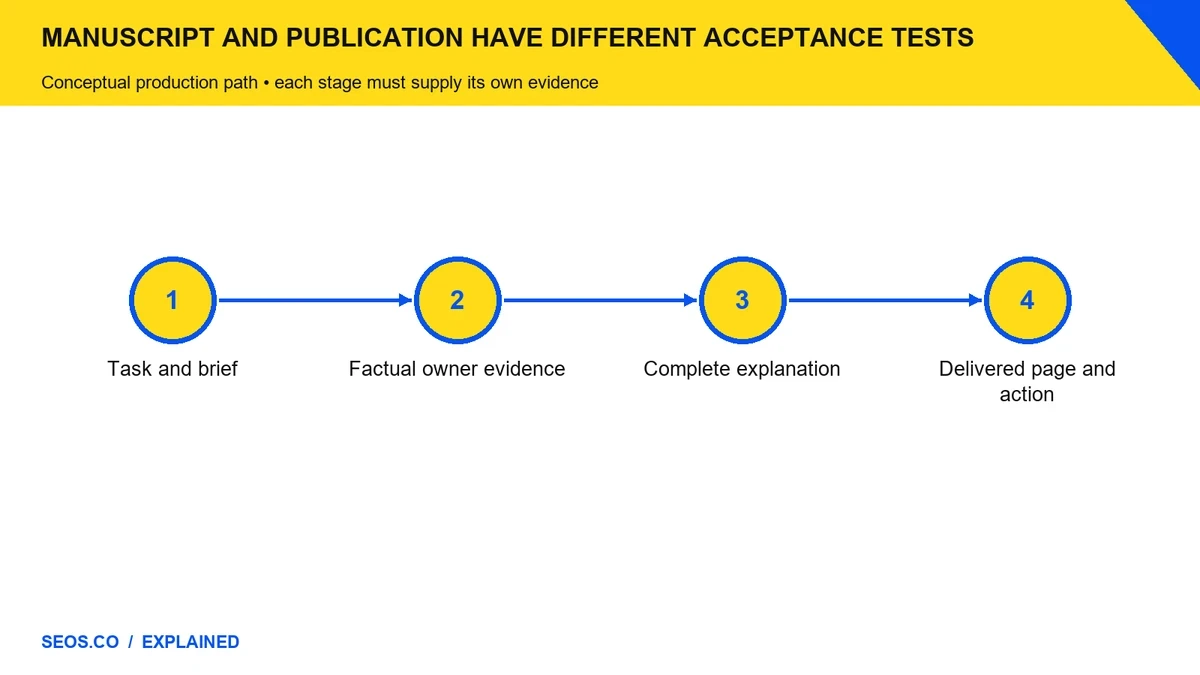
Separate manuscript acceptance from publication acceptance. The manuscript can pass when the answer, evidence, query coverage, examples and metadata are complete. Publication requires delivered-page checks, functioning links, readable media and a working primary action. Do not collapse those states into one vague done label.
Record the exact exclusions used for word counting and the unresolved factual dependencies. Preserve the brief before drafting so the team can compare the original scope with the delivered result. Retrospective additions can be useful, but they should not be presented as evidence that every requirement was known in advance.
A good content brief reduces uncertainty at the earliest useful moment. It gives the writer room to explain and the reviewer something concrete to assess. When reader task, ownership, evidence and acceptance agree, technical content becomes easier to produce without sacrificing the qualifications that make it useful.
Specify calculations before requesting a calculator or chart
If the page includes arithmetic, the brief should name the variables, units, assumptions and intended interpretation. For the connector example, collection waiting time and processing duration are separate inputs. Their sum can illustrate a simplified delay, but it should not be labeled a guaranteed maximum unless the evidence establishes every relevant stage and bound.
Include at least one manually checked worked case and an edge case. A receipt created just after collection tests waiting time; a rejected receipt tests whether retry duration belongs in the same calculation. The writer and designer need to know which cases the formula covers and which require another explanation. Otherwise a visually polished chart can communicate a broader promise than the underlying method supports.
Define rounding and missing-input behavior. If processing latency is unknown, the output should remain incomplete or show a clearly labeled scenario. It must not substitute zero merely to produce a result. If a range is appropriate, state whether it is an observed range, a planning assumption or a contractual bound.
The same specification should govern prose, tables, diagrams and interactive tools. A page that says approximately twenty minutes while its graphic says instant contains a factual inconsistency even if each element was produced by a different team. Review the final asset as one explanation, with calculations checked independently from grammar and layout.
Freeze the assignment without freezing learning
Record the approved brief version and the assumptions that can change it. If new evidence alters the task, update the affected requirement and explain why. Preserve accepted research and prose that remain valid. This prevents a small factual discovery from triggering an unnecessary rewrite of the entire article while keeping the final scope reviewable.