
The Search Brief · News analysis
Expert Interviews for Technical Content: Collect Decisions, Limits and Evidence
Prepare focused SME interviews, collect failure modes and limits, preserve claim provenance and review technical content without inventing expert approval.
Development covered: Primary-source guidance checked November 2, 2026
Expert interviews produce useful content when they reveal how a knowledgeable person makes decisions, handles exceptions and verifies results. A transcript of broad opinions is rarely enough. Prepare around the customer’s task, ask for concrete operating details and preserve which statements are supported, conditional or unresolved before turning the conversation into authoritative copy.
An interview is a source of testimony, not automatic proof of every claim. A specialist can accurately describe personal experience while misremembering a date, generalizing beyond the projects observed or speaking about an older product version. The editorial job is to preserve the useful knowledge and verify the consequential facts without inventing certainty or credentials.
The method below is an original commissioning and review workflow. Its warehouse example is fictional, and the sample questions are interview prompts rather than quotes from a real person. No expert participation, customer result or firsthand test is claimed.
Start with the reader’s unresolved decision
Before scheduling the interview, write the task the content must help someone complete. A warehouse manager evaluating synchronization needs to understand timing, recovery and responsibility. Asking an engineer to explain everything about integration is less likely to produce a focused resource than asking what could make that workflow unsuitable.
Review existing material first. Identify the claims already documented and the gaps the expert can uniquely address. Do not spend most of the session asking for definitions available in a specification. Use the limited time for judgment, exceptions, failure modes and the practical meaning of documented limits.
Use the search-intent guide to check the audience and format before the conversation. An implementation interview and a buying-guide interview can involve the same specialist but require different questions. The former needs procedural details; the latter needs evaluation criteria and trade-offs.
Send a compact preparation note with the intended audience, main decision, topics, recording arrangement and expected review role. Clarify whether the person will be quoted, attributed as a contributor or simply consulted for factual background. Do not assume that agreeing to a conversation means approving a public byline or every later interpretation.
Ask for the last concrete instance
Broad questions invite broad answers. Instead of asking whether migration is difficult, ask what made a recent migration difficult and which conditions mattered. A concrete instance exposes sequence, dependencies and judgment that can become a useful explanation. The person can describe the structure without sharing confidential customer details.
Follow with boundaries. Was the experience typical or exceptional? Which product version, operating scale and data quality applied? What would have changed the recommendation? These questions prevent a memorable example from becoming an unsupported universal claim.
Ask what evidence survives. There may be a test report, configuration guide, incident record or approved specification that can support the explanation. Record whether the material can be inspected internally, quoted publicly or described only at an abstract level. The available evidence determines how specific the published claim can be.
If the specialist cannot recall a value, leave it unresolved. “I think it was about five minutes” should not become a precise performance statement merely because the draft needs a number. Assign a follow-up source request and continue the conversation on questions that do not depend on that uncertainty.
Use failure questions to reveal the real workflow
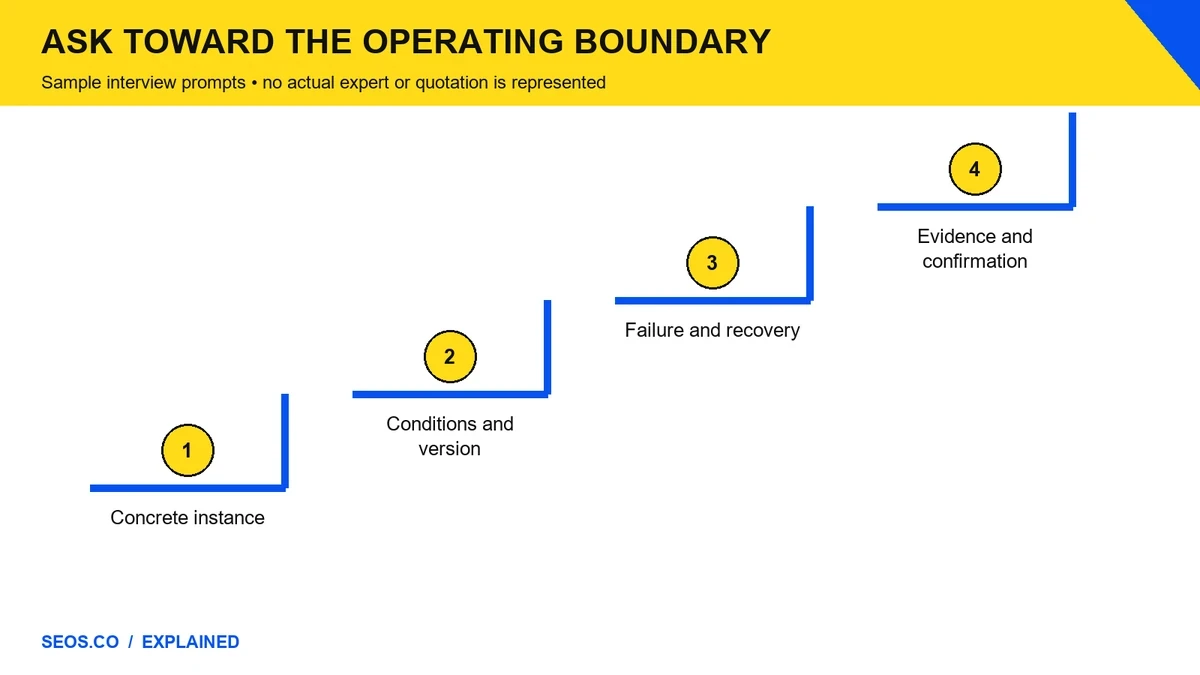
Ask what commonly fails, how the team notices and what happens next. A successful happy-path demonstration can hide the operational work customers need to plan. Failure questions often reveal ownership, alerting, recovery and exceptions that a generic feature description omits.
For the fictional synchronization guide, ask what happens when an item identifier is invalid. Does the record retry? Who corrects it? How is the corrected record resubmitted? Can a retry create a duplicate receipt? Each answer should identify behavior and responsibility rather than simply promise that errors are handled automatically.
Then ask about interruption. If the connector stops for an hour, how are changes made during downtime recovered? Is there a checkpoint, replay window or manual reconciliation step? A system can be running again while still missing records. The distinction matters to the customer’s operating decision.
Finally ask how success is confirmed. A success message, queued job and completed import are different states. Request the actual confirmation evidence and any known gaps. This helps the eventual article describe the whole task rather than a single visible interface event.
Capture a fictional interview as a claim ledger
Imagine the specialist explains that approved receipts move one way from System A to System B on a scheduled collection. The person is confident about direction and record eligibility but uncertain about maximum recovery delay. The interviewer records those as separate claims with different evidence states.
A reusable interview worksheet can separate prompts from evidence. These are sample questions, not statements made by an actual interviewee:
| Interview prompt | Evidence sought | Publication boundary |
|---|---|---|
| What failed in the last concrete instance? | Sequence, conditions and retained record | Do not generalize one case to every customer |
| Who corrected the invalid identifier? | Responsibility and recovery step | Preserve manual work rather than promise full automation |
| How was completion confirmed? | Received output or test evidence | A visible message alone may be insufficient |
| Which version and limits applied? | Current specification and scope | Keep conditions beside the claim |
The ledger includes exact wording, normalized meaning, scope, source reference, confidence boundary and follow-up owner. The direction claim points to the current specification. The recovery claim remains pending a test record. The article can progress on verified sections without pretending that the uncertain behavior has been resolved.
A conditional statement should remain conditional. If the expert says a custom connector can be assessed for SAP, the manuscript should not shorten that to SAP supported. If the expert describes a successful project under particular constraints, the article should not call the approach universally proven.
The ledger also records what is illustrative. An invented receipt identifier can make a workflow easy to follow, provided it is labeled as a teaching example. It should not be presented as a real customer incident or a test the writer performed. This distinction protects both usefulness and truthful attribution.
Separate testimony, documents and editorial inference
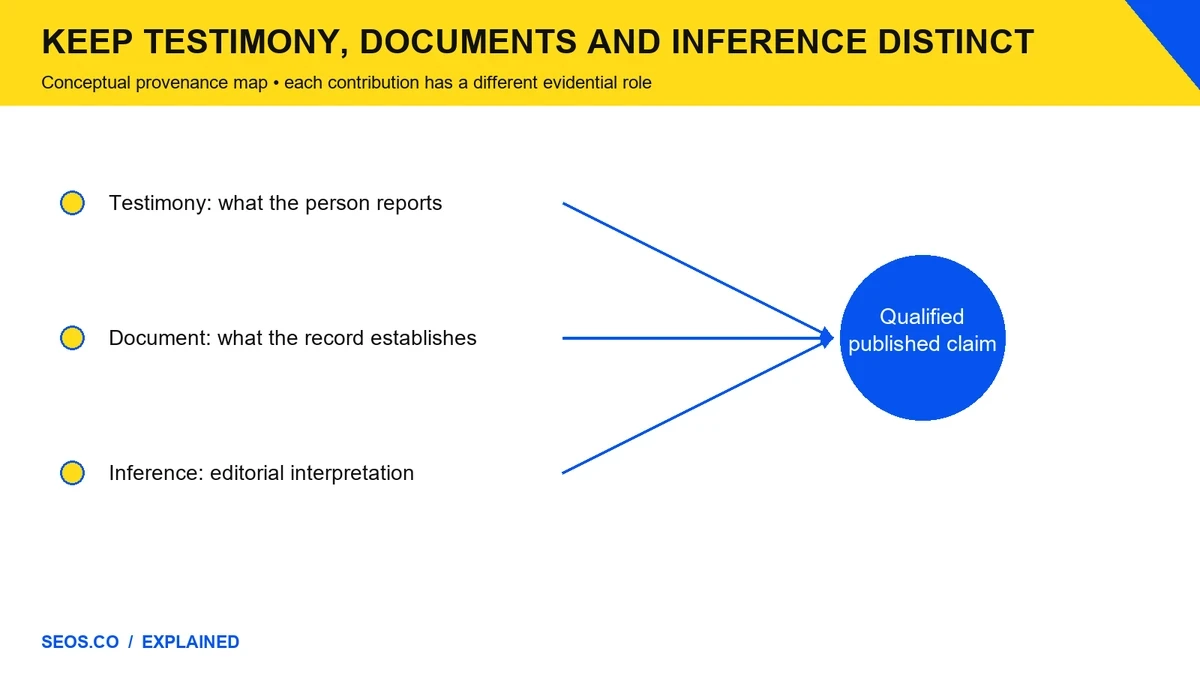
Testimony establishes what the person reports. A document can establish a specification or recorded event. Editorial inference explains how those facts relate to the reader’s decision. These evidence types can reinforce each other, but they should not be blended into one undifferentiated expert claim.
For example, a specialist may report that poor identifier hygiene often delays migration in the projects observed. A data-preparation checklist can show the required fields. The editor may infer that buyers should assess identifier quality before scheduling cutover. Label the scope of the experience and avoid inventing a population-wide failure rate.
Google’s helpful-content guidance encourages clear sourcing and information about who created content and how. That supports transparent attribution, but it does not mean that adding an expert name makes an unsupported claim reliable. The visible attribution should describe actual participation and relevant knowledge. Google people-first content guidance.
The guide to AI-assisted content and ranking provides related editorial context. A model can organize interview notes and suggest follow-up questions, but it cannot become the witness, supply missing experience or approve the resulting technical claim.
Preserve quotations without polishing them into new claims
When using a direct quote, check it against the recording or approved transcript and retain its meaningful qualifications. Removing a hesitation is different from removing a condition that changes the assertion. If substantial rewriting is needed, use a clearly attributed paraphrase and obtain the appropriate review.
Do not combine fragments from separate answers into a seamless sentence that the person never said. A concise editorial explanation may be clearer, but it should remain the publication’s explanation rather than a manufactured quote. Preserve the source locations so an editor can verify attribution.
Avoid using a quote as a shield for a factual error. A statement can be quoted accurately and still require correction or context. The publication remains responsible for the decision to present it. If the speaker disputes the source record, document the disagreement and resolve the wording before release.
For a confidential example, agree on what can be disclosed. Removing a customer name may not be enough if the operational details identify the project. Use an approved abstraction or a separately labeled hypothetical example rather than inventing a composite case and implying it is one real engagement.
Turn the conversation into a task-based structure
Organize the manuscript around the reader’s decisions rather than the interview’s chronology. An expert may discover the most important limitation near the end of a conversation. That limitation belongs beside the claim it qualifies, not buried at the end because the transcript happened to unfold that way.
Use a direct answer, then conditions, method, examples, failure modes and next steps as the task requires. Preserve what makes the contribution distinctive: a diagnostic question, a trade-off, an exception or a verified recovery process. Remove generic remarks that add no practical understanding.
The content SEO guide connects that structure to a broader publishing program. An interview should supply evidence and judgment that the existing library lacks, not simply justify another page targeting a close variation of the same keyword.
Plan explanatory media from the evidence. A sequence diagram can show receipt states and correction ownership. A decision tree can show when a custom assessment is required. A decorative portrait may establish identity, but it should not be treated as an explanation of the technical process.
Review focused claims rather than asking for blanket approval
Send the contributor the relevant factual statements and their context. Ask whether the scope, version, numbers, conditions and attribution are accurate. A focused question such as “Does this recovery sequence omit a required manual step?” is easier to assess than “Please approve the article.”
Record the version reviewed and the actual response. If the reviewer checks only technical sections, do not label the entire article expert-reviewed. If no response arrives, preserve the dependency and decide what can responsibly be published without claiming approval. Silence is not factual verification.
Separate contributor review from independent editorial review. A contributor can confirm what they intended to say, while an editor checks evidence, coherence, fairness and the page’s promise. Where independent review is unavailable, label the current process honestly rather than treating the contributor’s authority as universal certification.
When reviewers disagree, preserve the underlying sources and ask what condition explains the difference. Two specialists may be describing different versions or operating contexts. A precise qualification can resolve the conflict more usefully than choosing the more senior person’s wording without investigation.
Build reuse without losing provenance
An interview can support several resources when each has a distinct purpose and the evidence applies. Store claims as reusable records with source context and permissions. Do not copy a quote into unrelated pages where its original boundary disappears. Reuse should reduce repeated research while preserving claim accountability.
Connect the resulting resources through useful links. A selection article can point to a detailed implementation explanation, and the implementation guide can point to a troubleshooting procedure. The internal linking checklist helps turn those relationships into real navigable paths rather than a list of planned titles.
Assign review triggers for changing technical claims. A release, integration revision or operating-policy change should flag dependent excerpts. The original interview date remains part of provenance, but it is not proof that the information is current. A later update should preserve what changed and who verified it.
Judge the interview by the questions it resolves
A productive session leaves the team with clearer decisions, verified details and explicit unknowns. It does not need a dramatic quote or an impressive number. Count unresolved material claims, follow-up completion and whether the finished explanation helps the intended reader evaluate or complete the task.
The strongest expert interviews make tacit judgment inspectable. They reveal why a recommendation changes under different conditions, what can fail and how success is confirmed. Editorial rigor turns that knowledge into a reliable resource while preserving the limits of the experience behind it.
Manage the source record as an editorial asset
Store the recording or notes, transcript version, permission boundaries and claim ledger in the project’s approved location. Keep access limited to the people who need the material. The source record may contain customer details, security-sensitive information or commercial conditions that should not enter a public draft simply because they appeared in a conversation.
Mark redactions and abstractions explicitly in the internal record. A reviewer should be able to tell whether a published example comes directly from an approved case, omits identifying details or is wholly hypothetical. These states support different claims. A fictional teaching example can be valuable, but it cannot establish that a customer achieved a result.
When an expert changes a statement after checking evidence, preserve both the original uncertainty and the verified correction. That history shows the review doing useful work. It should not be erased to make the interview appear perfectly authoritative from the beginning. A reliable content process is allowed to discover and correct mistakes before publication.
Give the retained material a review trigger or retention rule appropriate to the organization. Reusing an old interview without checking version and permission can create new debt. Provenance remains useful only when the team can distinguish a historical contribution from a current approved fact.