
The Search Brief · News analysis
Pricing Content for Custom Services: Explain the Cost Without Inventing a Quote
Write useful pricing content with scope, inclusions, sensitivity and a fictional implementation-cost model that separates project fees from first-year budgets.
Development covered: Primary-source guidance checked November 2, 2026

Useful pricing content explains the cost structure, assumptions, inclusions and conditions that help a buyer judge whether an offer is worth investigating. A custom service does not need a fabricated fixed price to be transparent. It needs a clear account of what changes the work, which costs are included and what information is required for a real estimate.
Separate approved commercial facts from illustrative arithmetic. An actual minimum fee belongs to the business’s current policy. A hypothetical project budget belongs to a labeled teaching example. Mixing them can make a helpful explanation look like a binding offer or an observed customer result when it is neither.
The example below models a fictional implementation project. Its hours, rates and totals are deliberately hypothetical and do not describe SEOS.co pricing or an industry benchmark. The method is intended to help content teams explain variable costs accurately while giving sales a better-qualified starting conversation.
Identify the buying decision behind the cost question
A buyer asking how much something costs may be deciding whether the service is affordable, comparing delivery models or preparing an internal budget. Those are related but different tasks. A page that says contact us for every answer leaves the reader unable to determine whether a conversation is worthwhile.
Use the search-intent guide to identify the dominant decision. An early-stage budget guide can explain ranges and cost drivers. A package page needs current inclusions and conditions. A procurement worksheet needs assumptions that can be adjusted for the buyer’s situation.
Define the next action accordingly. A compatibility assessment may require systems, locations and data volumes. A project estimate may require scope, timeline and responsibilities. Tell the reader what information will make the next response useful instead of presenting a generic inquiry form as the only explanation.
Do not promise exactness the business cannot support. If the service is genuinely scoped case by case, explain why and identify the variables. Transparency comes from inspectable reasoning and truthful boundaries, not a falsely precise headline number.
Separate price, budget and total operating cost
Price is the amount charged under stated commercial conditions. A budget is a planning allowance for a defined scope. Total operating cost can include internal labor, third-party tools, maintenance and transition work beyond the supplier’s fee. A page should say which of these it is discussing.
A project fee can look inexpensive while requiring substantial customer preparation. Conversely, a higher fee may include migration, training or support that another offer excludes. Compare consistent scopes before suggesting one model is cheaper. An unexplained price table can conceal more than it reveals.
Record currency, billing basis, market, tax treatment where relevant, commitment period and validity date for actual offers. Have the responsible commercial owner confirm those fields. A writer should not infer current terms from an old proposal or convert another market’s amount by changing the currency symbol.
For illustrative budgets, state the assumptions beside the calculation. A reader should not need to reach the end of the article to discover that the attractive total excludes implementation. The qualification is part of the figure’s meaning.
Build the cost model from work components
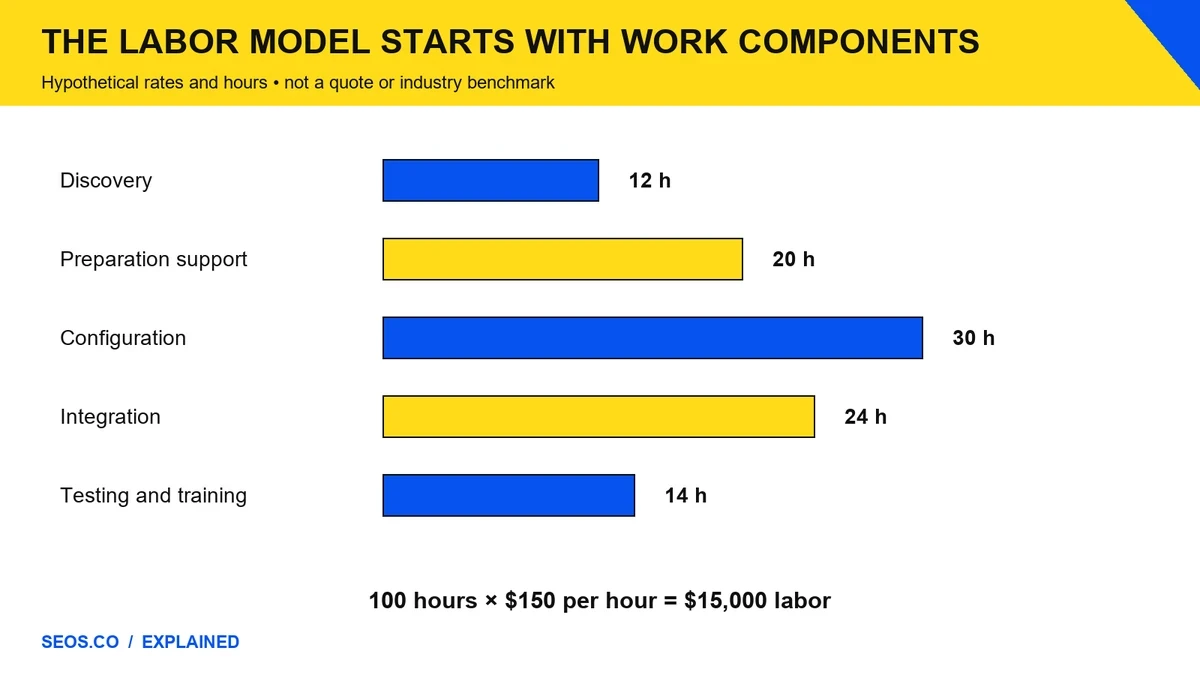
List the activities that consume effort: discovery, data preparation, configuration, integration, testing, training and launch support. Define who performs each activity and what completion means. A vague implementation line item makes it difficult to explain why two projects differ.
Identify fixed and variable components. A standard assessment might be fixed under a defined scope, while connector development varies with systems and complexity. Recurring support belongs in a separate time basis. Do not add a monthly service to a one-time project total without naming the period.
Record dependencies. Data quality, access readiness, approval delays and unsupported interfaces can change effort. These are not excuses to make every estimate meaningless; they are conditions the buyer can investigate. A useful guide explains how to reduce uncertainty before contracting.
The content SEO guide provides broader context for matching an asset to the user’s task. A cost guide earns its place by enabling an informed comparison, not by repeating a service page with the word pricing added.
Work through a fictional implementation budget
Assume a hypothetical project includes twelve hours of discovery, twenty hours of preparation support, thirty hours of configuration, twenty-four hours of integration work and fourteen hours of testing and training. The total is one hundred hours. At an illustrative rate of $150 per hour, the modeled labor amount is $15,000.
| Fictional work component | Hours | Illustrative rate | Modeled labor |
|---|---|---|---|
| Discovery | 12 | $150/hour | $1,800 |
| Preparation support | 20 | $150/hour | $3,000 |
| Configuration | 30 | $150/hour | $4,500 |
| Integration | 24 | $150/hour | $3,600 |
| Testing and training | 14 | $150/hour | $2,100 |
| Labor total | 100 | Same illustrative rate | $15,000 |
These are teaching assumptions, not a supplier quote or observed customer project.
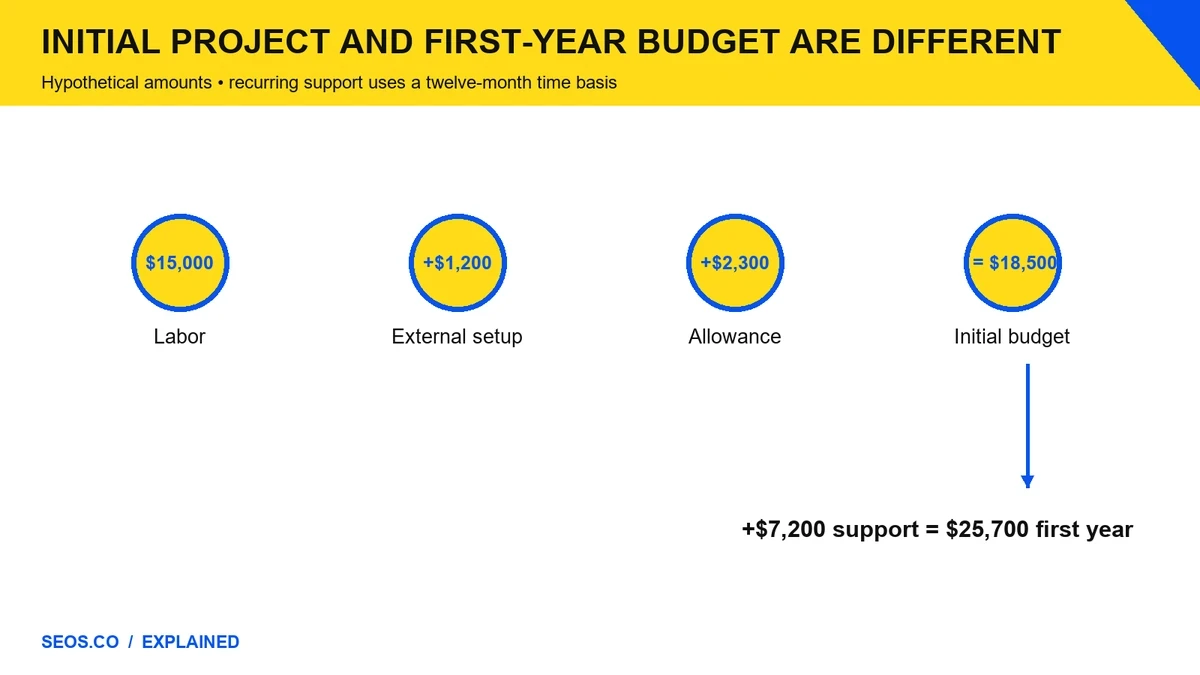
Now add a fictional one-time third-party setup charge of $1,200 and a planning allowance of $2,300 for identified uncertainty. The illustrative initial budget becomes $18,500. The allowance is not a measured expected loss or a universal contingency percentage. It is a visible assumption in this example that a real estimator would need to justify.
Suppose ongoing support is modeled separately at $600 per month. The first-year scenario includes twelve months of support, or $7,200, bringing the illustrative first-year amount to $25,700. That total should not be presented as the project fee, because it includes a year of a separate recurring service.
The table or diagram should preserve these distinctions: labor model, one-time external charge, uncertainty allowance and recurring support. A headline that advertises $15,000 while the main explanation relies on $25,700 would misrepresent the scope unless it clearly names what each figure covers.
Check the arithmetic independently and have a factual owner review the assumptions before using a real version. A polished calculator can reproduce a wrong model perfectly. Verification needs both correct calculation and commercially valid inputs.
Explain sensitivity rather than hiding it in a broad range
Show which variables materially change the result. If integration work rises from twenty-four to forty-four hours in the fictional model, labor increases by twenty hours times $150, or $3,000. The initial scenario becomes $21,500 if the other assumptions remain unchanged. That is a sensitivity example, not an observed project distribution.
Explain what could cause the change. An additional system, a custom interface or a more complex reconciliation process can require different work. Avoid saying that every difficult project costs more without identifying the actual mechanism. The buyer needs to know which inputs to investigate.
Do not make a narrow range appear authoritative when evidence is weak. A low-to-high interval can represent historical observations, a scenario set or a commercial offer. Those are different. Label the interval and disclose whether outliers, exclusions or scope differences affect it.
A sensitivity table is often more useful than one giant range. It can show a base scope and the effect of one changed assumption at a time. Keep the rest constant and state that simultaneous changes may interact. Do not imply that adding independent adjustments always predicts a real project accurately.
Make inclusions and exclusions easy to compare
Use plain descriptions of deliverables. “Data migration included” needs a boundary: source systems, record types, volume assumptions, cleanup responsibility and validation. The reader should understand what the supplier does and what remains with the customer.
Identify optional work separately. Training for an additional team or a custom report should not quietly enter the base total. Conversely, a required dependency should not be described as optional merely to advertise a lower starting amount. The commercial owner must confirm the classification.
Explain completion and acceptance. Configuration can be finished while customer data validation remains pending. A launch date can depend on access and approvals. Cost content should show these responsibilities so a buyer does not mistake a supplier milestone for a fully operational outcome.
Link to the supporting implementation explanation where useful. The topical authority checklist helps plan distinct supporting resources. In a real service library, the cost page should summarize the decisive conditions and point to the fuller process rather than duplicate every technical instruction.
Avoid false comparisons and invented customer savings
Compare offers only when the relevant scope and current terms are known. A lower advertised fee may omit services, and a higher fee may address a different operating scale. If evidence is incomplete, provide a criteria worksheet rather than declaring a winner from incompatible numbers.
Do not turn the hypothetical model into a customer case. “This example saves $10,000” requires a defined alternative and justified assumptions even as an illustration. A claim that a real customer saved that amount requires actual evidence and permission. Keep scenario arithmetic and observed outcomes visibly separate.
Likewise, a price is not proof of quality or suitability. Explain the capabilities, process and constraints that matter to the task. A buyer may reasonably choose a simpler approach when the more elaborate service is unnecessary. Honest pricing content should support that conclusion rather than force every reader toward the largest engagement.
Avoid invented urgency. If a price expires or capacity is limited, use the actual approved condition and expiry behavior. A generic countdown that resets for every visitor undermines the factual explanation and creates maintenance risk.
Keep titles, metadata and conversion messages aligned
A title promising exact pricing should lead to an actual approved price under stated conditions. A guide offering a planning model should say so. The description should reflect the same scope rather than advertise a number the body later qualifies away.
Google’s snippet guidance explains that search previews may be generated from page content or a useful meta description. That makes accurate visible wording and metadata worthwhile, but the publisher cannot guarantee which preview will be shown for every query. Google snippet guidance.
The estimate request should ask for inputs that correspond to the model. If system count drives scope, collect that information. If timing changes availability, ask for the intended window. Do not demand irrelevant personal data merely because the form template contains extra fields.
Make the confirmation truthful. A received estimate request is not a confirmed quote, approved scope or reserved project slot. Explain what happens next and which facts remain to be assessed. This preserves the same boundary established in the pricing explanation.
Maintain the model as the offer changes
Assign owners to rates, inclusions, external charges and package conditions. Store effective dates and review triggers. A new service model or tool charge should flag the dependent page, calculator, diagram and downloadable worksheet. Updating only one surface can leave contradictory offers in circulation.
Use the guide to when content should be updated for broader maintenance context. Pricing deserves particular attention because a small stale field can materially change a buyer’s decision. The review should verify facts, not merely refresh the date.
Preserve old versions internally for audit and customer conversations. If a historical public offer remains accessible, label its time scope clearly and provide the current path. Do not silently rewrite a past quote or pretend the current model applied to every earlier engagement.
A useful pricing page gives the buyer a fair starting point: what the cost represents, why it changes, what is included and what evidence a real estimate needs. It can be commercially helpful without inventing a universal price. The strongest content makes the assumptions visible enough that both buyer and supplier can discuss the same scope.
Give the buyer a usable input worksheet
A practical worksheet asks for the variables that materially change scope: systems involved, required records, locations, migration volume, data condition, training audience and intended timeline. Explain each field in plain language and allow unknown where the buyer genuinely lacks the information. An unknown input should lead to a clarification step, not silently become the cheapest assumption.
Separate customer effort from supplier effort. A project can require internal export preparation, validation and approval even when the supplier’s fee is fixed. Include those responsibilities in the planning explanation without assigning invented labor rates to the customer. The buyer can then estimate internal capacity using its own appropriate figures.
Show what the worksheet produces. It may support a discovery conversation or an initial scope classification; it should not be called an approved quote unless the business actually uses it that way. State who reviews the inputs and which conditions require a revised estimate. This turns transparency into a useful process rather than a decorative calculator.
Test the worksheet with an incomplete and an out-of-scope example. A buyer with an unsupported system should receive a truthful boundary or assessment requirement, not a confident automatic price. A missing volume should remain unresolved. These edge cases are part of the content’s usefulness because they prevent the model from appearing more certain than the information supplied.
Preserve the completed worksheet version with any real estimate derived from it. If the customer later changes scope, the business can identify which assumption changed and explain the revision. This is more useful than treating the first illustrative number as a permanent promise despite different inputs.