
The Search Brief · News analysis
Internal Linking Governance: Keep a Growing Content Library Connected
Maintain useful internal links with task ownership, donor planning, destination readiness, interrupted-release recovery and delivered-page verification.
Development covered: Primary-source guidance checked November 2, 2026

Internal linking works best as a maintained relationship between useful pages, not a last-minute quota added before publication. A content team needs to know which task each page owns, where a reader benefits from the next resource and whether the destination is ready. The operational record should include both outgoing links and the existing pages that can introduce a new asset.
A link can be technically valid and editorially weak. It can also be useful in a brief but fail in the delivered template. Treat relevance, destination readiness, crawlability and completion as separate checks. This makes the process more reliable than asking every writer to add an arbitrary number of links without a shared inventory.
Google’s link guidance recommends crawlable anchor elements with valid destinations and descriptive anchor text. It also explains that links help discovery and understanding. Those principles support implementation, but they do not establish a universal ideal link count or a guaranteed ranking outcome. Google link best practices.
Maintain a page inventory with task ownership
The inventory should identify canonical URL, title, primary task, audience, status, owner and related resources. Include draft and retired states so writers do not link to a proposed slug as though it were already public. A search over titles alone is useful discovery, but it does not establish that a page answers the intended question.
Record the preferred owner for each substantive task. If three articles explain the same implementation process, decide whether their audiences or evidence truly differ. Unresolved ownership makes linking arbitrary and can reinforce duplication. The topical authority checklist supplies broader context for a coherent coverage map.
Keep stable identifiers for pages separately from their current URLs where the publishing system allows it. A route can change while the content responsibility remains the same. An identifier helps update the affected graph without assuming that every mention of a keyword refers to the same destination.
Assign an owner to the inventory itself. Without maintenance responsibility, a useful spreadsheet becomes another stale source. New releases, consolidations and retirements should update the inventory as part of completion rather than waiting for a periodic cleanup project.
Choose links by the reader’s next decision
Ask what the reader needs at this point in the explanation. A selection guide discussing connectivity can link to a detailed outage procedure. A cost guide mentioning custom development can link to a compatibility-assessment explanation. These links extend the current task rather than interrupting it with loosely related topics.
Use an anchor that describes the destination in context. “How synchronization recovers after an outage” is more informative than “click here.” Avoid repeatedly forcing the same exact keyword where a natural phrase explains the relationship more clearly. Anchor language should serve the reader rather than a speculative density rule.
Check the destination’s actual answer. A page with integration in its title may not explain the recovery process. Open the resource and inspect the relevant section before selecting it. A title match is a candidate, not completed editorial verification.
Use the search-intent improvement guide when two destinations appear similar. The right link depends on audience, task, format and next action, not merely shared vocabulary. A detailed technical guide and a buying comparison can both be relevant but useful at different moments.
Record a link edge with its purpose
A simple edge record contains source page, destination owner, current destination URL, anchor intent, source section, reader benefit and status. The status can distinguish planned, target-ready, implemented and verified. This prevents a link graph in a planning document from being mistaken for deployed discovery.
Record whether the edge is contextual navigation, evidence support, a hub relationship or a commercial next step. These roles can overlap, but naming the purpose improves review. A source citation should establish a claim; a related guide should help the reader continue a task. Do not treat every link as interchangeable authority decoration.
Keep a short reason for uncertain links. If the relationship is weak, it may be better to omit the link than force a quota. The manuscript should remain understandable without an excessive chain of dependencies. A supporting resource can add depth without carrying the entire burden of answering the current page’s promise.
The internal linking checklist can guide the implementation review. Governance adds the ownership and state model that keeps those checks current as the library changes.
Work through a new-guide release
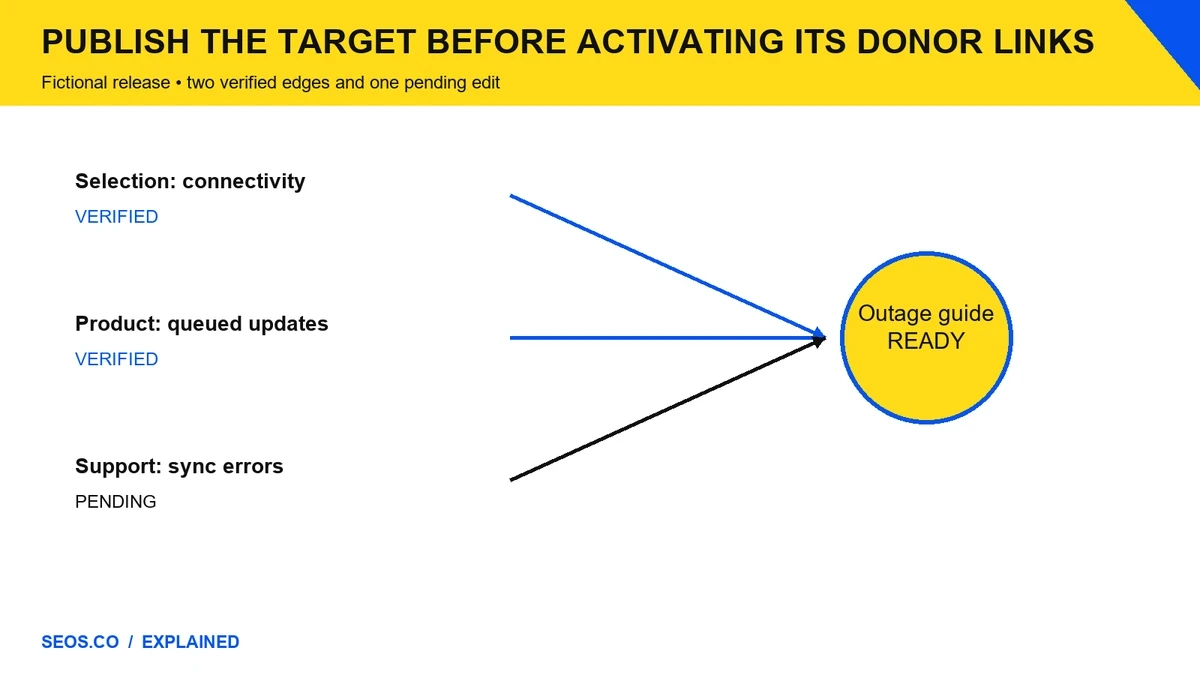
Imagine a fictional content team publishes a warehouse outage guide. The new page has a clear hub route and three useful outgoing links: supported operations, implementation responsibilities and identifier troubleshooting. Those destinations already exist and have been inspected for relevance.
The team also identifies three donor passages in existing pages. A selection guide mentions connectivity constraints, a product guide mentions queued updates and a support page explains synchronization errors. Each can introduce the new outage explanation at the point where the reader needs it. The donor plan is specific enough to implement without blind keyword replacement.
Before release, the new page remains staged. The existing donors should not publicly point to an empty URL. Once the target is published and verified, the authorized release owner enables the three incoming edges and checks their delivered anchors and destinations. The manifest records the actual state of each edge.
The fictional release can retain an edge-level worksheet:
| Donor passage | Intended target | Reader benefit | Example status |
|---|---|---|---|
| Selection guide: connectivity constraint | Outage guide | Evaluate lost-connectivity behavior | Verified after target publication |
| Product guide: queued updates | Outage guide | Understand recovery conditions | Verified after target publication |
| Support page: synchronization errors | Outage guide | Continue into the recovery explanation | Pending authorized edit |
If one donor cannot be edited immediately, the release record shows two incoming links verified and one pending. That is more useful than claiming the entire cluster is connected because the plan contains three rows. The remaining dependency has an owner and a concrete next action.
All numbers in this example are illustrative. The value is the sequence: inspect, plan, stage, publish target, activate edges and verify. It reduces broken transitions while preserving the distinction between desired architecture and public behavior.
Verify links in the delivered representation
Inspect the actual anchor markup and destination, including redirects and fragments where relevant. A visual button can look like a link while relying on an interaction that is not exposed as a normal navigable URL. The published output matters more than the editing interface.
Check the final destination after redirects. A link that now lands on a generic category may no longer deliver the promised troubleshooting step. A successful status code alone does not establish relevance. Confirm that the reader reaches the intended answer and can continue the task.
Test important links on representative mobile layouts and text-only extraction where appropriate. A link hidden behind a broken expansion panel is different from one that is simply lower on a long page. Record the observed problem rather than assuming all deep links are inaccessible.
Avoid nested anchors and links inserted inside existing citations. Automated replacement can create invalid or confusing markup when it searches only for text strings. Use structured content or an HTML-aware process, then inspect affected outputs. Mechanical success should not be inferred from a script exiting without an error.
Handle route changes without losing meaning
When a URL changes, identify all known incoming edges and update them to the preferred route. Keep a suitable redirect where the old location has a legitimate replacement. Verify the mapping and the destination’s task coverage. A redirect is a transition mechanism, not a substitute for maintaining internal references.
Do not redirect unrelated retired pages to the homepage merely to eliminate errors from a report. A visitor following an old troubleshooting link needs a relevant explanation or an honest unavailable state. The route decision should follow the original task and the available replacement.
For consolidation, transfer unique useful material before retiring the duplicate owner. Update donor anchors if the new page’s scope differs. A link promising a narrow technical procedure should not silently become a broad introductory guide without an editorial decision.
The content SEO guide discusses the broader relationship between architecture and useful content. The governance record should make each change inspectable: old owner, new owner, affected edges, transition and verification evidence.
Prevent orphaning during interrupted releases
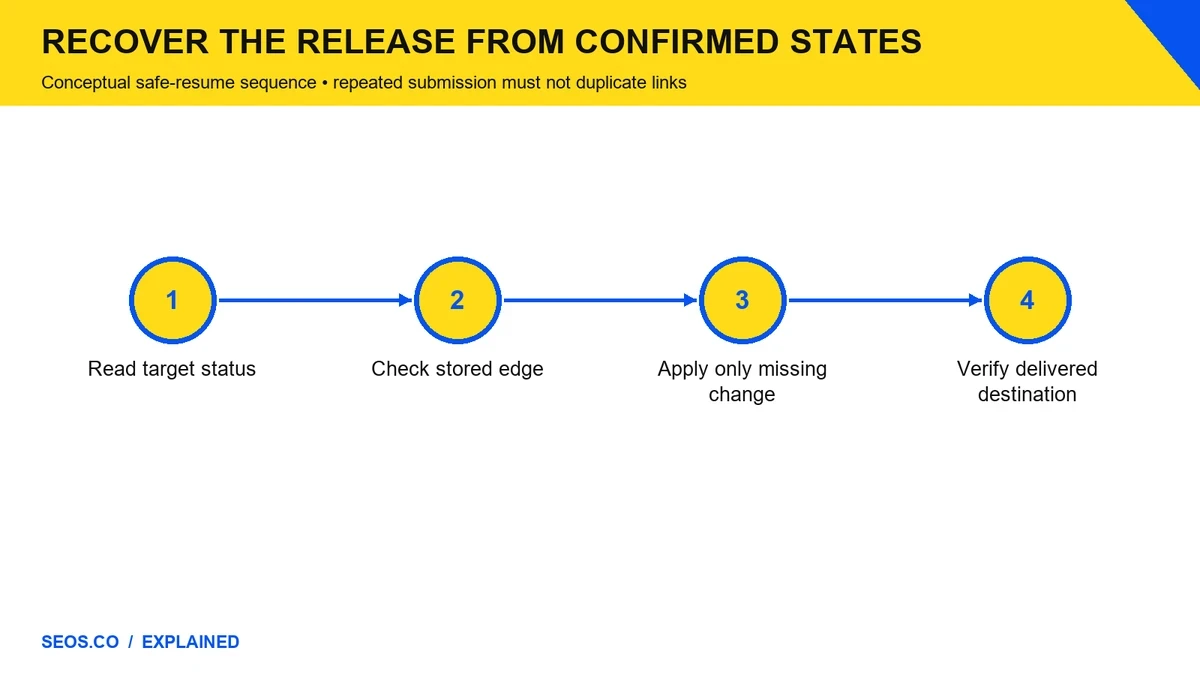
A multi-page release can fail halfway through. The target may publish while donor updates remain queued, or donors may update before the target becomes available. Use explicit dependencies and durable job states so a restart can resume the correct remaining work rather than repeating everything or skipping a stage.
Record target readiness and edge completion separately. A retry should be safe: submitting the same intended link twice should not create duplicate anchors or repeated related-post blocks. Compare the stored state before applying a mutation and preserve receipts where the publishing system provides them.
Set a bounded reconciliation after interruption. Confirm which pages exist, which links are delivered and which jobs remain pending. A running process is not proof that the graph is complete. The release owner needs confirmed outputs, especially when one long task can delay independent updates.
Preserve historical evidence of failures. An orphan detected after a restart may reveal a missing dependency rather than a writer’s oversight. Fix the process at the earliest useful boundary and retest the interrupted path before scaling the next release.
Review the graph without optimizing an imaginary score
Track important pages with no useful incoming path, broken destinations, excessive redirect chains and unresolved duplicate owners. Use those findings to inspect customer journeys and discovery. A graph metric can identify candidates, but it cannot decide whether a page deserves prominence.
Do not add all-to-all links simply to make every node appear connected. A dense graph can still be confusing and repetitive. Prefer a clear hub, meaningful contextual edges and distinct task ownership. The right number depends on the material and reader needs.
Measure useful link use where collection permits it. A click on a troubleshooting destination can indicate progression, but it does not prove the task was completed. Pair navigation data with destination outcomes and qualitative review. A link that receives few clicks may still provide valuable support for a small high-consequence audience.
Inspect changes in query coverage and qualified outcomes with appropriate caution. A new link can coincide with broader content or demand changes. Preserve dates and comparisons rather than claiming that one anchor caused every subsequent ranking movement.
Make the maintenance routine small and durable
At commissioning, verify ownership and planned destinations. At drafting, place contextual links where they support the explanation. At release, confirm target readiness and delivered edges. At consolidation or retirement, update affected references. These are concrete events that can keep the inventory current without an endless separate governance meeting.
Assign exceptions to an owner and retain their evidence. A destination awaiting factual review can remain pending while other links ship. A broken high-value path can receive urgent repair. The process should help work move, not turn every uncertain relationship into a reason to stop the whole library.
Internal linking governance succeeds when the reader reaches the promised next resource and the team can explain how that path is maintained. A coherent graph is the result of useful page responsibilities, verified destinations and reliable release states. It cannot be created by a link quota alone.
Audit anchor promises as well as destinations
A link can reach a valid page while promising the wrong thing. An anchor saying downloadable checklist should lead to an actual checklist or a clearly explained download path. If it lands on a general article with no such resource, the problem is editorial expectation rather than a broken status code. Include promise matching in representative reviews.
Check fragments after headings change. A destination page can remain live while an old section anchor no longer moves the reader to the relevant answer. Update the edge or restore an appropriate stable identifier where the publishing system supports it. Do not assume that a successful page response establishes every deep-link relationship.
Give commercial next steps particular attention. A link from a cost guide to an assessment should preserve the offer’s scope and qualification. If the destination now promotes a different service, the old anchor may mislead a reader even though the company still owns both pages. Task ownership and current offer boundaries should guide the repair.
A small audit sample can reveal a shared template or process fault. If every generated related link uses a title that no longer matches the destination, repair the generation source and inspect affected outputs. Count the root defect separately from the number of pages corrected. The result is a maintainable graph rather than another manual pass that will be undone by the next build.
Before closing a release, reconcile the requested edges with the verified outputs and the pending queue. This simple final count prevents a successful batch submission from hiding skipped donor updates. Keep the reconciliation attached to the release version so later changes do not erase its meaning.