
The Search Brief · News analysis
Content Refresh Triage: Diagnose the Decline Before Rewriting the Page
Separate demand, visibility, collection and conversion problems before refreshing content. Includes three diagnostic examples and a practical follow-up plan.
Development covered: Primary-source guidance checked November 2, 2026

A content refresh should respond to a diagnosed change in facts, task coverage, competitive usefulness or delivery. Traffic decline is a reason to investigate, not a complete explanation. Separate demand, visibility, click behavior, collection and conversion before deciding whether the page needs new evidence, a different format, technical repair or no rewrite at all.
The practical unit is a page-task cohort with a known observation window. A sitewide average can hide a broken template, a seasonal topic or a changed source mix. Preserve the earlier page and the relevant data, then compare the stages that could explain the decline. The goal is a repair that addresses the limiting stage rather than a ritual date change.
Google’s traffic-drop guidance identifies several possible causes, including technical issues, algorithmic changes, seasonality and changing interests. It recommends investigating the pattern with appropriate data. That supports diagnosis; it does not reveal the cause of your site’s decline without inspection. Google traffic-drop guidance.
Confirm that the decline is real and comparable
Check date ranges, timezone, filters, property and data maturity. A partial recent week should not be compared with a complete earlier week. A newly applied country filter can create an apparent decline that has nothing to do with the page. Preserve the exact report definition before changing content.
Inspect counts and rates separately. Fewer clicks can reflect fewer impressions, lower click-through rate or both. A stable average position does not establish stable exposure if the query mix changed. A falling conversion rate can reflect more informational visits rather than a broken page. The diagnosis needs the underlying segments.
Check collection changes. A consent update, replaced form or altered event definition can change measured outcomes. If the business received inquiries while analytics stopped recording them, the refresh queue contains a measurement defect. Rewriting the article would not repair the missing events.
Use the complete SEO audit guide to trace discovery through completion. A page can remain indexed and still fail the customer’s next step, so technical health should not be reduced to one successful URL inspection.
Separate demand loss from page deterioration
Compare the page’s query families and their impressions over equivalent periods. If interest falls broadly across the topic while the page retains similar visibility, the main constraint may be demand. That observation does not prove a universal market decline, but it weakens the argument for an immediate full rewrite.
Inspect current result formats and audience expectations. A query that once favored introductory articles may now require a calculator, current product comparison or troubleshooting procedure. The page can remain accurate while becoming a weaker fit for the task. The search-intent improvement guide provides a framework for that comparison.
Distinguish branded and non-branded patterns where the available data supports it. A product launch can change branded demand while informational tasks remain stable. Combining them can make a content refresh appear to cause growth that actually followed broader brand activity.
Keep missing query data in mind. A visible query table is not always a complete record of every search. Compare appropriate totals and avoid treating absent rows as proof that nobody asked the question. State the reporting boundary rather than inventing a complete demand census.
Inspect eligibility and delivery before editorial quality
Confirm the intended page returns the right content, uses coherent canonical signals and remains accessible under the relevant controls. Check whether important text survives rendering and extraction. A template change can remove decisive content or links while leaving the page’s title and status code intact.
Inspect the actual primary action. A consultation link may lead to an obsolete booking page, or a download may return an error. A form can display success while failing to create a business record. These are completion defects with specific acceptance conditions, not evidence that the introduction needs a new keyword.
Check caches and variants when the page appears different across observations. An editor may see the current version while ordinary visitors receive an old offer. Record the conditions and response evidence before guessing at the cause. A successful edit is not the same as verified public delivery.
If a technical defect is repaired alongside content changes, label the intervention as bundled. Later performance cannot be confidently assigned to one editorial section when access and conversion were repaired at the same time. The repair may still be valuable; its attribution simply has limits.
Build a factual change list
Identify the facts that became wrong or incomplete: prices, product behavior, screenshots, source statistics, availability, dates and process steps. Assign a factual owner and current source to each. An old article does not necessarily contain old facts, and a recent article can become obsolete quickly.
Preserve qualifications. A new product plan may add a capability under conditions that should remain beside the claim. Replacing an obsolete price with a current number without updating billing basis or market can leave the page misleading. Refresh the decision-relevant fact, not just the most visible value.
Check source continuity. A citation may redirect to a new document whose meaning differs from the original. A broken source can require replacement or narrower wording. Do not retain a confident claim merely because the old page once had a link beside it.
The guide to when SEO content should be updated gives broader maintenance context. For triage, the key record is a change list with verified evidence and consequences, not a generic statement that the article feels dated.
Work through three hypothetical declines
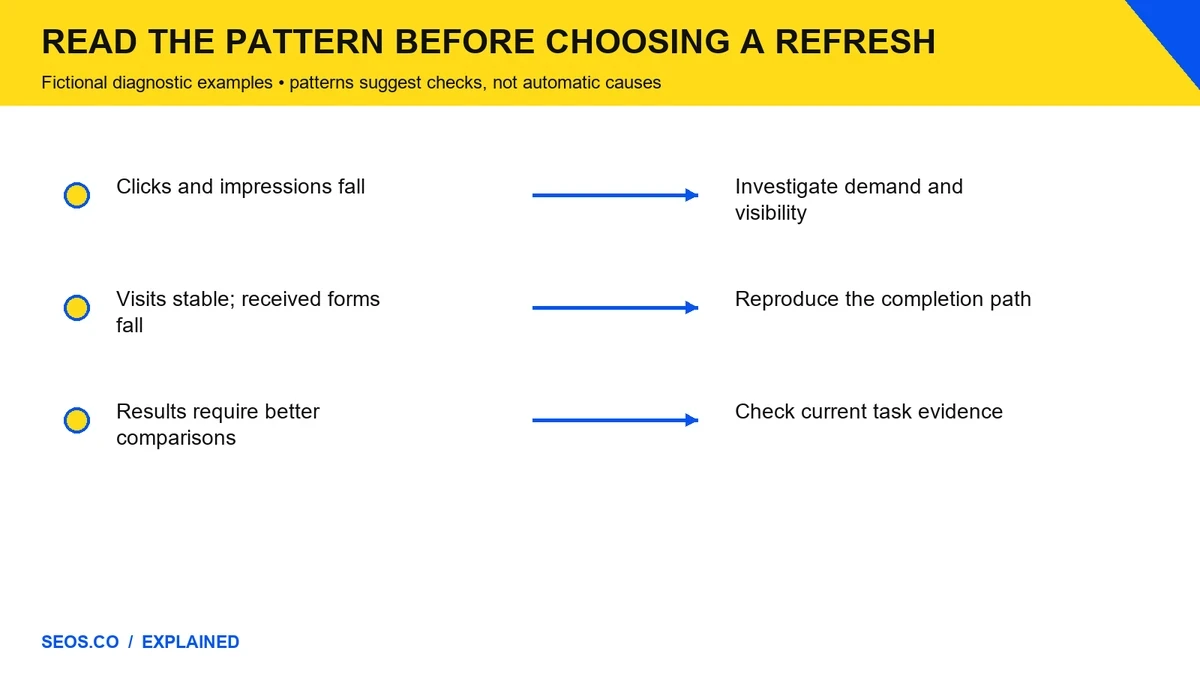
Imagine an integration guide loses thirty percent of measured clicks. Inspection shows impressions also fell across its main task family, while click-through rate and page eligibility remain broadly similar. The team records a demand-related hypothesis and reviews whether the audience’s task changed. It does not claim that a rewrite will restore the missing demand.
A pricing guide loses conversions while sessions remain stable. Testing reveals that its assessment button points to a retired form. The first repair is the completion path, followed by a received-record check. The team can separately review the cost explanation, but it should not attribute the broken form to weak topical coverage.
A selection guide keeps impressions but loses click-through rate and engagement. Current results emphasize detailed constraint comparisons, while the page offers a generic list. The team verifies that observation and proposes a criteria-based comparison with current evidence. This is an editorial hypothesis tied to a specific gap, not an automatic response to any traffic decline.
| Fictional symptom | Evidence pattern | Next discriminating check | Initial action |
|---|---|---|---|
| Integration clicks fall | Impressions also fall; eligibility similar | Inspect demand and changed task format | Diagnose before rewriting |
| Pricing conversions fall | Sessions stable; form destination retired | Complete a submission through receipt | Repair completion path |
| Selection clicks and engagement weaken | Current results require constraint comparisons | Compare current task evidence | Test a focused editorial revision |
All three cases are fictional. Their purpose is to show how similar headline symptoms can require different actions. The queue should preserve the evidence and uncertainty for each rather than applying one sitewide refresh recipe.
Prioritize the useful intervention
After urgent factual and completion defects, compare business importance, continuing task demand, evidence confidence, effort and potential loss. A previously useful guide with clear missing evidence can be a stronger candidate than a large article whose topic no longer relates to the offer.
Estimate the actual work. A refresh may require product verification, a new example, source checks, diagrams, donor-link updates and delivery testing. Treating it as an hour of copy editing can create unrealistic throughput expectations and leave the most consequential work unfinished.
Use dependencies to keep progress moving. If a pricing owner has not approved a new assumption, hold that field while repairing unrelated broken links or verified factual errors. Do not let one unknown become a reason to invent numbers or stop every independent task.
The content SEO guide connects those choices to the wider library. A refresh program should strengthen distinct task owners and consolidate true overlap, rather than produce a new page every time an existing page loses momentum.
Make the revision earn its length
Preserve useful material and replace what fails the current task. Add a worked example when it clarifies a decision, a table when it compares consistent attributes and a troubleshooting section when users need recovery guidance. More text is not automatically more useful.
Check whether the opening promise matches the revised body. If the article claims to provide a cost estimate, it needs assumptions and inclusions. If it promises implementation steps, it needs prerequisites, sequence, failure handling and confirmation. A new title should not raise expectations beyond the evidence.
Avoid superficial date rotation. A meaningful update should be explainable: a corrected capability, current source, clearer comparison or repaired procedure. Keep the original publication date where relevant and record the significant change without pretending the entire article was newly researched if only one section changed.
Plan media to explain the revision. A vibrant diagram can show the decision path or a before-and-after workflow. It should not imply measured uplift unless actual data supports the chart. Label hypothetical values and ensure the main text contains the decisive explanation.
Design a post-refresh observation plan
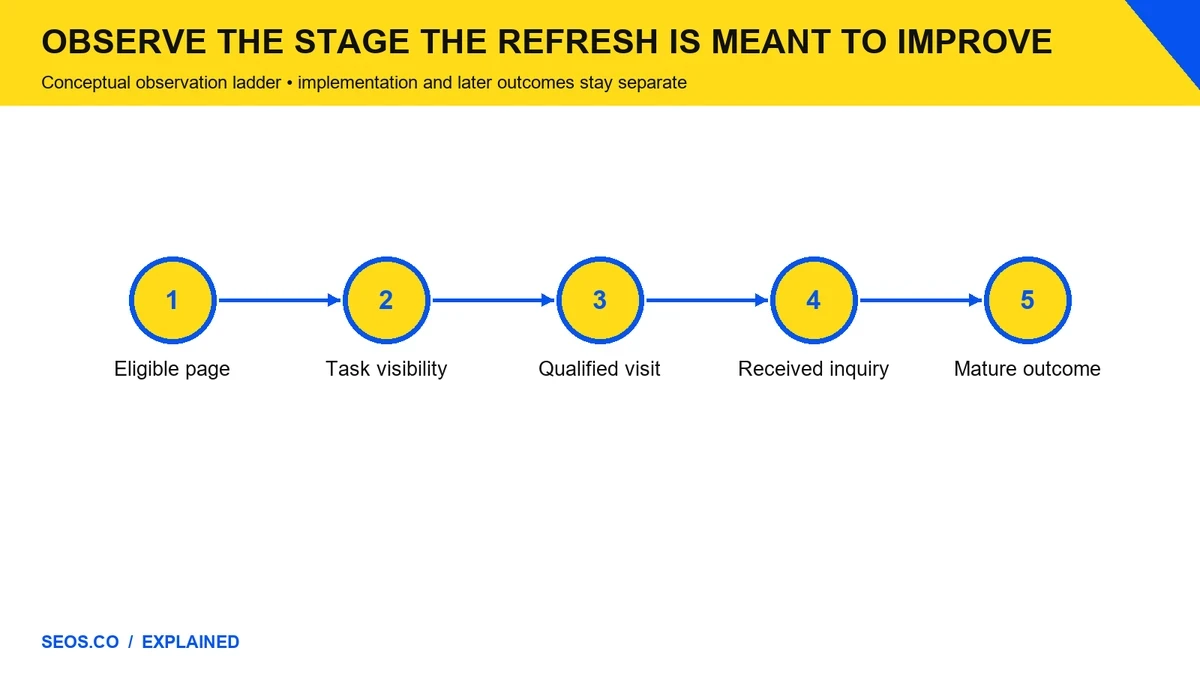
Save the release date, changed sections, technical actions and affected URLs. Choose a comparison window that accounts for data lag, buying cycle and topic seasonality. The appropriate interval depends on the task; a universal seven-day verdict can be misleading for a low-volume enterprise guide.
Track eligibility, task visibility, qualified visits, useful on-site actions and mature business outcomes separately. A rise in impressions with no increase in suitable visits is different from a repaired form producing received inquiries. Preserve counts alongside rates and include pending qualification states.
Where practical, compare with similar unchanged pages or a stable task cohort. A before-and-after chart remains vulnerable to simultaneous changes, but a relevant comparison can provide context. Do not label a correlation a controlled experiment merely because the dashboard has two lines.
Record external answer observations separately if AI discovery matters. A page refresh is a completed publisher action; a later supported citation is an observed outcome. Repeated favorable answers on a small panel do not prove universal visibility, and missing observations do not establish that no opportunity existed.
Close the queue with evidence rather than a new timestamp
A refresh is complete when its defined content and implementation conditions pass, with remaining dependencies explicitly named. Search effects can remain under observation. This avoids keeping a useful repair open indefinitely while also avoiding a premature claim that the whole acquisition system is fixed.
Store the before-and-after artifact, source changes, calculation checks, internal-link updates and delivered-page evidence. If the page later declines again, the record makes it possible to investigate what actually changed. Without that history, teams repeatedly rewrite from memory and lose useful lessons.
Review recurrence. If the same volatile fact becomes stale every month, the process needs a source or expiry control rather than another manual refresh. If every new article duplicates an existing task, the commissioning map needs repair. A mature program addresses the source of repeated debt as well as the current page.
The next action should be specific enough to verify: correct the expired offer, restore the form, add the missing compatibility evidence or investigate changing demand. Content refresh triage is successful when the team can explain why that action was chosen and confirm what it changed, while keeping future visibility and commercial effects separate from the work already completed.
Compare the query mix before trusting an average
An average position can remain stable while the underlying questions change substantially. Suppose a page loses impressions for a commercially important comparison and gains impressions for a broad definition. The blended position may look similar, yet the audience and expected next action have changed. Inspect task families and their counts rather than reading the average as a fixed property of the page.
The same issue affects conversion. If a guide attracts more early-stage educational visits, its immediate inquiry rate may fall while the number of useful later-stage inquiries remains stable. Compare the absolute qualified count, the source mix and the page’s intended task. Do not rewrite a useful educational explanation merely because its audience differs from a service page.
For sparse query rows, use the available evidence cautiously. A small observed family can suggest a hypothesis without establishing the whole cause. Preserve unknown or suppressed data as a limitation. If the decision would change materially under a different query mix, report that sensitivity and seek more appropriate evidence before a broad rewrite.
A practical triage worksheet can therefore include four columns: changed task family, observed symptom, competing explanation and next discriminating check. The final column is important. It turns an interesting pattern into a bounded investigation, such as checking current result formats or reproducing a broken path, rather than an untestable claim that the algorithm dislikes the article.