
The Search Brief · News analysis
Content Quality Gates: Verify the Asset, Not Just the Checklist
Build content-quality gates that separate mechanical checks, factual review, reader completion and public verification without treating detector scores as proof.
Development covered: Primary-source guidance checked November 2, 2026

A content quality program needs two different kinds of review. Mechanical checks verify countable properties such as required fields, working links, arithmetic and exact repetition. Substantive review evaluates whether the page answers a real task, supports consequential claims and adds useful value. Passing one does not establish the other.
The release record should name what was observed and what remains pending. A complete checklist is not factual proof, a detector score is not authorship certification and a successful upload is not a verified public page. Quality improves when those states remain distinct and defects are repaired at the stage where they originate.
The workflow below is an original editorial operating method. It includes a hypothetical technical-guide pilot to make the gates concrete. It does not claim that SEOS.co conducted a controlled quality experiment or that any checklist guarantees rankings, citations or error-free content.
Define quality through the reader’s task
Start with the decision the page promises to support. A cost guide should explain assumptions and inclusions. A troubleshooting guide should explain prerequisites, sequence, failure handling and confirmation. A research analysis should preserve the study’s population, method and limitations. A page can be fluent while failing its central task.
Use the search-intent improvement guide to frame that purpose before drafting. Generic labels such as informational are insufficient when the real question is whether a buyer can compare two operating models or determine compatibility.
Write a compact acceptance statement. For a connector guide, a reviewer should be able to identify supported records, timing definitions, recovery behavior and manual responsibility. That statement gives both writer and reviewer an observable target. A heading containing each phrase does not count as an answered question.
Google’s helpful-content guidance asks publishers to assess originality, completeness, clear sourcing and usefulness. These questions inform review, but they are not a numeric certification or a fixed ranking formula. Apply them to the finished resource rather than treating their presence in a checklist as a pass. Google helpful-content guidance.
Put evidence requirements in the brief
A quality gate at the end cannot efficiently repair an assignment built on unknown facts. Record the reader, task owner, distinct contribution, consequential claims, source needs and unresolved dependencies before drafting. If the evidence does not exist, narrow the claim or assign the factual investigation.
Distinguish verified facts, conditional claims and illustrative examples. A writer can use a hypothetical calculation to teach a method, but the page and diagram must label it. A plausible invented customer result cannot become evidence because it makes the article more engaging.
Assign factual owners to product behavior, pricing, markets and credentials. Editorial staff can improve expression but should not guess a service boundary. If approval has not occurred, preserve the pending state rather than naming a reviewer who has not actually participated.
Map relevant search and assistant questions to answer sections. The map is a planning and verification tool, not a quota. It should reveal whether a meaningful customer question remains unanswered, rather than reward the manuscript for containing a long list of loosely related prompts.
Use mechanical checks for what they can establish
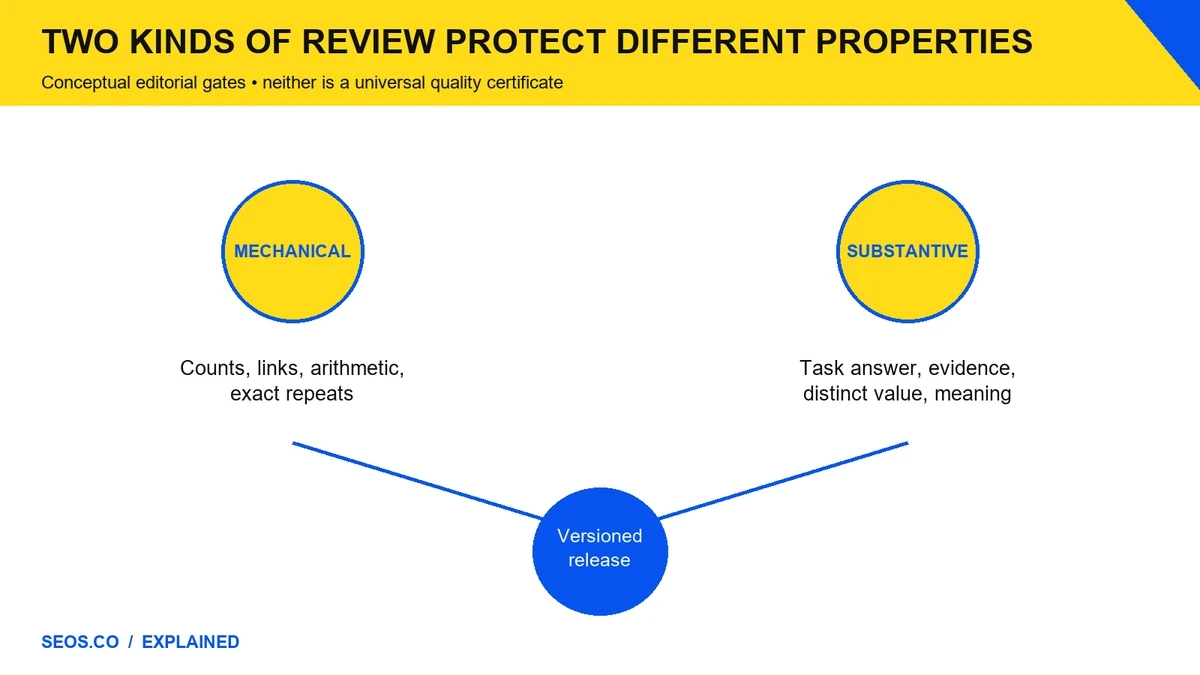
Count substantive body content with a documented extraction method. Exclude headings, navigation, metadata, image text, source lists and repeated boilerplate. Exact duplicate paragraphs should not be counted twice. A minimum length is a floor under the assignment’s requirements, not proof that the writing is useful.
Check title, description, heading structure, required fields, valid section references and source-link syntax. Confirm calculations independently from prose review. A perfectly grammatical paragraph can contain a wrong percentage, inconsistent unit or mislabeled scenario.
Scan for exact repetition and suspicious overlap across the batch. A shared source does not justify a near-duplicate article. Mechanical similarity can identify candidates, but editorial review must decide whether the pages serve distinct tasks or merely paraphrase each other.
Preserve gate reports tied to content hashes or versions. If the manuscript changes after approval, the old report may no longer describe the release. Recheck affected properties rather than assuming that an earlier pass covers all later edits.
Review claims at their actual consequence level
Not every sentence needs the same evidence burden. A general explanation can be supported by established documentation, while a precise performance claim needs a matching test or source. Prices, availability, technical limits and credentials deserve focused verification because errors can change customer decisions.
Read the cited source in context. A relevant link is not automatically support for every statement beside it. Check date, version, market, unit and qualifications. If the source supports only a narrower claim, narrow the wording rather than adding a second unrelated citation.
For research summaries, verify denominator and study design before repeating the headline number. An observational association is not a controlled causal effect. A historical benchmark is not a current error rate for every commercial system. The limitation belongs near the conclusion it constrains.
The AI-assisted content guide provides wider context for accountable review. The production method does not remove the publication’s responsibility to support the finished claim and describe the actual contribution.
Work through a hypothetical five-page pilot
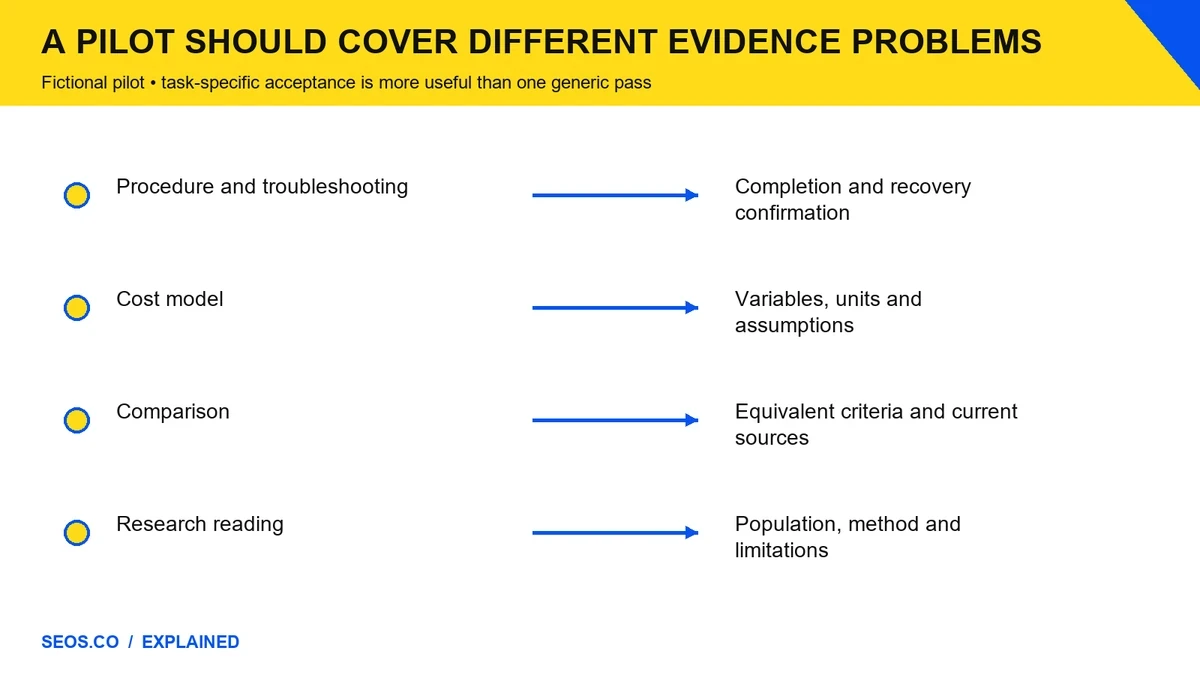
Imagine a team prepares five technical guides before expanding a library. The set includes a procedure, a cost model, a comparison, a research reading and a troubleshooting article. Each must meet the same substantive floor, but their evidence and presentation checks differ.
The procedure needs prerequisites and confirmed completion. The cost model needs variables, units and hypothetical labels. The comparison needs equivalent criteria and current evidence. The research reading needs method and scope. The troubleshooting article needs failure states and recovery ownership. One generic checklist can organize the process, but it cannot replace these task-specific tests.
| Fictional pilot asset | Task-specific acceptance question | Evidence required |
|---|---|---|
| Procedure | Can the reader complete and confirm the process? | Prerequisites, sequence and confirmation |
| Cost model | Are variables, units and assumptions correct? | Independently checked arithmetic and labels |
| Comparison | Are the criteria and conditions equivalent? | Current sources for each material comparison |
| Research reading | Are population, method and limitations preserved? | Original study and bounded interpretation |
| Troubleshooting guide | Are failure and recovery responsibilities clear? | Defined states and verified ownership |
Suppose mechanical review finds a short manuscript, two broken source links and a duplicated paragraph. Those defects can be repaired directly. Substantive review then finds that the comparison promises compatibility the source does not establish and that the research article overstates causality. Those require reasoning and factual correction, not merely another script run.
The pilot should stop expansion long enough to fix systemic problems. If every writer omits conditions, repair the brief and review standard before commissioning another twenty pages. If one source URL is broken, repair that field without rewriting the entire accepted batch. The response should match the defect’s scope.
All pilot details here are illustrative. The point is to test representative complexity early and preserve the difference between countable compliance and meaningful reader value.
Test the page as a reader encounters it
A manuscript can pass while the published template fails. Inspect the delivered page on representative desktop and mobile layouts. Check long headings, tables, diagrams, captions, navigation and the main action. A missing table label can detach a price from its billing condition even when the source document was clear.
Read a text-only representation where appropriate. Important facts should not exist only inside an image, color cue or inaccessible expansion. A diagram should have a useful text explanation and alt text suited to its meaning. The extraction check is especially important when the page is expected to support answer retrieval.
Follow the primary action through confirmed output. A successful button click is not necessarily a received inquiry, completed booking or working download. Verify the destination record or completed artifact and inspect duplicates or retries where they can affect the outcome.
Use the complete SEO audit framework to place presentation and completion within the full path. A narrow rendering pass should not be reported as proof that the entire acquisition system is healthy.
Keep AI-detector scores in proportion
A detector score is an output of a particular tool under particular conditions. It does not directly establish truth, originality, useful expertise or compliance with every search policy. Even a perfectly accurate authorship label would not tell the editor whether the article’s claims are supported.
If a detector is used, record tool, version, input length, date and result separately from release approval. Inspect flagged passages for actual editorial problems such as generic repetition, unsupported specificity or awkward phrasing. Repair those problems because they affect the reader, not to manufacture a human label.
Do not add fake anecdotes, deliberate errors or invented credentials to influence a classifier. Those changes make the content less reliable. A transparent assisted workflow with verified facts is a stronger editorial position than claiming human authorship that the record cannot support.
Google’s generative-content guidance focuses on accuracy, usefulness and added value, and warns about scaled production without value. That guidance should not be reduced to a detector threshold or an assumption that every assisted article is automatically acceptable. Google generative-content guidance.
Use release states that cannot be mistaken for outcomes
A practical sequence is brief-ready, evidence-ready, draft-complete, mechanically checked, substantively reviewed, media-ready, published and publicly verified. The organization can adapt the names, but each state needs an observable condition. Avoid a single done checkbox that hides missing sources or images.
Independent review should be labeled only when it occurred. A model checking its own draft is self-review. A factual owner approving one claim is not automatically an independent review of the whole article. Record the scope and version of actual review rather than decorating the byline with implied authority.
Keep held items moving through a focused exception queue. Each needs the failed field or section, owner, evidence required and next action. A missing product fact can remain pending while unrelated pages continue. A systemic error should trigger a process repair before more content multiplies it.
The content SEO guide connects release quality with the broader library. Production count matters operationally, but it is not a substitute for distinct tasks, verified content and useful customer outcomes.
Measure the program without rewarding hidden rework
Track first-pass acceptance, factual correction rate, rework time, unresolved high-consequence claims and post-publication defects. Separate research, drafting, review, media and implementation effort where the data is available. Unknown cost remains unknown rather than being reported as zero.
Compare like workloads. A short definition and a technical research analysis have different evidence requirements. A speed claim is meaningful only when depth, review, media and public verification are comparable. Counting raw drafts per hour can hide the work that makes them releasable.
Preserve rejected drafts and correction reasons within the project’s retention rules. They show whether the gate actually operates under pressure and help repair the earliest cause. A process with no recorded rejections is not automatically excellent; it may simply lack meaningful review.
After release, inspect fresh evidence when a defect is reported. Do not dismiss repeated incorrect behavior because a connection works or one isolated test passed. Trace the affected path and distinguish the repaired stage from the remaining uncertainty.
Make the gate improve decisions
A quality program should help a team answer whether the asset is useful, supported, distinct and correctly delivered. It should also say what has not yet been verified. The checklist, count and source map are instruments for that judgment, not replacements for it.
Start with a representative complete pilot, repair systemic defects and preserve accepted work. Then release bounded batches with evidence tied to their actual versions. Content quality becomes durable when the process rewards truthful claims and completed reader tasks rather than merely producing a larger pile of polished pages.
Set sampling rules that reflect consequence
Not every review can inspect every low-risk layout variant, but sampling should follow the risk and the shared dependency. A high-consequence price or product limit deserves direct verification. A repeated template component can be inspected through representative outputs plus targeted checks where variants differ. State the actual coverage rather than implying that a sample certifies every page.
When one sampled output fails, investigate whether the defect is local or shared. A missing label in one manually edited table may need a local correction. A renderer that drops all table headings requires a broader repair and renewed checks of affected pages. The gate should respond to the fault’s scope, not blindly repeat the same sample.
Preserve failed observations and the repair evidence. A clean final screenshot does not explain whether the original problem was reproduced or which dependency changed. The historical record matters when a later release reintroduces the fault. A quality program becomes faster by retaining reliable evidence, not by deleting inconvenient failures.
Use a bounded post-publication check for every released asset where the system supports it, then inspect representative visual variants and flagged exceptions. Future indexing and commercial performance remain separate observations. This creates a practical distinction between verified delivery, sampled presentation and unobserved outcomes without making an impossible claim of universal perfection.