
The Search Brief · News analysis
Content Measurement: Connect the Reader’s Task to a Confirmed Outcome
Measure content with compatible units, verified events, qualified business records and mature cohorts, using a fictional guide-conversion reconciliation.
Development covered: Primary-source guidance checked November 2, 2026

Content measurement should begin with the job a page is meant to do. A troubleshooting guide, a cost explanation and a research analysis can all be useful while producing different immediate actions. The measurement plan should define those actions, verify collection and connect them to business outcomes where the evidence permits. Page views alone cannot show whether the reader completed the task.
Keep the stages separate: eligibility, exposure, qualified visit, useful action, received business record and mature outcome. A failure at one stage changes how later numbers should be interpreted. A working analytics connection does not prove that the form reaches sales, and a citation does not establish that a customer visited or bought.
The model below is an original operating framework with a fictional guide cohort. Its counts teach reconciliation and interpretation; they are not SEOS.co performance results. The aim is to make content decisions reviewable without pretending that every influence can be observed or every association is causal.
Define the task outcome before choosing metrics
For a cost guide, a useful action might be completing an assumption worksheet or requesting a scoped estimate. For a troubleshooting page, it might be reaching a verified resolution step. For a research article, it might be using the method or consulting the underlying source. The action should reflect the page’s purpose rather than whichever event is easiest to collect.
Use the search-intent improvement guide to identify that purpose. A page can receive a large audience that is commercially irrelevant, while a smaller audience completes a high-value decision. The metric needs to reveal that distinction rather than reward volume alone.
Write a measurement contract containing page group, audience, intended action, event definition, business qualification rule, observation window and owner. Include the conditions under which the action counts as complete. Clicking an estimate button is different from submitting the request, receiving it and qualifying the inquiry.
Choose a small set of primary and diagnostic measures. A primary measure supports the decision to continue or change the content. Diagnostic measures help explain what happened. A dashboard with forty equally emphasized numbers can obscure the one stage that failed.
Build a stage model with compatible units
Eligibility concerns whether the intended page can be discovered and served under its actual controls. Exposure concerns observed impressions, answer appearances or citations within a defined system. Visits concern measured sessions or users. Actions concern events. Business outcomes concern unique inquiries, opportunities or customers. These units should not be silently combined.
A prompt panel’s citation count and a site’s total assistant sessions usually describe different populations. Dividing one by the other does not create a universal click-through rate. Similarly, dividing unique customers by raw event count can produce a number that has no useful acquisition meaning.
Name the denominator at every rate. Session conversion rate uses sessions; inquiry qualification rate uses unique reviewed inquiries; opportunity close rate uses an appropriately mature opportunity cohort. Pending records remain pending. Missing observations are not automatically rejections.
The content SEO guide provides broader measurement context. A stage model adds operational discipline by requiring compatible units and confirmed transitions rather than placing every metric in a funnel graphic.
Specify events as observable states
An event definition should state trigger, required conditions, identifier, deduplication rule and expected destination. A form-start event can fire when the reader first interacts with a relevant field. A submission event should represent a defined submission state, not every click on a button that may fail validation.
A received-record state belongs to the destination system. Confirm it separately from the browser event. If the network response is lost after the record was created, a retry may produce a duplicate unless the process has a suitable reconciliation mechanism. Measurement should account for the actual behavior rather than assume one click equals one lead.
Define error states too. Validation failure, network failure, destination rejection and user cancellation have different meanings. A generic unsuccessful event can hide a broken flow behind ordinary abandonment. Keep the classification proportionate to the task and the available collection.
Minimize unnecessary personal information. Use permitted identifiers and aggregate checks suited to the organization’s practices. A content team needs reliable outcomes, not an indiscriminate copy of every customer field in an analytics dashboard.
Verify collection through the full path
Test representative devices, consent states and routes where they materially affect the flow. Confirm that the page loads, the intended event fires under the defined condition, the submission reaches the business system once and the customer receives an accurate confirmation. Preserve the test environment and version.
A passing test in one browser does not establish every path. If a mobile form uses a different component or a booking flow moves to another service, inspect those variants. State the sample coverage and any untested conditions rather than calling the whole system verified from a narrow check.
Compare event timestamps with destination timestamps. Delayed background processing can matter when the business has a response deadline. A record arriving eventually is different from arriving within the useful window. Check queue delays, retries and restart recovery if they can cause silent loss or lateness.
Use the complete SEO audit guide to connect measurement with delivery and completion. A running process or connected account is evidence of one condition, not proof that the end-to-end reader task succeeds.
Work through a fictional guide cohort
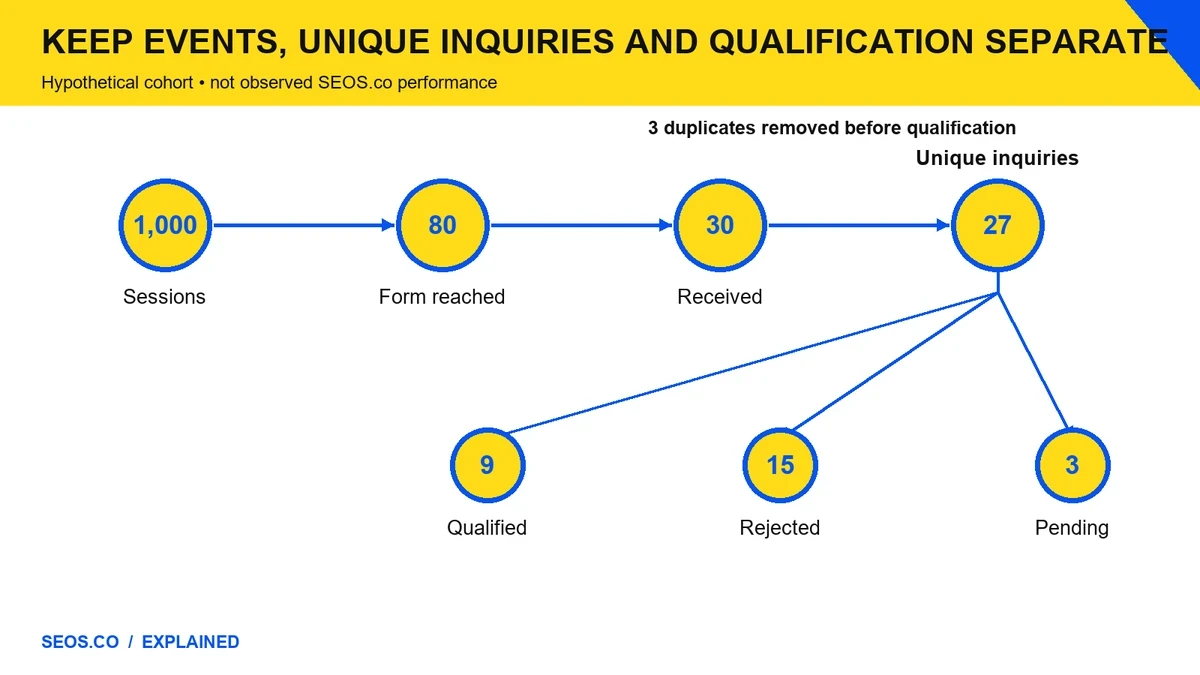
Imagine a fictional implementation guide receives 1,000 measured sessions during a settled month. Eighty sessions reach the compatibility form, thirty submissions are received and twenty-seven are unique after duplicate review. Sales qualifies nine inquiries, rejects fifteen under the agreed rule and leaves three pending.
| Fictional cohort stage | Count | Interpretation |
|---|---|---|
| Measured sessions | 1,000 | Acquisition denominator |
| Sessions reaching the form | 80 | Progression, not received inquiries |
| Received submissions | 30 | Destination receipts before deduplication |
| Unique inquiries | 27 | Three duplicates removed |
| Qualified inquiries | 9 | Confirmed under the stated rule |
| Rejected inquiries | 15 | Expected qualification outcome |
| Pending inquiries | 3 | Not yet qualified or rejected |
The received-submission rate is 30/1,000, or 3%. The unique-inquiry rate is 27/1,000, or 2.7%. The confirmed qualified-inquiry rate is 9/1,000, or 0.9%. These describe different stages. Reporting thirty leads and a 3% qualified conversion rate would overstate what the business confirmed.
Among the twenty-four inquiries already reviewed, nine qualified, giving 37.5% of reviewed inquiries. That is not the same as 9/27, or 33.3% of all unique inquiries so far. The three pending records create a maturity boundary. Show both the count and the rule used rather than choosing whichever percentage looks stronger.
If all three pending inquiries later qualify, the mature qualified count becomes twelve and the session-based rate becomes 1.2%. If none qualifies, it remains 0.9%. This is a pending-status range for the fictional cohort, not a statistical confidence interval or a prediction of future performance.
The example shows why a reliable report needs stage definitions and business reconciliation. A single conversion number can conceal duplicates, pending decisions and differences between browser events and received records.
Compare cohorts at similar maturity
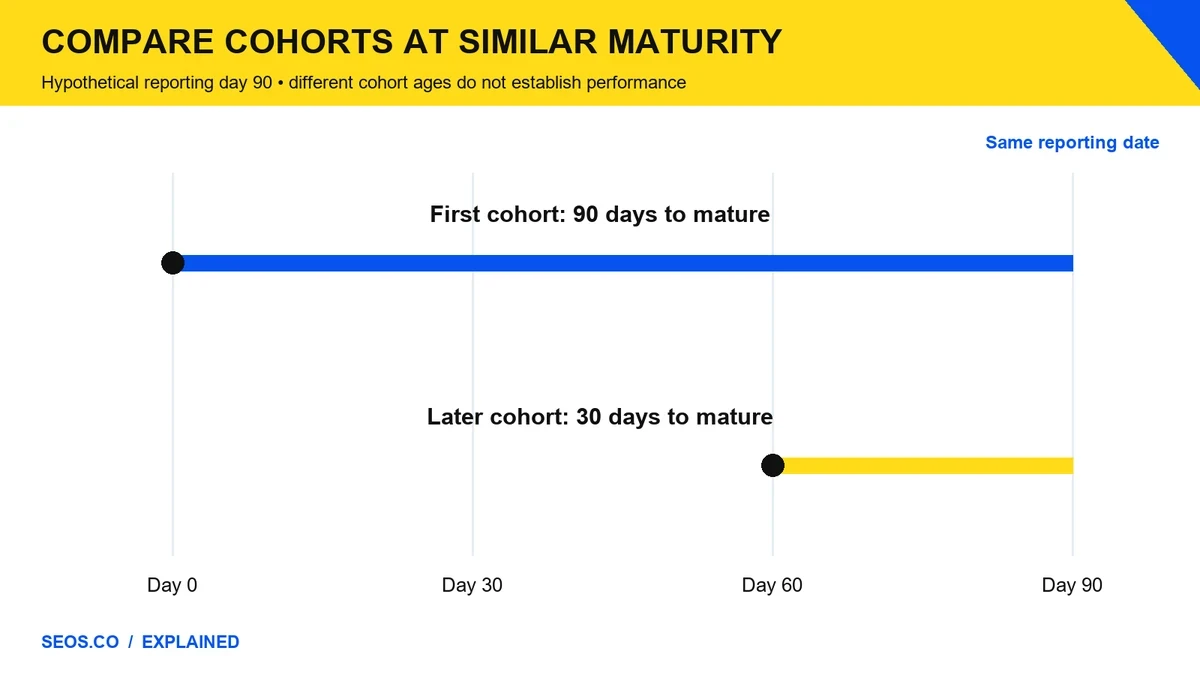
Group newly published, refreshed, consolidated and unchanged pages separately. Their starting conditions differ. A new guide with no historical audience should not be compared directly with a mature service page and declared ineffective because its early volume is smaller.
Account for the time needed to qualify inquiries and close opportunities. A ninety-day-old cohort has had more time to mature than a thirty-day-old cohort. Show cohort age and pending states. Do not count every open opportunity as a loss or every pipeline amount as realized revenue.
Preserve the original acquisition definition. A channel taxonomy change or revised event can break comparability. If a historical series is recalculated under new rules, label the change and retain the earlier version. A new label should not be presented as newly created demand.
Where data is sparse, show counts and useful examples rather than overinterpreting percentage changes. One additional qualified inquiry can create a large relative increase on a small base. The number can still matter commercially, but its uncertainty and scale should remain visible.
Diagnose the limiting stage before changing content
If impressions decline while click-through rate and eligibility remain similar, investigate demand and visibility. If visits remain stable but form starts fall, inspect task fit and on-page progression. If starts remain stable but received submissions fall, inspect the flow and collection. Each pattern suggests a different investigation.
Do not assume the pattern proves the cause. A changed source mix can affect several rates simultaneously. A more educational audience may convert less immediately while still using the guide successfully. Segment by task, landing-page group and acquisition context where the available data supports it.
Check current reader needs and competing formats when editorial fit is uncertain. The guide to refreshing old content provides a broader repair process. A refresh should address an observed gap rather than compensate for an unverified analytics defect.
Preserve qualitative evidence. Support questions, assessment notes and observed usability problems can explain why people struggle. They do not automatically represent the whole audience, but they can generate focused hypotheses and reveal defects a headline metric misses.
Separate attribution from causal claims
Attribution assigns credit within recorded paths under a model. Incrementality asks what would have happened without the intervention. A content report can use attributed outcomes while acknowledging that it has not established the counterfactual. The distinction matters when management decides whether to expand a program.
Google Analytics documents several attribution approaches and their scope. Use the actual property configuration and name the model when reporting credited outcomes. Do not treat the existence of an attribution report as independent proof that one page caused a sale. Google Analytics attribution guidance.
A bounded experiment or appropriate comparison can strengthen the causal case. Preserve baseline, intervention, timing and competing changes. If content, navigation and form routing changed together, the result describes a bundled intervention unless the design can separate their contributions.
Useful maintenance does not require a growth claim. Correcting an expired price or restoring a broken form can be justified by customer reliability even when incremental revenue remains uncertain. Keep baseline obligations separate from discretionary acquisition experiments.
Report AI discovery without blending incompatible evidence
A citation observation can show that a defined answer referenced a page. It cannot show how many people saw the answer or how many later visited unless the relevant system supplies that evidence. A session can show measured acquisition, but not every earlier exposure that influenced the reader.
Maintain a separate panel record for prompts, engine, date, language, search state, answer and cited URLs. Score factual accuracy and suitability alongside mentions. A misleading recommendation should not be counted as an uncomplicated win merely because the brand appeared.
Connect observed answer themes to landing-page questions carefully. The relationship can guide content improvements, but it does not establish that every session came from the sampled prompt. Keep the panel universe and analytics universe explicit.
The GEO improvement guide provides related planning context. The measurement program should make exposure, visits, qualified outcomes and uncertainty visible as separate evidence layers.
Make the report lead to a concrete decision
A useful monthly review identifies the intended task, completed observations, reliable outcomes, material collection gaps and the next action. It should say whether the team needs a factual correction, a flow repair, a clearer explanation, a narrower experiment or more mature outcome data.
Assign owners and acceptance tests to the action. “Improve engagement” is difficult to verify. “Replace the broken assessment destination and confirm one received record per valid submission across the two affected layouts” is concrete. Content measurement becomes operational when the response can be tested.
Preserve historical reports and corrections. A later data repair can change earlier totals, but the revision should remain explainable. Missing records are gaps, not proof that no customer opportunity existed. Equally, plausible unobserved influence should not become invented revenue.
The strongest content measurement connects a real reader decision to a confirmed outcome while preserving the limits of each stage. It gives the team enough evidence to act, enough context to avoid the wrong repair and a clear record of what remains uncertain. That is more valuable than a large dashboard whose numbers cannot be traced to completed work.
Keep an exception ledger beside the dashboard
Record mismatches between browser events and business records with timestamps, affected flow and current status. Group repeated observations of the same underlying fault so a retrying monitor does not inflate the number of incidents. A single routing defect can affect many submissions, while many repeated checks can observe one unchanged failure.
For each exception, distinguish missing data, delayed processing, duplicate records and expected rule-based rejection. These states require different action. A rejected incompatible inquiry is not a lost valid submission, and a delayed record is not necessarily permanently missing. The report should quantify confirmed impact and preserve unresolved gaps rather than turning every unknown into a zero.
When the repair is deployed, inspect fresh records under the affected conditions. Passing a narrow test establishes the tested path, while verified real-world receipts provide a separate operational observation. Keep those milestones visible so the team does not claim the whole system is fixed from a successful connection check alone.