
The Search Brief · News analysis
Content Debt: Prioritize the Pages That Cost Customers Time and Trust
Build a content-debt queue using task failures, factual risk, ownership and effort. Includes a five-issue example, consolidation rules and verification steps.
Development covered: Primary-source guidance checked November 2, 2026

Content debt is the accumulated cost of maintaining pages whose facts, purpose, structure or completion paths no longer match the business and its audience. It includes misleading offers, duplicated answers, obsolete instructions and resources that remain useful but have become difficult to discover. The right response is a repair queue tied to customer consequences, rather than a blanket demand to rewrite every old article.
An inventory becomes useful when each issue has evidence, an affected task, a factual owner and an acceptance condition. A low-traffic page may deserve urgent repair if it misstates a service boundary. A high-traffic definition may need no rewrite if it remains accurate and useful. Age and traffic are inputs to investigation, not automatic verdicts.
The framework below is an original editorial operating method, illustrated with hypothetical pages and numbers. It is not a Google score or a conducted SEOS.co study. Its purpose is to help a content team choose a defensible next action while preserving useful material and avoiding unnecessary new publishing.
Identify the debt by the task it damages
Start with the customer’s decision. A pricing guide should explain costs and conditions well enough to support evaluation. An integration guide should clarify compatibility and operating boundaries. A support article should help someone complete the stated procedure. If the page no longer does its job, record the exact failure rather than labeling it generically thin.
Useful categories include factual debt, intent debt, structural debt, operational debt and evidence debt. Factual debt contains wrong or expired claims. Intent debt contains a mismatch between the promised task and the actual answer. Structural debt includes orphaned pages and overlapping owners. Operational debt includes broken forms or download paths. Evidence debt contains unsupported assertions and missing provenance.
One page can contain several categories, but do not count repeated appearances of one underlying fault as separate root problems. An obsolete plan price repeated across six pages is one fact issue with six publishing dependencies. That distinction helps estimate both the conceptual repair and the distribution work required.
Use the search-intent improvement guide when the real question is whether the page still serves the right task. A content-debt queue should not assume that every decline is a writing problem. Collection, eligibility, demand and conversion can fail at different stages.
Build an inventory that supports decisions
Record URL, page type, primary task, factual owner, significant claims, current outcome role, last meaningful review and known dependencies. Add available search, analytics, link and customer-support evidence. Mark unavailable data as unknown rather than treating it as zero demand or proof that the page has no value.
Preserve the existing page before substantial changes. Save the content and relevant configuration so the team can compare the repair and recover useful material. An old screenshot or source note may explain why the original claim was reasonable at publication, even if it is now obsolete.
Separate observed defects from suspicions. “The form returns an error after submission” is an observed problem when reproduced. “The article may be too long” is a hypothesis requiring a task-based review. A queue filled with untested opinions is difficult to prioritize because every item appears to require the same broad rewrite.
For large libraries, begin with high-consequence templates and representative samples, then expand where a shared defect is found. A duplicated component can affect hundreds of pages, so one verified template repair may be more valuable than individually editing a dozen symptoms. The complete SEO audit framework provides broader context for separating those system layers.
Put eligibility and misleading promises ahead of optional polish
A blocked or broken priority page can fail before its writing is evaluated. An expired commercial promise can mislead a customer even if the page remains technically healthy. These issues should override an optional editorial score. The queue needs explicit urgent conditions, not just a formula that rewards traffic volume.
Examples include an unintended indexing restriction, a consultation form that never reaches the business system, an offer shown after expiry and a product page promising an unsupported integration. Each has a concrete acceptance test. The repaired page should be accessible, the received inquiry should exist, the expired offer should disappear or the capability should be accurately qualified.
Do not weaken factual standards to force more activity. If a service is unavailable, the correct page explains the boundary rather than encouraging unsuitable inquiries. A lower raw conversion count can accompany a better customer outcome when misleading promises are removed.
Google’s helpful-content guidance asks publishers to evaluate originality, completeness and whether their pages provide substantial value to people. Those questions support substantive review, but they are not a numeric debt formula or a promise that a particular repair will improve rankings. Google helpful-content guidance.
Use a transparent priority model for the remaining queue
After urgent defects are handled, compare likely customer value, evidence confidence, affected demand, effort and downside. A simple planning score can help, provided the inputs remain visible. Avoid presenting a rough business heuristic as a statistical prediction.
For example, a team could rate consequence, audience relevance and evidence confidence on a small ordinal scale, then divide their product by estimated effort. Explain why each rating was assigned. The usefulness comes from the discussion and consistency, not from calculating a number to several decimal places.
Include dependency constraints. A cost guide may be valuable but blocked by unapproved pricing assumptions. A technical example may require a product test. Continue independent repairs while the owner resolves the missing fact. A blocked dependency should remain visible instead of being silently replaced with a writer’s guess.
Consider potential loss from consolidation or retirement. A page can retain useful links, customer bookmarks or support references even when current traffic is small. Investigate those roles before removing it. The right decision can be to retain, clarify or redirect rather than delete.
Work through a hypothetical five-issue queue
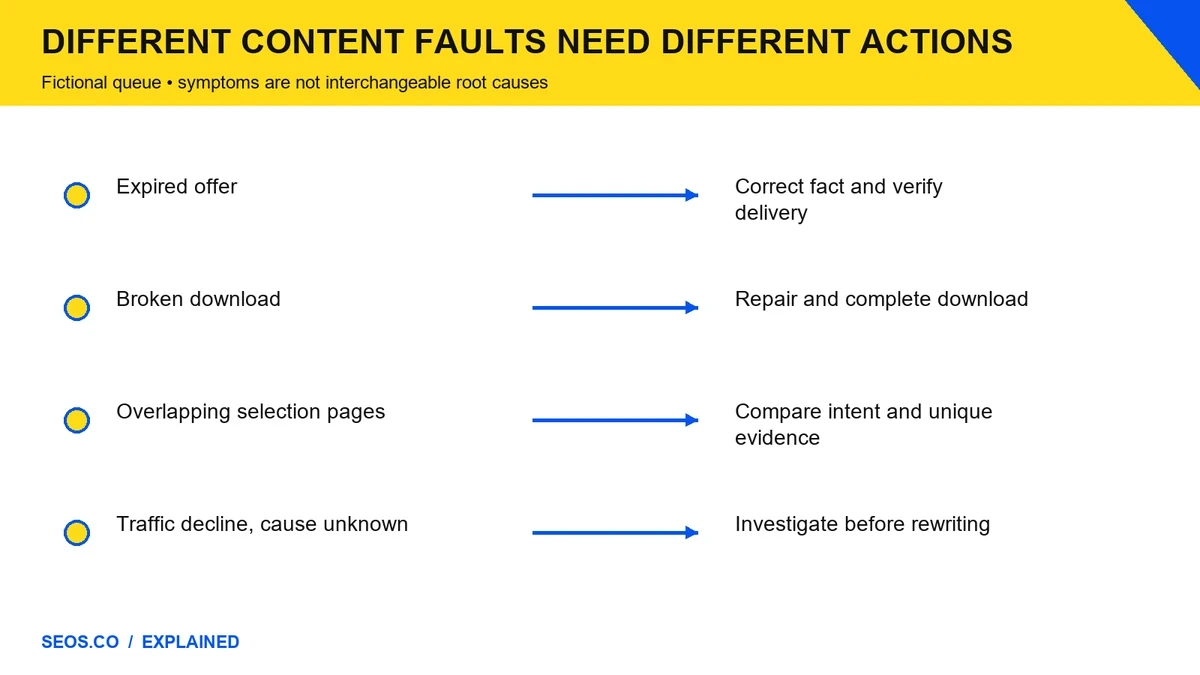
Imagine a software company reviews six pages across five issue groups. Its pricing guide contains an expired setup-fee waiver. Its integration article lacks a tested recovery explanation. Two selection articles answer substantially the same buying task. A glossary definition remains correct but has declining traffic. A support guide contains a broken download link.
The expired offer and broken download receive immediate attention because their defects are concrete and affect customer action. The offer needs a truthful current state and delivery verification. The support guide needs a working destination and a completed download check. Neither repair requires a speculative theory about a search algorithm.
The overlapping selection articles need a comparison of intent, unique evidence, existing links and business role. If they genuinely serve the same task, preserve useful material in the strongest owner and plan an appropriate transition. Do not choose the destination solely because one URL has a shorter slug or a newer date.
The integration guide can enter a bounded evidence task: product operations documents a recovery example, the writer explains it and a reviewer checks that the conditions survive publication. The glossary page remains in investigation until the team distinguishes demand change, result-format change and page deterioration. Declining traffic alone does not justify inventing new sections.
This fictional queue can be used as a compact decision worksheet:
| Page | Observed or suspected fault | Next action | Acceptance evidence |
|---|---|---|---|
| Pricing guide | Expired setup-fee waiver | Correct offer and verify delivery | Ordinary public response shows current terms |
| Support guide | Broken download | Repair destination | Intended download completes |
| Two selection articles | Possible duplicated task | Compare intent and unique evidence | One justified owner or documented distinction |
| Integration guide | Missing recovery evidence | Obtain approved behavior and example | Claim and conditions supported |
| Glossary page | Traffic decline, cause unknown | Diagnose demand and result changes | Evidence supports a specific action or retention |
The queue therefore produces different actions: urgent factual correction, urgent path repair, possible consolidation, evidence expansion and diagnosis. Calling all five issue groups a refresh would hide the work required and make success difficult to verify.
Decide when to retain, revise, merge or retire
Retain a page when its task remains distinct and its information is accurate. A review can legitimately end without a rewrite. Revise when the task remains useful but the evidence, explanation or next step needs repair. Merge when multiple pages duplicate the same substantive responsibility and a stronger owner can preserve their useful material.
Retire a page when its purpose is obsolete and no distinct audience or historical role remains. If a relevant replacement exists, plan a suitable transition and update internal references. If no equivalent exists, avoid redirecting people to an unrelated page merely to make the old URL disappear from a report.
Historical material may deserve a clear archive state rather than removal. An old product release guide can remain useful to existing customers. Label its version and time scope, and make the current path obvious for new buyers. The decision should follow the audience, not an indiscriminate pruning target.
The guide to refreshing old content offers a wider treatment of diagnosis and revision. In a debt program, the important addition is explicit ownership: someone must confirm which action is appropriate and what evidence will show that it worked.
Repair the source of repeated debt
If several pages inherit the same obsolete offer, fix the source field or shared component where possible. If every writer maintains a separate copy of pricing conditions, the team has a publishing dependency problem as well as a copy problem. Record those dependencies so the next change does not recreate the incident.
Add factual owners and review triggers to volatile fields. A new product release, contract change or market expansion should initiate updates to dependent pages. A quarterly editorial calendar cannot be the only mechanism for keeping a time-sensitive offer current.
Improve briefs when the debt originates before drafting. Missing audience, unclear task ownership and unknown evidence requirements often lead to overlapping or unsupported pages. A better commissioning decision can prevent more rework than a stricter grammar check at the end.
Keep automation bounded by verified inputs. A script can find broken destinations or repeated claims, but it cannot certify that a page remains commercially suitable. Use mechanical checks to identify candidates and human or accountable editorial judgment to resolve the meaning and consequence.
Verify the repair through delivery and completion
Check the stored content, the delivered page and the intended user action. A corrected CMS field is not sufficient if a cache still serves the expired offer. A working browser success message is not sufficient if the inquiry never reaches the destination system. Trace the path until the acceptance condition is observed.
For consolidation, verify the preferred destination, transferred useful material, relevant redirects, internal links and any affected downloads or fragments. A successful redirect test does not prove that the merged page answers the original task. Content and routing require separate checks.
For evidence repairs, inspect the exact claim and its qualifiers. A new source link can be relevant without establishing the statement. Record what the source supports and what remains unknown. If a calculation is hypothetical, keep that label visible in the body and any accompanying diagram.
Keep the before-and-after record. It should show the observed defect, implemented change, verification evidence and remaining dependency. This makes later investigations faster and prevents a team from repeatedly rediscovering the same issue as if it were new.
Measure debt reduction without rewarding superficial activity
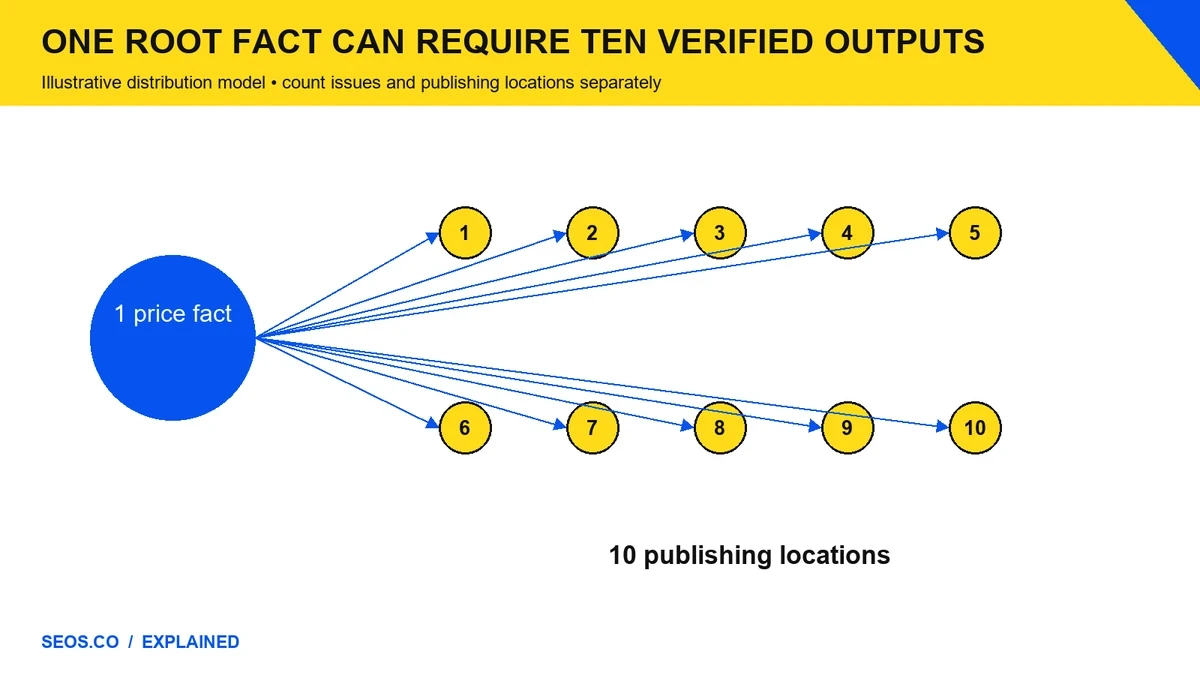
Count resolved root issues and corrected publishing locations separately. Correcting one price across ten pages is one factual issue and ten verified outputs. Rewriting ten introductions without resolving a task failure should not receive the same value merely because the production count matches.
Track recurrence, time to verified correction, unresolved high-consequence claims and the share of priority tasks with a clear maintained owner. These are operating measures, not ranking factors. They reveal whether the process is becoming easier to maintain.
Search and business outcomes belong in a separate follow-up. Preserve publication dates and compare appropriate page cohorts, considering demand, seasonality and simultaneous changes. A useful repair can be complete before its visibility effect is known. Do not call a narrow technical fix proof that the entire content program is healthy.
The content SEO guide connects those longer-term outcomes with page purpose. A content-debt program supplies the maintenance discipline beneath that strategy: verified facts, clear task ownership, working paths and a queue that makes remaining uncertainty visible. Start with the defects that can mislead or block customers, then improve the rest in a sequence the evidence can justify.
Estimate the real maintenance burden
Effort should include more than editing time. An expired offer may require approval, updates to a shared component, cache verification, partner corrections and a customer-service note. A one-paragraph repair can therefore have more operational work than a long evergreen rewrite. Record the work by dependency so the estimate reflects what must actually be completed.
Separate active work from waiting time. A legal review taking three calendar days is different from three days of editorial effort, yet both affect the release deadline. A queue can show a low-effort task blocked by approval and let independent work continue. This prevents a single unresolved field from stalling the entire maintenance program.
Track whether the repair reduces future work. Moving repeated offer data into a maintained source may take longer initially but lower recurrence. That benefit is a planning judgment until observed, so record the expected reduction and inspect later incidents rather than claiming an immediate quantified saving.