
The Search Brief · News analysis
Multilingual AI Search: Evaluate the Market, the Language and the Actual Offer
Evaluate multilingual AI search with task-equivalent prompts, language-market cells, accurate local offers and a worked Canada-France recommendation audit.
Development covered: Primary-source guidance checked November 2, 2026

Multilingual AI search requires more than translating an English prompt and comparing brand mentions. A useful evaluation separates language, market, task and offer eligibility. A French answer for a buyer in Canada is not automatically comparable to a French answer for a buyer in France, and a provider can be correctly excluded from one market while remaining suitable in another.
Begin with a matrix of real customer decisions in the markets you serve. Use local terminology, verify the offer’s actual boundaries and record the conditions of each answer observation. Then compare like tasks rather than treating every language as a cosmetic version of the same search universe. The result should guide corrections and useful content, not manufacture a global visibility score from incompatible samples.
The workflow below uses fictional examples and original measurement recommendations. It does not claim that any assistant always behaves in a particular way by language. Where a product does not expose location or retrieval settings, record the uncertainty. A careful evaluation can remain useful without pretending to control every variable.
Separate language from market and jurisdiction
Language describes how the question and answer are expressed. Market describes the customer’s commercial context. Jurisdiction can affect the rules, terms or service conditions relevant to the decision. These dimensions often overlap, but they are not interchangeable. An English-language buyer can be in Singapore, Canada or the United Kingdom and need different information.
Create a record for each intended combination. Include language, market, customer type, task, offer eligibility, currency, units and any material local conditions. This gives the reviewer a concrete frame for judging accuracy. Without it, an answer can appear correct in translation while recommending a service unavailable to the intended buyer.
Do not infer location solely from interface language. If the evaluation requires a particular market, state it in the neutral task where appropriate and record any observable locale settings. A question such as “Which inventory platforms support a Canadian distributor?” makes a commercial constraint explicit without requiring the analyst to guess how the assistant interprets an account’s location.
Keep legal or regulated questions within the evidence available. A local-language page should not invent compliance approval or claim expertise merely to seem market-specific. For consequential legal or regulatory assertions, use current authoritative sources and qualified review before publication. The evaluation can identify the gap without a writer pretending to resolve it.
Build task equivalents rather than literal prompt copies
A literal translation can preserve grammar while losing the buyer’s meaning. Product categories, job titles and procurement language can differ across markets. Ask a qualified local reviewer to confirm that each prompt expresses the same decision and level of specificity, not merely the same dictionary words.
The search-intent guide helps define what must remain equivalent. Keep the shared intent stable. If the English prompt asks for a shortlist under a budget and the translated prompt asks only for a definition, the resulting mention rates are not comparable. Record the task identifier and the rationale for any wording adaptation. This makes the panel reviewable without forcing unnatural language.
Avoid adding stronger commercial cues in one language. Words equivalent to “best,” “enterprise” or “recommended provider” can change the task. If local usage requires a different phrase, document why and inspect whether the implied audience and constraints still match. Prompt adaptation is a methodological decision, not an invisible editing step.
Use a separate branded accuracy panel. Asking what a company offers in a market can reveal wrong geography, currency or service assumptions. Keep those observations apart from neutral discovery questions that do not name the brand. Otherwise a language with more branded prompts can appear more visible by construction.
Work through a two-market evaluation
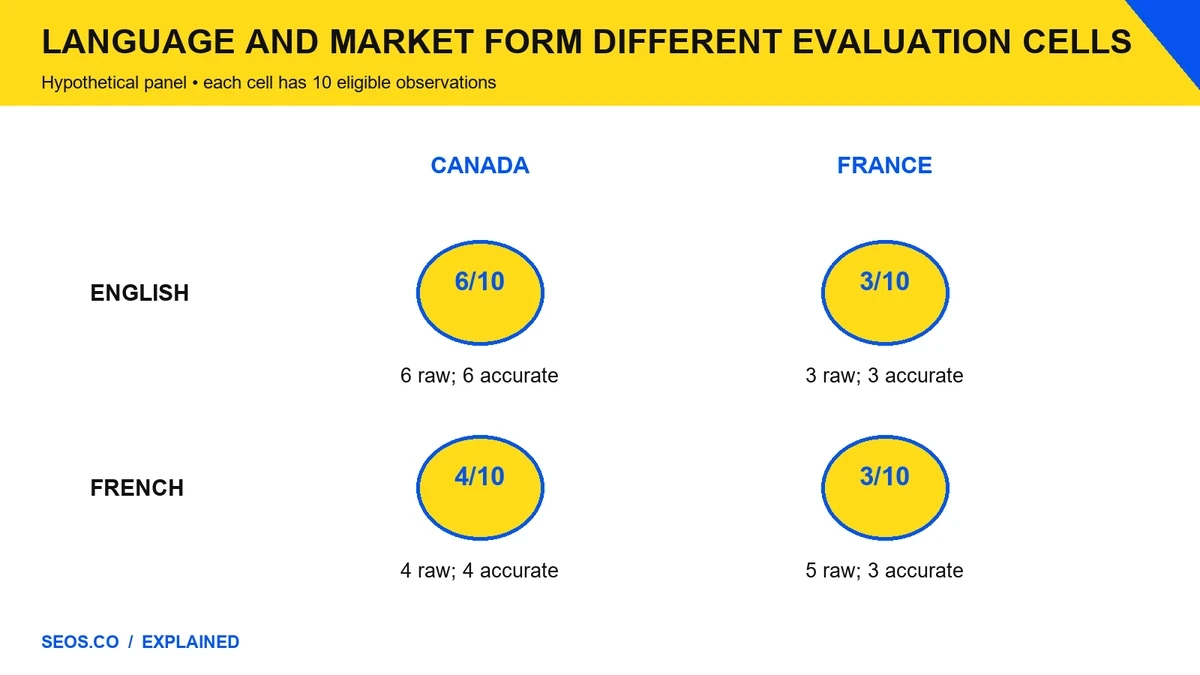
Imagine a fictional software provider serving Canada and France. It has English and French content, but only its Canadian offer includes a particular implementation package. The team wants to evaluate whether assistants recommend the appropriate package for a small distributor with two warehouses.
Create four cells: English-Canada, French-Canada, English-France and French-France. Each cell contains the same five decision families, adapted naturally for the language and market. Collect two observations per family under recorded conditions, yielding ten observations per cell and forty total. These counts describe an illustrative panel, not market demand.
Suppose the provider receives raw recommendations in six of ten eligible English-Canada observations, four of ten French-Canada observations, three of ten English-France observations and five of ten French-France observations. The descriptive raw rates are 60%, 40%, 30% and 50%. Their differences identify where to inspect the answers; they do not by themselves establish a statistically reliable language effect.
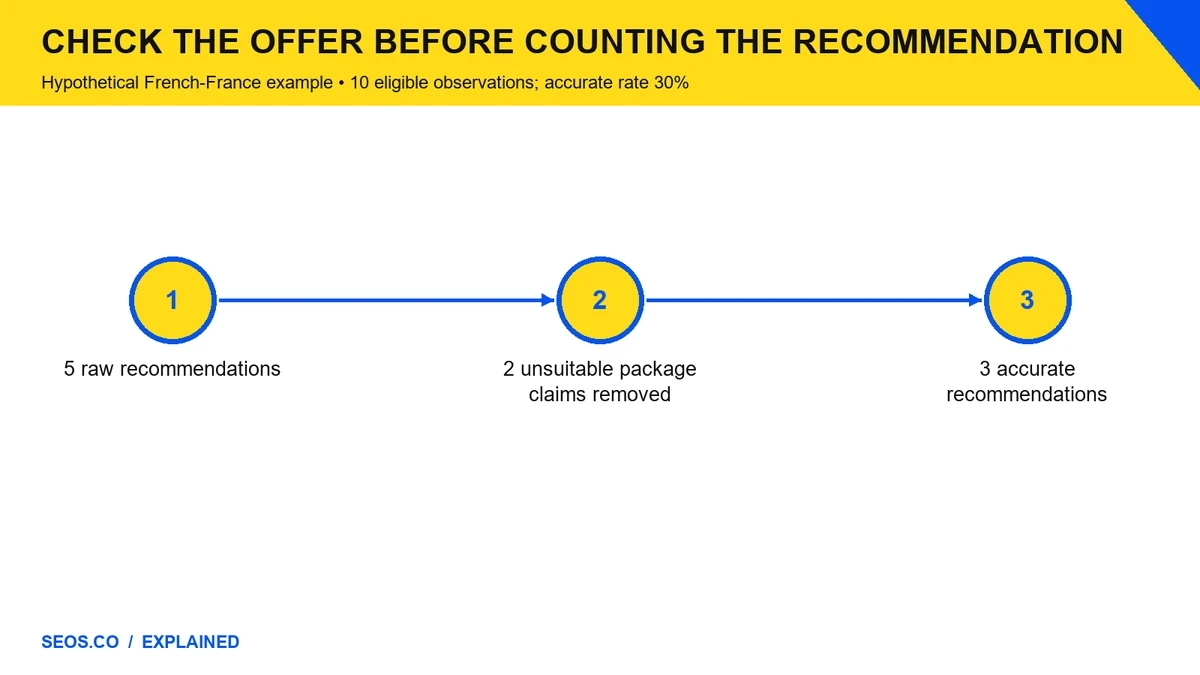
Now inspect suitability. If two French-France answers recommend the Canada-only package, they should not count as accurate recommendations. A raw mention score might look healthy while the recommendation is wrong for the market. The correction target is the package boundary and its evidence, not simply increasing the number of French brand mentions.
For this fictional example, assume the recommendations in the other three cells pass the market and package checks. Removing the two unsuitable French-France recommendations changes that cell from five raw recommendations to three accurate recommendations, or 30% of its ten eligible observations.
| Language-market cell | Eligible observations | Raw recommendations | Accurate after suitability checks |
|---|---|---|---|
| English-Canada | 10 | 6 | 6 (60%) |
| French-Canada | 10 | 4 | 4 (40%) |
| English-France | 10 | 3 | 3 (30%) |
| French-France | 10 | 5 | 3 (30%); two Canada-only package recommendations excluded |
Verify the source pages as market-specific evidence
The AI SEO best-practice guide provides the broader quality workflow. A translated page needs the same factual standard as the original. Confirm currency, tax presentation where relevant, units, support hours, service markets, plan names and implementation conditions with the responsible owners. Do not copy an English price into another market and change only the currency symbol.
The hreflang validation graph provides the implementation checks for reciprocal locale relationships; keep those checks separate from the evaluation of the local offer.
Keep material exclusions visible in the localized page. A link to an untranslated policy can be useful supplementary evidence, but it should not carry the entire burden of explaining a decisive local limitation. The reader should be able to determine basic eligibility in the language of the main offer.
Google documents hreflang annotations for indicating localized versions of pages. These annotations help communicate language and regional alternatives when implemented correctly; they do not certify that the content itself is accurate or guarantee assistant citations. Verify the current syntax and reciprocal relationships during implementation. Google localized-version guidance.
A locale URL should serve substantive localized content rather than an empty placeholder or an automatic language switch that hides the intended version. Inspect the delivered response and navigation. If a Canadian French page redirects every visitor to a generic French page for France, the market distinction may be lost before any external retrieval occurs.
Test meaning across text, tables and metadata
Review the title, description, headings, examples and calls to action in the target language. A technically correct paragraph can be undermined by a misleading title that promises availability everywhere. Metadata should describe the actual page, and the visible offer should remain consistent with the factual ledger.
Inspect number and date interpretation. A decimal separator, date order or unit conversion can change meaning. Write an unambiguous date when timing matters, and state units explicitly in tables. If an example uses a hypothetical amount, label it as an example rather than allowing it to look like a current commercial offer.
Check that translated tables preserve relationships. A shortened heading can accidentally turn a monthly equivalent under annual billing into a month-to-month price. A collapsed column can detach an exclusion from the product it limits. Read the table linearly and verify that the decisive conditions remain attached to their values.
Do not use machine fluency as proof of factual equivalence. A polished translation can confidently express the wrong market boundary. The review needs both language competence and access to the approved facts. Where those roles belong to different people, make the handoff explicit and preserve the approved version.
Record collection conditions without overstating control
For every answer observation, save the exact prompt, language, specified market, engine, visible model, date, search-enabled state and any observable locale settings. Preserve cited URLs and note the language of the answer. If the assistant changes language unexpectedly, record that behavior rather than silently translating the answer before scoring.
Use fresh conversations for the defined single-turn panel to reduce carryover from earlier branded discussion. That does not eliminate all personalization or account effects. State what the method controls and what remains unknown. A reproducible partial description is better than a claim of a perfectly neutral global environment.
Separate retrieval failures from unsuitable recommendations. A blocked page, unsupported language feature or collection timeout belongs in the operational record. An answer that completes but recommends the wrong package belongs in accuracy scoring. The repair owner depends on which stage failed.
Schedule observations so one slow market panel does not prevent the others from running within the intended window. Preserve planned and actual collection times. If an engine changes during a multi-day run, the language comparison can become confounded with time. A balanced schedule or repeated stable subset can help identify that problem.
Compare denominators before comparing percentages
A market with ten eligible buying questions should not be compared directly with one containing twenty mostly educational questions. Show task composition, eligible recommendation opportunities, completed answers and missing observations. The denominator is part of the result, not a footnote to be omitted from the dashboard.
Weight markets only for an explicit business purpose. Equal weighting answers how the defined markets perform on average. Revenue-priority weighting answers a different management question. Neither is universal global share. Publish the weights and preserve the unweighted components so a change can be explained.
Account for repeated observations and related prompts when estimating uncertainty. Forty answers from a small number of task families do not represent forty independent markets or customers. If formal analysis is unavailable, use descriptive counts and cautious comparisons rather than attaching an inappropriate confidence interval.
Keep unsupported markets out of the commercial opportunity denominator while preserving their accuracy observations. A provider correctly omitted from an unserved geography should not be penalized for unsuitable reach. However, an assistant falsely claiming that the provider operates there remains an accuracy issue worth recording.
Prioritize repairs by the market decision they affect
Start with wrong eligibility, currency, plan conditions and delivery promises. These can materially mislead a buyer. Next address missing local evidence that prevents a fair evaluation. Lower-priority language polish can follow when it does not alter the decision. This order keeps the program focused on usefulness rather than cosmetic parity.
Assign a factual owner to each correction and a local reviewer to its expression. A service boundary may need sales approval, while the translated wording needs language review. Preserve both approvals where the organization’s process requires them. Do not attribute expert review to someone who has not actually performed it.
Update the distributed record where material. A localized partner page or country profile can retain an old promise after the canonical page changes. Record which surfaces are corrected and which remain pending. A correction request is an action; the changed displayed fact is the verified outcome.
Use the complete SEO audit framework to include localized delivery in verification. After release, inspect delivered pages and collect fresh observations on the same task cells. Separate completed publisher changes from observed answer changes. If the error persists, examine the available sources and remaining contradictions without inventing a hidden language penalty or assuming that more translated articles will solve it.
Create a report a regional team can use
A useful report shows each language-market cell, its task coverage, accurate recommendations, supported citations, material errors and collection gaps. Include representative complete examples in the original language with a reviewer-approved explanation where needed. A global summary can orient management, but the cell-level evidence tells regional teams what to fix.
Preserve the panel version and wording history. When a prompt is improved for local meaning, mark the change and avoid treating its new result as perfectly comparable to the old wording. Similarly, a market expansion changes offer eligibility and may require a new baseline rather than a simple continuation of the old rate.
The first objective of multilingual AI search is accurate market fit. A company should be discoverable where it can help and described honestly where it cannot. A task-based matrix, verified local facts and consistent observation records make that objective measurable without reducing a diverse international audience to translated keywords and a single opaque score.
Preserve the local reviewer’s reasoning
When a reviewer adapts a prompt or corrects an assessment, save the reason with the task. A category term can imply a different product class locally, or a support-hours statement can be grammatically correct but commercially misleading. The record helps future analysts distinguish necessary adaptation from an unexplained design change.
Where local review is limited, prioritize the conditions that change suitability and label remaining uncertainty. A smaller reviewed panel can provide stronger evidence than a large translated panel whose meaning no one has verified. Expand after confirming task equivalence rather than pursuing a language quota that the evidence cannot support.