
The Search Brief · News analysis
GEO ROI: Build a Business Case Without Pricing Every Citation Like a Sale
Build a GEO ROI case with contribution margin, break-even arithmetic, attribution limits and transparent scenarios for incremental and zero-click influence.
Development covered: Primary-source guidance checked November 2, 2026

GEO ROI should compare attributable incremental value with the full cost of the work, while making uncertainty visible. A citation is an exposure event, a referral is an observed visit and a sale is a business outcome. Those stages can be related, but they cannot be substituted for one another in a return calculation.
A useful business case therefore has two layers. The observed layer contains measured visits, qualified leads, opportunities and realized contribution. The scenario layer contains assumptions about incremental influence, future conversion and unobserved exposure. Keep those layers separate so management can see which part of the decision rests on evidence and which part depends on a plausible forecast.
The model below is an editorial planning framework using hypothetical numbers. It is not investment advice, an industry benchmark or a report of SEOS.co campaign results. Its purpose is to help an operating team decide whether a bounded GEO program deserves additional resources and what evidence would make the next decision stronger.
Define the investment and the outcome window
List the actual work: research, writing, factual review, technical fixes, media, publishing, measurement and maintenance. Include internal time when it displaces other valuable work. A content program that appears cheap only because review and engineering were omitted from the budget is difficult to compare fairly with another acquisition investment.
Choose an outcome window suited to the buying cycle. A consultation business may learn something from qualified inquiries within a month, while enterprise sales can take much longer. Do not call an early cohort unprofitable simply because its opportunities have not matured. Equally, do not count the entire pipeline as realized revenue to make the early report look successful.
Separate one-time setup from recurring costs. An initial fact ledger or measurement repair may support several channels, while a recurring prompt panel serves ongoing evaluation. Explain how shared costs are allocated. The allocation is a management convention and should not be presented as an objective property of the platform.
Use contribution margin when the decision concerns resources available after delivery costs. Revenue alone can overstate value for services with substantial fulfillment expense. Define the margin consistently and have the relevant business owner confirm it. If reliable margin data is unavailable, show a range rather than inventing a precise profit number.
Build a stage model with observable boundaries
For the broader acquisition path, see how ChatGPT SEO works. A practical funnel can begin with observed answers on a defined question panel, then recognized assistant sessions, useful on-site actions, qualified inquiries, opportunities and won work. The answer panel and the acquisition records usually describe different populations. Do not divide all site sessions by a small panel’s citations and call the result a universal click-through rate.
The content SEO guide provides related page-outcome context. Track each stage in its own denominator. Citation rate belongs to eligible observed answers. Session conversion belongs to measured acquisition sessions. Lead qualification belongs to unique inquiries reviewed under the business rule. Close rate belongs to sufficiently mature opportunities. These definitions prevent a polished funnel from connecting incompatible counts.
Google Analytics distinguishes attribution models that assign credit to different interactions in a path. An assigned credit value is an analytical model output, rather than direct proof that one interaction caused the sale. Use the current property configuration and clearly name the model when reporting attributed value. Google Analytics attribution models.
Maintain the actual lead and opportunity identifiers needed for deduplication within permitted data practices. One buyer can return through several sessions and submit more than one form. Counting each event as a new customer inflates value long before attribution is considered. Reconcile unique business records before calculating return.
Work through a conservative hypothetical case
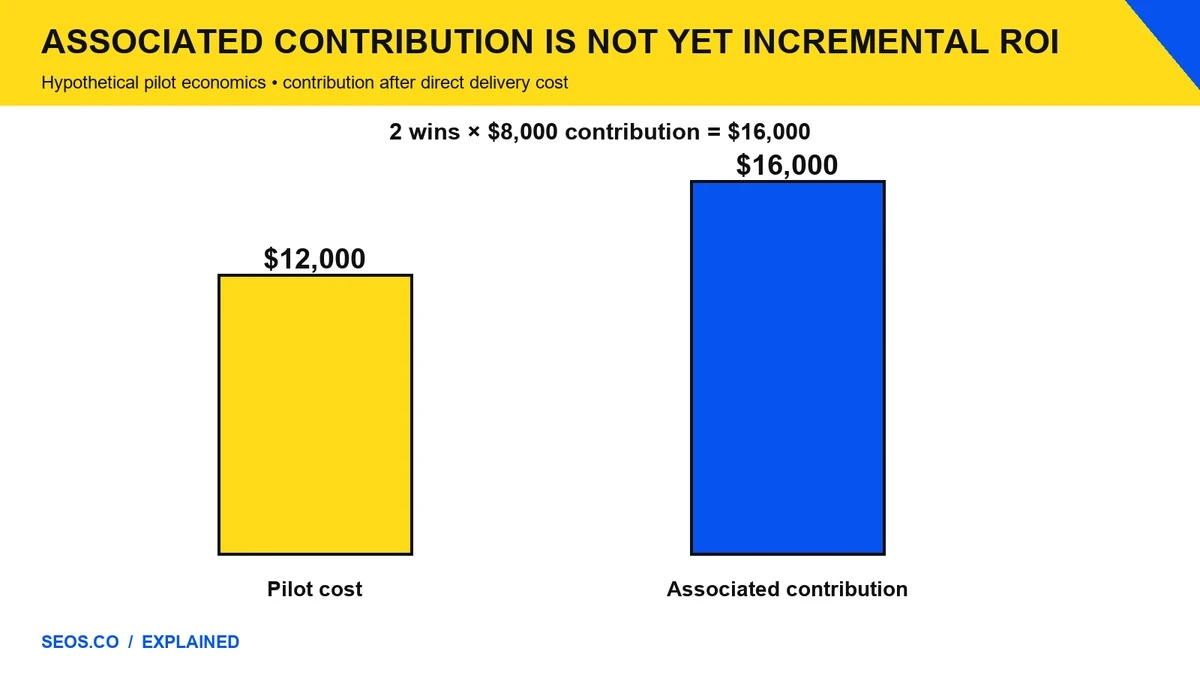
Suppose a fictional consultancy spends $12,000 on a three-month GEO pilot, including research, content, technical work, review and measurement. During the observation window, recognized assistant acquisition produces 900 sessions. Those sessions are associated with eighteen unique qualified inquiries, six mature opportunities and two won projects.
Each won project produces $15,000 revenue and $8,000 contribution after direct delivery cost in this example. Observed contribution associated with the channel is therefore $16,000. Dividing that by the $12,000 pilot cost gives a contribution-to-cost ratio of approximately 1.33. Subtracting cost before dividing gives an associated net return of approximately 33.3%.
| Illustrative economic field | Calculation | Result |
|---|---|---|
| Pilot cost | Full three-month program cost | $12,000 |
| Associated won-project contribution | 2 wins × $8,000 contribution | $16,000 |
| Associated contribution-to-cost ratio | $16,000 ÷ $12,000 | About 1.33 |
| Net return if all associated value is incremental | ($16,000 − $12,000) ÷ $12,000 | About positive 33.3% |
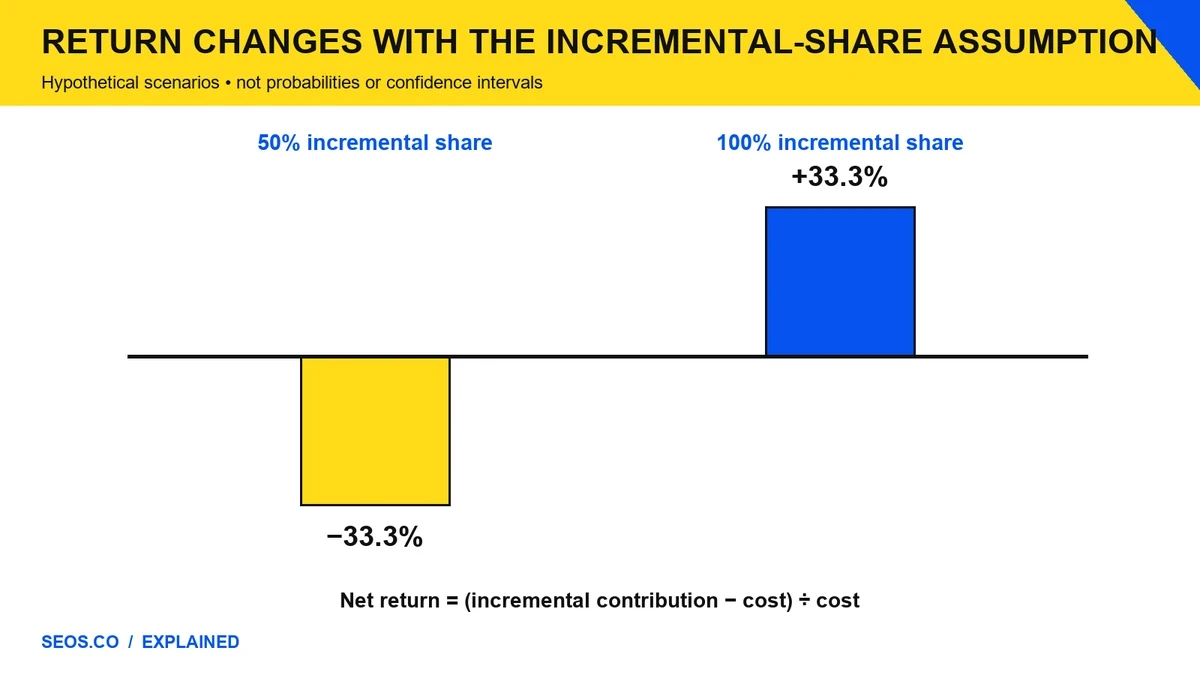
| Net return at a 50% incremental-share assumption | ($8,000 − $12,000) ÷ $12,000 | About negative 33.3% |
All entries describe the hypothetical example. The incremental-share rows are assumptions for sensitivity, not measured causal outcomes. That arithmetic does not establish incremental GEO ROI. Some inquiries might have occurred without the pilot, and some work might have been influenced by other channels. Label the figure “associated contribution” until an appropriate comparison supports an incremental claim. A correct formula can still answer the wrong causal question.
Now assume, solely for planning, that half the associated contribution is incremental to the pilot. Estimated incremental contribution becomes $8,000, and estimated net return becomes negative 33.3%: $8,000 minus $12,000, divided by $12,000. At full incrementality it is positive 33.3%. The conclusion depends strongly on the assumption, so the uncertainty belongs in the headline decision.
This does not mean the pilot failed or succeeded universally. It means the observed outcome supports a range, and the next investment decision should consider how plausible the incrementality assumption is, how much pipeline remains immature and what additional evidence can narrow the range.
Calculate break-even before inventing an uplift target
Using the same hypothetical economics, each incremental win contributes $8,000. A $12,000 investment requires one and a half incremental wins to break even in expectation. Since actual wins are discrete, two such wins would exceed cost while one would not. That is a useful planning threshold, not a forecast of what the pilot will produce.
If the mature opportunity-to-win rate is one third under an appropriate historical baseline, the expected break-even volume is four and a half incremental opportunities. The uncertainty in that close rate matters. A small history or changing sales process can make the estimate unstable, so show a plausible range rather than treating the historical average as a guarantee.
Work backward only through defensible conversion assumptions. If there is no evidence connecting prompt-panel citations to site sessions, stop at opportunities or qualified inquiries. Do not multiply a chain of guessed percentages and present the final revenue estimate with false precision. An incomplete but honest model is more useful than an elaborate fictional funnel.
Break-even can also reveal a poor economic fit. If a low-margin offer requires thousands of incremental conversions to recover a costly bespoke program, the team may need a narrower experiment or a reusable asset. Changing the business assumptions to make the spreadsheet positive is not optimization.
Treat zero-click influence as a separate hypothesis
An assistant answer can influence a buyer without a measured referral. The buyer may remember the brand, search for it later or contact sales directly. Those paths are plausible, but a direct visit alone does not reveal that they happened. Do not assign all unattributed revenue to GEO because influence is difficult to observe.
Use a customer-reported discovery question when appropriate, preserving the original response and recognizing recall limitations. A buyer saying “ChatGPT suggested you” is useful qualitative evidence. It still may not identify which page, citation or editorial change contributed. Keep the specificity of the conclusion aligned with the specificity of the evidence.
Branded-search movement can provide context, but it is affected by many simultaneous activities. Product launches, public relations, paid campaigns and seasonal demand can all change interest. A rise after a GEO release is a correlation until the design supports more. Use it to generate a hypothesis or triangulate evidence, not to claim the whole increase as incremental return.
A scenario can assign a range of possible unobserved influence, clearly labeled as such. Keep the observed case visible without that addition. Management should be able to see whether the program is viable under measured outcomes or depends entirely on an unverified influence assumption.
Distinguish attribution from incrementality
Attribution allocates credit within recorded journeys. Incrementality asks what would have happened without the intervention. These are related business questions with different evidence requirements. A last-click report can assign all credit to an assistant visit while the buyer was already committed. A multi-touch model can spread credit without establishing the counterfactual.
A bounded experiment can improve the incrementality estimate. For example, matched content groups can receive a specific improvement at different times while outcomes are compared under a predeclared design. The comparison must account for different demand, simultaneous site changes and engine drift. A before-and-after chart alone is usually a weak causal design.
Where experimentation is impractical, use a structured observational case. Preserve the baseline, compare similar tasks or pages, document competing explanations and report sensitivity to assumptions. This can still support a sensible management decision. It simply should not be labeled a randomized proof.
Use AI SEO best practices to distinguish baseline publishing work from experiments. Do not require perfect causal identification before maintaining clearly wrong facts or broken pages. Some repairs are justified by customer usefulness and operational reliability. Keep those baseline obligations separate from discretionary growth claims so the ROI discussion does not turn into an excuse to leave known defects in place.
Include maintenance and downside in the decision
A GEO asset can create ongoing obligations. Technical comparisons need updates, volatile prices need expiry controls and external profiles may require correction requests. Include those costs in the expected operating model. A pilot that succeeds only while everyone volunteers unrecorded review time may not scale economically.
Consider the cost of inaccurate recommendations. An invented service can generate unsuitable inquiries and sales effort. An obsolete offer can create customer dissatisfaction. A citation gain that increases those problems is not an uncomplicated business win. Include accuracy and suitability measures alongside acquisition and margin.
Measure displaced effort where material. If a specialist spends two weeks producing a comparison guide, what other work was delayed? Opportunity cost need not be estimated with artificial precision, but it should not disappear from the decision. A practical program can compare a narrow GEO improvement with a technical repair or a better conversion flow.
Shared benefits should be acknowledged without double counting. A stronger implementation guide may improve organic search, sales enablement and assistant citations. Allocate or describe those benefits consistently rather than claiming the entire value separately for every channel. The organization receives one commercial outcome even when several teams contributed.
Use decision thresholds instead of universal success claims
Before the pilot, define what would justify continuing, changing or stopping the discretionary investment. A continuation rule might require reliable collection, accurate recommendations and enough mature qualified opportunities to make break-even plausible. The exact rule depends on business economics and risk, not a universal citation target.
Separate measurement failure from business underperformance. If form submissions never reached the customer system, the pilot has an execution defect that prevents a clean outcome reading. Repair and verify the path. Do not declare the content ineffective from missing data, and do not declare success from front-end events that never became received inquiries.
Use a limited next step when uncertainty remains. Additional observations, a narrower content test or a repaired lead-reconciliation process can be more valuable than immediately doubling production. The next investment should target the uncertainty most likely to change the decision.
A concise management report can show total cost, associated mature contribution, estimated incremental range, unresolved pipeline, accuracy incidents and the next evidence milestone. That is a more useful GEO ROI discussion than multiplying citations by an invented dollar value. The model earns credibility by making the unknowns reviewable while keeping the commercial decision concrete.
Reconcile maturity before comparing cohorts
Suppose the first pilot month has had ninety days for opportunities to mature, while the third has had only thirty. Comparing won revenue immediately can make the later month look weaker even when qualified pipeline is similar. Group outcomes by acquisition cohort and show each cohort’s age at the reporting date.
Keep pending opportunities visible with stage and age. Probability-weighted pipeline can support planning when its probabilities have an appropriate historical basis, but it remains an estimate. Do not add it to realized contribution without distinction. A deal that closes later updates the mature outcome; it does not prove that the earlier forecast was observed revenue.
Reconcile duplicates, cancelled projects, refunds and material delivery-cost changes with the business system. Marketing events may persist after the commercial outcome changes. Preserve reasons for revisions so the return calculation remains reviewable.
Compare a concrete alternative
The same budget might fund a technical repair, a stronger implementation guide or a better conversion flow. Compare effort, customer usefulness and measurable uncertainty without forcing every benefit into an invented revenue figure. If the pilot repairs inaccurate facts, acknowledge that baseline value separately. The discretionary growth case can remain uncertain while the factual repair remains worthwhile. This prevents attribution debates from obscuring customer obligations that should be completed regardless of channel credit.