
The Search Brief · News analysis
Design a GEO Experiment That Can Distinguish Better Evidence From Ordinary Answer Drift
Design a GEO content experiment with matched pages, fixed prompts, verified delivery, drift checks and a worked difference-in-differences example.
Development covered: Primary-source guidance checked November 2, 2026

A useful GEO experiment tests one defined improvement against a credible comparison, using a fixed question panel and predeclared outcomes. It should tell the team whether a change is worth continuing, while preserving the difference between an observed association and a causal result. A before-and-after screenshot of a favorable answer is evidence of an observation, not proof that the content change caused it.
Begin with a customer problem and a repairable hypothesis. For example, a technical guide might omit the conditions under which an integration works. The proposed intervention can add verified constraints and a worked recovery example. The outcome should include accurate task coverage, rather than rewarding a mention that makes an unsuitable recommendation.
The design below is a hypothetical editorial pilot. Its numbers illustrate planning and interpretation; no study was conducted and no performance result is claimed. It is intended for teams improving useful content under ordinary search eligibility, not for manipulating answers with hidden instructions or manufacturing evidence.
Define the hypothesis at the level of the reader’s decision
A weak hypothesis says, “More GEO content will improve visibility.” It combines an undefined intervention with an undefined result. A stronger hypothesis says, “Adding verified integration conditions and a concrete recovery example will improve accurate coverage of outage-related buying questions on the defined panel.” The latter identifies what changes and why it should matter.
Name the expected mechanism without pretending it is proven. Better local context may help a source answer the task, but an external engine may retrieve another page or synthesize the evidence differently. The experiment tests the practical outcome under observed conditions. It does not establish a universal ranking factor.
The GEO improvement guide supplies broader measurement context. Choose a primary outcome before collection. Suitable recommendation rate, supported citation rate or task-completeness score may fit different goals. Include factual accuracy as a guardrail. A citation increase accompanied by invented capabilities should not be counted as uncomplicated success.
Keep commercial outcomes where the sample and buying cycle can support them. Qualified inquiries can be a secondary outcome, but a small editorial pilot may produce too few mature sales for a reliable revenue comparison. State that limitation in advance instead of changing the success metric after seeing which number improved.
Select comparable units and preserve the baseline
Pages are often the intervention units, while answers are the observation units. Multiple answers about one page do not create multiple independently assigned pages. Record that structure so the analysis does not overstate its effective sample size. The appropriate comparison depends on the assignment unit and the outcome being measured.
Choose candidate pages with reasonably similar tasks, demand, content maturity and technical eligibility. A long-established product guide and a new empty page are poor substitutes for each other. Matching does not eliminate every difference, but it can improve the relevance of a small pilot when random assignment alone would create unhelpful imbalance.
Preserve the original pages, headings, source references and relevant performance records. Save the question panel and collection setup before the intervention. A retrospective reconstruction is weaker because the team may unconsciously choose the baseline that best supports the desired story.
Use the complete SEO audit to locate those prerequisites. Resolve eligibility defects first when they would prevent the experiment from testing the content hypothesis. A blocked page and an accessible page do not offer a clean comparison of explanation quality. If a necessary technical fix is bundled with the editorial change, label the intervention as bundled and limit the conclusion accordingly.
Work through a matched-page pilot
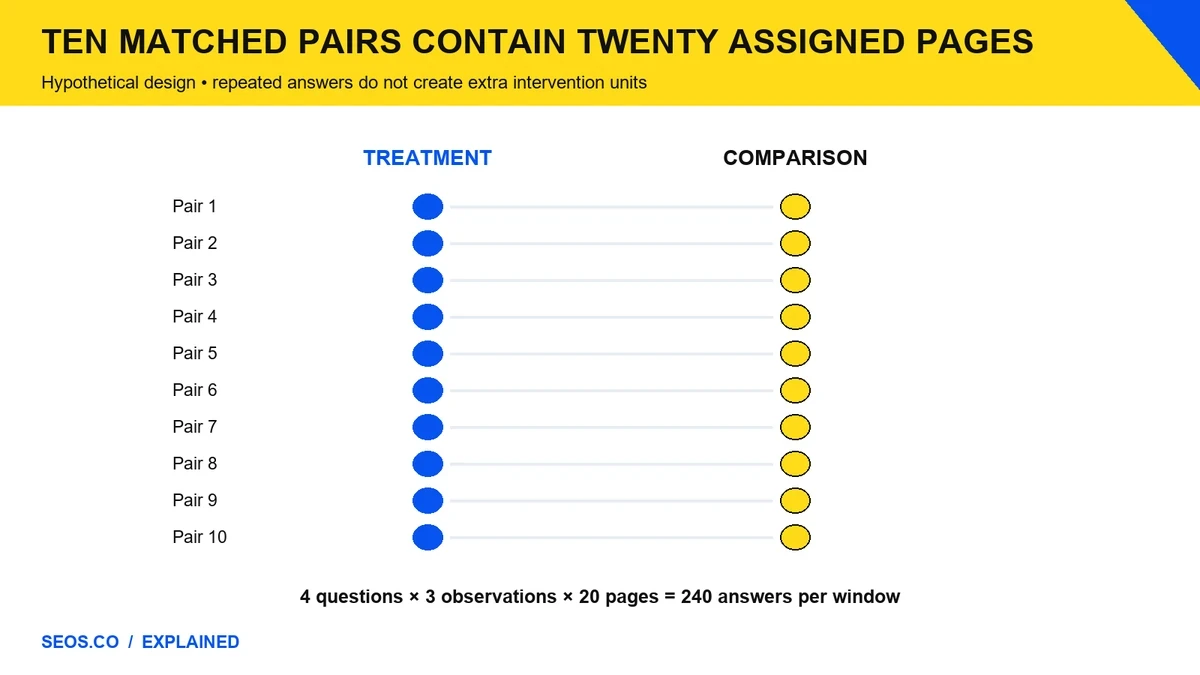
Imagine a hypothetical site with twenty integration guides arranged into ten matched pairs. Each pair addresses a comparable operating task and has similar baseline conditions. Within each pair, one page is assigned to receive the verified-conditions treatment while the other remains unchanged during the initial window. Random assignment within pairs can reduce discretionary selection bias.
The treatment includes three explicit elements: a direct task answer, locally attached eligibility conditions and one verified worked example. The team freezes other substantial changes to those pages during the pilot where practical. It also records unavoidable product, template and distribution changes rather than pretending the environment can remain perfectly static.
Each page maps to four neutral question variants, collected on three occasions per measurement window. That creates twelve answer observations per page and 240 across twenty pages in each window. The sample still contains twenty intervention units, not 240 independently treated assets. Repeated answers help describe variability within the assigned units.
The team records supported citations, accurate task coverage and material errors. It also tracks collection completion and whether the delivered treatment is actually present. An observation taken before a page’s new version is publicly served should not be casually labeled a post-treatment response. Save publication and delivery verification timestamps.
A staggered design may be useful when every page is eventually intended to receive the improvement. Keep an initial comparison window, then roll out the change to the remaining group after the evaluation. The later rollout does not retroactively turn the first period into a perfect experiment; it simply gives the team a controlled sequence for learning and implementation.
Measure the intervention before measuring the answer
Verify that the treatment exists in the delivered page. Check the direct answer, conditions, example, citations and relevant links. Inspect the text-only representation where appropriate. A successful edit in the CMS is not enough if the template or cache still serves the old version.
Record implementation fidelity for each page. If three treatment pages never received the worked example, the assigned intervention and delivered intervention differ. Preserve assignment for the main analysis where the design requires it, and report the delivery failure separately. Do not quietly remove inconvenient pages to improve the result.
Check that control pages did not receive the same material through a shared template or syndicated module. Shared components can contaminate the comparison. Similarly, sitewide navigation or schema changes may affect both groups and complicate the interpretation. The experiment log should identify those dependencies.
Confirm collection timing. A long-running task should not block the rest of the panel until the window expires. Record scheduled, started and finished times and preserve failures. Collection completeness is a prerequisite for interpreting the outcome, not an optional operational detail added after the chart is built.
Interpret changes with the comparison in view
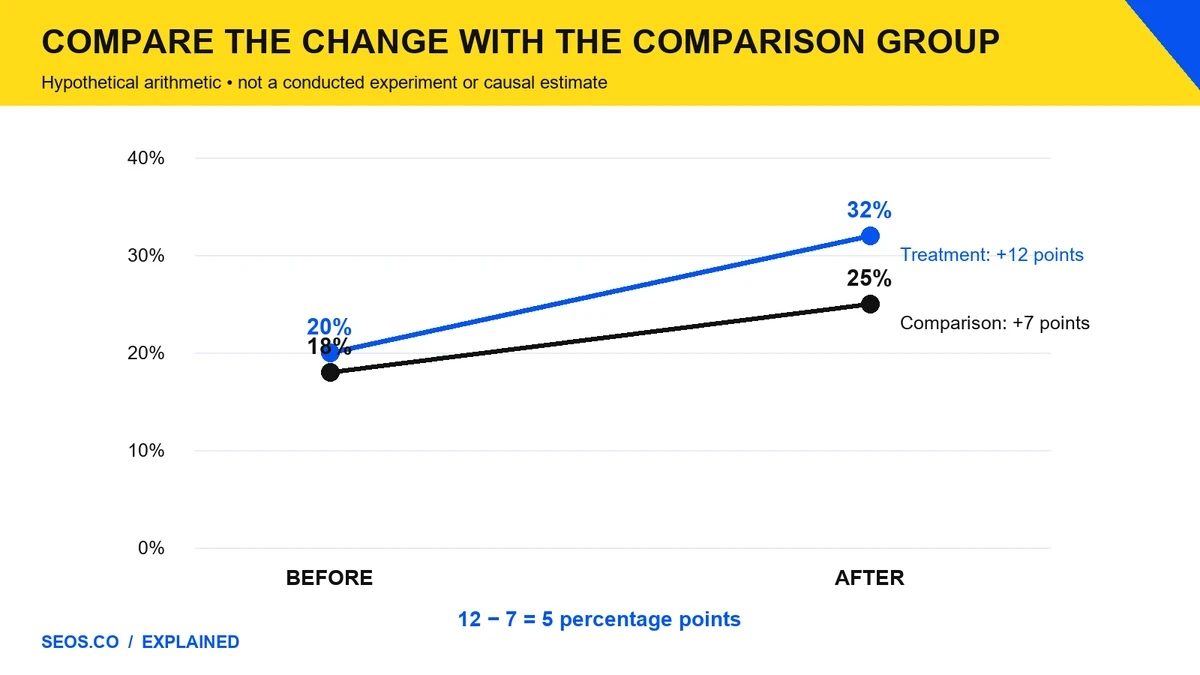
Suppose, in a purely illustrative outcome, the treatment group’s supported-citation rate rises from 20% to 32%, while the comparison group rises from 18% to 25%. The treatment group improved by 12 percentage points and the comparison group by 7. A simple difference-in-differences calculation is therefore 5 percentage points.
| Hypothetical group | Before | After | Absolute change |
|---|---|---|---|
| Treatment | 20% | 32% | 12 percentage points |
| Comparison | 18% | 25% | 7 percentage points |
| Difference in changes | — | — | 5 percentage points |
This table illustrates arithmetic only. It is not a conducted experiment, a confidence interval or an established causal effect. That arithmetic is not sufficient to establish a reliable causal effect. The design must consider whether the groups would plausibly have followed comparable trends, whether other changes differed between them and whether uncertainty is large relative to the estimate. The repeated observations also require analysis that respects page or task clustering.
Report absolute counts and baseline rates alongside the difference. A five-point change can have different practical meaning depending on the number of eligible opportunities, the accuracy of the resulting answers and the business value of the tasks. A decimal-heavy estimate should not hide a very small or unstable sample.
If uncertainty is wide, say that the pilot is inconclusive at the planned precision. Do not convert a positive point estimate into proof, and do not convert a lack of statistical significance into proof of no useful effect. The next decision can consider cost, downside, qualitative evidence and whether a larger test is justified.
Track engine drift and competing explanations
Maintain a small stable reference panel that is not directly tied to the changed pages. If answer behavior shifts widely across the reference tasks, the engine or collection environment may have changed. That pattern provides context, although it does not by itself identify the underlying cause.
Record visible model changes, interface changes, search settings and collection outages. If the pre-period uses one configuration and the post-period another, state the break. Continuing the experiment can still yield useful operational observations, but a clean attribution claim may no longer be justified.
Watch for product and market events. A vendor launch, major news story or revised commercial offer can affect the same buying questions. Document these events with dates and affected task families. Avoid inventing them after the fact as explanations for any result the team dislikes.
Keep publisher actions separate from external observations. The guide to AI search visibility mistakes provides useful context for this distinction. A newly verified guide is a successful content deliverable even if its citation effect remains unknown. A citation rise with no confirmed treatment delivery is an observation requiring investigation. The experiment becomes more credible when those statuses are reported honestly.
Limit metric shopping and repeated peeking
Choose a primary endpoint and a planned observation window before starting. If the team checks results daily and stops at the first favorable moment, the resulting headline can exaggerate evidence. Operational monitoring for broken pages should continue, but business-effect interpretation should follow the planned analysis unless a documented stop condition applies.
Secondary metrics can explain the result, but they should remain secondary. A null primary outcome cannot be quietly replaced with a favorable mention metric after collection. If an unexpected pattern is interesting, label it exploratory and use it to design a later test.
Avoid trying dozens of content variations on a handful of pages and reporting only the winning one. That selection process can produce an apparently successful example by chance. Preserve the tested variants and the selection rule. A useful program learns from failures rather than hiding them behind a single celebratory screenshot.
Historical GEO research introduced an optimization framework and reported improvements within its evaluated benchmark. Those results are evidence about that study’s methods and conditions, not a guaranteed uplift for a current site or assistant. Use the paper to inform hypotheses and evaluation literacy, while testing your own practical intervention. Original GEO paper.
Define stop rules and safe rollback conditions
Stop or repair the pilot if the intervention introduces incorrect claims, breaks the primary user task or creates a technical eligibility problem. These are operational guardrails, not disappointing business outcomes to conceal. Preserve the affected evidence and correct the defect before continuing interpretation.
A rollback should restore the relevant content or configuration without erasing the record of what happened. Keep the original and changed versions, release times and observed consequences. If a correction is clearly better for customers, it may remain justified even when a growth hypothesis is inconclusive; explain that decision separately.
Do not adjust offer claims or strategy thresholds merely to produce activity. An experiment should evaluate a truthful improvement, not force a preferred result by weakening suitability criteria. The definition of an accurate recommendation should remain tied to the actual business offer throughout the test.
Make the final decision reviewable
The final packet should include the hypothesis, assignment map, intervention specification, baseline, delivery verification, collection completeness, primary outcome, uncertainty and material deviations. Add representative complete answers so reviewers can see what the metric describes. Keep raw evidence available under the organization’s retention rules.
Choose a next action tied to the result. A clear useful improvement may justify a broader rollout with continued monitoring. An inconclusive small pilot may justify better measurement or a larger comparison. A harmful factual change should be corrected regardless of whether it increased mentions. The decision should follow the customer task and the evidence together.
A credible GEO experiment does not need a spectacular headline. It needs a defined intervention, a plausible comparison and an honest account of what changed. That discipline lets a team improve content while learning which effects are supported, which remain uncertain and which operational problems must be repaired before another test can answer the business question.
Predeclare exclusions and retain the exception log
Specify how missing answers, unsupported tasks and changed offers enter the analysis. An exclusion can be justified, but its rule should not depend on whether the observation helped the treatment. Retain the excluded record and reason so a reviewer can reconstruct the analyzed population. If a page becomes ineligible for a business reason, preserve its assignment and provide a clearly labeled sensitivity view where appropriate rather than erasing it from history.
Match precision to the decision
Ask how large an improvement would change the investment decision. A costly global rollout requires stronger evidence than a low-risk clarification on a few guides. A study aimed at a tiny difference may be unhelpful if management would act only on a substantial gain.
A qualified analyst can assess sample requirements using baseline rates, clustering and the chosen decision threshold. When those inputs are uncertain, plan a learning stage instead of inventing a confident power calculation. The experiment should reduce a meaningful uncertainty, with the design scaled to the consequence of the decision and the realistic ability to collect comparable observations.