
The Search Brief · News analysis
Brand Facts for AI Search: Build a Source of Truth That Can Survive Conflicting Pages
Build a verified brand-fact ledger, resolve conflicting service claims and confirm corrections across pages, profiles, caches and AI answer observations.
Development covered: Primary-source guidance checked November 2, 2026
When an assistant describes a business incorrectly, the first repairable question is whether the business publishes a clear, consistent factual record. A brand facts program should identify the correct value, its scope, the person or team responsible for it and every important place it appears. This is useful even when the assistant’s specific retrieval path is unknown.
A factual record cannot guarantee that an assistant will repeat it. It can remove contradictions that customers, search engines and other publishers encounter. The aim is accurate recommendations and informed decisions, not merely more brand mentions. An assistant that recommends a company for a service it does not provide creates a visibility metric and a customer problem at the same time.
Google’s Organization structured-data documentation describes fields that help communicate organizational details and disambiguate an organization. Markup should reflect real visible information; it is not a replacement for resolving contradictions in the underlying offer. Before implementing any field, verify the current supported properties and the organization’s actual facts. Google Organization guidance.
Identify facts whose errors change customer decisions
For broader answer-quality risks, see AI search visibility mistakes. Start with consequential facts: official name, public brand, service categories, operating markets, physical locations, product availability, integration status, pricing conditions and support boundaries. Add credentials only when they are real, relevant and verifiable. A long list of promotional adjectives is not a useful fact ledger.
Each fact needs a scope. A software feature might exist only in a particular plan. A service might be available nationally while in-person delivery is limited to several regions. A company might maintain a mailing address that is not a customer-facing office. Removing these distinctions makes the record simpler but less accurate.
Separate durable identity fields from volatile offer fields. The official organization name may change rarely, while appointment availability or a promotional price can change quickly. They need different review cadences and publishing controls. Treating every field as equally static leaves short-lived facts circulating long after they expire.
Prioritize fields by consequence and current inconsistency. An obsolete support telephone number is actionable even without an AI citation problem. A wrong service boundary may cause repeated unsuitable inquiries. A minor punctuation difference in a legal suffix usually has lower commercial impact. The ledger should help the team allocate effort rather than create an endless cleanup project.
Build a field-level ledger with provenance
For every material fact, store a field identifier, approved value, scope, effective date, expiry if relevant, factual owner, evidence source and publishing locations. Include the date last verified. “Marketing owns the website” does not mean marketing can independently certify product capability or regulatory status; ownership must reach the team that knows the fact.
Use a stable identifier for the real entity. A parent company, a product brand and a local branch may require separate records. If they are combined carelessly, an assistant or customer can receive the parent’s address with the product’s support promise. The ledger should show relationships without pretending the entities are interchangeable.
Preserve prior values in an internal history. When the business changes its minimum contract, the earlier value helps diagnose why old pages and third-party profiles disagree. History is evidence of the transition, not something to erase because it complicates the story. Record which version is current and when the change became effective.
The evidence source should establish the fact. An approved product specification can support an integration limit. A finance-owned pricing policy can support billing conditions. A staff biography may support an employee’s role but not an organization-wide certification. Evaluate provenance at the field level instead of labeling an entire website universally authoritative.
A worked conflict investigation
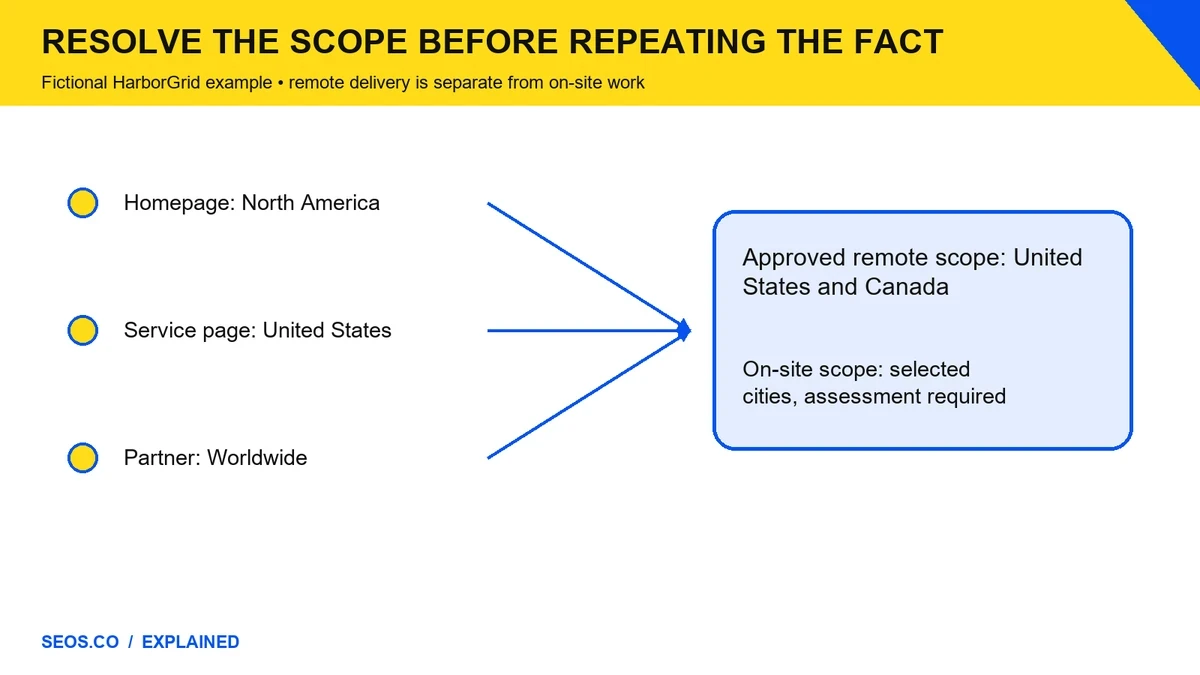
Imagine a hypothetical company called HarborGrid. Its homepage says it serves North America. A service page says United States only. An old partner directory lists worldwide delivery. Sales confirms that its current implementation offer supports the United States and Canada, while paid on-site work is available only in selected cities.
The correct repair is not to choose whichever wording sounds most ambitious. Create separate fields for remote service markets and on-site availability. The approved remote field becomes United States and Canada, with an effective date and sales-operations owner. The on-site field names the actual cities or explains the qualification process without inventing an office network.
The following fictional field ledger shows how qualified values can be stored. The dates are illustrative effective dates, not claims about an actual organization.
| Field | Approved value | Scope | Factual owner | Illustrative effective date |
|---|---|---|---|---|
| Remote implementation markets | United States and Canada | Current HarborGrid implementation offer | Sales operations | November 1, 2026 |
| On-site delivery | Selected cities; assessment required | On-site work only, not an office list | Delivery operations | November 1, 2026 |
| Other international delivery | Not part of the current standard offer | New implementation inquiries | Commercial operations | November 1, 2026 |
Suppose twelve publishing locations contain the market claim. Eight are corrected directly, two external profiles are confirmed corrected and two remain pending. Report ten corrected and two pending, not “brand facts fixed.” If fresh assistant answers still say worldwide, preserve those observations and inspect their sources where available. Do not assume the pending profiles caused every incorrect answer.
Create a clear canonical explanation for qualified facts
A source-of-truth page should answer ordinary customer questions in plain language. “Where can HarborGrid deliver implementation services?” should have a direct response, followed by relevant constraints. A table can distinguish remote delivery, on-site work and support hours without requiring the reader to reconcile three separate pages.
Keep qualifications beside the facts they limit. If Canadian delivery excludes a particular product line, say so in the same section. A global headline followed by a distant exception can remain misleading even when the exception is technically present somewhere on the site. The customer should not need legalistic reading to determine basic fit.
Avoid creating an artificial “AI facts” page filled with repeated claims solely for machines. A useful company, service or support page can serve as the authoritative explanation for people as well. If a compact fact sheet is warranted, connect it to the fuller evidence and keep it synchronized with the operational ledger.
Provide enough context for citations and extracted passages. “Available everywhere” is ambiguous without a product and market. “Remote implementation for the current HarborGrid platform is available to organizations in the United States and Canada” identifies the offer and boundary. Precise wording is more useful than a slogan when the fact may travel outside its original layout.
Synchronize templates and distributed profiles
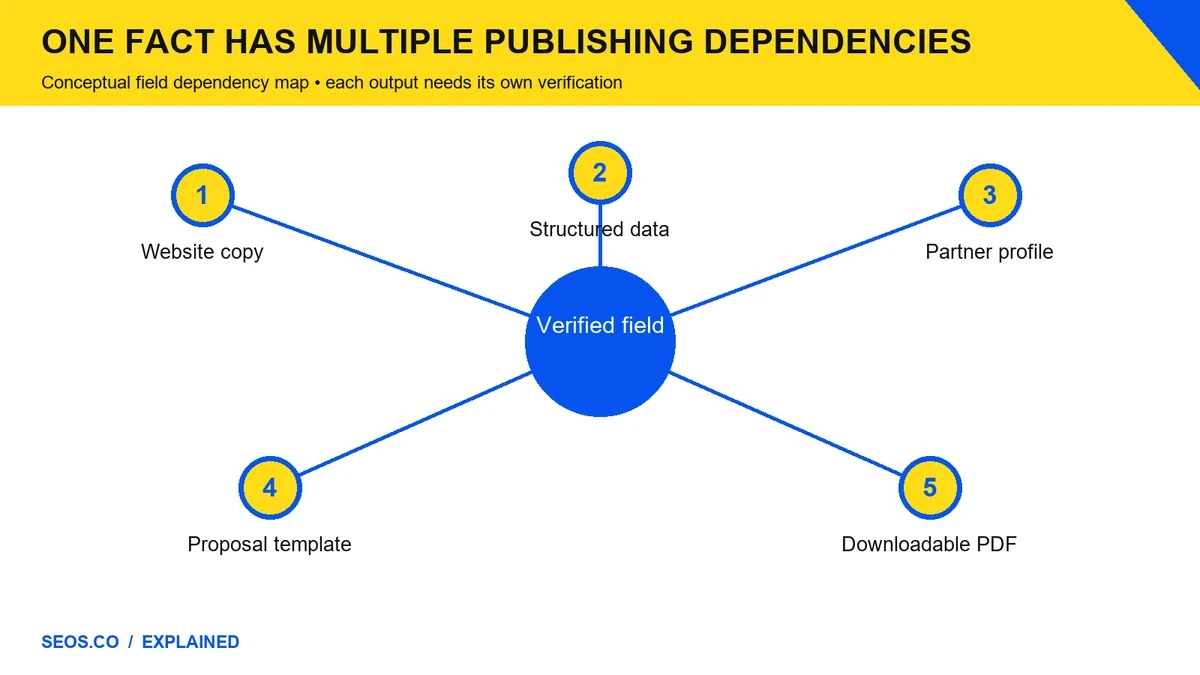
Correct the publishing system at its source when several pages inherit the same field. If the footer, location cards and contact page all pull from one organization record, update that record and verify its outputs. If they are manually maintained, record the duplication as an operational risk and assign a realistic maintenance process.
Use the structured data consistency contract to compare the same owned fact across visible copy, JSON-LD and applicable feeds.
Inspect structured data, visible text, feeds and downloadable documents where relevant. A corrected paragraph does not resolve an obsolete PDF that remains prominently linked from the service page. Likewise, updating markup without changing contradictory visible claims creates a mismatch rather than a stronger factual record.
For external profiles, use legitimate correction mechanisms and preserve evidence of submission and confirmation. Do not create fabricated branches, reviews or credentials to overwhelm an old description. The AI SEO best-practice guide places this work within accountable publishing. A factual consistency program should improve the reliability of the public record, not manufacture the appearance of a larger organization.
Prioritize external surfaces by actual relevance and observed use. An obscure unvisited directory may be less important than a major partner page linked from customer onboarding. If an assistant cites an outdated external profile in a material answer, that observation supplies a concrete reason to prioritize it. It does not prove that every directory needs an immediate campaign.
Separate entity identity from recommendation suitability
An assistant can identify the correct company and still recommend it for the wrong task. Identity fields help distinguish HarborGrid from another similarly named organization. Suitability requires evidence about services, constraints and customer needs. The two problems overlap, but one cannot be used as a substitute for the other.
Audit examples should therefore ask both kinds of questions. A branded accuracy question might ask where HarborGrid operates. A neutral selection question might ask for providers serving a Canadian manufacturing team with a particular implementation requirement. The first tests a field; the second tests the offer’s fit within a real decision.
Record whether a recommendation preserves material qualifiers. If it names HarborGrid for worldwide on-site delivery, the mention is commercially unsuitable even though the company identity is correct. Counting it as an uncomplicated visibility win would reward a misleading answer. Report accurate recommendation opportunities separately from raw mentions.
The same discipline applies to product families. A feature available in the enterprise product should not migrate into every mention of the entry-level plan. Keep product identifiers and package conditions close to capability statements. A consistent brand name cannot compensate for a blurred product taxonomy.
Verify the correction through the full publishing path
After editing, inspect the delivered page and its relevant variants. Check cached responses, mobile presentation, text extraction and downloadable versions where applicable. The factual owner should be able to locate the approved value in the customer-facing asset, not merely in an internal spreadsheet or editing screen.
Record the verification time and the version observed. If a cache still serves the old value, the source edit is complete but delivery remains stale. Investigate the cache path and update mechanism rather than repeatedly changing the paragraph. The operational goal is a confirmed current public response.
Then collect fresh assistant observations using a stable question set. Preserve engine, date, language, locale, search state and the answer evidence. A correct result in one new conversation is useful evidence, but it is not proof that all users now receive the correction. Repeated observations can reveal persistence and variation without pretending to represent every possible interaction.
If the incorrect fact persists, classify the remaining uncertainty. Is the answer citing an old page? Is the cited source current but the answer wrong? Are no sources exposed? Each condition suggests a different next step. Avoid claiming a hidden cause when the retrieval evidence is absent.
Maintain facts according to their change rate
The guide to when SEO content needs updating provides broader maintenance context. Assign review triggers as well as calendar dates. A product release, market expansion, office move or pricing change should initiate updates to its dependent fields. Waiting for a quarterly website audit can leave a known change unresolved for months. The ledger should make those dependencies visible at the point the business decision occurs.
For volatile fields, define expiry behavior. A temporary offer should stop appearing when it expires even if the scheduled replacement fails. A service availability page can show a current qualification requirement instead of an obsolete promise. Make the fallback truthful and useful rather than leaving the last successful value indefinitely.
Use a small exception queue for unresolved facts. Each item needs an owner, affected locations, consequence and next review action. Avoid broad “everything needs checking” tasks that remain open forever. A bounded queue makes it possible to distinguish completed corrections from genuine remaining risks.
Measure coverage using fields and publishing locations separately. Ten verified fields do not imply that every copy across the site is current. Conversely, fixing twenty pages that repeat one fact does not mean twenty distinct facts were resolved. The two denominators reveal whether the program is improving factual breadth, distribution consistency or both.
Answer the common implementation questions
Does a company need Organization markup to correct every AI error? No. Markup is one communication surface, and the right implementation depends on the site and supported properties. The first requirement is a verified factual record and consistent visible information. No markup should invent a value or claim a guarantee of assistant inclusion.
Should old company names disappear from the web? Not necessarily. Historical relationships can be legitimate and useful. Explain a rebrand, merger or product transition clearly, preserving the context that helps a reader identify the current entity. Erasing history can make older references harder to interpret without ensuring that assistants stop using them.
Can an external directory correction be counted as success when submitted? It can be counted as a submitted correction action, but the displayed fact remains pending until verified. Keep action status and outcome status separate. This prevents an activity report from being mistaken for a fully reconciled public record.
A practical first release is a ledger of the twenty or thirty facts most likely to change a customer decision, their approved values and their most important publishing locations. Complete those corrections, verify delivery and observe the relevant questions. Brand facts become a durable advantage when they are maintained as operational data rather than treated as a one-time copywriting exercise.
Preserve unresolved evidence conflicts
If two internal teams disagree about a field, do not publish a confident compromise that neither approved. Record the conflicting values, their sources and the decision needed. A temporary explanation can state the known boundary and invite confirmation where that reflects the real process. When the conflict is resolved, preserve the adjudication and effective date. This prevents an old internal document from quietly restoring an obsolete value and records why the current fact is authoritative rather than merely showing the latest text entered.