
The Search Brief · News analysis
Agent Task Testing: Move From Read-Only Checks to Verified Completion
Test read-only, preparation, reversible and authorized consequential tasks with explicit evidence, recovery cases and a practical release matrix.
Development covered: Primary documentation checked November 2, 2026
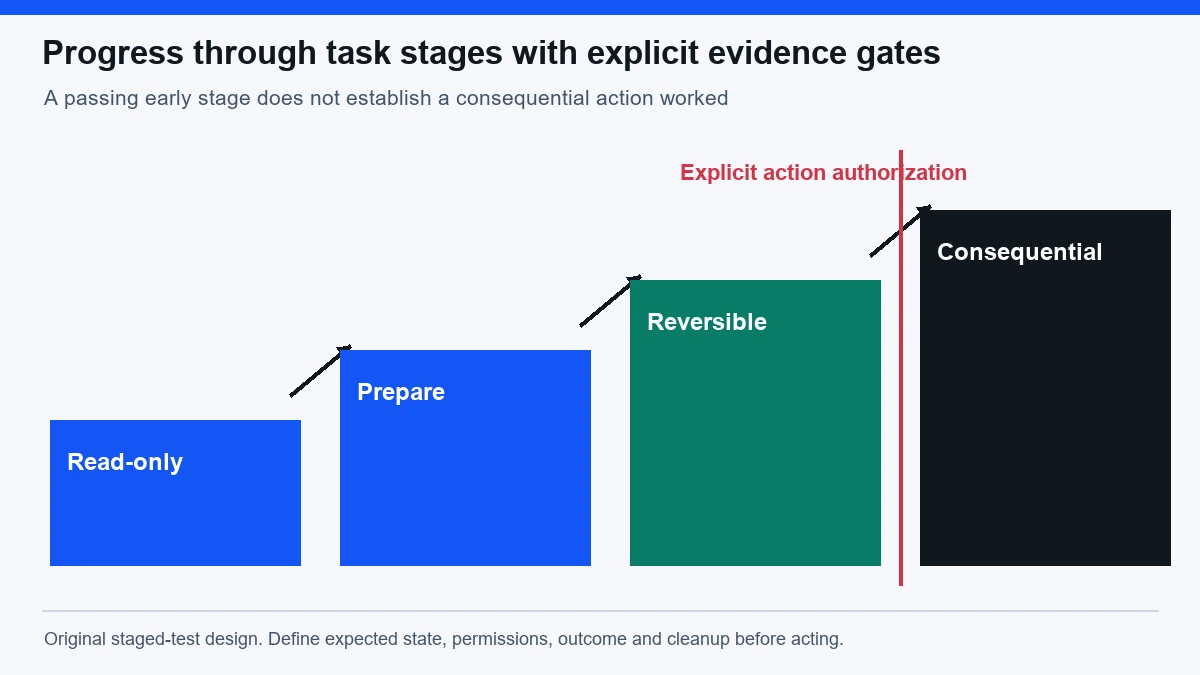
Agent task testing should establish that a website supports the user’s intended task under the relevant conditions, rather than merely showing that an agent can click a few controls. Begin with observable read-only tasks, progress to reversible changes and use controlled consequential actions only within explicit authorization. At every stage, verify the actual outcome and preserve the evidence needed to explain a failure.
The purpose of staging is to learn safely and precisely. A source-extraction defect should be found before a purchase test depends on it. A session-boundary problem should be resolved before an account change is attempted. A passing early stage is useful evidence, but it should not be described as proof that the entire journey works.
Accessibility testing is a foundation, not the whole evaluation
W3C’s accessibility evaluation overview describes evaluation as an ongoing activity and points to different approaches, tools and review resources. It does not present one automated tool as a complete replacement for evaluating how people use a website. This is a useful foundation for a broader task program, while agent-specific behavior still needs direct testing of the actual supported system. W3C accessibility evaluation overview.
Clear names, roles, labels, keyboard behavior and status messages help make an interaction understandable. They do not establish that the business operation reached the correct account or stored the right result. A task test should combine interface review with the evidence appropriate to the underlying action.
Do not use a single readiness score as the release criterion for every task. A site can perform well on many low-impact checks while failing its one important submission flow. Prioritize the actual visitor outcomes and the consequences of failure. Keep component diagnostics as supporting evidence rather than a substitute for completion.
Define a testable task contract
Describe the starting state, intended outcome, required constraints, permission boundary and evidence of success. For a product comparison, success may mean identifying suitable options with current terms. For a quote request, it may mean one accepted request containing approved information. For a settings change, it may mean a confirmed value in the correct account.
Separate required conditions from preferences and unknowns. A task should not pass if it completes an action that violates a mandatory constraint. An accurate clarification or no-result response can be appropriate. The evaluation needs to recognize those outcomes rather than rewarding activity for its own sake.
Record the authorized action scope. A user request to inspect a form does not authorize sending it. A request to compare products does not authorize purchasing. A controlled test can use a supported test environment or other authorized mechanism, but the existence of a test plan does not create permission for unrelated live mutations.
Use search intent alignment to choose tasks that reflect what visitors actually need from the page. Broad labels such as informational and transactional are starting points. The test should state the concrete decision or action a person should be able to complete.
Stage one: read-only understanding
Start with tasks that inspect information without changing business state. Ask the agent to identify an offer, compare variants, explain eligibility or locate the current authoritative policy. Verify the exact facts and qualifications against suitable sources. A plausible summary is not enough if it omits the condition that determines the user’s decision.
Trace delivered and extracted content where the tooling permits it. A fact visible in a screenshot may be missing from the representation the agent uses. Tables can lose headers, interactive panels can hide conditions and cached responses can contain old versions. Identify the actual evidence available to the agent before blaming its reasoning.
Include unanswerable and ambiguous cases. If current availability is not established, the correct response may be to explain the gap. If two products share a name, clarification may be needed. A system that always produces a confident answer can appear successful while inventing the very information the user needs to verify.
Save the question, source version, observed response, interpretation and uncertainty. Repeated observations help assess instability, while distinct tasks broaden coverage. Report both counts. Ten runs of one easy question do not establish the same breadth as ten different user decisions.
Stage two: navigation and preparation
Next, test finding and preparing the intended action without committing it. The agent can select a product variant, fill a quote draft or reach a settings review screen where authorized. Verify that the selected context still matches the original task: account, item, quantity, region and relevant constraints.
Inspect labels, grouping, conditional requirements, keyboard flow and visible state. A field that looks filled may not have a committed selection in a custom widget. A filter chip may remain visible while the results belong to an older query. Preparation should be established by the actual state, not the agent’s report that it clicked something.
Test correction paths. Enter a value that produces a known validation error, then repair it while preserving unrelated valid information. Check whether the message identifies the affected field and accepted format. A generic error that forces guessing is a usability and reliability defect even before external submission is involved.
The technical SEO checklist helps assess surrounding delivery and rendering. Keep preparation correctness separate from crawlability. A page can be eligible for search and still lose a selected variant when the user returns from a detail page.
Stage three: reversible state changes
Use reversible changes where the product supports them and authorization covers the action. Examples can include saving a draft or changing a nonconsequential test preference. Define the rollback or cleanup process before execution, and verify both the change and restoration. Do not call an action reversible merely because a button appears to undo it.
Check the authoritative state in the correct scope. A success toast can coexist with a failed save or a change to the wrong organization. The test should connect the prepared input to the stored result and the user-visible confirmation. Preserve identifiers and versions sufficient to detect a mismatch.
Include session expiry and account switching between preparation and submission. A recovered screen should not silently apply an old approval in a different account. Verify the active identity and permission at the consequential boundary, then confirm the actual destination of the change.
Test restart recovery where background processing is involved. An accepted draft-save operation should not disappear silently because a worker restarts, and a retry should not create unintended duplicates. The relevant guarantee depends on the application’s documented behavior, so test that contract rather than assume a universal one.
Stage four: controlled consequential actions
Only progress when the earlier evidence supports it and the action is within explicit authorization. Use a suitable test mechanism where available. Define the exact operation, expected business effect, permitted cost or exposure, outcome verification and reconciliation path. Keep the test bounded to the task rather than expanding into unrelated workflows.
A quote request test should establish one accepted request with the approved information and destination. A purchase test should preserve the exact item, quantity and current terms. A settings test should establish the intended value in the correct account. These outcomes are more specific than a page transition to a success URL.
Prepare for unknown outcomes. A connection can fail after the server accepts an operation but before confirmation arrives. The recovery plan should check or safely resume the original operation under its documented contract. Repeating a consequential action blindly can create duplicate effects and invalidate the test’s assumptions.
Do not force activity to make the test look productive. A correct rejection because inventory changed or a permission is absent may be the appropriate outcome. Distinguish expected rule-based rejection from missing data, stale data, scheduling failure and execution failure. The classification determines the repair.
A worked staged test plan
Imagine a fictional consultation workflow. The read-only test checks service scope and required contact information. The preparation test fills a draft and reaches review without sending. The reversible test saves and reopens that draft in the same account. The controlled submission test sends one authorized request and confirms its server reference.
The failure matrix includes invalid email format, session expiry, a delayed response, connection loss after acceptance and a restarted background notification worker. Each case has an expected business state and an expected visible explanation. A missing email notification should not automatically cause another quote request to be created.
The test record groups all retries under the original task intent. If three attempts recover one accepted request, report one completed request and three attempts. If two accepted requests result from one intent, report a duplicate-effect failure. Counting response codes alone would conceal the difference.
These events are an illustrative test design, not executed results. The value is the explicit relationship between task, stage, failure condition and evidence. A release owner can adapt it to the actual product while preserving the boundaries that make the result reviewable.
Test timing and shared dependencies
Compare source cadence and processing latency with the task’s deadline. If a consumer needs current availability within two minutes, a five-minute producer schedule cannot reliably satisfy that requirement. Include queue delay and cache reuse rather than reporting only the fastest isolated request.
Check locks and background work. A catalog rebuild or report job can occupy a shared resource while an independent task misses a time-sensitive opportunity. The process may remain alive and connected. Test whether the observer actually evaluated the relevant event in time, with current data, before claiming the system was operationally healthy.
Test realistic load where it is relevant and authorized. A quiet demonstration can hide tail latency, contention and retries. Record actual start, finish and confirmation times. A result arriving after the user-facing deadline may be technically correct but unusable for the intended task.
Preserve historical evidence through restarts and repairs. Missing observations remain gaps. Do not infer that no opportunity existed because the system failed to record it. A responsible report distinguishes established outcomes, likely mechanisms and conditions that cannot be reconstructed.
Use a release record that separates claims
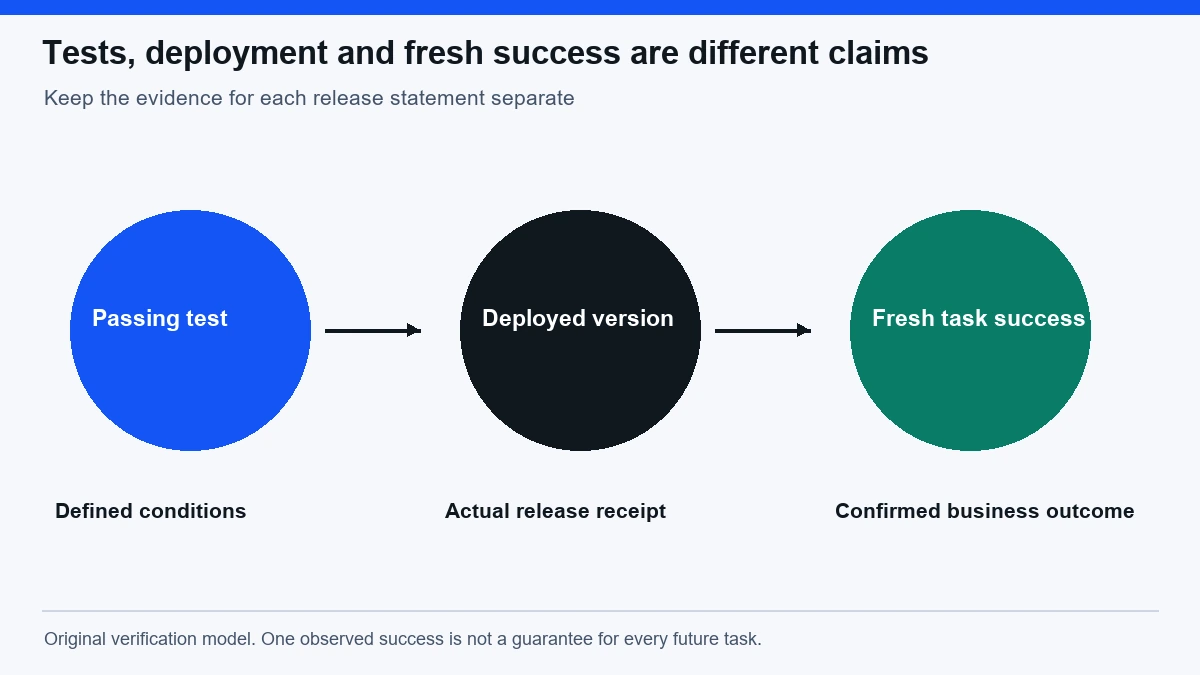
Record passing tests, deployed changes and fresh operational observations separately. A local test establishes behavior under its conditions. A deployment receipt establishes that a version was released. A fresh confirmed task establishes that the deployed path worked in an observed event. None automatically proves all future cases.
Keep the test matrix versioned. If task definitions or acceptance rules change, annotate the comparison. A looser success rule can improve the reported rate without improving the product. Retain a stable reference set to detect regressions while adding new tasks in a separately reported expansion set.
Use the internal linking checklist when task testing exposes unclear routes between explanation, preparation and status resources. Repair navigation where it helps the visitor, then verify the actual workflow rather than assuming that a new link completes the business operation.
Assign remaining issues to concrete owners and dependencies. A source gap needs content or data work, a stale cache needs delivery repair, a wrong account needs context handling and a missed deadline needs scheduling investigation. A generic agent-readiness backlog can hide these different responsibilities.
Questions for a staged testing program
Does passing accessibility checks prove an agent task works? No. Accessibility is an important foundation, while task completion also depends on current data, identity, authority, business rules, execution and confirmation. Test the actual supported interaction and intended outcome.
Should every test end in an external action? No. Read-only and preparation tests can reveal many defects, and consequential actions require appropriate authorization and controls. The goal is reliable evidence, not maximizing mutations. An accurate bounded noncompletion can be a correct result.
What should a final report say? State the tasks and stages covered, relevant conditions, actual business outcomes, deployed version and remaining uncertainty. Include representative failures and confirmed recoveries. The report should let another reviewer understand exactly what was established without relying on a readiness badge.
A compact release matrix
Use a release matrix to keep stage evidence separate. The table is an illustrative planning tool, not a report that any live system passed. Record the tested task variant, environment, version and actual outcome beside each row. A later stage should not erase a failure discovered earlier in the path.
| Test stage | Authorized activity | Evidence of a pass | What the pass does not establish |
|---|---|---|---|
| Read-only understanding | Inspect current source information and constraints | Correct facts, preserved qualifications and explicit gaps | Permission to submit, purchase or change account state |
| Navigation and preparation | Select options and prepare a draft without commitment | Correct context, selected values and reachable review state | Acceptance by the server or external business system |
| Reversible state change | Perform a supported authorized change and restoration | Correct stored result and verified rollback in the right scope | Safe handling of every consequential external action |
| Controlled consequential task | Execute the specifically authorized operation | Correct business effect, identity and truthful confirmation | Reliability under untested load or interruption conditions |
| Interruption and recovery | Introduce a defined failure and reconcile state | Preserved intent, appropriate retries and correct effect count | Knowledge of historical events for which evidence is missing |
| Fresh deployed verification | Observe a new task through the released process | Deployed version and confirmed operational outcome connected | A guarantee that all future tasks will succeed |
The matrix makes a bounded conclusion possible. A release owner can state which rows passed, which were deferred and which defects remain. This is more informative than declaring the site agent-ready because one automated score improved.