
The Search Brief · News analysis
Quote Request Idempotency: Recover From Retries Without Creating Duplicate Leads
Prevent duplicate quote requests by linking authorized intent, retries, durable outcomes and truthful confirmation, with a worked recovery example.
Development covered: Primary documentation checked November 2, 2026

Quote request idempotency means that retrying the same intended submission does not create another independent request. It matters when a connection fails after the server accepts the request but before the visitor receives confirmation. An agent trying to recover needs to discover or safely resume the original outcome, rather than repeatedly pressing submit and creating duplicate leads.
The solution is an explicit relationship among user intent, submission attempt, server outcome, and visible confirmation. A disabled button can reduce accidental clicks, but it cannot establish this relationship across timeouts, reloads, parallel tabs, and restarted processes. Reliable recovery belongs in the task’s server-side design as well as its interface.
Idempotency is a contract, not a button style
HTTP semantics distinguish methods partly through properties such as idempotency; those properties concern intended effects, not a promise that every response will be identical. An application-specific submission also needs a documented retry contract. Do not assume that every operation is safely repeatable because the transport uses HTTP. HTTP semantics specification.
Stripe provides a concrete provider-specific example: its documentation describes idempotency keys and distinguishes API v1 response replay from API v2 retry behavior. It also documents limits and parameter checks. This is evidence for Stripe’s documented contract, not proof that a quote form or another API behaves the same way. Stripe idempotent requests documentation.
For a quote workflow, define the desired business invariant: one authorized intent produces at most one accepted quote request. Retries belong to that intent until a defined terminal state or expiry rule says otherwise. A later user decision to send a genuinely different request is a new intent, not a retry that should be silently suppressed.
Separate intent, attempt and outcome
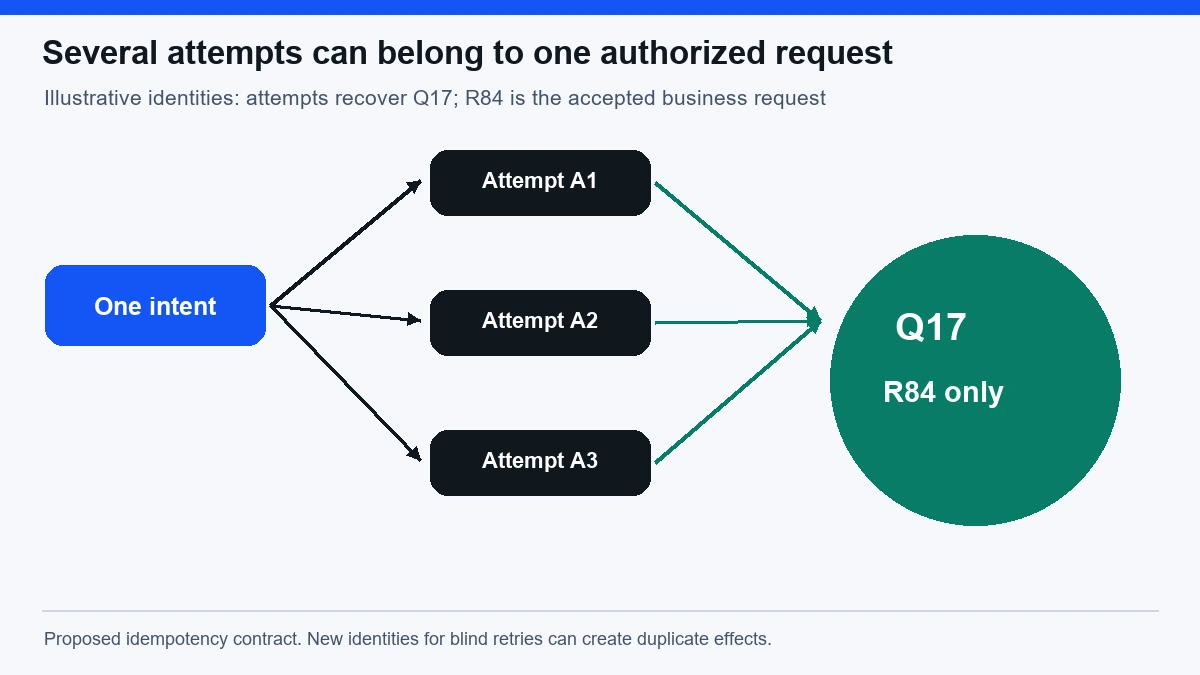
Intent describes what the user authorized: send this information to this organization for this purpose. An attempt is one delivery effort. The outcome is the server’s recorded result. Several attempts can correspond to one intent, while only one accepted business object should result from safe recovery.
The submission identity should remain stable across retries of the same operation. Generating a new identity after every timeout defeats deduplication because the server sees each retry as independent. Conversely, reusing one identity for different requests can suppress legitimate work or return an outcome for the wrong data.
Bind the identity to an appropriate payload or payload fingerprint. If the visitor changes the service, destination, or contact information after reviewing the form, the system needs a clear rule for whether this is a revised draft or a new submission. It should not replay an old outcome while pretending the changed information was delivered.
Preserve the user’s authorization boundary. Preparing a draft request is different from sending it. A technical retry policy cannot create permission that was never granted. The review screen and attempt record should identify the actual destination and content the user approved, rather than treating any filled form as an authorized action.
A useful state model
Start with a draft state containing editable information. A reviewed state records what is ready for approval. After authorized submission begins, the operation can be pending, confirmed, rejected, or unknown to the client. These states should be named according to observable evidence, not optimistic interface assumptions.
Confirmed means the server recorded the accepted request and can identify it. Rejected means the server declined it under a known rule, such as invalid required information. Unknown means the client cannot establish the outcome. Unknown is not equivalent to rejected, and it is not permission to create a new independent request automatically.
Pending requires a bounded observation policy. The client may poll an operation endpoint or receive a supported notification, but it should not spin forever without explaining the state. A sensible timeout can transition the client to an explicit unknown state while retaining the operation identity for later lookup.
The business object and delivery notifications can have separate states. A quote request may be accepted even if an email notification fails. Retrying the entire creation operation to resend email can create duplicates. Record the accepted request durably and handle notification recovery as a separate operation with its own evidence.
Work through an interrupted submission
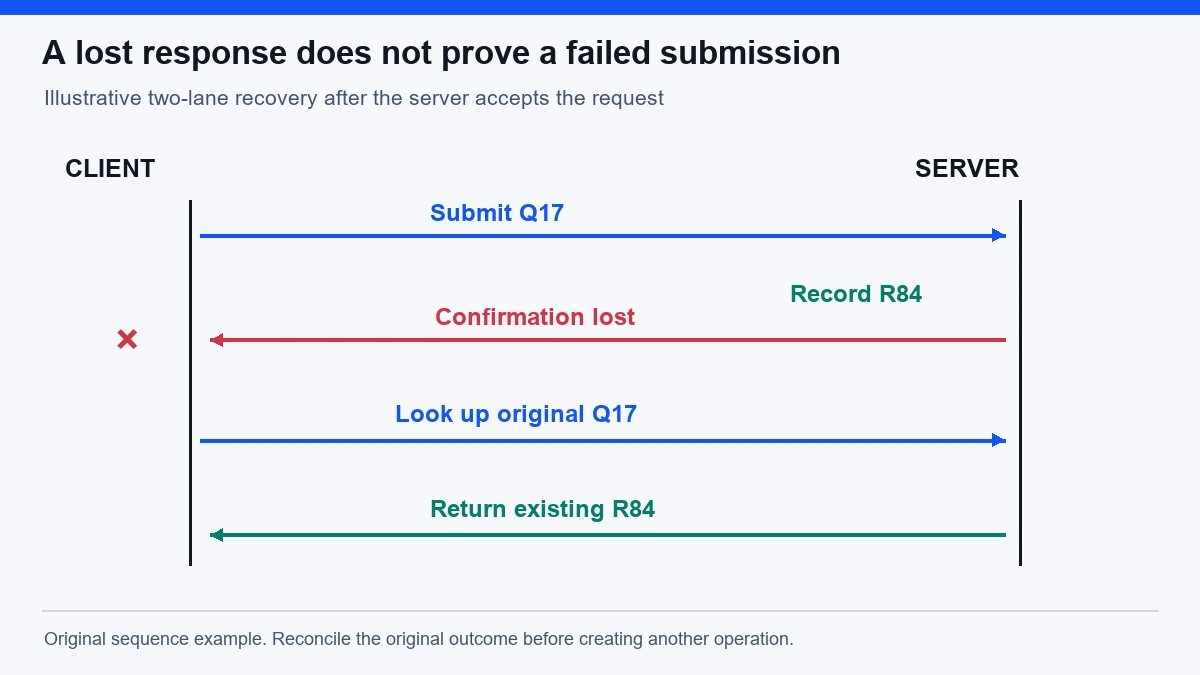
Imagine a fictional visitor who authorizes an agent to send a technical SEO quote request to Cedar Agency. The client assigns operation Q17 and submits the reviewed payload. The server stores request R84, but the network connection closes before the client receives the response. The client now sees uncertainty while the business already has one accepted request.
A weak recovery path resets the form and creates Q18 when submit is pressed again. The server accepts another request R85. The agency receives duplicate inquiries, and the visitor may receive multiple follow-ups. Both requests can look legitimate in isolated logs unless the original intent and attempts are linked.
A stronger path retains Q17, checks its outcome, and returns confirmation of R84. If a retry is necessary, the server recognizes Q17 and applies the documented contract without creating a second request. The visible interface can then show the confirmed request identifier and explain that the original submission succeeded.
These identifiers and events are illustrative, not a report of an executed test. The example demonstrates why an uncertain client response must be resolved against durable server state. A local animation or browser event cannot establish whether the business object exists.
Deduplication needs atomic behavior
Two attempts can arrive nearly simultaneously. A check that asks whether an operation exists and then creates it in a separate unprotected step can allow both requests through. The implementation needs an atomic way to claim or create the operation according to the storage system’s supported guarantees.
Store the outcome relationship durably enough for restart recovery. An in-memory map may work during a quiet demonstration and lose all attempt history when the process restarts. If the business object survives but its deduplication record disappears, a later retry can create another object despite apparently successful earlier testing.
Define what happens when the process fails between recording the operation and creating the request. The system may need a pending operation with a recoverable workflow, a transaction, or another reliable pattern appropriate to its architecture. The design should not mark an operation confirmed before the corresponding business state exists.
Likewise, define retention and expiry. An expired attempt record can change retry behavior. The client must not assume a retry remains safe forever if the server’s contract retains identities for a limited period. Document how older unknown outcomes are investigated and how the user can intentionally create a new request when appropriate.
Explain uncertainty in the interface
A useful message says that the submission outcome is being checked and avoids encouraging repeated independent attempts. It can provide a request identifier when confirmed and a clear repair instruction when rejected. A generic error toast that disappears after two seconds leaves both people and agents without a reliable state to act on.
Preserve valid form data during recoverable problems. If the server rejects one field, identify it and retain the rest. If the outcome is unknown, avoid presenting the same editable form as though nothing happened. The page should distinguish correcting invalid data from recovering an already attempted submission.
Do not promise a response deadline unless the business actually supports that commitment. Confirmation that a request was recorded is different from confirmation that a person has reviewed it. Accurate language reduces unnecessary retries and later confusion about whether the service failed.
Use search intent alignment to ensure the surrounding page clearly distinguishes research, quote preparation and external submission. The visitor should understand what the action does before an agent reaches the retry logic.
Observe the complete operation
Link client attempts, server operation identity, business request identity, validation results, and confirmation delivery. The diagnostic record should establish whether a duplicate arose from multiple authorized intents, unsafe retry identity, concurrent execution, or recovery failure. Raw request counts alone cannot answer that question.
Avoid logging unnecessary personal information. Correlation identifiers and appropriately scoped payload fingerprints can support diagnosis without copying all contact details into every trace. Access to operational evidence should reflect the sensitivity of the actual data. Observability should be sufficient for the task rather than indiscriminate.
Measure unique accepted requests separately from attempts. A high retry count may reflect unreliable delivery without a high duplicate count, while a low retry count can still contain a severe duplication defect. Report both the number of affected intents and the total attempts to avoid treating repeated evaluations as distinct business opportunities.
The technical SEO checklist covers the surrounding page’s response and rendering context. Keep those delivery checks separate from the operation’s submission evidence: a successful page response does not establish a successful quote request.
Test the failure windows deliberately
Test a normal submission, a validation rejection, a connection loss before server receipt, and a connection loss after acceptance but before response. The last case is particularly important because it exposes the difference between client uncertainty and business state. A test that only disconnects before any request reaches the server cannot establish safe recovery after acceptance.
Test simultaneous retries with the same identity and with changed payloads. Verify that the documented parameter policy is applied and that the accepted request remains coherent. Do not merely count successful response codes; inspect the actual business objects and the outcome returned to the client.
Restart the relevant process while an operation is pending. Confirm that it resumes or reaches a well-defined state without duplicate creation. Include background work and shared-resource contention where those conditions exist in production. A passing isolated unit check is useful but narrower than verified end-to-end recovery.
After deployment, inspect a fresh controlled event through the actual deployed process. State separately that the change passed tests, was deployed, and produced a confirmed operational result. Do not close a duplicate-lead incident solely because a service is connected or a process is running.
Keep the reader’s next step clear
A confirmed request should give a useful next action without inviting another submission of the same intent. That might be returning to the service explanation, saving the reference identifier, or using an established contact route for changes. Avoid a prominent submit-again button that looks like the natural continuation of a successful flow.
Use the internal linking checklist to connect service guidance, request preparation and confirmation resources where those links help the visitor. The links should support understanding, while operation state remains governed by the server’s actual record.
If a visitor needs to change an accepted request, provide a distinct supported revision path or explain the available contact process. Editing the old form and resubmitting under the same identity may be incompatible with the original contract. A clear revision action prevents legitimate changes from being mistaken for duplicate retries.
Questions for a quote-flow review
Is disabling the submit button enough? No. It can reduce rapid repeated clicks in one interface state, but it does not protect against reloads, parallel clients, connection failures, or process restarts. The server must recognize the operation and preserve a reliable outcome relationship.
Should every retry use a new identity? Not when it represents the same intended operation under an idempotency contract. A new identity usually represents a new operation. Define the contract explicitly and preserve the approved payload relationship rather than relying on a generic retry label.
Does an error response prove that nothing happened? Not necessarily. The response can be lost or generated after part of the operation occurred. Inspect the documented contract and durable outcome. When the result remains unknown, retain that state and investigate rather than inventing a successful or failed conclusion.
What should a repair prove? It should demonstrate that the same authorized intent can recover through the relevant failure window, produce the correct number of business objects, and reach a truthful user-visible state. The evidence should include source state, attempts, stored outcome and final confirmation.
Reconcile downstream duplicates carefully
If duplicate requests already exist, preserve the evidence before merging or closing them. Two similar records may represent one retried intent, or two people from the same organization may have independently requested help. Compare operation identity, authorization context, payload and timing rather than deleting records solely because their email addresses match.
Keep operational repair separate from business follow-up. Preventing future duplicate creation does not automatically retract duplicate notifications or reconcile an agency’s customer-management records. Identify which downstream artifacts were affected and confirm their disposition through the appropriate authorized workflow. Missing logs should remain an evidence gap, not a reason to assume every similar inquiry was a duplicate. This makes the incident report accurate about both the technical fix and any remaining business consequences.