
The Search Brief · News analysis
Agent Inventory Freshness: Available to View Is Not Reserved to Buy
Separate cached availability, current checks, reservations and confirmed orders, using a freshness budget and commitment ledger.
Development covered: Primary documentation checked November 2, 2026

Agent inventory freshness concerns whether the availability used for a decision is still valid when the action occurs. A product page can accurately show stock at one moment without promising that a unit will remain available through checkout. Reliable commerce flows distinguish an observation, a current recheck, a reservation and a confirmed order.
That distinction prevents two common errors: treating old availability as a commitment, and treating every changed result as a system defect. Stock can legitimately change while a user compares options. The website should explain the state and preserve a safe recovery path, while the agent verifies the conditions required by the user’s authorized task.
HTTP freshness is not business validity
RFC 9111 defines HTTP caching behavior, including how caches determine whether stored responses are fresh and when revalidation is needed. These protocol mechanisms govern response reuse. They do not establish whether a particular stock count is sufficiently current for a purchase decision or whether a unit has been reserved for a user. HTTP Caching specification.
A response can be fresh under its configured cache policy while its business data has already changed. Conversely, a response that requires revalidation may contain information that remains accurate. The application must choose caching and validation behavior appropriate to the consequences of stale inventory rather than equate a cache status with a commercial guarantee.
Separate the clocks involved. The warehouse records a stock event, an inventory system processes it, a commerce service publishes availability, a cache stores a response, and a visitor receives it. Each stage can add delay. A timestamp near the product page should identify what it actually measures if it is presented as evidence of currency.
Do not display a decorative real-time badge unless the system can support the implied meaning. A page regenerated every hour is not necessarily a live inventory confirmation. Accurate language helps users understand whether they are viewing an estimate, a recent observation or a reserved quantity.
Define the stock state you expose
Physical stock, sellable stock and available-to-promise stock can differ under a business’s rules. Some units may be reserved, damaged, allocated to another channel or unavailable in the user’s region. The website should expose the state relevant to the offer rather than a large number that cannot actually be fulfilled.
Variant identity matters. A family-level in-stock label can mislead if the selected size or capacity is unavailable. The availability check should apply to the exact sellable unit and relevant quantity. The page, cart and backend should agree about which variant is being evaluated.
Location and fulfillment method can also change availability. A unit available for local pickup may not be eligible for delivery. A warehouse may serve only particular regions. State those conditions near the offer so that an agent does not infer universal availability from a narrow local result.
Use the ecommerce SEO best-practices guide for the wider catalog and fulfillment context. The operational focus here is the age, scope and commitment level of the availability evidence used during a task.
A worked freshness budget
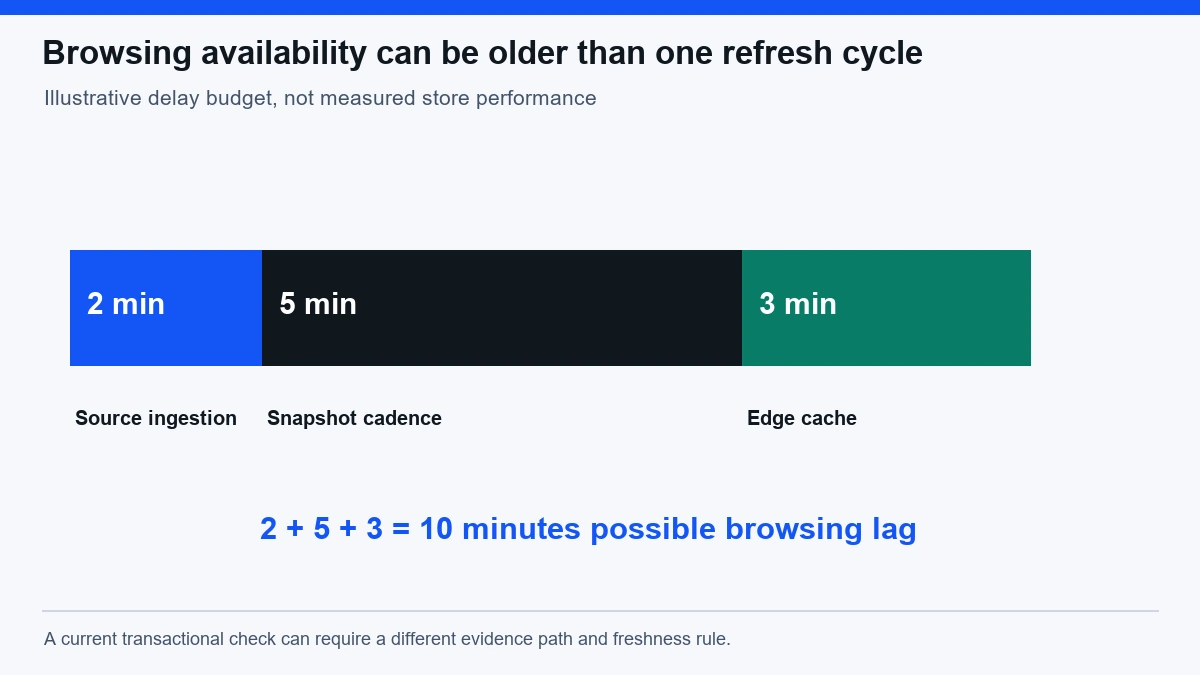
Imagine a fictional store where warehouse events can take two minutes to reach the inventory service. The storefront refreshes its availability snapshot every five minutes, and an edge cache can serve that snapshot for three more minutes. A conservatively aligned event can therefore remain invisible for roughly ten minutes before considering other delays.
This arithmetic is illustrative, not a measured result from a real store. It shows why producer cadence plus processing and cache delay must be compared with the consumer’s required freshness. Reporting a five-minute refresh schedule alone would omit the other stages that can make the delivered view older.
Now suppose the business permits a browsing estimate to be ten minutes old but requires a current transactional check before accepting an order. The same architecture can be suitable for discovery and unsuitable as the sole checkout authority. Different decisions can legitimately require different freshness rules.
If the transactional check is queued behind a slow background job, the configured policy may still fail in practice. Record actual request and completion times, not only nominal schedules. A connected inventory service can miss a deadline when contention prevents it from responding in time.
Observation and reservation are different events
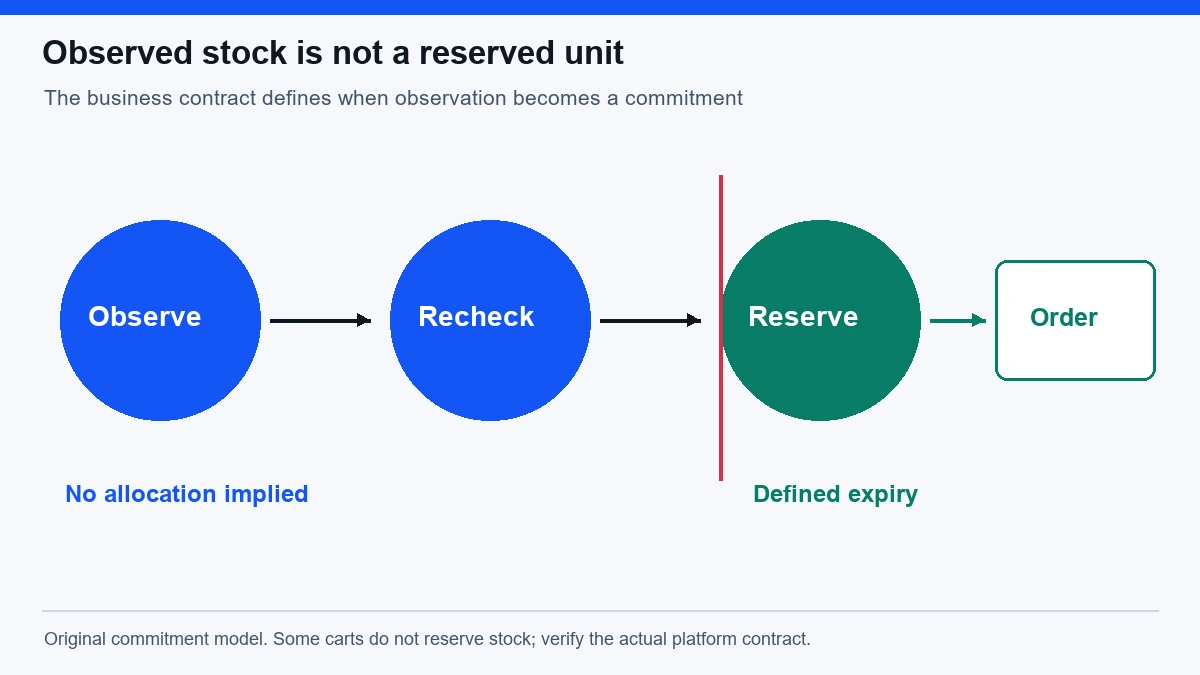
A page observation says what the system reported at the time of the read. A reservation changes business state under a defined policy, such as temporarily allocating a unit. A confirmed order may create a different commitment. The interface should not use the same word for all three if the distinction affects the buyer.
For a fictional limited-stock item, an agent may see two units available while comparing shipping terms. Another customer can purchase both before the agent reaches checkout. A final rejection can be correct behavior if no reservation was made. The site should explain the change and offer a useful next step rather than pretend the earlier observation guaranteed supply.
If the cart reserves inventory, state the relevant duration and conditions accurately. If it does not, avoid a misleading countdown or message that implies ownership of a unit. The agent should use the product’s documented behavior rather than assume all carts create the same commitment.
Reservation expiry needs recovery. A user returning after the expiry may need a new availability check and review of current terms. Automatically continuing an old purchase can violate the user’s price or product constraints if the offer changed. Preserve the original intent and make material differences visible before action.
Recheck at the decision boundary
Before a consequential submission, verify the exact item, quantity, region, fulfillment method and current terms required by the task. The backend must enforce the business rules for acceptance. A client-side stock badge is useful guidance, but it should not be the sole authority for committing inventory.
If the check returns a changed state, distinguish a valid business rejection from an execution failure. No stock, insufficient quantity and unsupported delivery region are known outcomes. A timeout or unavailable dependency means the check did not establish the state. Those conditions need different interface messages and operational treatment.
Do not silently substitute a different variant or fulfillment method to force completion. The user may permit alternatives, but the scope must be explicit. A smaller size or a pickup-only offer can violate a required constraint even when the broad product family matches.
The structured-data improvement guide helps align public offer markup with visible facts. Keep that representation synchronized, while recognizing that structured data is not a reservation mechanism or proof of a future stock commitment.
Cache according to the information’s role
Stable product descriptions can often tolerate different reuse policies from volatile availability. Separating those concerns can improve delivery without presenting stale stock as live state. The right architecture depends on the platform, but the user-facing meaning should remain clear.
A cache key should account for dimensions that materially change the returned offer. If availability depends on region or selected variant, serving one representation to every request can produce incorrect information. Test actual responses under the relevant conditions rather than assuming a successful cache hit is necessarily the right response.
Revalidation and invalidation should be tied to the business update process where supported. A stock event may need to invalidate an affected offer representation. Verify that the deployed path performs the intended update, and inspect fresh output after a controlled change. A configuration entry is weaker evidence than a confirmed current result.
Preserve a safe fallback policy. Serving the last known observation can be useful for browsing if its age and limitations are clear. It may be unsuitable for committing an order. Define whether the application withholds the action, rechecks an authoritative service or offers another route when freshness cannot be established.
Diagnose stale availability end to end
Begin with the exact affected task and expected deadline. Record the item identity, quantity, market, observed availability, action time and actual outcome. A general report that stock was wrong is a starting point, not a complete cause. Determine which claim was stale and which source establishes the correct state.
Trace the warehouse or source event through ingestion, availability calculation, publication, cache and delivered page. Check timestamps, versions, failed jobs and skipped updates. A successful fetch can still return an old snapshot, and a completed batch can omit an affected item. Preserve the historical record rather than replacing it with current state.
Inspect locks and shared dependencies. A periodic refresh can be delayed when a full catalog rebuild monopolizes a resource. Independent observers should not silently miss short-lived availability changes because another component is busy. Measure actual cadence under load and compare it with the task’s freshness limit.
The technical SEO checklist covers delivery, rendering and canonical context around the product page. Keep those checks separate from inventory correctness: an indexed page can still contain the wrong availability for the selected offer.
Count affected opportunities carefully
Repeatedly checking one unavailable product does not create a new independent missed purchase each time. Group observations by user intent or a defensible opportunity definition. Report unique affected tasks, repeated attempts and the period of stale exposure separately.
Do not infer lost revenue by multiplying every stale observation by the item price. Some users would not have purchased, some had alternative options and some tasks never reached a purchase decision. Use measured outcomes where available and label scenario estimates. Missing observations are gaps, not proof that no opportunity existed.
Expected rejection also differs from a defect. If stock changed after a valid browsing observation and checkout correctly rejected an unavailable item, the system may have behaved as designed. If the page claimed a reservation that never existed, the representation was misleading. The incident classification should follow the evidence and stated contract.
After repair, verify tests, deployment and fresh operational behavior separately. A unit test of cache expiry does not establish that the production warehouse feed arrives on time. A deployment receipt does not establish that a real affected offer now reflects its current state. Trace the complete path before claiming the system is fixed.
Test the transition cases
Include a normal in-stock purchase, insufficient quantity, a variant becoming unavailable, reservation expiry, region changes, source-feed delay and a dependency timeout. For each case, define the expected state and appropriate next action. The goal is correct handling, not a maximum number of completed orders under every condition.
Test concurrent attempts against limited stock using a controlled environment or authorized test mechanism. Verify accepted business objects and final inventory state, not only frontend messages. If the platform provides reservation semantics, test their actual boundaries and expiry behavior rather than assuming a particular guarantee.
Test restart recovery around stock events and pending orders. The process should not replay a decrement, forget a reservation or abandon an accepted order silently. Durable state and reconciliation need to preserve the business meaning across interruptions. Record unresolved cases explicitly.
Questions for an availability review
Does a fresh cache response mean an item is guaranteed available? No. Protocol freshness describes response reuse under a policy. Business validity and reservation status require their own definitions and authoritative checks. State the relevant commitment level clearly.
Should an agent trust a page’s in-stock label? It can treat the label as evidence within its stated scope and time, then perform the required current checks before an authorized commitment. It should not infer a reservation or relax the user’s constraints without permission.
What should a successful repair prove? It should show that source changes reach the intended representations within the defined budget and that consequential actions use suitable current state. Preserve evidence of timing, identity and confirmed output, with any remaining external or untested dependencies named precisely.
A freshness and commitment ledger
Document each availability representation separately. The table below uses fictional timing assumptions to illustrate the calculation; it is not a measured store architecture. The final row is a different kind of evidence from a browsing snapshot because it concerns whether the intended business commitment was accepted.
| Stage | Illustrative delay or meaning | Evidence required | Decision it can support |
|---|---|---|---|
| Warehouse event reaches inventory service | Up to two minutes of processing delay | Source event and ingestion timestamps for the same item | Establish when the underlying change entered the application |
| Storefront snapshot refreshes | Up to five minutes before the next refresh | Actual refresh start, completion and stored version | Describe the age of a browsing availability observation |
| Edge representation remains reusable | Up to three additional minutes under this scenario | Delivered response version and applicable cache policy | Explain the possible age of the page the visitor received |
| Conservative aligned browsing delay | Two plus five plus three equals ten minutes | All stages observed rather than schedule assumptions alone | Compare the architecture with a browsing freshness requirement |
| Checkout checks the exact offer | Current business rule evaluation, not a cached badge | Item, quantity, region and authoritative response | Decide whether the submitted order may be accepted |
| Reservation or order is recorded | Commitment under the merchant’s documented contract | Durable business reference and relevant expiry or outcome | Explain what is actually allocated or confirmed |
When testing, replace assumptions with observed timing ranges and retain the original source events. If the system cannot establish one stage, mark that dependency unknown rather than presenting the total as a verified operational bound.