
The Search Brief · News analysis
Agent Confirmation States: Make Completed, Pending and Unknown Outcomes Distinct
Make agent task outcomes clear with an evidence-based state model, actionable recovery, accessible messages and a practical acceptance table.
Development covered: Primary documentation checked November 2, 2026

An agent confirmation state should describe what the website can establish about a task, rather than what the interface hopes happened. A click, a completed progress animation, and a successful business transaction are different events. Reliable websites distinguish preparation, submission, pending work, confirmed completion, rejection and an outcome the client cannot yet determine.
This distinction serves people as well as agents. A visitor should not have to guess whether an inquiry was sent, a reservation was accepted, or a saved change reached the correct account. Clear states also make recovery safer: an unknown outcome calls for checking the original operation, while a validation rejection calls for correcting the input. Treating both as a generic error encourages mistakes.
Start with accessible status communication
W3C’s explanation of WCAG Success Criterion 4.1.3 describes status messages that can be determined programmatically and presented through assistive technology without receiving focus. It identifies the need to make important changes available beyond their visual presentation. This is accessibility guidance, not a guarantee that every automated agent will understand a particular implementation. W3C status message guidance.
The practical foundation is a message whose meaning is available in the actual interface. A green icon alone is weak evidence. A visible sentence, appropriate semantics and a stable relationship to the task make the state easier to understand. The website still needs to establish that the sentence accurately reflects its authoritative backend outcome.
Avoid announcing every minor visual change as urgent. A busy interface can overwhelm a person using assistive technology and obscure the one event that matters. Reserve attention-grabbing treatment for genuinely important conditions, and make routine progress understandable without constantly interrupting the task. Test the interaction rather than assuming that adding a role attribute completes accessibility work.
Define states using evidence
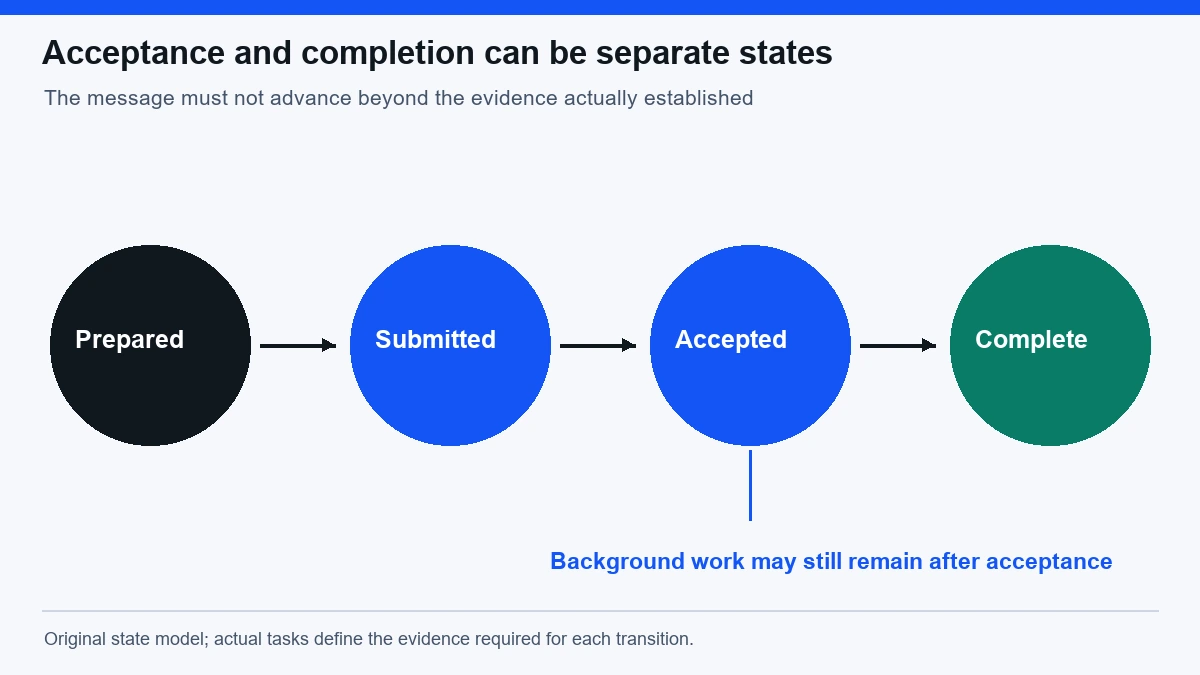
Prepared means the required information is ready but has not been sent. Submitted means the client initiated delivery. Accepted means the receiving system recorded the request under its rules. Completed means the intended business action reached its defined terminal state. Some workflows combine acceptance and completion; others separate them by minutes or days.
For example, accepting an appointment request may not reserve a confirmed slot. A service inquiry may be stored before a representative reviews it. A file export request may be accepted while generation continues in the background. The interface should name the event actually established and explain the next dependency where it affects the visitor’s decision.
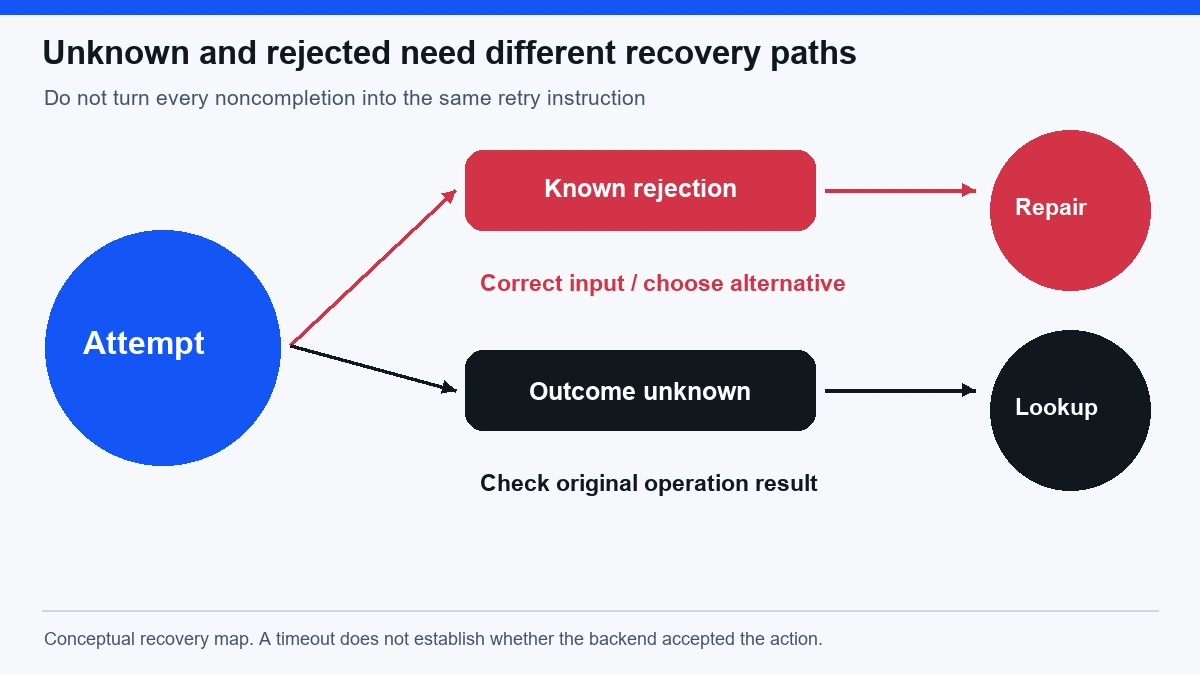
Rejected means a known rule prevented the requested action. An invalid required field, unavailable slot, insufficient permission and expired offer can all produce rejection, but their repair paths differ. Preserve the reason rather than collapsing them into a single failure label. A person cannot correct a permission issue by repeatedly changing a phone number.
Unknown means the client lacks sufficient evidence to determine the result. A timeout after submission can create this state even when the server succeeded. Unknown is not confirmed failure, and it is not confirmed success. Giving it an explicit place in the state model prevents an optimistic interface from making unsupported claims.
A worked appointment scenario
Imagine a fictional website where a user authorizes an agent to request a consultation at 10 a.m. on Tuesday. The page first displays that the slot is available. The agent selects it, enters contact information and reaches a review screen. At this point, the site has prepared a request; it has not necessarily reserved the appointment.
After authorized submission, the site shows “Checking availability.” The server then either reserves the slot and returns an appointment identifier, rejects the request because another visitor took the slot, or fails to deliver a clear response. Those outcomes should lead to different messages and next actions.
A confirmed result should identify the appointment time, relevant time zone, service and reference number. A rejection should preserve valid contact information and explain how to select another slot. An unknown result should retain the original operation identity and provide a way to check it before a second independent reservation is attempted.
These events are an illustrative design, not results from a tested booking system. Their purpose is to show that the same click can precede several business states. An agent must read and verify the resulting state rather than treat the click itself as completion.
Keep confirmation tied to the original intent
A confirmation should make the completed action recognizable. “Success” is insufficient if the user needs to know which account, item, destination or appointment was affected. Include the decision-relevant details without exposing unnecessary personal information. The message should help detect a wrong action, not merely celebrate that some action occurred.
If the user changes a constraint during preparation, refresh the review state. A confirmation based on the old time or product variant should not be presented as satisfying the new request. Link the operation to the approved payload or a meaningful version so that the interface and backend agree about what was authorized.
Authorization remains separate from technical readiness. An agent that can fill a form does not automatically have permission to submit it. An interface can make the review boundary clear, while the agent must preserve the user’s actual instruction. The website should not turn a harmless preview control into a hidden consequential action.
Use search intent alignment when deciding whether a page primarily explains a service, prepares a request or performs a transaction. Clear task ownership reduces the chance that visitors encounter a submission flow when they expected only information.
Distinguish recoverable and terminal errors
A recoverable validation error should identify the affected field and the accepted format. Keep correct values where appropriate so that the user can repair the specific problem. A terminal rule-based rejection should explain the available alternative, such as another time slot or a suitable account permission, without suggesting that repeated identical attempts will change the result.
Execution failures need their own language. If a service is temporarily unavailable, say what is known and how recovery works. Do not accuse the user of invalid input when the real fault is a failed dependency. This distinction improves trust and gives operational teams a more accurate incident signal.
An uncertain outcome needs a lookup or reconciliation path. A retry may be safe under a documented idempotency contract, but a generic submit-again instruction can create duplicates. Keep the original attempt identity and distinguish a retry of that attempt from a new user-authorized action.
For long-running work, provide a stable status location or supported notification mechanism. A visitor who reloads should be able to recover the operation’s state where the product supports it. A temporary progress toast that disappears with the page is not a durable record of work that continues on the server.
Put the state in every relevant representation
Check the visible page, programmatic semantics, keyboard flow and actual response data. A message can be visible but missing from the representation an interaction tool uses. Conversely, an internal status value can exist while the visitor sees no useful explanation. The relevant representations should agree on the operation’s current meaning.
Focus management needs task-specific judgment. A newly displayed error summary may need to guide the visitor toward corrections, while a routine saved-state message may be announced without moving focus. Test both discovery and continuity. Moving focus unexpectedly can interrupt a user who is still entering information.
Avoid hiding decisive confirmation details in an image. Reference numbers, dates, quantities and next actions should remain available as text. A decorative celebration can accompany confirmation, but it should not be the only indication that the task succeeded. The same principle applies to failure icons and color changes.
Use the technical SEO checklist for the surrounding page’s delivery and rendering checks. Keep interactive completion separate: a crawlable page and a healthy response code do not establish that an appointment or inquiry reached its intended state.
Trace asynchronous work to a terminal outcome
Background tasks introduce another gap between acceptance and completion. A server may accept an export request, enqueue work, generate a file, store it and notify the user. Each stage can fail independently. The status should reflect the stage actually confirmed, and the operational record should connect them under one task identity.
Compare queue delay and execution time with the promised deadline. A worker scheduled to run every minute can still miss time-sensitive work if another job holds a shared lock. A running process does not prove that the task was evaluated, started or completed in time. Measure actual transitions and preserve delayed or skipped events.
Check restart recovery. A process can restart after accepting a task but before recording completion. The system should resume or reconcile durable state rather than silently abandon the task or repeat an external action. A terminal message should be based on the recovered business outcome, not an in-memory progress flag.
If the system cannot reconstruct a historical outcome, preserve the gap. Missing logs are not proof that the action never happened. Mark the incident unknown where evidence is insufficient and improve future instrumentation. This prevents a tidy dashboard from erasing uncertainty that matters to the user.
Test state transitions, not only ideal screenshots
Create a matrix covering normal completion, validation rejection, permission rejection, stale data, delayed processing, connection loss and restart. For each case, specify the expected backend state, user-visible message, available recovery action and evidence that would establish success. This makes the test assess behavior rather than merely mirror labels in the implementation.
Test a connection loss after the server commits the action but before the client receives confirmation. This is different from disconnecting before the server receives anything. The first case reveals whether the interface can recover an accepted operation without duplicating it. Include parallel attempts if the product can receive them.
Use keyboard and assistive-technology review as part of the human task check, then test the authorized agent’s supported interaction method. Record the actual task variants and conditions. A pass in one interaction method should not be described as universal accessibility or universal agent compatibility.
After a repair, verify the deployed process with a fresh event. Passing local tests, deploying the change and observing real operational success are separate claims. Report all three accurately and state any remaining untested conditions, especially load or background contention that contributed to the original failure.
Connect confirmation to useful next steps
The next action should fit the confirmed state. A completed request might offer a reference number and service explanation. A rejected slot might offer alternative availability. An unknown submission might offer outcome checking. The same generic call to action after every result can send users down the wrong recovery path.
The internal linking checklist can help connect service guidance and confirmation resources with descriptive routes. Links support navigation; they do not replace the operation’s authoritative state. A visitor should not have to infer success because the site redirected to a page with a reassuring title.
Keep confirmation language consistent across email, account history and the page. If the page says confirmed while an email says pending review, users and agents receive contradictory evidence. Identify the source of truth and ensure downstream messages describe the same business event or clearly explain their different stages.
Questions for a state-design review
Is a successful HTTP response enough to report completion? Not necessarily. It may establish receipt or acceptance while the business task remains pending. Define what the response means and confirm the corresponding stored outcome. The interface should describe that meaning accurately.
Should every error offer a retry? No. Invalid input requires correction, a permission failure requires an appropriate authorized route, and a known unavailable slot requires another choice. Unknown outcomes require reconciliation. A retry is useful only when its semantics and consequences are understood.
What is the first useful audit question? Ask what observable evidence establishes the user’s intended outcome. Then trace backward through the confirmation, backend record, submission and input. Any transition based only on appearance or assumption deserves investigation before the task is called reliable.
A practical state acceptance table
Use a table like this to agree on what each message is allowed to claim. The evidence column is more important than the wording: a message should not advance beyond the state its source establishes. Adapt the business object names to the actual application and preserve the distinction between acceptance and completion where work continues asynchronously.
| Observed condition | Accurate state | Required evidence | Appropriate next step |
|---|---|---|---|
| Form values are ready but no delivery began | Prepared | Current reviewed input exists in the intended account | Request any required authorization before submission |
| Client initiated delivery and is awaiting a response | Submitted or pending | Original operation identity and attempt timing | Observe the original operation without creating another intent |
| Server recorded the request but later work remains | Accepted | Durable request reference and documented remaining stage | Show reference and explain what has not completed |
| Intended business action reached its terminal state | Confirmed complete | Authoritative business record matches approved task details | Present outcome and useful task-specific continuation |
| Validation or a business rule rejected the action | Rejected | Specific evaluated rule and affected input or resource | Correct the input or choose a permitted alternative |
| Connection ended before the client learned the outcome | Unknown | Attempt exists but authoritative result has not been established | Reconcile or safely resume under the documented contract |
This is a proposed acceptance tool, not an executed test result. During review, add the actual observed message and evidence reference beside each row. A state mismatch is actionable even when the interface is visually polished.