
The Search Brief · News analysis
Agent Session Boundaries: Preserve the Right Account, Permission and Intent
Preserve the correct account, resource and authorization through session expiry, account switching and task recovery, with a concrete test matrix.
Development covered: Primary documentation checked November 2, 2026

Agent session boundaries keep an authenticated task attached to the correct user, account, permission and authorized action. A session proves some relationship to an authenticated identity; it does not mean every action inside that session is appropriate. Reliable websites recheck relevant authority and state at consequential transitions, especially after expiry, account switching or a long preparation step.
The practical objective is to prevent a prepared task from silently changing meaning. A quote draft should not move to another organization because a user switched accounts in another tab. An order review should not become an unreviewed purchase after reauthentication. An agent recovering a session should resume the intended task only after the relevant identity and current state are established.
Authentication and authorization answer different questions
OWASP’s session-management guidance explains the role of sessions in connecting authenticated activity and describes controls around session identifiers, lifecycle and expiry. It treats session management as part of the application’s security architecture. This guidance is a primary security reference, not an agent-specific protocol or a promise that one configuration is suitable for every website. OWASP Session Management Cheat Sheet.
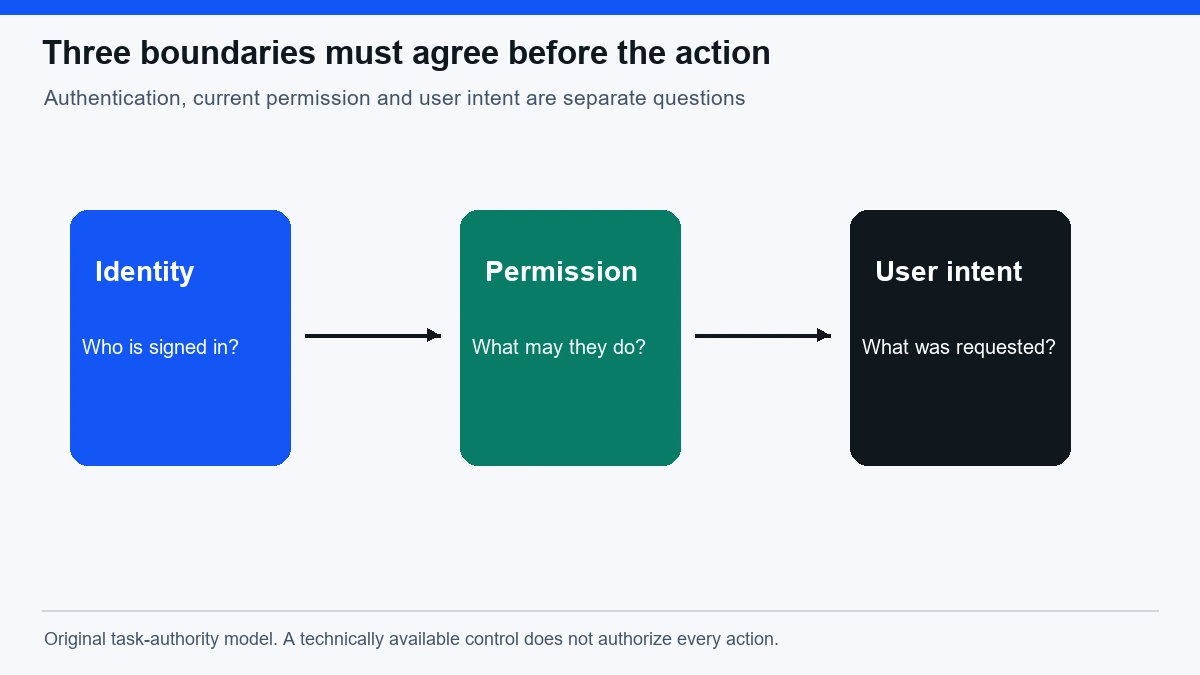
Authentication establishes an identity under the application’s rules. Authorization determines what that identity can do in the relevant context. The user’s instruction establishes what the agent is being asked to do. These three relationships can differ. A person may be signed in as an administrator while asking an agent only to compare settings, not change them.
Account scope is another dimension. A user can belong to several organizations with different permissions. The interface should make the active organization recognizable at the point of action. A small avatar in a global header may be insufficient when two accounts have similarly named projects and the same form structure.
Do not interpret technical capability as intent. A button that is enabled for the signed-in user may still perform an action the user did not request. The website should make consequential actions clear, while the agent preserves the current authorization boundary. Neither side should rely on the other to repair an ambiguous task silently.
Model the task context explicitly
A useful task record identifies the account or organization, relevant resource, requested operation, prepared input and current approval state. It does not need to duplicate all personal information. It needs enough stable identity to detect that the context changed before the operation was committed.
For a fictional advertising workspace, the task might be to prepare a report for Organization Cedar, Project North, covering a particular month. Exporting the report is one action. Changing campaign budgets is another. The fact that both controls appear in the same authenticated interface does not merge their authorization requirements.
Attach the review screen to the actual resource identity, not only its display name. Names can change or repeat. A project identifier and recognizable account context help both the application and user detect a mismatch. Present the relevant context in ordinary language so that it is not hidden exclusively in a technical token.
Use search intent alignment when separating explanatory pages from authenticated task pages. Public guidance can describe a process, while account-specific state requires the authorized application. A public article should not be treated as evidence of a user’s current permissions or subscription.
A worked session-expiry scenario
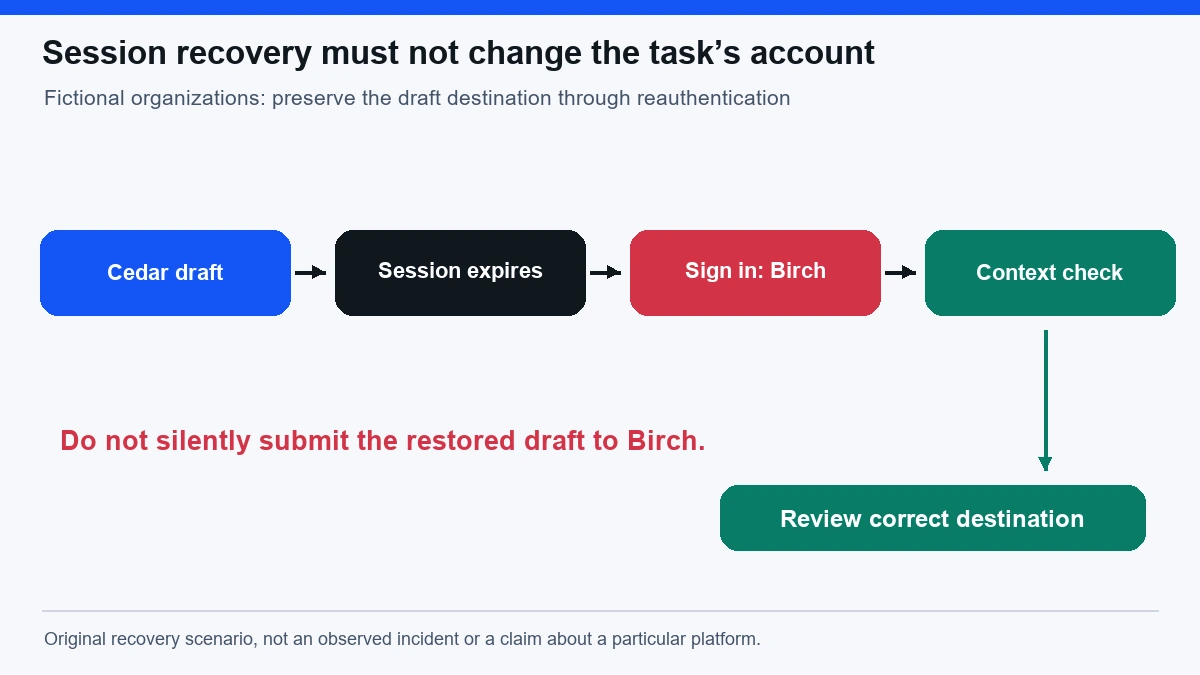
Imagine a fictional agent preparing a support request inside Organization Cedar. The user authorizes submission after reviewing the draft. Before the agent sends it, the session expires. The website redirects to sign-in. After authentication, the active organization defaults to Birch, another organization the user can access.
A weak recovery flow restores the form and submits it without checking the organization. The request is valid syntactically and the user is authenticated, but it reaches the wrong account. A generic success message can conceal the mistake because the task’s original context was lost.
A stronger flow restores the draft as prepared information, establishes the active account and shows the destination before any consequential submission. If the context differs, it returns to a meaningful review boundary. The agent should not infer that reauthentication automatically preserves the previous approval for a changed destination.
This is an illustrative failure design, not a report of an observed client incident. It demonstrates that session recovery is not merely restoring a cookie or rendering the same screen. The recovered task must still represent the user’s intended account, resource and action.
Recheck at consequential transitions
The backend should enforce authorization when it receives the action. A client-side button state can guide the interface but is not authoritative permission enforcement. A role may have changed while a form remained open, or the underlying resource may no longer be available. The submission needs to be evaluated against current rules.
For a long preparation step, revalidate decision-relevant data as well. A price, slot, recipient or resource version can change independently of the session. A user who approved one set of terms should not unknowingly commit to materially different terms because the application refreshed them silently during recovery.
The appropriate review depends on the task. Not every harmless navigation needs a new confirmation. Focus checks on changes that alter the action’s meaning, destination or consequence. A well-designed boundary preserves continuity while preventing a stale approval from being stretched over a new operation.
If the operation was already accepted before session loss, recover its outcome rather than creating another operation. Authentication recovery and submission recovery are separate problems. A newly valid session does not establish whether the earlier request succeeded. The application should retain a safe outcome lookup relationship where the workflow supports it.
Make active identity visible without exposing secrets
Display the account context a user needs to verify the task. An organization name, project label and appropriate account indicator can be sufficient. Do not expose session tokens or secret credentials to make the interface more understandable. Debugging information should not become a public identity mechanism.
Use clear controls for switching accounts and explain what happens to unfinished work. A draft may remain attached to its original organization, be discarded with warning, or require an explicit supported transfer. Silently moving it can change the recipient, available options and data-handling context.
Distinguish signing out from changing a visible account label. The application’s server-side state must reflect the intended session lifecycle. A visually signed-out page that still permits authenticated mutations is a different and more serious defect than a stale avatar. Verify actual behavior through the supported security and testing process.
For agents, avoid instructions that require guessing which identity is active from a hidden layout convention. The page should expose the relevant account context in meaningful text and semantics. This helps humans inspect the same state and reduces dependence on brittle visual positions.
Handle permission changes as known outcomes
If a user’s role changes during a task, return a clear authorization result. Preserve safe draft information where appropriate and explain the available route. Do not present a permission rejection as an unexplained network problem. Repeated retries will not resolve a rule-based denial and may obscure the real issue in logs.
If permission information cannot be loaded because a dependency failed, distinguish that uncertainty from a confirmed denial. The application may need to withhold the action, but the operational cause is different. Record the missing check and relevant failure rather than claiming that the user lacks a permission the system never evaluated.
Do not weaken authority checks merely to increase task completion. A high completion rate achieved by allowing the wrong account or operation is not a success. Evaluation should count appropriate completion, appropriate rejection and execution failure separately, with their own denominators and evidence.
The technical SEO checklist helps assess public delivery and rendering, but authenticated authorization belongs to a separate application review. A private account screen can be intentionally excluded from search while still requiring excellent usability and reliable task behavior.
Test parallel tabs and shared session changes
Users commonly leave a draft open while changing accounts elsewhere. Test whether the application detects a resulting context change before submission. If the session is shared across tabs, the visible account indicator in the first tab can become stale. The action should not rely on that stale display as proof of current identity.
Test role changes, sign-out in another tab, session expiry during upload, and reauthentication after a review step. Include a task that was accepted immediately before the connection or session state changed. These scenarios expose different boundaries and should not be treated as one generic expired-session test.
Verify the actual target resource after a controlled submission. A successful response is narrower evidence than a stored change in the correct organization. Inspect both the business object and the confirmation details. The test should establish that the right action happened in the right scope, not merely that some request succeeded.
Preserve the original task and recovery trace. If an incident cannot be reconstructed because context identifiers were never recorded, mark the evidence gap. Missing observations do not establish that the account stayed constant. Improve future instrumentation without inventing a historical explanation.
Keep recovery observable and proportionate
Operational records can connect task identity, account scope, permission decision, session transition and confirmed result. They should avoid unnecessary secrets and personal data. A useful trace establishes the relevant state transitions while respecting the actual sensitivity of the application.
Measure session-related noncompletion by unique task intent. Ten retries of one expired task are not ten independent lost customers. They are repeated observations of one affected task. Report affected intents, attempts and final outcomes separately so that the scale and persistence of the failure remain clear.
Check contention and restart behavior. A permission service that responds in isolation may miss deadlines under load, while a recovery worker may hold a shared lock. Trace actual timings from user request through authority checks and submission. A connected dependency is not proof that the correct check completed in time.
After repair, confirm the deployed path with fresh operational evidence. A unit test, a deployment receipt and a successful recovered task establish different things. State which have occurred and which conditions remain untested. This is especially important when the original problem involved timing rather than a simple deterministic rule.
Connect public guidance to the authenticated task
Public help should explain what account or permission is required without implying that every reader already has it. The application should offer an appropriate route to sign in or request access. Keep public explanations and private state separate so that an agent does not mistake a general policy for account-specific confirmation.
The internal linking checklist can help make those routes clear and descriptive. A link to account settings should identify its purpose, while the application decides what the signed-in user is authorized to see. Navigation clarity supports the task without weakening access control.
If an action requires a different role, explain that requirement near the task. Avoid sending a user through a long form only to reveal a predictable permission barrier at the end. Early guidance can reduce wasted effort, while the server still performs the authoritative check at submission.
Questions for a session-boundary review
Does being signed in authorize an agent to act? It establishes an authenticated context, not the user’s instruction for every action. The task must remain within the user’s authorization and the application’s current permissions. These boundaries should be checked independently.
Can a draft resume automatically after sign-in? It can resume as prepared information when the product supports that behavior, but consequential submission should preserve the original account, resource and approval conditions. A changed context may require a new review rather than silent continuation.
What should a successful recovery prove? It should establish the correct active identity, current authority, preserved intended payload and confirmed outcome in the correct scope. A restored screen alone does not establish those facts. The evidence should trace the recovered task to its actual business result.
A session-transition test matrix
The following matrix turns account continuity into concrete checks. Each row should be exercised against the actual application’s supported behavior. Record the starting account, resource and approval state before introducing the transition, then inspect the authoritative destination afterward. A recovered screen is not sufficient evidence if the underlying target changed.
| Transition | Risk to task meaning | Evidence to inspect | Expected boundary |
|---|---|---|---|
| Session expires while a draft is open | Prepared values may return without their original account scope | Draft owner, active account and restored resource identity | Resume preparation while re-establishing current context |
| Another tab switches organizations | Visible labels can remain stale in the original tab | Current server account and target resource on submission | Prevent silent execution in a different organization |
| Role changes after the review step | Old interface capability may exceed current permission | Authoritative permission decision at the action boundary | Return a clear rule-based result without weakening controls |
| Reauthentication follows an uncertain submission | A repeated action may duplicate an earlier accepted operation | Original operation identity and durable business outcome | Reconcile acceptance before creating another intent |
| User revises the requested destination | Previous approval may no longer describe the intended action | Current instruction, reviewed payload and target account | Establish the appropriate new review boundary |
Treat this matrix as a design and verification aid, not a security certification. Add product-specific cases involving delegated access, shared workspaces or resource ownership where they materially change authority. The final report should state which rows were tested and which remain unresolved.