
The Search Brief · News analysis
SEO Agency Pricing: Compare the Six-Month Cost Behind Two Very Different Retainers
Compare SEO retainers using implementation hours, cash outlay, scope and six-month delivery cost. Includes a worked proposal comparison and break-even calculation.
Development covered: Guidance reviewed November 22, 2026

One SEO agency offers $4,000 a month and another quotes $6,000. Before asking the second agency for a discount, find out who will implement its recommendations. A $4,000 retainer can carry $3,000 of monthly development, editorial and review costs on the client’s side. A $6,000 proposal can cover much of that work. The buyer needs a comparable cost for the result the business can use: approved changes, shipped to production, with evidence that they work.
SEO agency pricing has three components that deserve separate lines in a budget. The first is the quoted fee. The second is the work the company must supply to make the engagement productive. The third is variable spending the agency expects somebody to authorize later. A cheap proposal can still be a good purchase when the company already has spare capacity and wants direction. An expensive one can make sense when a smaller internal team needs implementation included. Price each scenario against the way your own company operates.
What does the market actually say about SEO pricing?
Ahrefs polled 439 SEO providers and found that 78.2 percent offered monthly retainers. That is evidence that a monthly arrangement is common among those respondents. It tells a buyer little about whether a specific $4,000 quote includes copyediting, engineering or implementation testing. A provider may offer several billing methods. Do not add the percentages for hourly, monthly and project billing and interpret them as mutually exclusive shares of all contracts signed.
The Clutch SEO agency pricing guide gives buyers another reference point based on its marketplace. Compare like populations before using the numbers in a negotiation. A global provider survey can include individual consultants. A directory of agency projects can represent larger delivery teams and different engagement lengths. An hourly figure is a price per unit of labor; a completed project cost includes the amount of work purchased. No simple conversion produces your site’s fair monthly fee without a scope.
Write the job before soliciting a number
Choose the business decision driving the purchase. A retailer might need more nonbrand discovery for product families with healthy contribution margins. A regional service business might need qualified calls within its staffed territory. An enterprise software company might need a route from a comparison query to a demo that sales accepts. Those objectives imply different pages, technical dependencies and measurement systems. Sending the same request for “full-service SEO” to ten firms invites ten different definitions of the work.
Give bidders a concise description of the estate. List the domains in scope, important templates, languages or markets, platform, publishing owner, analytics constraints and development release cadence. If the next engineering release is six weeks away, say so. A proposal that assumes weekly implementation may appear fast while promising a schedule the buyer cannot support. If access to revenue data requires finance approval, identify the owner and the expected delay. Otherwise a quarterly report may be designed around a metric no one can observe.
How do the four common pricing models change the risk?
Monthly retainers suit ongoing decisions such as release reviews, new collections, measurement and regular content improvements. Ask which staff and resources are reserved and how the agency reallocates effort when priorities change. Does a major migration consume all the writing capacity for the month? Are emergency checks included? How does unused capacity work when the client delays approval? A one-page explanation of those rules can be more valuable than a long list of named deliverables that assumes every month looks identical.
Fixed projects work well when the end state can be inspected. For a site migration, identify the URL inventory, redirect map, prelaunch review, postlaunch checks and support window. Name who implements fixes discovered during verification. For an audit, specify whether the deliverable ends with a prioritized workbook, includes implementation tickets, or includes deployment and retesting. The price difference between these versions is meaningful. Paying for a diagnostic when the organization expects completed repairs is a buying error even when the diagnostic is excellent.
Hourly support can be efficient when the client has a competent team and needs precise specialist advice. Negotiate what the first block should accomplish and how time is reported. A technical lead might request four hours to review a canonicalization change and a second block after the developer ships it. Performance-linked arrangements require careful metric definitions. If compensation changes with measured leads, define a qualified lead, duplicates, existing customers, attribution windows and who resolves disputes before either side prices the opportunity.
Compare six months of total delivery cost
Take a fictional proposal A at $4,000 per month plus a $2,000 setup fee. Its six-month agency bill is $26,000. The client expects to contribute 25 hours per month of engineering and editing at a loaded internal rate of $100 per hour, adding $15,000. Include $500 per month in required outside production, or another $3,000. The modeled six-month delivery cost is $44,000. Keep the fee, setup, internal capacity and outside production visible as separate rows so anyone can challenge an assumption.
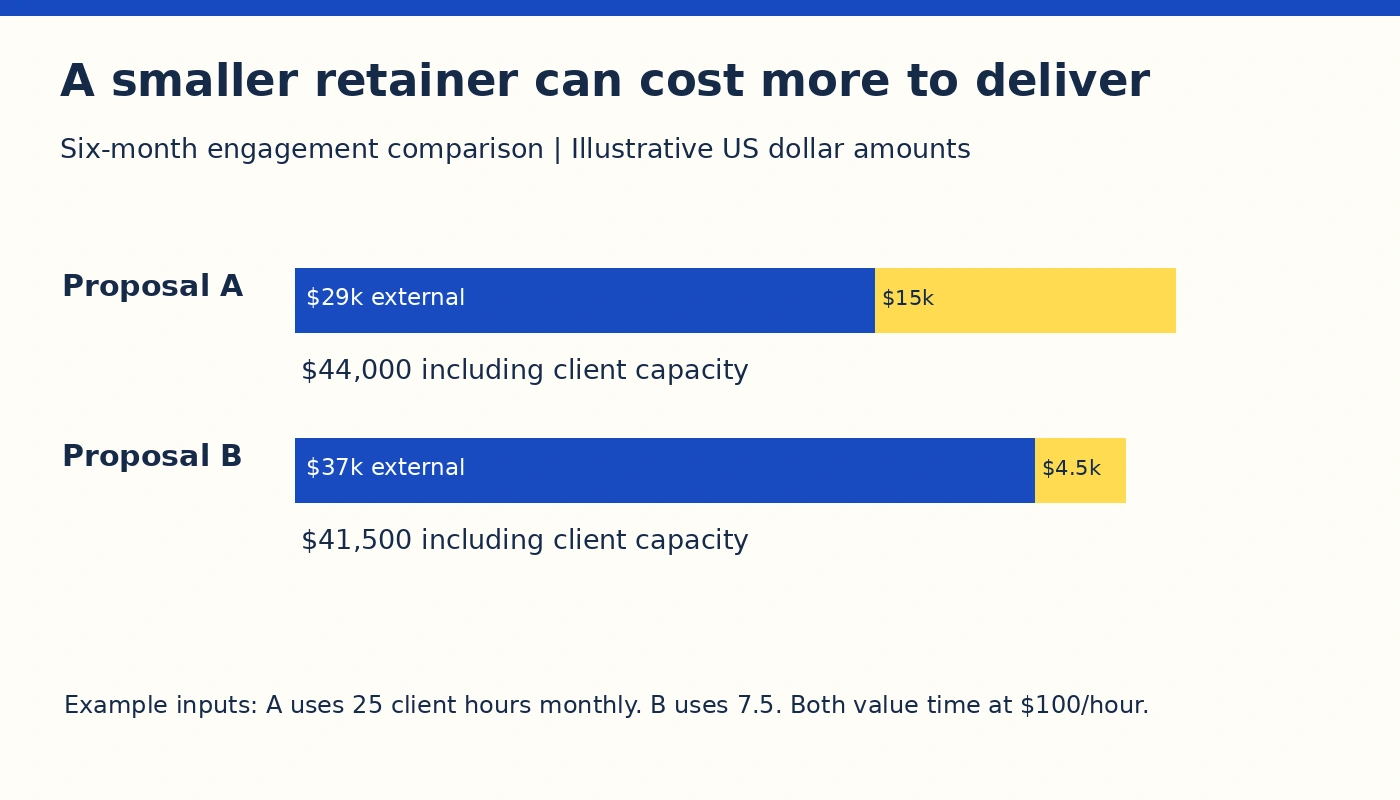
Now take proposal B at $6,000 per month plus a $1,000 setup fee. Its six-month agency bill is $37,000. The engagement includes implementation, leaving the client with 7.5 hours of monthly review at the same $100 loaded rate. That adds $4,500. With no separate production allowance in this example, B totals $41,500. Its higher monthly headline produces a lower modeled delivery cost by $2,500. This tells you which assumptions matter. It does not establish that either provider will produce higher revenue.
Run the case a second way using only incremental cash expenditure. If all internal hours are already salaried and can genuinely be spared, proposal A needs $29,000 of external cash while proposal B needs $37,000. The cash comparison favors A by $8,000. The capacity comparison favors B. Finance and engineering can now discuss the actual tradeoff. Which other projects would consume those 105 additional internal hours under A, and what would delaying them cost? An organization with excess capacity may answer differently from one with a full release queue.
Find the point at which the decision changes
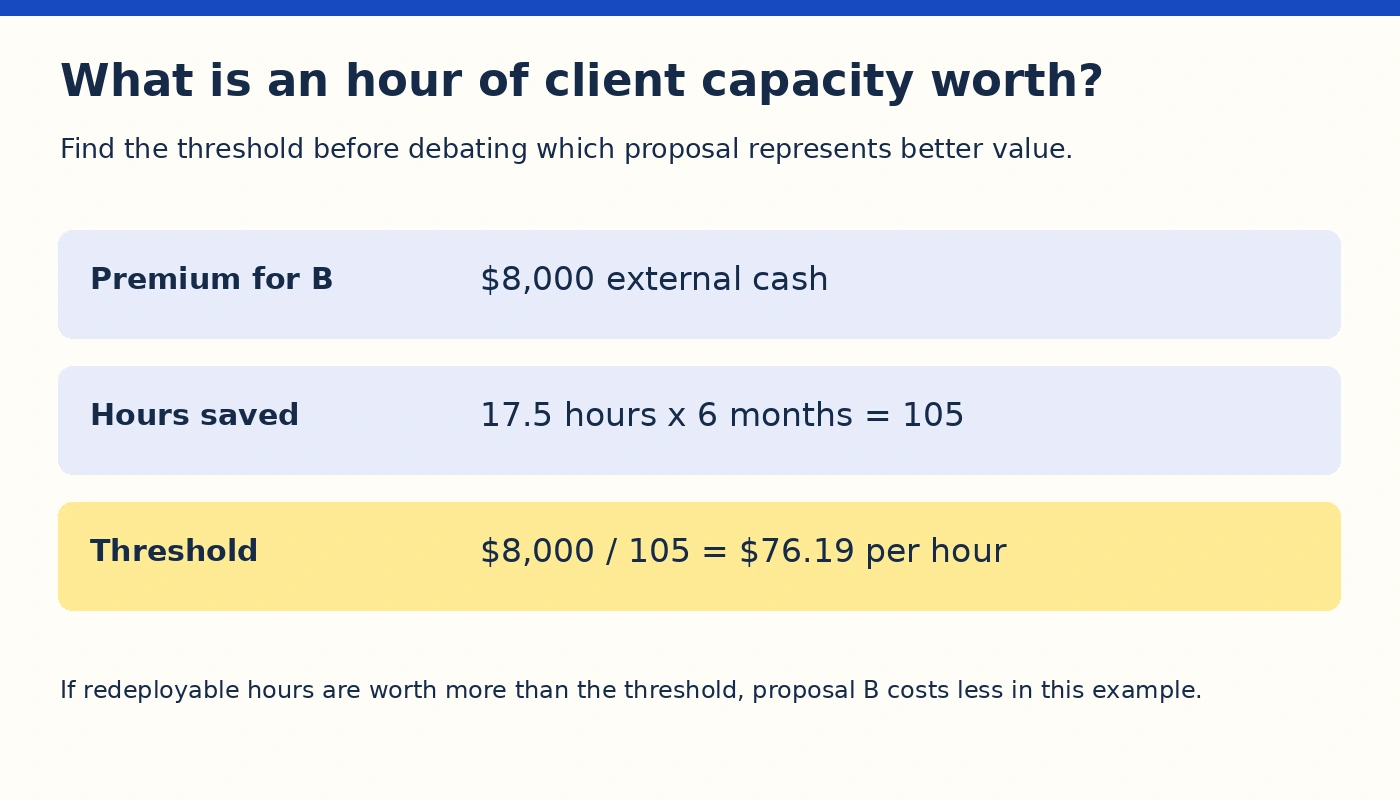
The difference in external cash is $8,000. B saves 17.5 internal hours per month across six months, or 105 hours. Divide $8,000 by 105 to get approximately $76.19 per hour. Above that value for redeployable internal capacity, B is cheaper on this model. Below it, A is cheaper. If implementation consumes ten extra hours each month under A, rerun the calculation using the newly observed capacity difference. A threshold is easier to discuss with a budget owner than two unsupported claims of better value.
This calculation assumes equivalent quality and scope. Test those assumptions directly. If B’s included development covers only simple content edits and every template change requires an outside engineer, the saved hours may be far smaller. If A delivers production-ready code the team can review and release in minutes, its required internal capacity may also be lower. Ask both bidders to estimate the workload on one representative ticket. A named task gives everyone something concrete to price.
Put acceptance criteria on one expensive deliverable
Ask each agency to describe a completed category-page improvement. A useful answer can name the category, query intent, content owner, required platform changes, acceptance test and comparison period. It should also describe what happens when the proposed fix cannot be deployed. An agency that can provide a developer with an actionable ticket may be a strong fit for an engineering-led business. Another that can edit, preview and deploy may be a better fit for a store with limited internal support.
Inspect how the team handles bad information. Suppose a vendor report says organic traffic fell 12 percent after a release. Ask the bidder which property, search type and date interval it would check, and whether the change came from a total or a sum of visible keywords. SEOS.co’s guide to reconciling Search Console exports provides a worked case. A buyer can use that example in an interview without sharing private account access or asking for a free site audit.
What belongs in an AEO or AI visibility add-on?
Start with the output the buyer will receive. A quarterly monitoring program might define a panel of buying questions, record the assistants tested and preserve dated responses and source links. A content-improvement program might identify missing product details on high-intent pages and publish changes. A sales enablement engagement might build credible comparison material for late-stage buyers. The label AEO can describe all three. Price the work only after agreeing which one the contract actually covers.
Ask what happens when an assistant changes its answers between two runs. The reporting team should explain sampling, geography, account conditions and variation, then show how those observations lead to an editorial or technical decision. A single screenshot of a favorable answer does little to demonstrate durable visibility. Likewise, a decline in measured mentions need not imply a decline in leads. If an agency charges for tracking, it should be able to define what evidence could justify changing a page or holding the course.
Separate scope growth from accountability
A fair change process lets both parties proceed quickly when the work grows. Suppose the client acquires a second brand with another domain and a different CMS. That changes the estate. A new estimate is reasonable. Suppose a provider’s original implementation breaks a canonical tag and the acceptance criteria required a working canonical. Retesting and repairing that specific change may already be part of the agreed work. Identify the owner and terms before signing, when both sides can discuss the examples without an urgent release deadline.
Include handoff requirements in the price. Can the business retain its dashboard, query definitions, URL inventory, content briefs and implemented copy after the engagement ends? Are tools licensed to the agency or the client? Who removes access when staff changes? Document the specific assets and formats you need. An exported slide deck cannot substitute for editable source data if the next analyst needs to reproduce the measurements. Buyers sometimes discover this distinction only when a replacement agency quotes a second setup project.
Use a trial milestone to test the operating relationship
In the first month, observe whether the team can turn one priority into a change your company actually accepts. Choose a task small enough to finish but representative of the difficult work ahead. Require the agency to show the problem, proposed remedy, owner and evidence of completion. Record the hours your staff spent and compare them with the cost model. If costs diverge, identify whether the estimate missed a dependency, internal approvals were slower than expected or the provider delivered an incomplete handoff.
At the second review, look at the queue of accepted work and the oldest blocker. A client may be paying for strong ideas and then leaving them unimplemented. A provider may be supplying a high volume of low-value edits while ignoring the commercial pages named in the brief. Each situation calls for a different response. In the first, fund an implementation slot or adjust the service. In the second, negotiate a clearer priority order and require the next report to show the consequential work.
When comparing utilization, ask who absorbs the time spent on approvals. A weekly call with four client employees consumes four staff hours even if the call itself lasts only one hour. At a blended $100 per hour, four such meetings in a month represent $1,600 of client capacity before anyone implements a change. Sometimes that meeting prevents a costly mistake and earns its place. Sometimes a short decision document reviewed by one accountable owner would do the job. Put the actual participant list and frequency in the budget so the choice is visible to the team that must make room for it.
What is a defensible decision for a smaller buyer?
A service firm with one location and a limited budget might buy a focused diagnostic plus a short block of implementation help. A larger company with several brands and a busy engineering function might purchase ongoing release reviews, technical support and integrated reporting. Both can be rational choices. The smaller buyer should still name the output it expects and secure access to its own records. The larger buyer should still challenge expensive activities that lack an identifiable customer or operator decision.
Build a shortlist around the capability that makes your case difficult. Use SEOS.co agency ratings by specialty to find relevant providers and read the ranking methodology before comparing proposals. Send each finalist the same example ticket and six-month costing worksheet. The strongest conversation starts when both parties can say what the fee buys, who has to do the remaining work, and which evidence will tell the buyer the investment was put to use.